Phase Transitions in Primary Hair Planar Black Holes and Solitons
Pith reviewed 2026-05-10 19:59 UTC · model grok-4.3
The pith
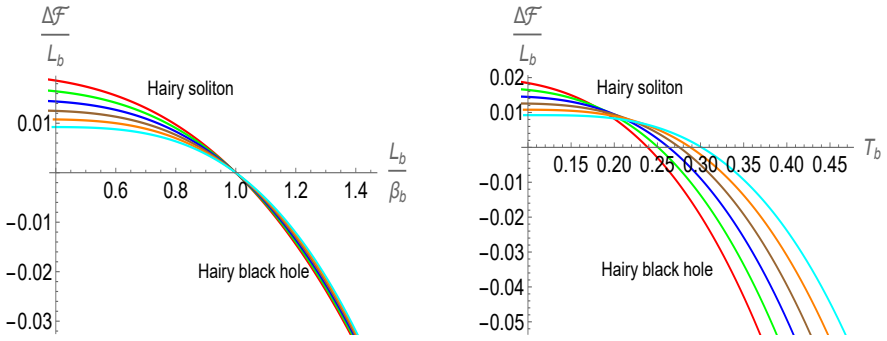
Hairy solitons are the ground state in planar AdS spacetimes, with a first-order phase transition to hairy black holes controlled by the ratio of Euclidean time and spatial periods.
A machine-rendered reading of the paper's core claim, the machinery that carries it, and where it could break.
Core claim
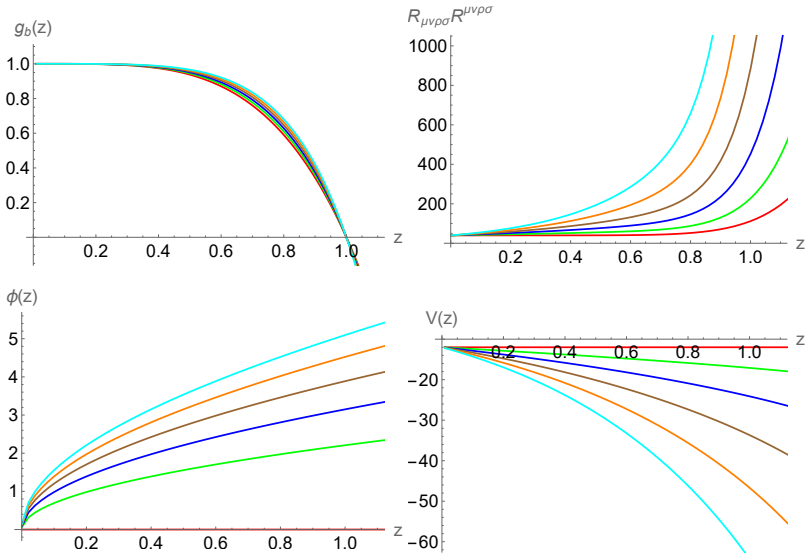
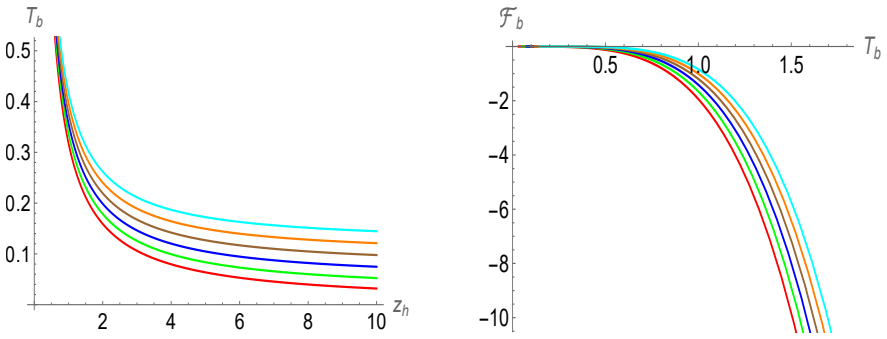
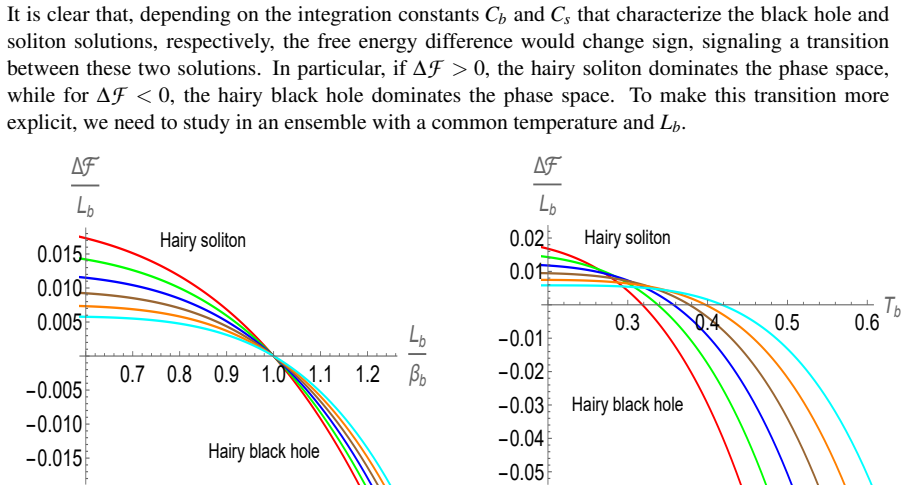
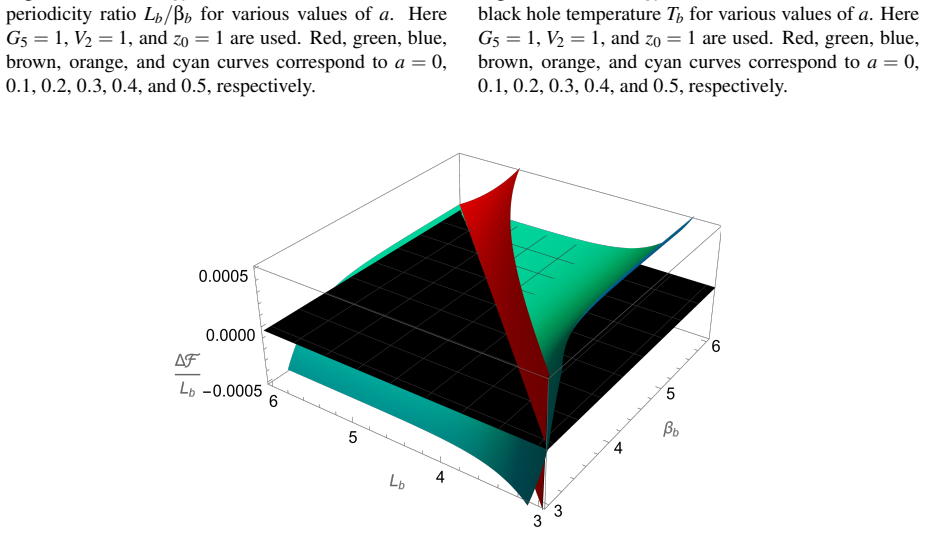
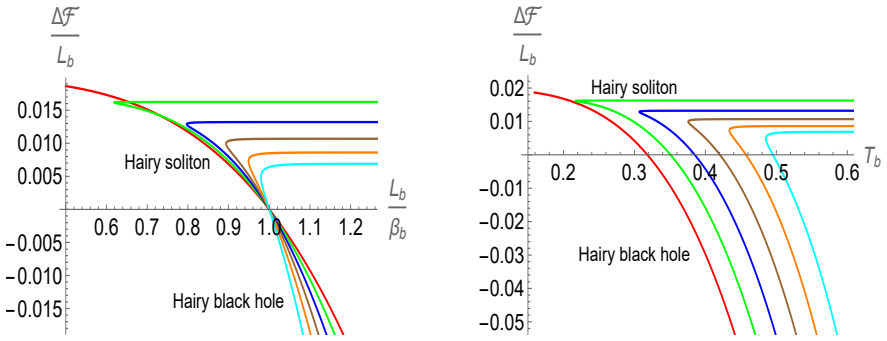
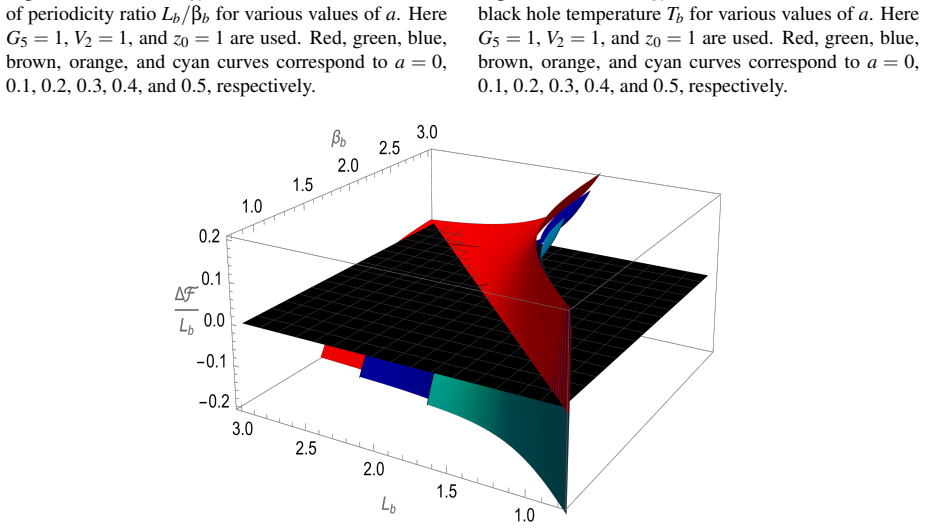
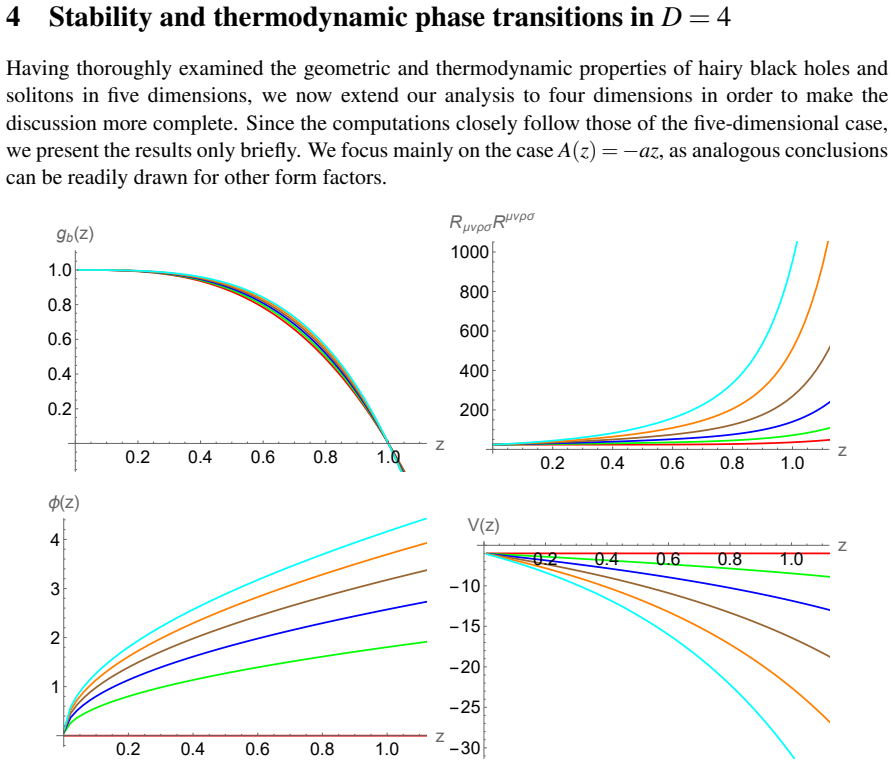
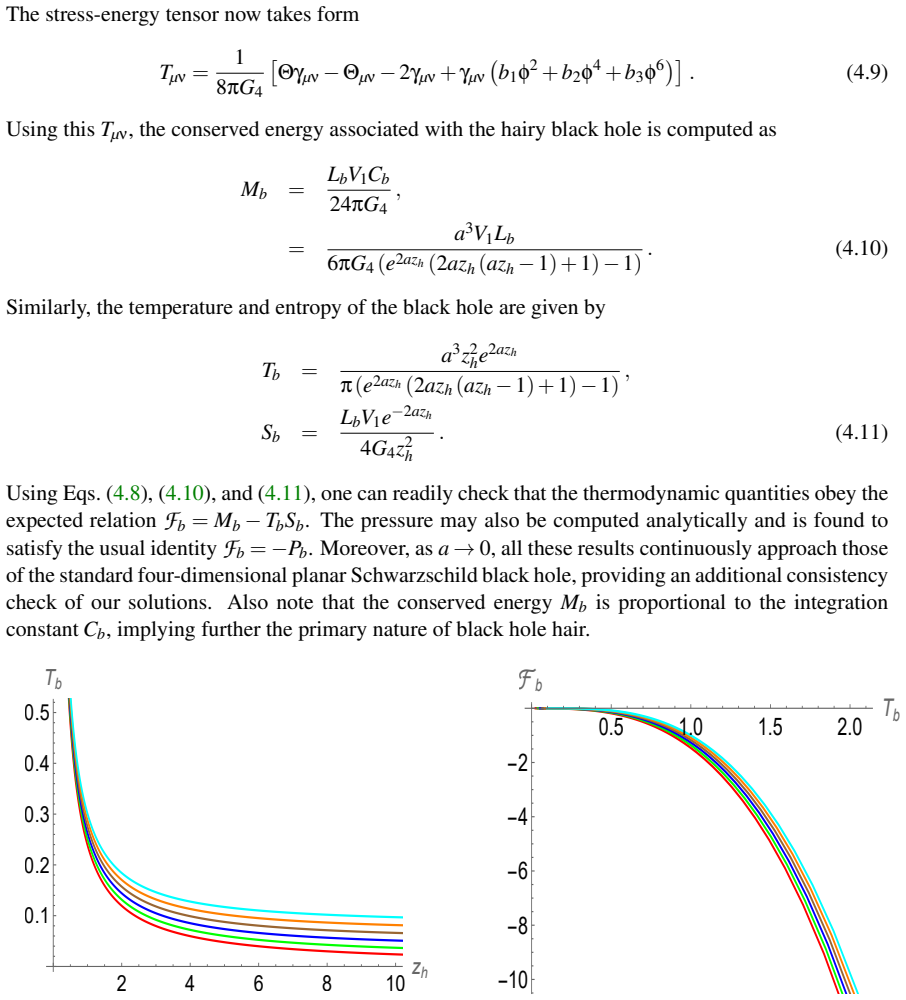
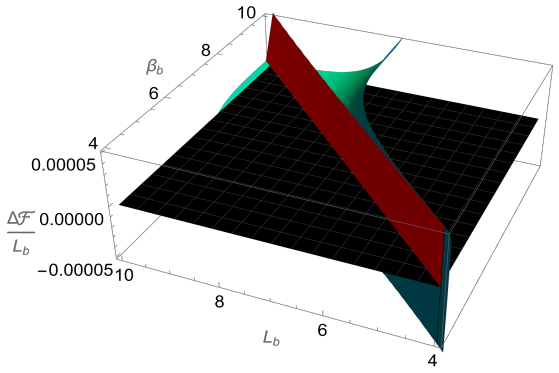
By solving the coupled Einstein-scalar field equations we obtain analytic planar hairy black hole and soliton geometries in which the scalar field and curvature scalars remain regular everywhere. Analytic expressions for the mass and free energy indicate that the hairy soliton represents the ground state of the system. There exists a first-order phase transition between the hairy black hole and the hairy soliton, with the transition point controlled by the ratio of the periods of Euclidean time and compact spacelike cycle. The temperature window in which the soliton phase remains preferred expands as the hair parameter increases.
What carries the argument
The analytic planar hairy black hole and soliton geometries obtained by integrating the Einstein-scalar equations for a specific scalar profile and potential that admits closed-form solutions.
If this is right
- The hairy soliton is thermodynamically preferred over the black hole below the transition temperature.
- The transition is first order, so thermodynamic quantities such as entropy jump discontinuously at the transition point.
- Increasing the strength of the primary scalar hair enlarges the temperature interval in which the soliton is the global minimum of the free energy.
- These solutions provide a gravitational dual for the confined phase in bottom-up holographic QCD models.
Where Pith is reading between the lines
- The ratio dependence suggests that the phase structure can be tuned by changing the compactification radius in the spatial direction.
- Similar first-order transitions might occur in other matter-coupled AdS solutions beyond the planar case.
- Testing the stability of these solutions beyond free-energy comparison could confirm or refute their role as true ground states.
Load-bearing premise
The specific scalar field profile and potential permit regular analytic solutions whose free-energy comparison reliably identifies the global thermodynamic minimum without additional stability checks.
What would settle it
Numerical computation of the on-shell action or free energy for the same boundary conditions showing the black hole free energy lower than the soliton's in the regime the paper identifies as soliton-dominated, or linear perturbation analysis revealing an instability in the soliton.
Figures
read the original abstract
We present a new family of Ricci-flat black hole and soliton solutions with primary scalar hair in asymptotically anti-de Sitter (AdS) space in $D$ dimensions. By solving the coupled Einstein-scalar field equations, we obtain analytic planar hairy black hole and soliton geometries. In these solutions, the scalar field and curvature scalars remain regular everywhere. We also derive analytic expressions for the mass and free energy, which indicate that the hairy soliton represents the ground state of the system. We further analyze the phase transitions between the hairy black hole and the hairy soliton, and find that there exists a first-order phase transition between them, with the transition point controlled by the ratio of the periods of Euclidean time and compact spacelike cycle. We further analyze how the scalar hair affects the transition temperature, and find that the temperature window in which the soliton phase remains preferred expands as the hair parameter increases. The hairy soliton solution obtained here is partly motivated by holographic QCD and may provide a useful gravitational background for modeling the confined phase of QCD from a bottom-up holographic perspective.
Editorial analysis
A structured set of objections, weighed in public.
Referee Report
Summary. The paper constructs a new family of analytic Ricci-flat planar black hole and soliton solutions with primary scalar hair in asymptotically AdS_D spacetime. It derives closed-form expressions for the mass and free energy, identifies the hairy soliton as the ground state, and demonstrates a first-order phase transition between the hairy black hole and soliton whose location is controlled by the ratio of the Euclidean time period to the compact spatial cycle period; the temperature interval favoring the soliton widens with increasing hair parameter. The construction is partly motivated by bottom-up holographic QCD.
Significance. If the analytic solutions are regular and the free-energy comparison is thermodynamically valid, the work supplies an explicit, controllable family of hairy backgrounds that could serve as gravitational duals for the confined phase in holographic models of QCD. The closed-form mass and free-energy expressions, together with the direct dependence of the transition temperature on the hair parameter, constitute a concrete, falsifiable prediction that is rare in this class of models.
major comments (2)
- [phase-transition analysis] The assertion that the hairy soliton is the ground state rests on free-energy comparison alone. No linear stability analysis, quasinormal-mode spectrum, or perturbation analysis around either background is reported, leaving open the possibility that the lower-free-energy solution is unstable. This directly affects the claim that the soliton remains preferred below the critical temperature (phase-transition section).
- [solution construction] The manuscript states that the Einstein-scalar equations admit closed-form integration for a chosen scalar profile and potential, yet the explicit metric ansatz, scalar potential, and integration steps are not supplied in sufficient detail to verify regularity of curvature scalars and the scalar field everywhere. This is load-bearing for the central claim of analytic, regular solutions.
minor comments (1)
- Notation for the hair parameter and the two periods should be introduced once with a clear table or equation reference to avoid ambiguity when the ratio is varied.
Simulated Author's Rebuttal
We thank the referee for the careful reading, the positive assessment of the work's potential significance for holographic QCD, and the recommendation for major revision. We address each major comment below, providing clarifications and indicating the revisions planned for the manuscript.
read point-by-point responses
-
Referee: [phase-transition analysis] The assertion that the hairy soliton is the ground state rests on free-energy comparison alone. No linear stability analysis, quasinormal-mode spectrum, or perturbation analysis around either background is reported, leaving open the possibility that the lower-free-energy solution is unstable. This directly affects the claim that the soliton remains preferred below the critical temperature (phase-transition section).
Authors: We agree that the identification of the ground state relies solely on free-energy comparison, which is the standard thermodynamic criterion used in the holographic literature for determining preferred phases. A full linear stability analysis via perturbations or quasinormal modes would indeed provide additional support and is a genuine limitation of the current work. We will revise the phase-transition section to explicitly note this assumption, clarify that the soliton is preferred on thermodynamic grounds, and add a remark suggesting a stability analysis as a natural direction for future research. This is a partial revision, as we do not perform the analysis here. revision: partial
-
Referee: [solution construction] The manuscript states that the Einstein-scalar equations admit closed-form integration for a chosen scalar profile and potential, yet the explicit metric ansatz, scalar potential, and integration steps are not supplied in sufficient detail to verify regularity of curvature scalars and the scalar field everywhere. This is load-bearing for the central claim of analytic, regular solutions.
Authors: We thank the referee for highlighting this presentational gap. The explicit metric ansatz, scalar potential, chosen scalar profile, and integration steps were not detailed in the original submission to maintain brevity. In the revised manuscript we will supply the full metric ansatz, the explicit form of the scalar potential V(φ), the scalar profile φ(r), the step-by-step integration of the Einstein-scalar equations, and direct verification (via explicit expressions or plots) that all curvature scalars and the scalar field remain regular everywhere, including at the horizon and in the asymptotic region. revision: yes
Circularity Check
Derivation chain is self-contained with no circular reductions
full rationale
The paper constructs explicit analytic solutions to the Einstein-scalar equations for a chosen scalar profile and potential that permit closed-form integration, then computes mass and free-energy expressions directly from the metric and scalar field. Phase-transition points are identified by comparing these derived free energies as functions of temperature and the hair parameter. No step reduces by construction to a fitted input, self-definition, or self-citation chain; the hair parameter enters the ansatz to enable analyticity but does not tautologically force the reported transition behavior. The analysis is therefore independent of its own outputs.
Axiom & Free-Parameter Ledger
free parameters (1)
- hair parameter
axioms (1)
- domain assumption The coupled Einstein-scalar field equations in D-dimensional AdS admit regular, Ricci-flat planar solutions with primary hair.
Reference graph
Works this paper leans on
-
[1]
S. W. Hawking and Don N. Page. Thermodynamics of Black Holes in anti-De Sitter Space. Commun. Math. Phys., 87:577, 1983
work page 1983
-
[2]
The LargeNlimit of superconformal field theories and supergravity
Juan Martin Maldacena. The LargeNlimit of superconformal field theories and supergravity. Adv. Theor . Math. Phys., 2:231–252, 1998
work page 1998
-
[3]
S. S. Gubser, Igor R. Klebanov, and Alexander M. Polyakov. Gauge theory correlators from noncritical string theory.Phys. Lett. B, 428:105–114, 1998
work page 1998
-
[4]
Anti de Sitter space and holography.Adv
Edward Witten. Anti de Sitter space and holography.Adv. Theor . Math. Phys., 2:253–291, 1998
work page 1998
-
[5]
J. P. S. Lemos. Cylindrical black hole in general relativity.Phys. Lett. B, 353:46–51, 1995
work page 1995
-
[6]
Friedman, Kristin Schleich, and Donald M
John L. Friedman, Kristin Schleich, and Donald M. Witt. Topological censorship.Phys. Rev. Lett., 71:1486–1489, 1993. [Erratum: Phys.Rev.Lett. 75, 1872 (1995)]
work page 1993
-
[7]
Black plane solutions in four-dimensional space-times
Rong-Gen Cai and Yuan-Zhong Zhang. Black plane solutions in four-dimensional space-times. Phys. Rev. D, 54:4891–4898, 1996
work page 1996
-
[8]
Black holes with unusual topology.Phys
Luciano Vanzo. Black holes with unusual topology.Phys. Rev. D, 56:6475–6483, 1997
work page 1997
-
[9]
Topological black holes in Anti-de Sitter space.Class
Danny Birmingham. Topological black holes in Anti-de Sitter space.Class. Quant. Grav., 16:1197–1205, 1999
work page 1999
-
[10]
Robert B. Mann. Pair production of topological anti-de Sitter black holes.Class. Quant. Grav., 14:L109–L114, 1997
work page 1997
-
[11]
Brill, Jorma Louko, and Peter Peldan
Dieter R. Brill, Jorma Louko, and Peter Peldan. Thermodynamics of (3+1)-dimensional black holes with toroidal or higher genus horizons.Phys. Rev. D, 56:3600–3610, 1997
work page 1997
-
[12]
Analytic topological hairy dyonic black holes and thermodynamics.Phys
Supragyan Priyadarshinee, Subhash Mahapatra, and Indrani Banerjee. Analytic topological hairy dyonic black holes and thermodynamics.Phys. Rev. D, 104(8):084023, 2021
work page 2021
-
[13]
Thermodynamics of charged topological dilaton black holes.Phys
Ahmad Sheykhi. Thermodynamics of charged topological dilaton black holes.Phys. Rev. D, 76:124025, 2007
work page 2007
-
[14]
Anti-de Sitter space, thermal phase transition, and confinement in gauge theo- ries.Adv
Edward Witten. Anti-de Sitter space, thermal phase transition, and confinement in gauge theo- ries.Adv. Theor . Math. Phys., 2:505–532, 1998
work page 1998
-
[15]
Andrew Chamblin, Roberto Emparan, Clifford V . Johnson, and Robert C. Myers. Charged AdS black holes and catastrophic holography.Phys. Rev. D, 60:064018, 1999. 29
work page 1999
-
[16]
Andrew Chamblin, Roberto Emparan, Clifford V . Johnson, and Robert C. Myers. Holography, thermodynamics and fluctuations of charged AdS black holes.Phys. Rev. D, 60:104026, 1999
work page 1999
-
[17]
Mirjam Cvetic and Steven S. Gubser. Phases of R charged black holes, spinning branes and strongly coupled gauge theories.JHEP, 04:024, 1999
work page 1999
-
[18]
David Kubiznak and Robert B. Mann. P-V criticality of charged AdS black holes.JHEP, 07:033, 2012
work page 2012
-
[19]
Caldarelli, Guido Cognola, and Dietmar Klemm
Marco M. Caldarelli, Guido Cognola, and Dietmar Klemm. Thermodynamics of Kerr- Newman-AdS black holes and conformal field theories.Class. Quant. Grav., 17:399–420, 2000
work page 2000
-
[20]
David Kubiznak, Robert B. Mann, and Mae Teo. Black hole chemistry: thermodynamics with Lambda.Class. Quant. Grav., 34(6):063001, 2017
work page 2017
-
[21]
Sharmila Gunasekaran, Robert B. Mann, and David Kubiznak. Extended phase space thermo- dynamics for charged and rotating black holes and Born-Infeld vacuum polarization.JHEP, 11:110, 2012
work page 2012
-
[22]
S. H. Hendi and M. H. Vahidinia. Extended phase space thermodynamics and P-V criticality of black holes with a nonlinear source.Phys. Rev. D, 88(8):084045, 2013
work page 2013
-
[23]
Critical behavior of Born-Infeld AdS black holes in the extended phase space thermodynamics.Phys
De-Cheng Zou, Shao-Jun Zhang, and Bin Wang. Critical behavior of Born-Infeld AdS black holes in the extended phase space thermodynamics.Phys. Rev. D, 89(4):044002, 2014
work page 2014
-
[24]
Chiral transition in the probe approximation from an Einstein-Maxwell-dilaton gravity model.Phys
Hardik Bohra, David Dudal, Ali Hajilou, and Subhash Mahapatra. Chiral transition in the probe approximation from an Einstein-Maxwell-dilaton gravity model.Phys. Rev. D, 103(8):086021, 2021
work page 2021
-
[25]
Siddhi Swarupa Jena, Jyotirmoy Barman, Bruno Toniato, David Dudal, and Subhash Mahapa- tra. A dynamical Einstein-Born-Infeld-dilaton model and holographic quarkonium melting in a magnetic field.JHEP, 12:096, 2024
work page 2024
-
[26]
Probing quarkonium diffusion in a magnetized quark-gluon plasma.Phys
Siddhi Swarupa Jena, Arpan Bhattacharjee, David Dudal, and Subhash Mahapatra. Probing quarkonium diffusion in a magnetized quark-gluon plasma.Phys. Rev. D, 112(8):086010, 2025
work page 2025
-
[27]
Sumati Surya, Kristin Schleich, and Donald M. Witt. Phase transitions for flat AdS black holes. Phys. Rev. Lett., 86:5231–5234, 2001
work page 2001
-
[28]
Gary T. Horowitz and Robert C. Myers. The AdS / CFT correspondence and a new positive energy conjecture for general relativity.Phys. Rev. D, 59:026005, 1998
work page 1998
-
[29]
G. J. Galloway, S. Surya, and E. Woolgar. A Uniqueness theorem for the AdS soliton.Phys. Rev. Lett., 88:101102, 2002
work page 2002
-
[30]
G. J. Galloway, S. Surya, and E. Woolgar. On the geometry and mass of static, asymptotically AdS space-times, and the uniqueness of the AdS soliton.Commun. Math. Phys., 241:1–25, 2003
work page 2003
-
[31]
The rigid Horowitz-Myers conjecture.JHEP, 03:104, 2017
Eric Woolgar. The rigid Horowitz-Myers conjecture.JHEP, 03:104, 2017. 30
work page 2017
-
[32]
AdS Bubbles, Entropy and Closed String Tachyons
Tatsuma Nishioka and Tadashi Takayanagi. AdS Bubbles, Entropy and Closed String Tachyons. JHEP, 01:090, 2007
work page 2007
-
[33]
Holographic Superconduc- tor/Insulator Transition at Zero Temperature.JHEP, 03:131, 2010
Tatsuma Nishioka, Shinsei Ryu, and Tadashi Takayanagi. Holographic Superconduc- tor/Insulator Transition at Zero Temperature.JHEP, 03:131, 2010
work page 2010
-
[34]
Andres Anabalon and Simon F. Ross. Supersymmetric solitons and a degeneracy of solutions in AdS/CFT.JHEP, 07:015, 2021
work page 2021
-
[35]
Phase transition of electrically charged Ricci-flat black holes.JHEP, 07:047, 2007
Nabamita Banerjee and Suvankar Dutta. Phase transition of electrically charged Ricci-flat black holes.JHEP, 07:047, 2007
work page 2007
-
[36]
Phase transitions for charged planar solitons in AdS.Phys
Andr ´es Anabal ´on, Patrick Concha, Julio Oliva, Constanza Quijada, and Evelyn Rodr ´ıguez. Phase transitions for charged planar solitons in AdS.Phys. Lett. B, 835:137521, 2022
work page 2022
-
[37]
Constanza Quijada, Andr ´es Anabal´on, Robert B. Mann, and Julio Oliva. Triple points of grav- itational AdS solitons and black holes.Phys. Rev. D, 110(2):L021902, 2024
work page 2024
-
[38]
Rong-Gen Cai, Sang Pyo Kim, and Bin Wang. Ricci flat black holes and Hawking-Page phase transition in Gauss-Bonnet gravity and dilaton gravity.Phys. Rev. D, 76:024011, 2007
work page 2007
- [39]
-
[40]
Steven S. Gubser. Breaking an Abelian gauge symmetry near a black hole horizon.Phys. Rev. D, 78:065034, 2008
work page 2008
-
[41]
Sean A. Hartnoll, Christopher P. Herzog, and Gary T. Horowitz. Building a Holographic Su- perconductor.Phys. Rev. Lett., 101:031601, 2008
work page 2008
-
[42]
Steven S. Gubser and Abhinav Nellore. Mimicking the QCD equation of state with a dual black hole.Phys. Rev. D, 78:086007, 2008
work page 2008
-
[43]
Oliver DeWolfe, Steven S. Gubser, and Christopher Rosen. A holographic critical point.Phys. Rev. D, 83:086005, 2011
work page 2011
- [44]
-
[45]
Holographic Models for QCD in the Veneziano Limit.JHEP, 03:002, 2012
Matti Jarvinen and Elias Kiritsis. Holographic Models for QCD in the Veneziano Limit.JHEP, 03:002, 2012
work page 2012
-
[46]
Hot QCD phase diagram from holographic Ein- stein–Maxwell–Dilaton models.Prog
Romulo Rougemont, Joaquin Grefa, Mauricio Hippert, Jorge Noronha, Jacquelyn Noronha- Hostler, Israel Portillo, and Claudia Ratti. Hot QCD phase diagram from holographic Ein- stein–Maxwell–Dilaton models.Prog. Part. Nucl. Phys., 135:104093, 2024
work page 2024
-
[47]
Dumitru Astefanesei, Paulina Cabrera, Robert B. Mann, and Ra´ul Rojas. Extended phase space thermodynamics for hairy black holes.Phys. Rev. D, 108(10):104047, 2023
work page 2023
-
[48]
Thermodynamics and phase structure of an Einstein-Maxwell-scalar model in extended phase space.Phys
Guangzhou Guo, Peng Wang, Houwen Wu, and Haitang Yang. Thermodynamics and phase structure of an Einstein-Maxwell-scalar model in extended phase space.Phys. Rev. D, 105(6):064069, 2022. 31
work page 2022
-
[49]
Different phases of hairy black holes in AdS5 space.Phys
Gaston Giribet, Andres Goya, and Julio Oliva. Different phases of hairy black holes in AdS5 space.Phys. Rev. D, 91(4):045031, 2015
work page 2015
-
[50]
Robie A. Hennigar and Robert B. Mann. Reentrant Phase Transitions and van der Waals Be- haviour for Hairy Black Holes.Entropy, 17(12):8056–8072, 2015
work page 2015
-
[51]
Remo Ruffini and John A. Wheeler. Introducing the black hole.Phys. Today, 24(1):30, 1971
work page 1971
-
[52]
Jacob D. Bekenstein. Nonexistence of baryon number for static black holes.Phys. Rev. D, 5:1239–1246, 1972
work page 1972
-
[53]
Event horizons in static vacuum space-times.Phys
Werner Israel. Event horizons in static vacuum space-times.Phys. Rev., 164:1776–1779, 1967
work page 1967
-
[54]
Robert M. Wald. Final states of gravitational collapse.Phys. Rev. Lett., 26:1653–1655, 1971
work page 1971
-
[55]
B. Carter. Axisymmetric Black Hole Has Only Two Degrees of Freedom.Phys. Rev. Lett., 26:331–333, 1971
work page 1971
-
[56]
D. C. Robinson. Uniqueness of the Kerr black hole.Phys. Rev. Lett., 34:905–906, 1975
work page 1975
-
[57]
P. O. Mazur. PROOF OF UNIQUENESS OF THE KERR-NEWMAN BLACK HOLE SOLU- TION.J. Phys. A, 15:3173–3180, 1982
work page 1982
-
[58]
C. Teitelboim. Nonmeasurability of the quantum numbers of a black hole.Phys. Rev. D, 5:2941–2954, 1972
work page 1972
-
[59]
M. S. V olkov and D. V . Galtsov. Black holes in Einstein Yang-Mills theory. (In Russian).Sov. J. Nucl. Phys., 51:747–753, 1990
work page 1990
-
[60]
P. Bizon. Colored black holes.Phys. Rev. Lett., 64:2844–2847, 1990
work page 1990
-
[61]
H. P. Kuenzle and A. K. M. Masood-ul Alam. Spherically symmetric static SU(2) Einstein Yang-Mills fields.J. Math. Phys., 31:928–935, 1990
work page 1990
-
[62]
Horowitz, and Andrew Strominger
David Garfinkle, Gary T. Horowitz, and Andrew Strominger. Charged black holes in string theory.Phys. Rev. D, 43:3140, 1991. [Erratum: Phys.Rev.D 45, 3888 (1992)]
work page 1991
-
[63]
Brian R. Greene, Samir D. Mathur, and Christopher M. O’Neill. Eluding the no hair conjecture: Black holes in spontaneously broken gauge theories.Phys. Rev. D, 47:2242–2259, 1993
work page 1993
-
[64]
Black holes with nonAbelian hair and their thermodynamical properties.Phys
Takashi Torii and Kei-ichi Maeda. Black holes with nonAbelian hair and their thermodynamical properties.Phys. Rev. D, 48:1643–1651, 1993
work page 1993
-
[65]
Carlos A. R. Herdeiro and Eugen Radu. Kerr black holes with scalar hair.Phys. Rev. Lett., 112:221101, 2014
work page 2014
-
[66]
Emanuele Berti, Vitor Cardoso, Leonardo Gualtieri, Michael Horbatsch, and Ulrich Sperhake. Numerical simulations of single and binary black holes in scalar-tensor theories: circumventing the no-hair theorem.Phys. Rev. D, 87(12):124020, 2013
work page 2013
- [67]
-
[68]
Rotating hairy black holes and thermodynamics from gravitational decoupling.Phys
Subhash Mahapatra and Indrani Banerjee. Rotating hairy black holes and thermodynamics from gravitational decoupling.Phys. Dark Univ., 39:101172, 2023
work page 2023
-
[69]
Coherent quantum hairy black holes from gravita- tional decoupling
Henrique Navarro and Roldao da Rocha. Coherent quantum hairy black holes from gravita- tional decoupling. 2 2026
work page 2026
-
[70]
V . F. Guimar˜aes, R. T. Cavalcanti, and R. da Rocha. Hair imprints of the gravitational decou- pling and hairy black hole spectroscopy.Class. Quant. Grav., 42(17):175011, 2025
work page 2025
-
[71]
Gravitational decoupling, hairy black holes and conformal anomalies.Eur
Pedro Meert and Roldao da Rocha. Gravitational decoupling, hairy black holes and conformal anomalies.Eur . Phys. J. C, 82(2):175, 2022
work page 2022
-
[72]
Hairy black hole solutions in nonlocal quadratic gravity
Roldao da Rocha. Hairy black hole solutions in nonlocal quadratic gravity. 1 2026
work page 2026
-
[73]
Carlos A. R. Herdeiro and Eugen Radu. Asymptotically flat black holes with scalar hair: a review.Int. J. Mod. Phys. D, 24(09):1542014, 2015
work page 2015
-
[74]
No scalar hair conjecture in asymptotic de Sitter space-time.Phys
Takashi Torii, Kengo Maeda, and Makoto Narita. No scalar hair conjecture in asymptotic de Sitter space-time.Phys. Rev. D, 59:064027, 1999
work page 1999
-
[75]
Scalar hair on the black hole in asymptotically anti-de Sitter space-time.Phys
Takashi Torii, Kengo Maeda, and Makoto Narita. Scalar hair on the black hole in asymptotically anti-de Sitter space-time.Phys. Rev. D, 64:044007, 2001
work page 2001
-
[76]
Exact black hole solution with a minimally coupled scalar field.Phys
Cristian Martinez, Ricardo Troncoso, and Jorge Zanelli. Exact black hole solution with a minimally coupled scalar field.Phys. Rev. D, 70:084035, 2004
work page 2004
-
[77]
Elizabeth Winstanley. On the existence of conformally coupled scalar field hair for black holes in (anti-)de Sitter space.F ound. Phys., 33:111–143, 2003
work page 2003
-
[78]
A New Class of Exact Hairy Black Hole Solutions.Gen
Theodoros Kolyvaris, George Koutsoumbas, Eleftherios Papantonopoulos, and George Siopsis. A New Class of Exact Hairy Black Hole Solutions.Gen. Rel. Grav., 43:163–180, 2011
work page 2011
-
[79]
Oscar J. C. Dias, Pau Figueras, Shiraz Minwalla, Prahar Mitra, Ricardo Monteiro, and Jorge E. Santos. Hairy black holes and solitons in globalAdS 5.JHEP, 08:117, 2012
work page 2012
-
[80]
Small Hairy Black Holes inAdS 5xS5.JHEP, 11:035, 2011
Sayantani Bhattacharyya, Shiraz Minwalla, and Kyriakos Papadodimas. Small Hairy Black Holes inAdS 5xS5.JHEP, 11:035, 2011
work page 2011
discussion (0)
Sign in with ORCID, Apple, or X to comment. Anyone can read and Pith papers without signing in.