Surface mechanisms governing long-term stability of GEM detectors in CO₂-based gaseous mixtures
Pith reviewed 2026-05-14 22:20 UTC · model grok-4.3
The pith
CO2 forms thin inorganic oxygenated layers on GEM copper electrodes that reduce charge accumulation.
A machine-rendered reading of the paper's core claim, the machinery that carries it, and where it could break.
Core claim
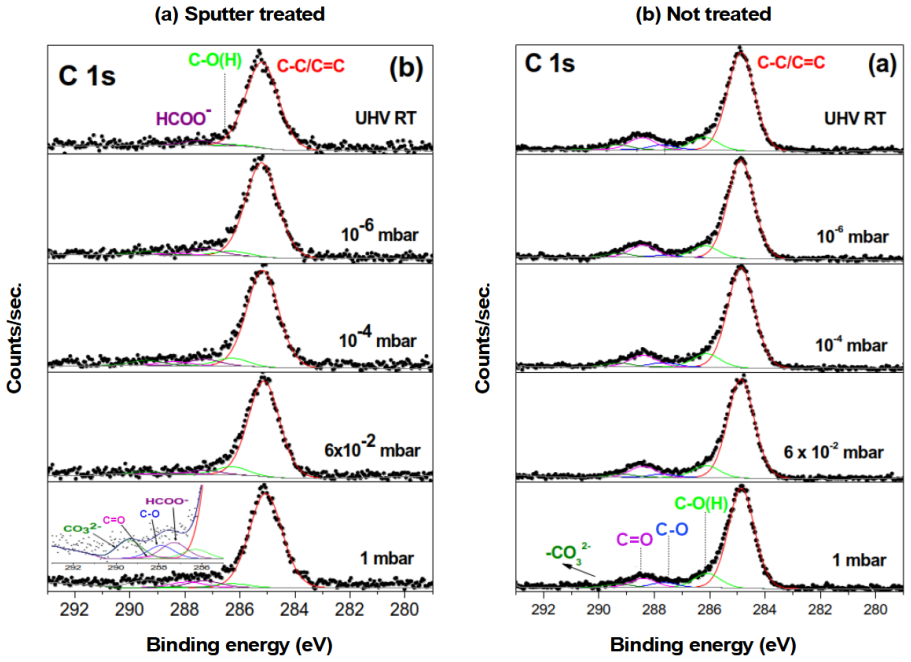
CO2 exposure on GEM copper foils establishes self-limiting redox equilibria that favor thin inorganic oxygenated layers, with NAP-XPS revealing reduction of CuO to Cu2O, formation of C=O, C-O, carbonate, and hydroxyl species, and a spectral feature for ionized CO2, while Raman confirms heterogeneous Cu2O dominance at the micrometer scale.
What carries the argument
Self-limiting redox equilibria on copper surfaces driven by CO2, observed through NAP-XPS and Raman mapping to produce stable oxygenated films instead of polymeric deposits.
If this is right
- GEM detectors operated in CO2 mixtures achieve longer operational lifetimes due to lower charge accumulation on electrodes.
- Aging effects decrease compared to hydrocarbon mixtures because the surface layers remain inorganic and thin.
- Ionized CO2 species generated in avalanches interact directly with copper electrodes to maintain the redox balance.
- The oxygenated layers form heterogeneously but consistently favor Cu2O over higher oxides.
- Detector systems gain reliability for applications needing continuous high-voltage running.
Where Pith is reading between the lines
- Monitoring charge buildup in actual long-term GEM runs could directly test whether the NAP-XPS layers form under avalanche conditions.
- Similar redox control might extend to other gas mixtures or electrode materials in gaseous detectors.
- Varying CO2 concentration could be checked for effects on layer thickness and overall detector gain stability.
- The copper-CO2 surface chemistry may connect to related redox processes in sensors or catalytic surfaces.
Load-bearing premise
Surface changes observed under NAP-XPS conditions accurately represent the behavior inside a real GEM detector during prolonged operation with gas avalanches and ionized species.
What would settle it
Detection of thick polymeric deposits or rapid charge accumulation after months of operation in a CO2-based GEM detector would contradict the formation of stable thin oxygenated layers.
Figures




read the original abstract
Understanding the chemical stability of Gas Electron Multipliers (GEMs) operated in CO$_2$-based mixtures is essential for improving detector longevity and reliability. In this work, we investigate the interaction between CO$_2$ molecules and the copper electrodes of GEM foils through near-ambient pressure X-ray photoelectron spectroscopy (NAP-XPS) and complementary Raman mapping. The measurements reveal that CO$_2$ exposure promotes a mild reduction of CuO to Cu$_2$O on untreated surfaces, while sputter-cleaned foils remain metallic and chemically stable. Raman spectroscopy confirms the predominance of Cu$_2$O with spatially heterogeneous contributions from CuO at the micrometer scale, providing structural support for the oxidation-state evolution inferred from XPS. Carbon 1s spectra identify carbonyl (C=O), C-O, carbonate, and hydroxyl species, indicating that oxidized copper sites mediate surface reactions and the formation of oxygenated films. A spectral feature consistent with ionized gas phase CO$_2$ species is observed in the O 1s region, suggesting that a fraction of the gas phase may become ionized in the near-surface region during acquisition. This is relevant for GEM detectors, where CO$_2^{+}$ and other ionized species generated in the avalanche can interact with the copper electrodes. These findings indicate that CO$_2$ acts not only as a quencher but also as a weakly reactive component capable of establishing self-limiting redox equilibria that favor the formation of thin, inorganic oxygenated layers. Such layers are expected to be significantly less prone to charge accumulation than the polymeric or carbonaceous deposits typically formed in hydrocarbon-based mixtures. The results provide experimental insight into the mechanisms underlying GEM stability and contribute to a deeper understanding of aging phenomena in GEM-based systems.
Editorial analysis
A structured set of objections, weighed in public.
Referee Report
Summary. The manuscript investigates the interaction of CO2 with copper electrodes in GEM foils using near-ambient pressure XPS (NAP-XPS) and Raman mapping. It reports that CO2 exposure induces mild reduction of surface CuO to Cu2O on untreated foils (while sputter-cleaned surfaces remain stable), identifies carbonyl, C-O, carbonate and hydroxyl species in C 1s spectra, and observes a weak O 1s feature attributed to ionized CO2. The central claim is that these observations demonstrate CO2 acting as a weakly reactive component that establishes self-limiting redox equilibria, forming thin inorganic oxygenated layers expected to be less prone to charge accumulation than polymeric deposits in hydrocarbon mixtures, thereby contributing to long-term GEM stability.
Significance. If the extrapolation to operating conditions holds, the work supplies direct spectroscopic evidence for a surface mechanism that could explain the superior longevity of CO2-based mixtures in GEM detectors. Complementary XPS and Raman data strengthen species identification, and the suggestion of ionized CO2 near the surface links to avalanche-generated species, offering a concrete hypothesis for aging studies.
major comments (2)
- [Abstract and Discussion] Abstract and Discussion: the assertion that the observed oxygenated layers (Cu2O, carbonates) are 'significantly less prone to charge accumulation' than polymeric deposits is not supported by any measurement of surface resistivity, charge-up rate, or gain stability under high-field avalanche conditions. The inference therefore rests on an untested extrapolation from NAP-XPS/Raman conditions to real GEM operation.
- [Results] Results section (XPS and Raman data): while the spectra show consistent features for Cu2O and oxygenated carbon species, no quantitative correlation is provided between the thickness or coverage of these layers and any detector performance metric (e.g., long-term gain or discharge probability), leaving the link to stability claims qualitative.
minor comments (2)
- [Experimental / Results] The binding-energy values and fitting constraints for the C 1s and O 1s components should be tabulated or stated explicitly to allow independent assessment of the species assignments.
- [Results (O 1s spectra)] Clarify whether the 'ionized gas phase CO2' feature in O 1s was observed only under X-ray illumination or also in the absence of the beam, to strengthen the relevance to avalanche ionization.
Simulated Author's Rebuttal
We thank the referee for the constructive review and for recognizing the potential significance of the spectroscopic results. We address the two major comments point by point below and have revised the manuscript to clarify the inferential nature of the stability claims.
read point-by-point responses
-
Referee: [Abstract and Discussion] Abstract and Discussion: the assertion that the observed oxygenated layers (Cu2O, carbonates) are 'significantly less prone to charge accumulation' than polymeric deposits is not supported by any measurement of surface resistivity, charge-up rate, or gain stability under high-field avalanche conditions. The inference therefore rests on an untested extrapolation from NAP-XPS/Raman conditions to real GEM operation.
Authors: We agree that the manuscript contains no direct measurements of surface resistivity, charge-up rate, or gain stability under avalanche conditions. The statement rests on the spectroscopic observation of thin, self-limiting inorganic layers whose chemical character differs from polymeric deposits known to cause aging in hydrocarbon mixtures. To address the concern, we have revised the abstract and discussion to replace 'significantly less prone' with 'potentially less prone' and have added explicit language stating that this remains an inference supported by the observed redox equilibria and by prior GEM aging literature. The revision makes the extrapolation transparent while preserving the mechanistic insight provided by the NAP-XPS and Raman data. revision: yes
-
Referee: [Results] Results section (XPS and Raman data): while the spectra show consistent features for Cu2O and oxygenated carbon species, no quantitative correlation is provided between the thickness or coverage of these layers and any detector performance metric (e.g., long-term gain or discharge probability), leaving the link to stability claims qualitative.
Authors: The study is deliberately focused on the chemical identification of surface species and reaction pathways under near-ambient CO2 exposure. No quantitative correlation between layer thickness or coverage and detector metrics such as long-term gain or discharge probability is presented, because obtaining such data would require a separate campaign that combines in-operando spectroscopy with full detector characterization. In the revised manuscript we have added a dedicated paragraph in the discussion that (i) states the qualitative character of the stability link, (ii) explains how the thin inorganic films are expected to affect charge transport on the basis of their chemical composition, and (iii) outlines the experimental steps needed to establish quantitative correlations in future work. revision: partial
Circularity Check
No circularity: purely observational surface spectroscopy with interpretive claims
full rationale
The manuscript reports direct NAP-XPS and Raman measurements of CO2-exposed GEM foils, documenting CuO reduction to Cu2O, carbonyl/carbonate species, and a weak ionized-CO2 feature. The central statement that these layers are 'expected to be significantly less prone to charge accumulation' is an explicit forward-looking inference, not a fitted parameter, self-referential prediction, or equation that reduces to prior inputs. No derivations, uniqueness theorems, or self-citations are invoked as load-bearing steps. The work is therefore self-contained against external benchmarks and receives the default non-circularity finding.
Axiom & Free-Parameter Ledger
axioms (1)
- standard math Standard XPS binding energy shifts reliably distinguish CuO from Cu2O and metallic Cu
Lean theorems connected to this paper
-
IndisputableMonolith/Cost/FunctionalEquationwashburn_uniqueness_aczel unclear?
unclearRelation between the paper passage and the cited Recognition theorem.
These findings indicate that CO2 acts not only as a quencher but also as a weakly reactive component capable of establishing self-limiting redox equilibria that favor the formation of thin, inorganic oxygenated layers.
-
IndisputableMonolith/Foundation/AbsoluteFloorClosurereality_from_one_distinction unclear?
unclearRelation between the paper passage and the cited Recognition theorem.
The observation of ionized CO2 species in the O 1s region suggests that part of the gas phase is ionized in the vicinity of the surface during acquisition.
What do these tags mean?
- matches
- The paper's claim is directly supported by a theorem in the formal canon.
- supports
- The theorem supports part of the paper's argument, but the paper may add assumptions or extra steps.
- extends
- The paper goes beyond the formal theorem; the theorem is a base layer rather than the whole result.
- uses
- The paper appears to rely on the theorem as machinery.
- contradicts
- The paper's claim conflicts with a theorem or certificate in the canon.
- unclear
- Pith found a possible connection, but the passage is too broad, indirect, or ambiguous to say the theorem truly supports the claim.
Reference graph
Works this paper leans on
-
[1]
F. Sauli, GEM: A new concept for electron amplification in gas detectors, Nuclear Instruments and Methods in Physics Re- search Section A: Accelerators, Spectrometers, Detectors and Associated Equipment 386 (1997) 531–534
work page 1997
-
[2]
J. Va’vra, Physics and chemistry of aging – early develop- ments, Nuclear Instruments and Methods in Physics Research Section A: Accelerators, Spectrometers, Detectors and Associ- ated Equipment 515 (2003) 1–14
work page 2003
-
[3]
F. Sauli, Fundamental understanding of aging processes: review of the workshop results, Nuclear Instruments and Methods in Physics Research Section A: Accelerators, Spectrometers, De- tectors and Associated Equipment 515 (2003) 358–363
work page 2003
-
[4]
C. Niebuhr, Aging effects in gas detectors, Nuclear Instru- ments and Methods in Physics Research Section A: Accelera- tors, Spectrometers, Detectors and Associated Equipment 566 (2006) 118–122
work page 2006
-
[5]
F. Fallavollita, D. Fiorina, J. A. Merlin, Advanced Aging study on Triple-GEM Detectors, Journal of Physics: Conference Se- ries 1498 (2020) 012038
work page 2020
-
[6]
M. Poli Lener, M. Alfonsi, G. Bencivenni, D. Brundu, A. Car- dini, P. De Simone, M. Giovannetti, F. Murtas, G. Morello, D. Pinci, A. Perez, D. Raspino, S. Sgobba, Irradiation effects on GEM detectors operated at RUN1 and RUN2 at the LHCb experiment, Nuclear Instruments and Methods in Physics Re- search Section A: Accelerators, Spectrometers, Detectors and...
work page 2024
-
[7]
T. B. Saramela, T. F. Silva, M. Bregant, M. G. Munhoz, T. T. Quach, R. Hague, I. S. Gilmore, C. J. Roberts, G. F. Trindade, Evidence for polyimide redeposition and possible correlation with sparks in Gas Electron Multipliers working in CF 4 mix- tures, Nuclear Instruments and Methods in Physics Research Section A: Accelerators, Spectrometers, Detectors an...
work page 2024
-
[8]
M. Corbetta, R. Guida, B. Mandelli, Triple-GEM detectors op- eration under gas recirculation in high-rate radiation environ- ment, Nuclear Instruments and Methods in Physics Research Section A: Accelerators, Spectrometers, Detectors and Associ- ated Equipment 984 (2020) 164627
work page 2020
-
[9]
S. Procureur, D. Atti ´e, S. Bouteille, D. Calvet, X. Coppolani, B. Gallois, H. Gomez, M. Kebbiri, E. Le Courric, P. Magnier, I. Mandjavidze, N. Sellami, R. Veenhof, Why do we flush gas in gaseous detectors?, Nuclear Instruments and Methods in Physics Research Section A: Accelerators, Spectrometers, De- tectors and Associated Equipment 955 (2020) 163290
work page 2020
-
[10]
A. Racz, M. Menyhard, Evaluation methods for XPS depth pro- filing; A review, Applied Surface Science Advances 30 (2025) 100872
work page 2025
-
[11]
N. Fairley, V . Fernandez, M. Richard-Plouet, C. Guillot- Deudon, J. Walton, E. Smith, D. Flahaut, M. Greiner, M. Biesinger, S. Tougaard, D. Morgan, J. Baltrusaitis, System- atic and collaborative approach to problem solving using x-ray photoelectron spectroscopy, Applied Surface Science Advances 5 (2021) 100112
work page 2021
-
[12]
D. A. Shirley, High-resolution x-ray photoemission spectrum of the valence bands of gold, Phys. Rev. B 5 (1972) 4709–4714
work page 1972
-
[13]
M. Favaro, H. Xiao, T. Cheng, W. A. Goddard, J. Yano, E. J. Crumlin, Subsurface oxide plays a critical role in CO2 activation by Cu(111) surfaces to form chemisorbed CO 2 , the first step in reduction of CO 2, Proceedings of the National Academy of Sciences 114 (2017) 6706–6711
work page 2017
-
[14]
J. F. Moulder, W. F. Stickle, P. E. Sobol, K. D. Bomben, Handbook of X-ray Photoelectron Spectroscopy, Perkin-Elmer Corporation, Physical Electronics Division, Eden Prairie, Min- nesota, USA, 1992. Perkin-Elmer Corporation, Physical Elec- tronics Division
work page 1992
-
[15]
A. S. Zoolfakar, R. A. Rani, A. J. Morfa, A. P. O’Mullane, K. Kalantar-zadeh, Nanostructured copper oxide semiconduc- tors: a perspective on materials, synthesis methods and applica- tions, J. Mater. Chem. C 2 (2014) 5247–5270
work page 2014
-
[16]
A. Regoutz, G. Kerherve, I. Villar-Garcia, C. K. Williams, D. J. Payne, The influence of oxygen on the surface interaction be- tween CO2 and copper studied by ambient pressure x-ray pho- toelectron spectroscopy, Surface Science 677 (2018) 121–127
work page 2018
- [17]
- [18]
-
[19]
W. N. R. W. Isahak, Z. A. C. Ramli, M. W. Ismail, K. Is- mail, R. M. Yusop, M. W. M. Hisham, M. A. Yarmo, Adsorp- tion–desorption of CO2 on different type of copper oxides sur- 10 faces: Physical and chemical attractions studies, Journal of CO2 Utilization 2 (2013) 8–15
work page 2013
-
[20]
A. J. Garza, A. T. Bell, M. Head-Gordon, Is subsurface oxygen necessary for the electrochemical reduction of CO2 on copper?, The Journal of Physical Chemistry Letters 9 (2018) 601–606
work page 2018
- [21]
-
[22]
A. Jafarzadeh, K. M. Bal, A. Bogaerts, E. C. Neyts, Activa- tion of CO 2 on copper surfaces: The synergy between electric field, surface morphology, and excess electrons, The Journal of Physical Chemistry C 124 (2020) 6747–6755. 11
work page 2020
discussion (0)
Sign in with ORCID, Apple, or X to comment. Anyone can read and Pith papers without signing in.