Nonlinear phononics in LaFeAsO: Optical control of the crystal structure toward possible enhancement of superconductivity
Pith reviewed 2026-05-10 18:00 UTC · model grok-4.3
The pith
Selective excitation of an infrared phonon drives the anion height in LaFeAsO toward its ideal value for enhanced superconductivity.
A machine-rendered reading of the paper's core claim, the machinery that carries it, and where it could break.
Core claim
The central claim is that selective excitation of an appropriate infrared-active phonon mode in LaFeAsO causes the anion height h to approach its ideal value through nonlinear phononic effects on the anharmonic lattice potential, suggesting a route to enhance superconductivity via optical control of the crystal structure.
What carries the argument
Nonlinear phononics acting on the anharmonic lattice potential, where selective driving of an infrared-active mode produces a persistent shift in the equilibrium anion height.
If this is right
- Optical pulses can induce lasting changes in the lattice parameters of iron-based superconductors.
- The anion height can be tuned dynamically to optimize the superconducting transition temperature.
- This nonlinear phononics approach may extend to other structural parameters in related materials.
Where Pith is reading between the lines
- Ultrafast x-ray diffraction could directly measure the predicted structural shift after laser excitation.
- If the effect persists long enough, it might enable light-controlled tuning of superconducting properties.
- The same selective excitation strategy could be tested in other pnictide compounds that share the anion-height dependence.
Load-bearing premise
The first-principles anharmonic potential accurately captures the real material's response to intense phonon driving without significant energy dissipation or competing processes.
What would settle it
An experiment that excites the targeted phonon mode in LaFeAsO and measures no movement of the anion height toward the ideal value, or a shift in the opposite direction.
Figures



read the original abstract
Nonlinear phononics provides a route to control crystal structures through light-induced phonon excitation. In this study, we apply nonlinear phononics to an iron-based superconductor, LaFeAsO, with the aim of tuning its crystal structure toward the ideal one to enhance superconductivity. We simulate light-induced phonon dynamics on the anharmonic lattice potential determined by first-principles calculations. We find that the anion height $h$, a key structural parameter in iron-based superconductors, approaches its ideal value when an appropriate infrared-active phonon mode is selectively excited. This result suggests the possibility of controlling crystal structures and enhancing superconductivity in iron-based superconductors based on the concept of nonlinear phononics.
Editorial analysis
A structured set of objections, weighed in public.
Referee Report
Summary. The manuscript uses first-principles calculations to obtain the anharmonic lattice potential of LaFeAsO and performs classical simulations of the phonon dynamics under selective excitation of an infrared-active mode. It reports that the anion height h shifts toward its optimal value, suggesting a route to enhance superconductivity via nonlinear phononics.
Significance. If the central result holds, the work would illustrate optical control of a key structural parameter in an iron-based superconductor through nonlinear coupling, extending the nonlinear-phononics framework to a materials class where anion height directly correlates with Tc. The ab-initio derivation of the potential is a methodological strength.
major comments (2)
- [phonon dynamics simulations] The phonon-dynamics simulations integrate the equations of motion on the computed anharmonic potential without damping, friction, or coupling to electronic baths or other modes. Because the model is strictly Hamiltonian, any rectified displacement appears as a long-lived offset; the manuscript must demonstrate that the time-averaged or post-decay anion height remains shifted once the finite phonon lifetime (set by the experimental linewidth) is taken into account.
- [abstract and methods] The abstract and methods sections provide no numerical values for the excitation amplitudes, no convergence tests with respect to supercell size or k-point sampling, and no direct comparison of the computed phonon frequencies to experimental data. These omissions leave the quantitative support for the reported structural shift unclear.
minor comments (1)
- [introduction] The notation for the anion height h and the definition of the 'ideal value' should be stated explicitly with a reference to the relevant literature value.
Simulated Author's Rebuttal
We thank the referee for the positive evaluation of our work and for the detailed comments, which have helped us strengthen the manuscript. We address each major comment below and have revised the manuscript accordingly.
read point-by-point responses
-
Referee: [phonon dynamics simulations] The phonon-dynamics simulations integrate the equations of motion on the computed anharmonic potential without damping, friction, or coupling to electronic baths or other modes. Because the model is strictly Hamiltonian, any rectified displacement appears as a long-lived offset; the manuscript must demonstrate that the time-averaged or post-decay anion height remains shifted once the finite phonon lifetime (set by the experimental linewidth) is taken into account.
Authors: We agree that the finite phonon lifetime must be considered to assess the persistence of the structural shift. In the revised manuscript we have augmented the classical equations of motion with a phenomenological damping term whose rate is taken from the experimental IR linewidth of the relevant mode. The resulting trajectories show that the time-averaged anion height remains displaced toward the optimal value throughout the driven oscillation and for a duration set by the phonon lifetime after the pulse is turned off. We have added a new subsection discussing these damped dynamics and the associated timescales relevant to superconductivity. revision: yes
-
Referee: [abstract and methods] The abstract and methods sections provide no numerical values for the excitation amplitudes, no convergence tests with respect to supercell size or k-point sampling, and no direct comparison of the computed phonon frequencies to experimental data. These omissions leave the quantitative support for the reported structural shift unclear.
Authors: We thank the referee for highlighting these omissions. The revised methods section now reports the specific excitation amplitudes used (peak electric-field strengths of 5–15 MV cm⁻¹, within the range of current THz sources). We have added convergence tests demonstrating that the anion-height shift is stable to within 0.005 Å when the supercell is enlarged from 1×1×1 to 2×2×2 and when the k-point mesh is increased to 6×6×6. In addition, we include a table comparing our computed harmonic phonon frequencies with available experimental Raman and infrared data, with mean absolute deviations below 7 %. These additions provide the quantitative support requested. revision: yes
Circularity Check
No significant circularity; forward simulation from DFT potential
full rationale
The central result follows from computing an anharmonic potential via first-principles DFT and then numerically integrating the classical equations of motion under selective IR-mode driving. The anion-height shift is an emergent output of that integration, not a quantity defined in terms of itself or obtained by fitting a parameter to the target observable. No load-bearing step reduces to a self-citation, ansatz smuggled via citation, or renaming of a known result. The derivation is self-contained against external benchmarks (DFT + Hamiltonian dynamics) and receives the default low score.
Axiom & Free-Parameter Ledger
axioms (1)
- domain assumption First-principles calculations accurately determine the anharmonic lattice potential for phonon dynamics in LaFeAsO.
Reference graph
Works this paper leans on
-
[1]
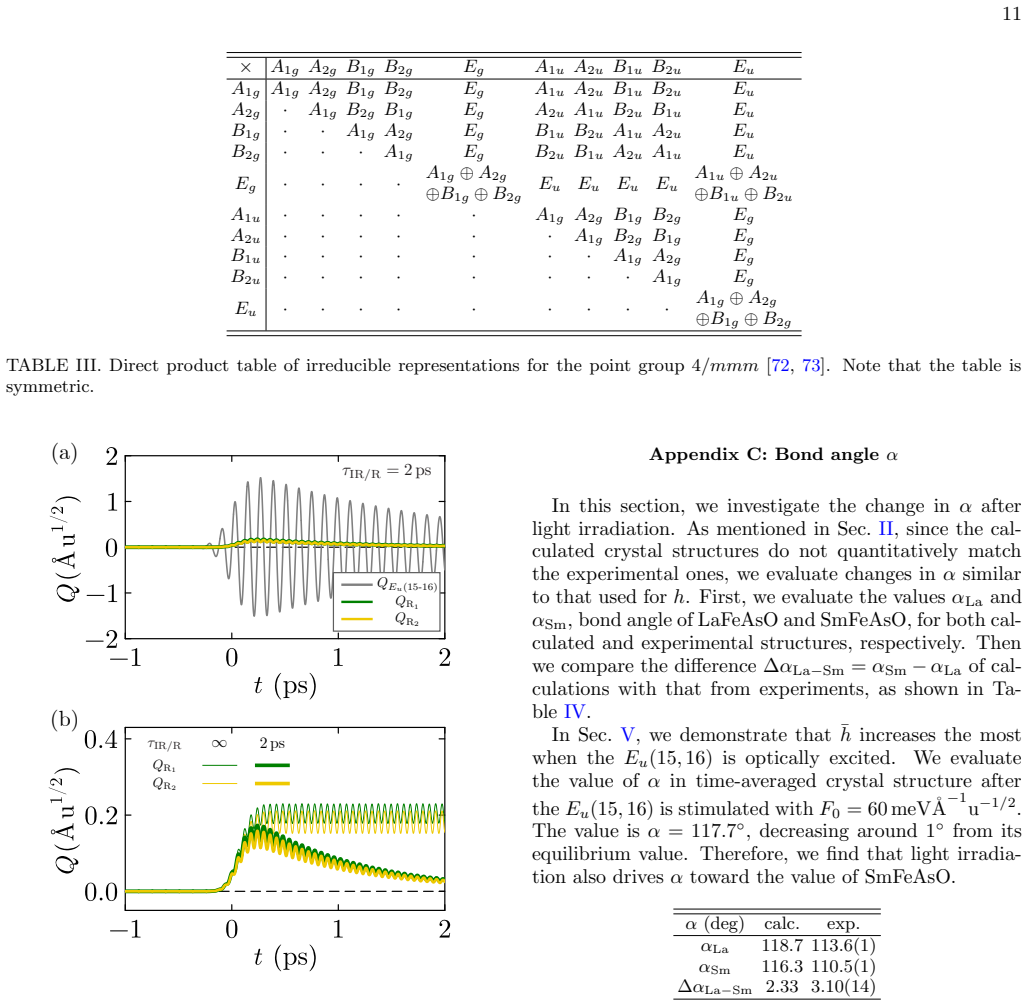
Atomic Displacements The relationship between the Γ point phonon normal coordinateQ α for modeαand the displacement vector Uα,j for atomjis expressed as Uα,j = Qα √mj eα,j,(6) wherem j is the mass of atomjande α,j is the dimen- sionless eigenvector of the phonon mode. B. Results: Time evolution of phonon modes Here, we show the time evolution of the phono...
-
[2]
Y. Zhai, P. Gong, J. Hasaien, F. Zhou, and J. Zhao, Co- herent phonons in correlated quantum materials, Prog. Surf. Sci.99, 100761 (2024)
work page 2024
-
[3]
A. A. Maradudin and R. F. Wallis, Ionic raman effect. I. scattering by localized vibration modes, Phys. Rev. B2, 4294 (1970)
work page 1970
-
[4]
R. F. Wallis and A. A. Maradudin, Ionic raman effect. II. the first-order ionic raman effect, Phys. Rev. B3, 2063 (1971)
work page 2063
-
[5]
M. F¨ orst, C. Manzoni, S. Kaiser, Y. Tomioka, Y. Tokura, R. Merlin, and A. Cavalleri, Nonlinear phononics as an ultrafast route to lattice control, Nat. Phys.7, 854 (2011)
work page 2011
-
[6]
M. F¨ orst, R. I. Tobey, S. Wall, H. Bromberger, V. Khanna, A. L. Cavalieri, Y.-D. Chuang, W. S. Lee, R. Moore, W. F. Schlotter, J. J. Turner, O. Krupin, M. Trigo, H. Zheng, J. F. Mitchell, S. S. Dhesi, J. P. Hill, and A. Cavalleri, Driving magnetic order in a man- ganite by ultrafast lattice excitation, Phys. Rev. B84, 241104 (2011)
work page 2011
-
[7]
M. F¨ orst, R. Mankowsky, H. Bromberger, D. Fritz, H. Lemke, D. Zhu, M. Chollet, Y. Tomioka, Y. Tokura, R. Merlin, J. Hill, S. Johnson, and A. Cavalleri, Dis- placive lattice excitation through nonlinear phononics viewed by femtosecond x-ray diffraction, Solid State Commun.169, 24 (2013)
work page 2013
-
[8]
Subedi, Proposal for ultrafast switching of ferro- electrics using midinfrared pulses, Phys
A. Subedi, Proposal for ultrafast switching of ferro- electrics using midinfrared pulses, Phys. Rev. B92, 214303 (2015)
work page 2015
-
[9]
R. Mankowsky, A. von Hoegen, M. F¨ orst, and A. Cav- alleri, Ultrafast reversal of the ferroelectric polarization, Phys. Rev. Lett.118, 197601 (2017)
work page 2017
-
[10]
M. Fechner, M. F¨ orst, G. Orenstein, V. Krapivin, A. S. Disa, M. Buzzi, A. von Hoegen, G. de la Pena, Q. L. Nguyen, R. Mankowsky, M. Sander, H. Lemke, Y. Deng, M. Trigo, and A. Cavalleri, Quenched lattice fluctuations in optically driven SrTiO 3, Nat. Mater.23, 363 (2024)
work page 2024
- [11]
-
[12]
D. M. Juraschek, M. Fechner, and N. A. Spaldin, Ul- trafast structure switching through nonlinear phononics, Phys. Rev. Lett.118(2017)
work page 2017
- [13]
-
[14]
A. S. Disa, M. Fechner, T. F. Nova, B. Liu, M. F¨ orst, D. Prabhakaran, P. G. Radaelli, and A. Cavalleri, Po- larizing an antiferromagnet by optical engineering of the crystal field, Nat. Phys.16, 937 (2020)
work page 2020
-
[15]
Zeng, Nonlinear phononic coupling in antiferromag- netic monolayer MnPS 3, Phys
Y. Zeng, Nonlinear phononic coupling in antiferromag- netic monolayer MnPS 3, Phys. Rev. B108, 054308 (2023)
work page 2023
-
[16]
R. Tang, F. Boi, and Y.-H. Cheng, Light-induced topo- logical phase transition via nonlinear phononics in super- conductor CsV3Sb5, npj Quantum Mater.8, 78 (2023)
work page 2023
-
[17]
T. G. H. Blank, K. A. Grishunin, K. A. Zvezdin, N. T. Hai, J. C. Wu, S.-H. Su, J.-C. A. Huang, A. K. Zvezdin, and A. V. Kimel, Two-dimensional terahertz spectroscopy of nonlinear phononics in the topological in- sulator MnBi2Te4, Phys. Rev. Lett.131, 026902 (2023)
work page 2023
- [18]
-
[19]
R. Mankowsky, A. Subedi, M. F¨ orst, S. O. Mariager, M. Chollet, H. T. Lemke, J. S. Robinson, J. M. Glow- nia, M. P. Minitti, A. Frano, M. Fechner, N. A. Spaldin, T. Loew, B. Keimer, A. Georges, and A. Cavalleri, Non- linear lattice dynamics as a basis for enhanced supercon- ductivity in YBa 2Cu3O6.5, Nature516, 71 (2014)
work page 2014
-
[20]
R. Mankowsky, M. F¨ orst, T. Loew, J. Porras, B. Keimer, and A. Cavalleri, Coherent modulation of the YBa2Cu3o6+x atomic structure by displacive stimulated ionic raman scattering, Phys. Rev. B91, 094308 (2015)
work page 2015
-
[21]
M. Fechner and N. A. Spaldin, Effects of intense optical phonon pumping on the structure and electronic proper- ties of yttrium barium copper oxide, Phys. Rev. B94, 134307 (2016)
work page 2016
-
[22]
D. M. Juraschek, T. Neuman, J. Flick, and P. Narang, Cavity control of nonlinear phononics, Phys. Rev. Res. 3, L032046 (2021)
work page 2021
-
[23]
A. S. Disa, T. F. Nova, and A. Cavalleri, Engineering crystal structures with light, Nat. Phys.17, 1087 (2021)
work page 2021
-
[24]
Subedi, Light-control of materials via nonlinear phononics, C
A. Subedi, Light-control of materials via nonlinear phononics, C. R. Phys.22, 161 (2021)
work page 2021
-
[25]
S. Kamiyama, T. Kaneko, K. Kuroki, and M. Ochi, Opti- cal control of the crystal structure in the bilayer nickelate superconductor La3Ni2O7 via nonlinear phononics, Phys. Rev. B112, 094115 (2025)
work page 2025
-
[26]
M. Rini, R. Tobey, N. Dean, J. Itatani, Y. Tomioka, Y. Tokura, R. W. Schoenlein, and A. Cavalleri, Control of the electronic phase of a manganite by mode-selective vibrational excitation, Nature449, 72 (2007)
work page 2007
-
[27]
W. Hu, S. Kaiser, D. Nicoletti, C. R. Hunt, I. Gierz, M. C. Hoffmann, M. Le Tacon, T. Loew, B. Keimer, and A. Cavalleri, Optically enhanced coherent transport in YBa 2Cu3O6.5 by ultrafast redistribution of interlayer coupling, Nat. Mater.13, 705 (2014)
work page 2014
- [28]
-
[29]
S. Fava, G. De Vecchi, G. Jotzu, M. Buzzi, T. Gebert, Y. Liu, B. Keimer, and A. Cavalleri, Magnetic field ex- pulsion in optically driven YBa 2Cu3O6.48, Nature632, 75 (2024)
work page 2024
-
[30]
M. Rosenberg, D. Nicoletti, M. Buzzi, A. Iudica, C. Putzke, Y. Liu, B. Keimer, and A. Cavalleri, Signa- tures of three-dimensional photoinduced superconductiv- ity in YBa 2Cu3O6.48, Phys. Rev. B112, 214522 (2025)
work page 2025
-
[31]
H. Sakakibara, H. Usui, K. Kuroki, R. Arita, and H. Aoki, Two-orbital model explains the higher transition temper- ature of the single-layer Hg-cuprate superconductor com- pared to that of the La-cuprate superconductor, Phys. Rev. Lett.105, 057003 (2010)
work page 2010
-
[32]
H. Sun, M. Huo, X. Hu, J. Li, Z. Liu, Y. Han, L. Tang, Z. Mao, P. Yang, B. Wang, J. Cheng, D.-X. Yao, G.-M. Zhang, and M. Wang, Signatures of superconductivity near 80 K in a nickelate under high pressure, Nature621, 493 (2023)
work page 2023
-
[33]
For a review, see, e.g., H. Hosono and K. Kuroki, Iron- based superconductors: Current status of materials and pairing mechanism, Physica C514, 399 (2015)
work page 2015
-
[34]
Y. Kamihara, T. Watanabe, M. Hirano, and H. Hosono, Iron-based layered superconductor La[O1 –x Fx]FeAs (x= 0.05−0.12) withT c = 26 K, J. Am. Chem. Soc.130, 3296 (2008)
work page 2008
- [35]
- [36]
-
[37]
C.-H. Lee, A. Iyo, H. Eisaki, H. Kito, M. Teresa Fernandez-Diaz, T. Ito, K. Kihou, H. Matsuhata, M. Braden, and K. Yamada, Effect of structural parameters on superconductivity in fluorine-free LnFeAsO1 –y (Ln= La, Nd), J. Phys. Soc. Jpn77, 083704 (2008)
work page 2008
- [38]
-
[39]
Y. Mizuguchi, Y. Hara, K. Deguchi, S. Tsuda, T. Yam- aguchi, K. Takeda, H. Kotegawa, H. Tou, and Y. Takano, Anion height dependence ofT c for the Fe-based super- conductor, Supercond. Sci. Technol.23, 054013 (2010)
work page 2010
- [40]
-
[41]
K. Okazaki, H. Suzuki, T. Suzuki, T. Yamamoto, T. Someya, Y. Ogawa, M. Okada, M. Fujisawa, T. Kanai, N. Ishii, J. Itatani, M. Nakajima, H. Eisaki, A. Fuji- mori, and S. Shin, Antiphase Fermi-surface modulations accompanying displacement excitation in a parent com- pound of iron-based superconductors, Phys. Rev. B97, 121107 (2018)
work page 2018
-
[42]
T. Suzuki, T. Someya, T. Hashimoto, S. Michimae, M. Watanabe, M. Fujisawa, T. Kanai, N. Ishii, J. Itatani, S. Kasahara, Y. Matsuda, T. Shibauchi, K. Okazaki, and S. Shin, Photoinduced possible superconducting state with long-lived disproportionate band filling in fese, Commun. Phys.2, 115 (2019). 14
work page 2019
-
[43]
K. Isoyama, N. Yoshikawa, K. Katsumi, J. Wong, N. Shikama, Y. Sakishita, F. Nabeshima, A. Maeda, and R. Shimano, Light-induced enhancement of superconduc- tivity in iron-based superconductor FeSe 0.5Te0.5, Com- mun. Phys.4, 160 (2021)
work page 2021
-
[44]
H. J. Zeiger, J. Vidal, T. K. Cheng, E. P. Ippen, G. Dres- selhaus, and M. S. Dresselhaus, Theory for displacive excitation of coherent phonons, Phys. Rev. B45, 768 (1992)
work page 1992
-
[45]
S. Gerber, K. W. Kim, Y. Zhang, D. Zhu, N. Plonka, M. Yi, G. L. Dakovski, D. Leuenberger, P. S. Kirchmann, R. G. Moore, M. Chollet, J. M. Glownia, Y. Feng, J.-S. Lee, A. Mehta, A. F. Kemper, T. Wolf, Y.-D. Chuang, Z. Hussain, C.-C. Kao, B. Moritz, Z.-X. Shen, T. P. De- vereaux, and W.-S. Lee, Direct characterization of pho- toinduced lattice dynamics in B...
work page 2015
- [46]
-
[47]
S. Kasahara, T. Watashige, T. Hanaguri, Y. Kohsaka, T. Yamashita, Y. Shimoyama, Y. Mizukami, R. Endo, H. Ikeda, K. Aoyama, T. Terashima, S. Uji, T. Wolf, H. von L¨ ohneysen, T. Shibauchi, and Y. Matsuda, Field- induced superconducting phase of fese in the bcs-bec cross-over, Proc. Natl. Acad. Sci.111, 16309 (2014)
work page 2014
-
[48]
K. Momma and F. Izumi,VESTA3for three-dimensional visualization of crystal, volumetric and morphology data, J. Appl. Cryst.44, 1272 (2011)
work page 2011
-
[49]
J. P. Perdew, K. Burke, and M. Ernzerhof, Generalized gradient approximation made simple, Phys. Rev. Lett. 77, 3865 (1996)
work page 1996
-
[50]
G. Kresse and J. Hafner, Ab initio molecular dynamics for liquid metals, Phys. Rev. B47, 558 (1993)
work page 1993
-
[51]
G. Kresse and J. Hafner, Ab initio molecular-dynamics simulation of the liquid-metal–amorphous-semiconductor transition in germanium, Phys. Rev. B49, 14251 (1994)
work page 1994
-
[52]
G. Kresse and J. Furthm¨ uller, Efficiency of ab-initio total energy calculations for metals and semiconductors using a plane-wave basis set, Comput. Mater. Sci.6, 15 (1996)
work page 1996
-
[53]
G. Kresse and J. Furthm¨ uller, Efficient iterative schemes for ab initio total-energy calculations using a plane-wave basis set, Phys. Rev. B54, 11169 (1996)
work page 1996
-
[54]
G. Kresse and D. Joubert, From ultrasoft pseudopoten- tials to the projector augmented-wave method, Phys. Rev. B59, 1758 (1999)
work page 1999
-
[55]
I. I. Mazin, M. D. Johannes, L. Boeri, K. Koepernik, and D. J. Singh, Problems with reconciling density func- tional theory calculations with experiment in ferropnic- tides, Phys. Rev. B78, 085104 (2008)
work page 2008
-
[56]
A. Martinelli, M. Ferretti, P. Manfrinetti, A. Palenzona, M. Tropeano, M. R. Cimberle, C. Ferdeghini, R. Valle, C. Bernini, M. Putti, and A. S. Siri, Synthesis, crystal structure, microstructure, transport and magnetic prop- erties of SmFeAsO and SmFeAs(O 0.93F0.07), Supercond. Sci. Technol.21, 095017 (2008)
work page 2008
-
[57]
A. Togo, L. Chaput, T. Tadano, and I. Tanaka, Imple- mentation strategies in phonopy and phono3py, J. Phys.: Condens. Matter35, 353001 (2023)
work page 2023
-
[58]
Togo, First-principles phonon calculations with phonopy and phono3py, J
A. Togo, First-principles phonon calculations with phonopy and phono3py, J. Phys. Soc. Jpn.92, 012001 (2023)
work page 2023
-
[59]
TheE u(15) andE u(16) modes correspond to displace- ments along theaandbaxes, respectively
-
[60]
The different sign ofg IR−R between R 1 and R 2 modes likely originates from the difference in the directions of La atomic displacements between the two Raman modes
-
[61]
The values ofg A2u(6)−R1,g A2u(6)−R2,g Eu(4,5)−R1, gEu(4,5)−R2 are 2.48×10 −1,−4.13,−2.40×10 −2,−3.71 meV ˚A−3 u−3/2, respectively
-
[62]
If the external field is applied in a direction not parallel to thecaxis, the projection of its amplitude onto thec axis plays the role ofF 0 in Eq. (4)
-
[63]
For a time-evolution dataX(t), we evaluate a time average of after light irradiation in the time domain [tmin, tmax] as follows: ¯X= 1 tmax −t min Z tmax tmin dt′ Z t′ tmin dt X(t) t′ −t min , where the time average overt∈[t min, t′] is again time- averaged overt ′ ∈[t min, tmax]. While the first time av- erage, R t′ tmin dt X(t) t′−tmin , exhibits a deca...
-
[64]
P. J. Hirschfeld, M. M. Korshunov, and I. I. Mazin, Gap symmetry and structure of fe-based superconduc- tors, Rep. Prog. Phys.74, 124508 (2011)
work page 2011
-
[65]
Y. Bang, Pairing mechanism of heavily electron doped fese systems: dynamical tuning of the pairing cutoff en- ergy, New J. Phys.18, 113054 (2016)
work page 2016
- [66]
-
[67]
Bang, Phonon boost effect on thes±-wave supercon- ductor with incipient band, Sci
Y. Bang, Phonon boost effect on thes±-wave supercon- ductor with incipient band, Sci. Rep.9, 3907 (2019)
work page 2019
- [68]
-
[69]
O. Bistoni, P. Barone, E. Cappelluti, L. Benfatto, and F. Mauri, Giant effective charges and piezoelectricity in gapped graphene, 2D Mater.6, 045015 (2019)
work page 2019
- [70]
-
[71]
C. E. Dreyer, S. Coh, and M. Stengel, Nonadiabatic born effective charges in metals and the drude weight, Phys. Rev. Lett.128, 095901 (2022)
work page 2022
-
[72]
C.-Y. Wang, S. Sharma, E. K. U. Gross, and J. K. De- whurst, Dynamical born effective charges, Phys. Rev. B 106, L180303 (2022)
work page 2022
-
[73]
C. J. Bradley and A. P. Cracknell,The mathematical theory of symmetry in solids : representation theory for point groups and space groups(Clarendon Press, 1972)
work page 1972
-
[74]
S. L. Altmann and P. Herzig,Point-group Theory Tables (Clarendon Press, 1994)
work page 1994
discussion (0)
Sign in with ORCID, Apple, or X to comment. Anyone can read and Pith papers without signing in.