FedDAP: Domain-Aware Prototype Learning for Federated Learning under Domain Shift
Pith reviewed 2026-05-10 17:54 UTC · model grok-4.3
The pith
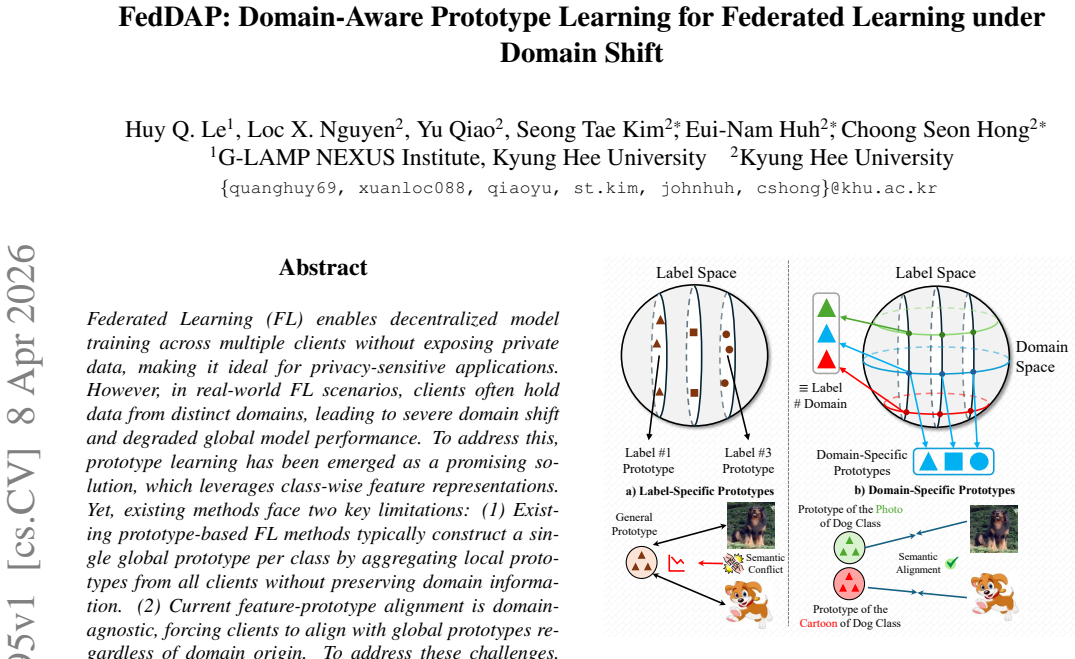
FedDAP builds domain-specific prototypes by fusing same-domain client prototypes to align features and improve generalization in federated learning under domain shift.
A machine-rendered reading of the paper's core claim, the machinery that carries it, and where it could break.
Core claim
The central claim is that domain-specific global prototypes formed by similarity-weighted aggregation of local prototypes from clients in the same domain, when used for same-domain feature alignment and cross-domain separation during local training, overcome the loss of domain information in single global prototypes and the domain-agnostic alignment of prior methods, yielding better performance under domain shift.
What carries the argument
Similarity-weighted fusion to create domain-specific global prototypes, followed by dual alignment that pulls local features toward same-domain prototypes and repels them from different-domain prototypes.
If this is right
- Single global prototypes per class are replaced by multiple domain-specific ones to retain domain structure.
- Local training gains from explicit same-domain alignment and cross-domain separation.
- The global model generalizes across diverse domains without sacrificing local domain knowledge.
- Extensive tests on DomainNet, Office-10, and PACS confirm gains over prior prototype-based federated approaches.
Where Pith is reading between the lines
- When domain labels are absent, the method would need pairing with unsupervised clustering to identify groups before fusion.
- Prototype sharing could reduce communication volume compared with exchanging full model updates in some federated setups.
- The same dual-alignment idea might extend to other forms of data heterogeneity such as class imbalance or temporal shifts.
Load-bearing premise
Domain labels or reliable clustering information must exist to correctly group clients when aggregating prototypes.
What would settle it
An experiment that removes domain labels, applies random client grouping, and shows no gain or actual loss versus standard single-prototype federated methods would disprove the benefit of domain-aware construction.
Figures


read the original abstract
Federated Learning (FL) enables decentralized model training across multiple clients without exposing private data, making it ideal for privacy-sensitive applications. However, in real-world FL scenarios, clients often hold data from distinct domains, leading to severe domain shift and degraded global model performance. To address this, prototype learning has been emerged as a promising solution, which leverages class-wise feature representations. Yet, existing methods face two key limitations: (1) Existing prototype-based FL methods typically construct a $\textit{single global prototype}$ per class by aggregating local prototypes from all clients without preserving domain information. (2) Current feature-prototype alignment is $\textit{domain-agnostic}$, forcing clients to align with global prototypes regardless of domain origin. To address these challenges, we propose Federated Domain-Aware Prototypes (FedDAP) to construct domain-specific global prototypes by aggregating local client prototypes within the same domain using a similarity-weighted fusion mechanism. These global domain-specific prototypes are then used to guide local training by aligning local features with prototypes from the same domain, while encouraging separation from prototypes of different domains. This dual alignment enhances domain-specific learning at the local level and enables the global model to generalize across diverse domains. Finally, we conduct extensive experiments on three different datasets: DomainNet, Office-10, and PACS to demonstrate the effectiveness of our proposed framework to address the domain shift challenges. The code is available at https://github.com/quanghuy6997/FedDAP.
Editorial analysis
A structured set of objections, weighed in public.
Referee Report
Summary. The paper proposes Federated Domain-Aware Prototypes (FedDAP) for federated learning under domain shift. It identifies two limitations in prior prototype-based FL methods: construction of a single global prototype per class that discards domain information, and domain-agnostic feature-prototype alignment. FedDAP constructs domain-specific global prototypes by aggregating local client prototypes within the same domain via a similarity-weighted fusion mechanism. These prototypes then supervise local training through same-domain attraction and cross-domain repulsion. The method is evaluated on DomainNet, Office-10, and PACS, with code released at https://github.com/quanghuy6997/FedDAP.
Significance. If the reported gains hold under the stated conditions, FedDAP offers a concrete way to preserve domain structure inside prototype-based FL without raw data sharing. The public code release is a clear strength that enables direct reproduction and extension. The approach sits within the active line of work on personalized and domain-aware FL, but its practical reach is constrained by the domain-grouping requirement.
major comments (3)
- [§3] §3 (Method): The central aggregation step constructs domain-specific prototypes by 'aggregating local client prototypes within the same domain using a similarity-weighted fusion mechanism.' This presupposes either explicit per-client domain labels or a reliable unsupervised clustering procedure that recovers domain structure from prototype similarities alone. The subsequent local alignment (same-domain attraction + cross-domain repulsion) inherits the same grouping. The manuscript does not specify how 'same domain' is determined when labels are unavailable, which is load-bearing for the claim that FedDAP handles realistic domain shift.
- [§4] §4 (Experiments): All reported datasets (DomainNet, Office-10, PACS) are partitioned by predefined domain labels, so the evaluation never probes the failure mode in which clients hold mixed-domain data or domain labels are absent. An ablation that removes or corrupts domain grouping information would be required to substantiate the method's robustness beyond the supervised-domain setting.
- [§3.2] §3.2 (similarity-weighted fusion): The similarity weight is listed as a free hyper-parameter. No sensitivity analysis, default-value justification, or ablation on its effect on prototype quality or final accuracy is provided, leaving open whether performance gains are stable or require per-dataset tuning that is not available in true FL deployments.
minor comments (1)
- [Abstract] The abstract contains a minor grammatical issue ('prototype learning has been emerged') that should be corrected in the final version.
Simulated Author's Rebuttal
We thank the referee for the constructive comments on FedDAP. We address each major point below, clarifying assumptions, agreeing where revisions are needed, and outlining changes to the manuscript.
read point-by-point responses
-
Referee: [§3] §3 (Method): The central aggregation step constructs domain-specific prototypes by 'aggregating local client prototypes within the same domain using a similarity-weighted fusion mechanism.' This presupposes either explicit per-client domain labels or a reliable unsupervised clustering procedure that recovers domain structure from prototype similarities alone. The subsequent local alignment (same-domain attraction + cross-domain repulsion) inherits the same grouping. The manuscript does not specify how 'same domain' is determined when labels are unavailable, which is load-bearing for the claim that FedDAP handles realistic domain shift.
Authors: We agree the manuscript should explicitly state the domain-grouping assumption. FedDAP is designed for settings where domain labels or client groupings are available (standard in domain-shift FL benchmarks like those used here). When labels are absent, prototype-based clustering could infer groups, but this is not part of the core method and was not implemented. We will revise §3 to clearly articulate this requirement and discuss it as a scope limitation rather than claiming unsupervised domain recovery. revision: partial
-
Referee: [§4] §4 (Experiments): All reported datasets (DomainNet, Office-10, PACS) are partitioned by predefined domain labels, so the evaluation never probes the failure mode in which clients hold mixed-domain data or domain labels are absent. An ablation that removes or corrupts domain grouping information would be required to substantiate the method's robustness beyond the supervised-domain setting.
Authors: The referee is correct that evaluations use standard predefined partitions. To address this, we will add an ablation in the revised experiments that corrupts domain labels or mixes domains within clients, measuring performance degradation. This will better illustrate the method's dependence on accurate grouping while retaining the main results on the original benchmarks. revision: yes
-
Referee: [§3.2] §3.2 (similarity-weighted fusion): The similarity weight is listed as a free hyper-parameter. No sensitivity analysis, default-value justification, or ablation on its effect on prototype quality or final accuracy is provided, leaving open whether performance gains are stable or require per-dataset tuning that is not available in true FL deployments.
Authors: We acknowledge the lack of analysis for this hyper-parameter. In the revision we will include a sensitivity study varying the weight across a range of values, report its effect on accuracy and prototype quality for all three datasets, and justify the default value used in the main experiments. revision: yes
Circularity Check
No significant circularity; constructive method with external validation
full rationale
The paper presents FedDAP as an algorithmic proposal for domain-aware prototype aggregation and alignment in federated learning. No equations reduce claimed performance gains to fitted parameters or self-referential definitions from the same data. The method is validated through experiments on DomainNet, Office-10, and PACS rather than being forced by construction. Assumptions about domain grouping are stated as part of the framework but do not create a self-definitional loop or load-bearing self-citation chain. This is a standard constructive contribution without the enumerated circularity patterns.
Axiom & Free-Parameter Ledger
free parameters (1)
- similarity weight parameter
axioms (1)
- domain assumption Clients can be partitioned or clustered into domains for prototype aggregation
invented entities (1)
-
domain-specific global prototypes
no independent evidence
Reference graph
Works this paper leans on
-
[1]
Fed- erated learning based on dynamic regularization
Durmus Alp Emre Acar, Yue Zhao, Ramon Matas, Matthew Mattina, Paul Whatmough, and Venkatesh Saligrama. Fed- erated learning based on dynamic regularization. InInterna- tional Conference on Learning Representations, 2021. 2
work page 2021
-
[2]
A tutorial on the cross-entropy method.Annals of operations research, 134(1):19–67, 2005
Pieter-Tjerk De Boer, Dirk P Kroese, Shie Mannor, and Reuven Y Rubinstein. A tutorial on the cross-entropy method.Annals of operations research, 134(1):19–67, 2005. 5
work page 2005
-
[3]
Junyu Gao, Xinhong Ma, and Changsheng Xu. Learning transferable conceptual prototypes for interpretable unsuper- vised domain adaptation.IEEE Transactions on Image Pro- cessing, 2024. 3
work page 2024
-
[4]
Geodesic flow kernel for unsupervised domain adaptation
Boqing Gong, Yuan Shi, Fei Sha, and Kristen Grauman. Geodesic flow kernel for unsupervised domain adaptation. In2012 IEEE conference on computer vision and pattern recognition, pages 2066–2073. IEEE, 2012. 5
work page 2066
-
[5]
Preserving privacy in federated learning with ensemble cross-domain knowledge distillation
Xuan Gong, Abhishek Sharma, Srikrishna Karanam, Ziyan Wu, Terrence Chen, David Doermann, and Arun Innanje. Preserving privacy in federated learning with ensemble cross-domain knowledge distillation. InProceedings of the AAAI Conference on Artificial Intelligence, pages 11891– 11899, 2022. 2
work page 2022
-
[6]
Deep residual learning for image recognition
Kaiming He, Xiangyu Zhang, Shaoqing Ren, and Jian Sun. Deep residual learning for image recognition. InProceed- ings of the IEEE conference on computer vision and pattern recognition, pages 770–778, 2016. 6
work page 2016
-
[7]
Rethinking federated learning with domain shift: A proto- type view
Wenke Huang, Mang Ye, Zekun Shi, He Li, and Bo Du. Rethinking federated learning with domain shift: A proto- type view. In2023 IEEE/CVF Conference on Computer Vi- sion and Pattern Recognition (CVPR), pages 16312–16322. IEEE, 2023. 2, 6, 1
work page 2023
-
[8]
Wenke Huang, Mang Ye, Zekun Shi, Guancheng Wan, He Li, Bo Du, and Qiang Yang. Federated learning for general- ization, robustness, fairness: A survey and benchmark.IEEE Transactions on Pattern Analysis and Machine Intelligence,
-
[9]
Scaffold: Stochastic controlled averaging for feder- ated learning
Sai Praneeth Karimireddy, Satyen Kale, Mehryar Mohri, Sashank Reddi, Sebastian Stich, and Ananda Theertha Suresh. Scaffold: Stochastic controlled averaging for feder- ated learning. InInternational conference on machine learn- ing, pages 5132–5143. PMLR, 2020. 2
work page 2020
-
[10]
Efficiently assemble normalization layers and regularization for federated domain generalization
Khiem Le, Long Ho, Cuong Do, Danh Le-Phuoc, and Kok- Seng Wong. Efficiently assemble normalization layers and regularization for federated domain generalization. InPro- ceedings of the IEEE/CVF Conference on Computer Vision and Pattern Recognition, pages 6027–6036, 2024. 2
work page 2024
-
[11]
Joohyung Lee, Faranaksadat Solat, Tae Yeon Kim, and H Vincent Poor. Federated learning-empowered mobile net- work management for 5g and beyond networks: From access to core.IEEE Communications Surveys & Tutorials, 26(3): 2176–2212, 2024. 1
work page 2024
-
[12]
Deeper, broader and artier domain generaliza- tion
Da Li, Yongxin Yang, Yi-Zhe Song, and Timothy M Hospedales. Deeper, broader and artier domain generaliza- tion. InProceedings of the IEEE international conference on computer vision, pages 5542–5550, 2017. 5
work page 2017
-
[13]
Model- contrastive federated learning
Qinbin Li, Bingsheng He, and Dawn Song. Model- contrastive federated learning. InProceedings of the IEEE/CVF conference on computer vision and pattern recognition, pages 10713–10722, 2021. 6, 1
work page 2021
-
[14]
Fed- erated learning on non-iid data silos: An experimental study
Qinbin Li, Yiqun Diao, Quan Chen, and Bingsheng He. Fed- erated learning on non-iid data silos: An experimental study. In2022 IEEE 38th international conference on data engi- neering (ICDE), pages 965–978. IEEE, 2022. 1
work page 2022
-
[15]
Tian Li, Anit Kumar Sahu, Manzil Zaheer, Maziar Sanjabi, Ameet Talwalkar, and Virginia Smith. Federated optimiza- tion in heterogeneous networks.Proceedings of Machine learning and systems, 2:429–450, 2020. 1, 2, 6
work page 2020
-
[16]
FedBN: Federated learning on non-IID features via local batch normalization
Xiaoxiao Li, Meirui JIANG, Xiaofei Zhang, Michael Kamp, and Qi Dou. FedBN: Federated learning on non-IID features via local batch normalization. InInternational Conference on Learning Representations, 2021. 2
work page 2021
-
[17]
Quande Liu, Cheng Chen, Jing Qin, Qi Dou, and Pheng-Ann Heng. Feddg: Federated domain generalization on medical image segmentation via episodic learning in continuous fre- quency space. InProceedings of the IEEE/CVF conference on computer vision and pattern recognition, pages 1013– 1023, 2021. 2
work page 2021
-
[18]
Shijie Ma, Fei Zhu, Xu-Yao Zhang, and Cheng-Lin Liu. Pro- togcd: Unified and unbiased prototype learning for general- ized category discovery.IEEE Transactions on Pattern Anal- ysis and Machine Intelligence, 2025. 3
work page 2025
-
[19]
Communication- efficient learning of deep networks from decentralized data
Brendan McMahan, Eider Moore, Daniel Ramage, Seth Hampson, and Blaise Aguera y Arcas. Communication- efficient learning of deep networks from decentralized data. InArtificial intelligence and statistics, pages 1273–1282. PMLR, 2017. 1, 6
work page 2017
-
[20]
Federated learning for smart health- care: A survey.ACM Computing Surveys (Csur), 55(3):1– 37, 2022
Dinh C Nguyen, Quoc-Viet Pham, Pubudu N Pathirana, Ming Ding, Aruna Seneviratne, Zihuai Lin, Octavia Dobre, and Won-Joo Hwang. Federated learning for smart health- care: A survey.ACM Computing Surveys (Csur), 55(3):1– 37, 2022. 1
work page 2022
-
[21]
Moment matching for multi-source domain adaptation
Xingchao Peng, Qinxun Bai, Xide Xia, Zijun Huang, Kate Saenko, and Bo Wang. Moment matching for multi-source domain adaptation. InProceedings of the IEEE/CVF inter- national conference on computer vision, pages 1406–1415,
-
[22]
Yu Qiao, Md Shirajum Munir, Apurba Adhikary, Huy Q Le, Avi Deb Raha, Chaoning Zhang, and Choong Seon Hong. Mp-fedcl: Multi-prototype federated contrastive learning for edge intelligence.IEEE Internet of Things journal, 2023. 2, 3
work page 2023
-
[23]
Sashank J. Reddi, Zachary Charles, Manzil Zaheer, Zachary Garrett, Keith Rush, Jakub Kone ˇcn´y, Sanjiv Kumar, and Hugh Brendan McMahan. Adaptive federated optimization. InInternational Conference on Learning Representations,
-
[24]
Fedproto: Federated proto- type learning across heterogeneous clients
Yue Tan, Guodong Long, Lu Liu, Tianyi Zhou, Qinghua Lu, Jing Jiang, and Chengqi Zhang. Fedproto: Federated proto- type learning across heterogeneous clients. InProceedings of the AAAI Conference on Artificial Intelligence, pages 8432– 8440, 2022. 2, 3, 6, 1
work page 2022
-
[25]
Yue Tan, Guodong Long, Jie Ma, Lu Liu, Tianyi Zhou, and Jing Jiang. Federated learning from pre-trained models: A contrastive learning approach.Advances in neural informa- tion processing systems, 35:19332–19344, 2022. 3
work page 2022
-
[26]
Federated learning with matched averaging
Hongyi Wang, Mikhail Yurochkin, Yuekai Sun, Dimitris Pa- pailiopoulos, and Yasaman Khazaeni. Federated learning with matched averaging. InInternational Conference on Learning Representations, 2020. 2
work page 2020
-
[27]
Lei Wang, Jieming Bian, Letian Zhang, Chen Chen, and Jie Xu. Taming cross-domain representation variance in feder- ated prototype learning with heterogeneous data domains. In The Thirty-eighth Annual Conference on Neural Information Processing Systems, 2024. 2, 3, 6, 1
work page 2024
-
[28]
Federated learning with domain shift eraser
Zheng Wang, Zihui Wang, Xiaoliang Fan, and Cheng Wang. Federated learning with domain shift eraser. InProceedings of the Computer Vision and Pattern Recognition Conference, pages 4978–4987, 2025. 2
work page 2025
-
[29]
Collaborative optimization and aggregation for decentralized domain generalization and adaptation
Guile Wu and Shaogang Gong. Collaborative optimization and aggregation for decentralized domain generalization and adaptation. InProceedings of the IEEE/CVF international conference on computer vision, pages 6484–6493, 2021. 6, 1
work page 2021
-
[30]
A simple data augmentation for feature distribution skewed federated learning
Yunlu Yan, Huazhu Fu, Yuexiang Li, Jinheng Xie, Jun Ma, Guang Yang, and Lei Zhu. A simple data augmentation for feature distribution skewed federated learning. InProceed- ings of the Computer Vision and Pattern Recognition Con- ference, pages 25749–25758, 2025. 2, 6, 1
work page 2025
-
[31]
Mang Ye, Xiuwen Fang, Bo Du, Pong C Yuen, and Dacheng Tao. Heterogeneous federated learning: State-of-the-art and research challenges.ACM Computing Surveys, 56(3):1–44,
-
[32]
Prototype completion with primitive knowledge for few-shot learning
Baoquan Zhang, Xutao Li, Yunming Ye, Zhichao Huang, and Lisai Zhang. Prototype completion with primitive knowledge for few-shot learning. InProceedings of the IEEE/CVF conference on computer vision and pattern recognition, pages 3754–3762, 2021. 3
work page 2021
-
[33]
Eliminating domain bias for federated learning in representation space
Jianqing Zhang, Yang Hua, Jian Cao, Hao Wang, Tao Song, Zhengui Xue, Ruhui Ma, and Haibing Guan. Eliminating domain bias for federated learning in representation space. InNeurIPS, 2023. 1
work page 2023
-
[34]
Jianqing Zhang, Yang Liu, Yang Hua, and Jian Cao. Fedtgp: Trainable global prototypes with adaptive-margin-enhanced contrastive learning for data and model heterogeneity in fed- erated learning. InProceedings of the AAAI conference on artificial intelligence, pages 16768–16776, 2024. 3
work page 2024
-
[35]
Jianqiao Zhang, Caifeng Shan, and Jungong Han. Fedgmkd: An efficient prototype federated learning framework through knowledge distillation and discrepancy-aware aggregation. Advances in Neural Information Processing Systems, 37: 118326–118356, 2024. 3
work page 2024
-
[36]
Federated domain general- ization with generalization adjustment
Ruipeng Zhang, Qinwei Xu, Jiangchao Yao, Ya Zhang, Qi Tian, and Yanfeng Wang. Federated domain general- ization with generalization adjustment. InProceedings of the IEEE/CVF Conference on Computer Vision and Pattern Recognition, pages 3954–3963, 2023. 2, 6, 1
work page 2023
-
[37]
Tailin Zhou, Jun Zhang, and Danny HK Tsang. Fedfa: Feder- ated learning with feature anchors to align features and clas- sifiers for heterogeneous data.IEEE Transactions on Mobile Computing, 23(6):6731–6742, 2023. 5
work page 2023
-
[38]
Yanbing Zhou, Xiangmou Qu, Chenlong You, Jiyang Zhou, Jingyue Tang, Xin Zheng, Chunmao Cai, and Yingbo Wu. Fedsa: A unified representation learning via semantic an- chors for prototype-based federated learning. InProceed- ings of the AAAI Conference on Artificial Intelligence, pages 23009–23017, 2025. 3 FedDAP: Domain-Aware Prototype Learning for Federate...
work page 2025
-
[39]
More Details 6.1. Details of Baselines We consider the following baselines in this work, including standard federated learning methods as well as advanced approaches specifically designed to address domain shift problem. •FedAvg[19] is the vanilla FL method that update the global model by iteratively averaging the local trained models. •FedProx[15] introd...
-
[40]
Efficiency Table 6 compares communication and computation costs on Office-10 dataset
Additional Results 7.1. Efficiency Table 6 compares communication and computation costs on Office-10 dataset. Introducing domain-specific global pro- totypes increases only thedownloadtraffic, since the server broadcasts one prototype per domain:Prototype down = D×Prototype up, whereDis the number of domains. This additional payload is negligible compared...
discussion (0)
Sign in with ORCID, Apple, or X to comment. Anyone can read and Pith papers without signing in.