MVOS_HSI: A Python Library for Preprocessing Agricultural Crop Hyperspectral Data
Pith reviewed 2026-05-10 16:54 UTC · model grok-4.3
The pith
MVOS_HSI is an open-source Python library that automates calibration, leaf segmentation, and augmentation of hyperspectral crop data.
A machine-rendered reading of the paper's core claim, the machinery that carries it, and where it could break.
Core claim
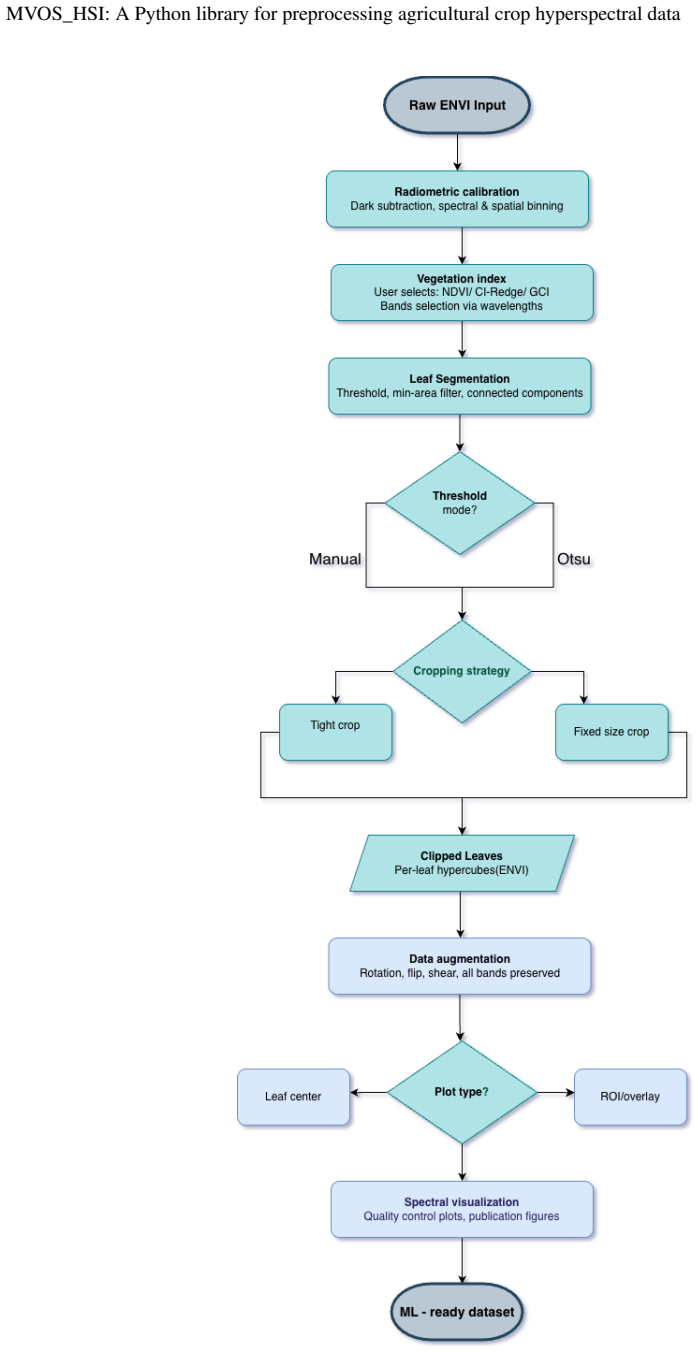
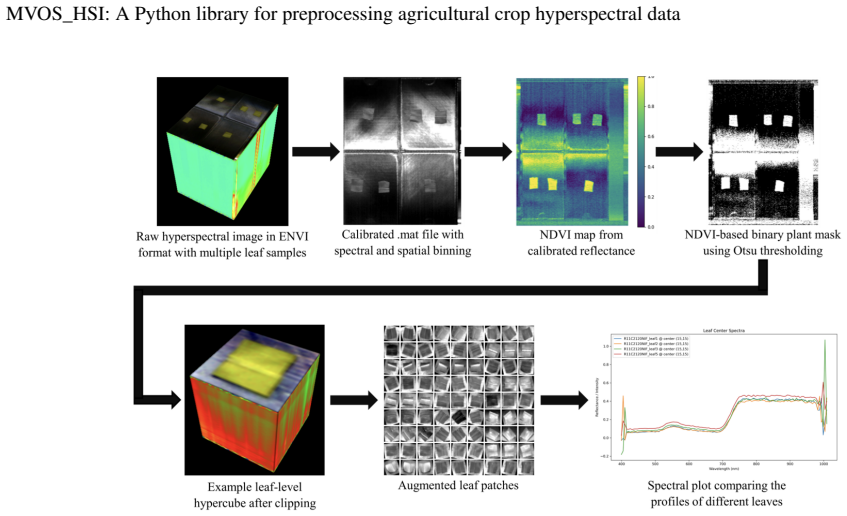
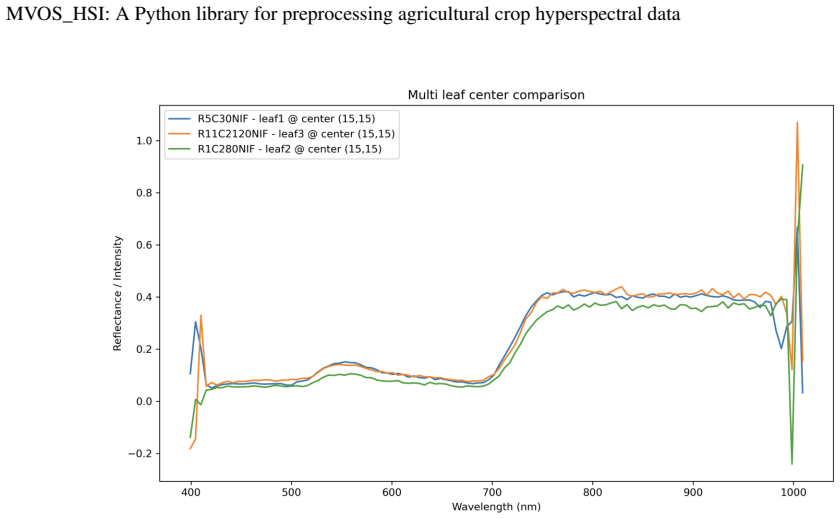
MVOS_HSI is an open-source Python library that provides an end-to-end workflow for processing leaf-level HSI data. The software handles everything from calibrating raw ENVI files to detecting and clipping individual leaves based on multiple vegetation indices (NDVI, CIRedEdge and GCI). It also includes tools for data augmentation to create training-time variations for machine learning and utilities to visualize spectral profiles. MVOS_HSI can be used as an importable Python library or run directly from the command line.
What carries the argument
The MVOS_HSI library, which links raw ENVI calibration, multi-index leaf detection and clipping, data augmentation, and spectral visualization into one package usable as code or command-line tool.
If this is right
- Researchers can run identical preprocessing steps on different datasets and obtain matching results.
- Built-in augmentation creates varied training examples directly from the processed leaves.
- Command-line access lets users without programming experience apply the full workflow.
- Spectral profile plots allow quick checks of data quality before machine learning or further analysis.
Where Pith is reading between the lines
- The same structure could support preprocessing of other spectral imaging types if the index-based detection is replaced with suitable alternatives.
- Making the package installable through standard Python channels would let labs adopt it with minimal setup effort.
- Adding options to export processed data in formats common to popular machine learning libraries would speed up model training pipelines.
Load-bearing premise
The leaf detection steps based on NDVI, CIRedEdge, and GCI will produce accurate segmentations for many crop species, growth stages, and imaging conditions without extra user changes.
What would settle it
Applying the library to hyperspectral images of a new crop species or under changed lighting and finding that the automatic leaf clipping does not match careful manual outlines would show the methods do not generalize.
Figures
read the original abstract
Hyperspectral imaging (HSI) allows researchers to study plant traits non-destructively. By capturing hundreds of narrow spectral bands per pixel, it reveals details about plant biochemistry and stress that standard cameras miss. However, processing this data is often challenging. Many labs still rely on loosely organized collections of lab-specific MATLAB or Python scripts, which makes workflows difficult to share and results difficult to reproduce. MVOS_HSI is an open-source Python library that provides an end-to-end workflow for processing leaf-level HSI data. The software handles everything from calibrating raw ENVI files to detecting and clipping individual leaves based on multiple vegetation indices (NDVI, CIRedEdge and GCI). It also includes tools for data augmentation to create training-time variations for machine learning and utilities to visualize spectral profiles. MVOS_HSI can be used as an importable Python library or run directly from the command line. The code and documentation are available on GitHub. By consolidating these common tasks into a single package, MVOS_HSI helps researchers produce consistent and reproducible results in plant phenotyping
Editorial analysis
A structured set of objections, weighed in public.
Referee Report
Summary. The manuscript presents MVOS_HSI, an open-source Python library that supplies an end-to-end workflow for preprocessing leaf-level hyperspectral imaging (HSI) data from agricultural crops. It covers calibration of raw ENVI files, leaf detection and clipping via vegetation indices (NDVI, CIRedEdge, GCI), data augmentation for machine-learning training, and spectral-profile visualization utilities. The package is usable both as an importable module and via command-line interface, with code and documentation available on GitHub to promote consistent, reproducible results in plant phenotyping.
Significance. If the implemented preprocessing steps function as described, the library would consolidate scattered lab-specific scripts into a single, openly available tool, thereby supporting reproducibility in hyperspectral crop analysis. The open-source release and dual library/CLI interface are concrete strengths that align with the stated goal of reducing workflow fragmentation.
major comments (1)
- [Leaf detection and clipping module description] The central claim that MVOS_HSI delivers a usable end-to-end workflow producing 'consistent and reproducible results' without 'additional user tuning' depends on the reliability of the leaf-detection routines. However, the manuscript provides no quantitative validation of the NDVI-, CIRedEdge-, and GCI-based segmentation: no IoU, Dice, precision/recall scores, no ground-truth leaf-mask comparisons, and no tests across crop species, growth stages, or illumination conditions. Standard index-thresholding methods are known to be sensitive to these factors; without such evidence the practical-utility assertion remains unsupported.
Simulated Author's Rebuttal
We thank the referee for their constructive and detailed review of our manuscript describing the MVOS_HSI library. We address the single major comment below and outline the revisions we will make to improve the manuscript.
read point-by-point responses
-
Referee: The central claim that MVOS_HSI delivers a usable end-to-end workflow producing 'consistent and reproducible results' without 'additional user tuning' depends on the reliability of the leaf-detection routines. However, the manuscript provides no quantitative validation of the NDVI-, CIRedEdge-, and GCI-based segmentation: no IoU, Dice, precision/recall scores, no ground-truth leaf-mask comparisons, and no tests across crop species, growth stages, or illumination conditions. Standard index-thresholding methods are known to be sensitive to these factors; without such evidence the practical-utility assertion remains unsupported.
Authors: We agree that the manuscript does not provide quantitative validation metrics (IoU, Dice, precision/recall, or cross-condition tests) for the leaf-detection and clipping routines. MVOS_HSI implements standard vegetation-index thresholding methods drawn from the existing literature rather than introducing a new segmentation algorithm; the library's primary contribution is consolidating these steps into a reproducible, open-source pipeline with both Python API and CLI interfaces. The phrasing regarding 'consistent and reproducible results' without 'additional user tuning' does overstate the out-of-the-box robustness of the default thresholds, which can indeed be sensitive to species, growth stage, and illumination as the referee notes. In the revised manuscript we will: (1) qualify all claims about end-to-end usability by stating that default index thresholds are provided as literature-based starting points and that users should inspect and adjust them for their datasets; (2) add a dedicated limitations paragraph in the discussion section that explicitly acknowledges the sensitivity of index-based segmentation and recommends user-led validation with ground-truth masks; (3) include a short usage example in the documentation showing how to compute basic overlap metrics against user-supplied masks. These textual changes will be incorporated in the next version; we will not add new empirical validation experiments at this stage, as that would require new annotated datasets outside the current scope of a software-description paper. revision: yes
Circularity Check
No circularity: software library description with no derivations or self-referential predictions
full rationale
The manuscript is a description of an open-source Python library (MVOS_HSI) that implements standard preprocessing steps for hyperspectral leaf data, including ENVI calibration, vegetation-index-based segmentation (NDVI, CIRedEdge, GCI), augmentation, and visualization. No equations, fitted parameters, or predictive claims appear; the text simply enumerates library capabilities and points to the GitHub repository. Because there are no load-bearing derivations, no self-citations invoked as uniqueness theorems, and no quantities defined in terms of themselves, the paper contains no circular steps.
Axiom & Free-Parameter Ledger
Reference graph
Works this paper leans on
-
[1]
Furbank, R. T., & Tester, M. (2011). Phenomics – technologies to relieve the phenotyping bottleneck.Trends in Plant Science,16(12), 635–644. doi: 10.1016/j.tplants.2011.09.005 Geladi, P., Burger, J., & Lestander, T. (2004). Hyperspectral imaging: Calibration problems and solutions.Chemometrics and Intelligent Laboratory Systems,72(2), 209–217. doi: 10.101...
-
[2]
doi: 10.1186/s13007-017 -0233-z Otsu, N. (1979). A threshold selection method from gray-level histograms.IEEE Transactions on Systems, Man, and Cybernetics,9(1), 62–66. doi: 10.1109/TSMC.1979.4310076 Rouse, J. W., Haas, R. H., Schell, J. A., & Deering, D. W. (1974). Monitoring vegetation systems in the Great Plains with ERTS. InThird earth resources techn...
discussion (0)
Sign in with ORCID, Apple, or X to comment. Anyone can read and Pith papers without signing in.