Human-AI Collaboration Reconfigures Group Regulation from Socially Shared to Hybrid Co-Regulation
Pith reviewed 2026-05-10 18:06 UTC · model grok-4.3
The pith
Making generative AI available during group tasks shifts collaborative regulation from mostly socially shared to more hybrid co-regulatory forms.
A machine-rendered reading of the paper's core claim, the machinery that carries it, and where it could break.
Core claim
In a parallel-group randomized experiment with 71 university students completing the same collaborative tasks, GenAI availability shifted regulation away from predominantly socially shared forms towards more hybrid co-regulatory forms, with selective increases in directive, obstacle-oriented, and affective regulatory processes, while participatory-focus distributions remained broadly similar.
What carries the argument
The distinction between socially shared regulation (joint management by human group members) and hybrid co-regulation (AI participating in regulatory functions), measured via statistical comparisons of regulatory mode and process distributions in human discourse alone.
If this is right
- GenAI availability promotes hybrid co-regulatory forms over purely socially shared regulation.
- Directive, obstacle-oriented, and affective regulatory processes increase selectively under GenAI conditions.
- Participatory focus distributions in regulation stay similar whether or not AI is available.
- The reconfiguration of regulatory responsibility carries implications for the human-centred design of AI-supported collaborative learning.
Where Pith is reading between the lines
- If hybrid co-regulation turns out to be more efficient than fully shared human regulation, groups with AI access could complete tasks faster or with fewer breakdowns.
- Designers of collaborative tools could add explicit supports for directive and affective regulation to amplify the observed benefits.
- The same redistribution might appear in non-educational settings such as professional project teams that adopt generative AI assistants.
Load-bearing premise
That differences observed in human discourse alone, without AI contributions or full interaction logs, accurately isolate the causal effect of GenAI availability on regulatory mode distributions.
What would settle it
Re-analysis of the same interactions using complete logs that include AI-generated messages and showing no difference in the distribution of regulatory modes between conditions would falsify the reported shift.
Figures
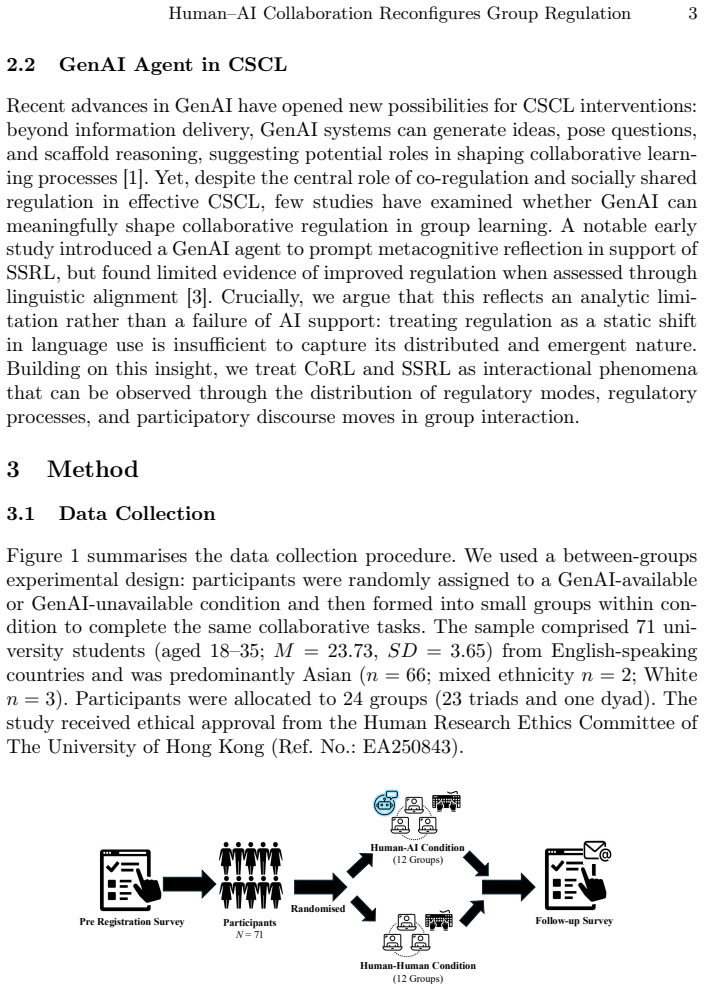

read the original abstract
Generative AI (GenAI) is increasingly used in collaborative learning, yet its effects on how groups regulate collaboration remain unclear. Effective collaboration depends not only on what groups discuss, but on how they jointly manage goals, participation, strategy use, monitoring, and repair through co-regulation and socially shared regulation. We compared collaborative regulation between Human-AI and Human-Human groups in a parallel-group randomised experiment with 71 university students completing the same collaborative tasks with GenAI either available or unavailable. Focusing on human discourse, we used statistical analyses to examine differences in the distribution of collaborative regulation across regulatory modes, regulatory processes, and participatory focuses. Results showed that GenAI availability shifted regulation away from predominantly socially shared forms towards more hybrid co-regulatory forms, with selective increases in directive, obstacle-oriented, and affective regulatory processes. Participatory-focus distributions, however, were broadly similar across conditions. These findings suggest that GenAI reshapes the distribution of regulatory responsibility in collaboration and offer implications for the human-centred design of AI-supported collaborative learning.
Editorial analysis
A structured set of objections, weighed in public.
Referee Report
Summary. The manuscript reports a parallel-group randomized experiment involving 71 university students who completed collaborative tasks either with or without access to generative AI. Focusing exclusively on human discourse, the authors apply statistical analyses to compare distributions of collaborative regulation across regulatory modes (socially shared vs. hybrid co-regulatory), regulatory processes (e.g., directive, obstacle-oriented, affective), and participatory focuses. The central finding is that GenAI availability shifts regulation away from predominantly socially shared forms toward hybrid co-regulatory forms, with selective increases in certain processes, while participatory-focus distributions remain broadly similar; implications for human-centred AI design in collaborative learning are discussed.
Significance. If the core empirical patterns hold after addressing methodological gaps, the work offers a useful contribution to research on AI in collaborative learning by linking GenAI availability to measurable changes in group regulatory processes via a randomized design. This could help ground discussions of how AI tools reconfigure joint goal management and monitoring. The randomized parallel-group structure and grounding in established regulation frameworks (co-regulation and socially shared regulation) are strengths that support causal claims about availability effects, though the hybrid interpretation requires further substantiation.
major comments (3)
- [Results and Discussion] The claim that GenAI availability produces a shift to 'hybrid co-regulatory forms' (Abstract and Discussion) rests on changes observed in human discourse alone. Without analysis of AI utterances, prompts, or full interaction logs, the data cannot distinguish true distribution of regulatory responsibility across human-AI boundaries from human adaptation to an external tool; this directly undermines the hybrid-reconfiguration interpretation that is load-bearing for the central claim.
- [Methods] The Methods section provides no details on inter-rater reliability for discourse coding, effect sizes, exact statistical tests (beyond generic 'statistical analyses'), data exclusion rules, or baseline comparisons. These omissions prevent assessment of whether the reported shifts in directive, obstacle-oriented, and affective processes are robust or practically meaningful.
- [Results] The reported similarity in participatory-focus distributions across conditions (Results) is not reconciled with the claim of overall regulatory-architecture reconfiguration; if participatory focus is unchanged, it is unclear how the selective process increases constitute a fundamental shift rather than a localized adjustment.
minor comments (1)
- [Abstract] The abstract could more precisely state the sample size, task details, and specific statistical approach to improve immediate readability.
Simulated Author's Rebuttal
We thank the referee for these constructive comments, which help clarify the scope and interpretation of our findings. We address each major point below and indicate the revisions planned for the next version of the manuscript.
read point-by-point responses
-
Referee: [Results and Discussion] The claim that GenAI availability produces a shift to 'hybrid co-regulatory forms' (Abstract and Discussion) rests on changes observed in human discourse alone. Without analysis of AI utterances, prompts, or full interaction logs, the data cannot distinguish true distribution of regulatory responsibility across human-AI boundaries from human adaptation to an external tool; this directly undermines the hybrid-reconfiguration interpretation that is load-bearing for the central claim.
Authors: We agree that the hybrid co-regulatory interpretation is inferred rather than directly observed, as the manuscript explicitly states that analysis was restricted to human discourse. The observed shifts in human regulatory modes and processes when GenAI is available provide evidence that groups adapt their regulation in ways consistent with co-regulation involving an external agent, rather than purely socially shared regulation among humans. However, we acknowledge the limitation: without coding AI contributions, we cannot map the precise allocation of regulatory responsibility. In revision we will (a) qualify the Abstract and Discussion to describe the shift as occurring in human regulatory patterns under GenAI availability and (b) add an explicit limitations paragraph calling for future studies that jointly code human and AI utterances. This preserves the empirical result while tempering the stronger causal claim about hybrid distribution. revision: partial
-
Referee: [Methods] The Methods section provides no details on inter-rater reliability for discourse coding, effect sizes, exact statistical tests (beyond generic 'statistical analyses'), data exclusion rules, or baseline comparisons. These omissions prevent assessment of whether the reported shifts in directive, obstacle-oriented, and affective processes are robust or practically meaningful.
Authors: These details were omitted from the submitted version. The revised Methods section will include: (1) inter-rater reliability statistics (Cohen’s kappa and percentage agreement) for the discourse coding scheme; (2) the precise statistical tests (chi-square tests of independence for distributional comparisons, with post-hoc adjusted residuals); (3) effect sizes (Cramér’s V and odds ratios where appropriate); (4) explicit data exclusion criteria (e.g., incomplete sessions, technical failures); and (5) any baseline equivalence checks between conditions. These additions will allow readers to evaluate the robustness and practical significance of the reported process shifts. revision: yes
-
Referee: [Results] The reported similarity in participatory-focus distributions across conditions (Results) is not reconciled with the claim of overall regulatory-architecture reconfiguration; if participatory focus is unchanged, it is unclear how the selective process increases constitute a fundamental shift rather than a localized adjustment.
Authors: Participatory focus (who initiates or directs regulation) and regulatory mode/process (how regulation is enacted) are distinct dimensions in the coding framework. The similarity in focus distributions indicates that the balance of individual versus collective participation did not change, while the mode shift (socially shared to hybrid co-regulatory) and selective increases in directive, obstacle-oriented, and affective processes reflect a change in the regulatory architecture—specifically, the incorporation of an external agent into the regulatory loop. We will add a short reconciling paragraph in the Results and Discussion sections clarifying this distinction and noting that the reconfiguration is selective rather than global, thereby addressing the apparent tension. revision: yes
Circularity Check
No significant circularity in empirical experimental comparison
full rationale
The paper reports a parallel-group randomized experiment comparing Human-AI and Human-Human collaborative groups, with statistical analysis of coded human discourse for regulatory modes, processes, and participatory focuses. The central claims derive directly from observed condition differences in these distributions rather than from any self-referential definitions, fitted parameters renamed as predictions, or load-bearing self-citation chains. References to prior regulation frameworks exist but serve only as background and do not reduce the new comparative results to inputs by construction. The study remains self-contained as an independent empirical test against external benchmarks.
Axiom & Free-Parameter Ledger
axioms (1)
- domain assumption The coding scheme for regulatory modes, processes, and participatory focuses validly and reliably captures collaborative regulation in both Human-Human and Human-AI discourse.
Reference graph
Works this paper leans on
-
[1]
Cognitive Computation 16(5), 2487–2510 (2024) Human–AI Collaboration Reconfigures Group Regulation 9
Bansal, G., Chamola, V., Hussain, A., Guizani, M., Niyato, D.: Transforming con- versations with ai—a comprehensive study of chatgpt. Cognitive Computation 16(5), 2487–2510 (2024) Human–AI Collaboration Reconfigures Group Regulation 9
work page 2024
-
[2]
Journal of Learning Analytics11(3), 192–209 (12 2024).https://doi.org/10.18608/jla.2024.8393
Dang, B., Nguyen, A., Järvelä, S.: Deliberative interactions for socially shared regulation in collaborative learning. Journal of Learning Analytics11(3), 192–209 (12 2024).https://doi.org/10.18608/jla.2024.8393
-
[3]
British Journal of Educational Technology56(2), 712–733 (2025)
Edwards, J., Nguyen, A., Lämsä, J., Sobocinski, M., Whitehead, R., Dang, B., Roberts, A.S., Järvelä, S.: Human-ai collaboration: Designing artificial agents to facilitate socially shared regulation among learners. British Journal of Educational Technology56(2), 712–733 (2025)
work page 2025
-
[4]
International Journal of Computer-Supported Collaborative Learning20, 425–461 (2025).https://doi
Feng, S., Wei, Z.: The CoMPAS framework for modeling individual participation in collaborative learning processes: a systematic review. International Journal of Computer-Supported Collaborative Learning20, 425–461 (2025).https://doi. org/10.1007/s11412-025-09450-x
-
[5]
British Journal of Educational Technology (2025)
Feng, S.: Group interaction patterns in generative ai-supported collaborative prob- lem solving: Network analysis of the interactions among students and a gai chatbot. British Journal of Educational Technology (2025)
work page 2025
-
[6]
Hadwin, A., Järvelä, S., Miller, M.: Self-regulation, co-regulation, and shared reg- ulation in collaborative learning environments. In: Schunk, D.H., Greene, J.A. (eds.) Handbook of Self-Regulation of Learning and Performance, pp. 83–106. Routledge/Taylor & Francis Group, 2 edn. (2018).https://doi.org/10.4324/ 9781315697048-6
work page 2018
-
[7]
Educational Psychologist50(3), 204–219 (2015)
Järvenoja, H., Järvelä, S., Malmberg, J.: Understanding regulated learning in situ- ative and contextual frameworks. Educational Psychologist50(3), 204–219 (2015)
work page 2015
-
[8]
International Journal of Computer-Supported Collaborative Learning11(3), 263–280 (8 2016)
Järvelä, S., Kirschner, P.A., Hadwin, A., Järvenoja, H., Malmberg, J., Miller, M., Laru, J.: Socially shared regulation of learning in CSCL: understanding and prompting individual- and group-level shared regulatory activities. International Journal of Computer-Supported Collaborative Learning11(3), 263–280 (8 2016). https://doi.org/10.1007/s11412-016-9238-2
-
[9]
Education and Information Technologies30(9), 11483–11521 (1 2025)
Kim, J., Detrick, R., Yu, S., Song, Y., Bol, L., Li, N.: Socially shared regula- tion of learning and artificial intelligence: Opportunities to support socially shared regulation. Education and Information Technologies30(9), 11483–11521 (1 2025). https://doi.org/10.1007/s10639-024-13187-9
-
[10]
Computers & Education161, 104064 (10 2020).https: //doi.org/10.1016/j.compedu.2020.104064
Lyons, K.M., Lobczowski, N.G., Greene, J.A., Whitley, J., McLaughlin, J.E.: Using a design-based research approach to develop and study a web-based tool to support collaborative learning. Computers & Education161, 104064 (10 2020).https: //doi.org/10.1016/j.compedu.2020.104064
-
[11]
British Journal of Educational Technology54(1), 293–312 (10 2022)
Nguyen, A., Järvelä, S., Rosé, C., Järvenoja, H., Malmberg, J.: Examining socially shared regulation and shared physiological arousal events with multimodal learning analytics. British Journal of Educational Technology54(1), 293–312 (10 2022). https://doi.org/10.1111/bjet.13280
-
[12]
Cognition and Instruction29(4), 375–415 (2011).https://doi.org/10
Rogat, T.K., Linnenbrink-Garcia, L.: Socially shared regulation in collaborative groups: An analysis of the interplay between quality of social regulation and group processes. Cognition and Instruction29(4), 375–415 (2011).https://doi.org/10. 1080/07370008.2011.607930
-
[13]
Science 330(6004), 686–688 (2010).https://doi.org/10.1126/science.11931
Woolley, A.W., Chabris, C.F., Pentland, A., Hashmi, N., Malone, T.W.: Evidence for a collective intelligence factor in the performance of human groups. Science 330(6004), 686–688 (2010).https://doi.org/10.1126/science.11931
-
[14]
Nature Human Behaviour8, 1839–1850 (2024)
Yan, L., Greiff, S., Teuber, Z., Gašević, D.: Promises and challenges of generative artificial intelligence for human learning. Nature Human Behaviour8, 1839–1850 (2024)
work page 2024
discussion (0)
Sign in with ORCID, Apple, or X to comment. Anyone can read and Pith papers without signing in.