A Closer Look at the Application of Causal Inference in Graph Representation Learning
Pith reviewed 2026-05-10 17:15 UTC · model grok-4.3
The pith
Aggregating diverse graph elements into causal variables violates core causal inference assumptions.
A machine-rendered reading of the paper's core claim, the machinery that carries it, and where it could break.
Core claim
We prove that aggregating diverse graph elements into single causal variables compromises causal validity. Building on this conclusion, we propose a theoretical model grounded in the smallest indivisible units of graph data to ensure that the causal validity is guaranteed. With this model, we further analyze the costs of achieving precise causal modeling in graph representation learning and identify the conditions under which the problem can be simplified. To empirically support our theory, we construct a controllable synthetic dataset that reflects real-world causal structures and conduct extensive experiments for validation. Finally, we develop a causal modeling enhancement module that can
What carries the argument
The theoretical model grounded in the smallest indivisible units of graph data, which prevents aggregation and thereby guarantees causal validity.
If this is right
- Valid causal inference in graphs requires avoiding aggregation of elements into single variables.
- The costs of precise causal modeling can be quantified and reduced under identified conditions.
- Existing graph representation learning methods can incorporate an enhancement module to improve causal modeling.
- Experiments on synthetic datasets mirroring real causal structures validate the theoretical claims.
Where Pith is reading between the lines
- This may necessitate re-evaluating previous causal graph learning results that used aggregation.
- It highlights a scalability challenge for causal methods on complex graphs unless simplification conditions are met.
- Connections could be drawn to causal inference in other non-Euclidean data structures.
- Practical implementations might focus on efficient decomposition algorithms for graph data.
Load-bearing premise
That graph data can be decomposed into smallest indivisible units that individually satisfy causal inference assumptions without requiring aggregation.
What would settle it
A demonstration that causal inferences remain valid even after aggregating graph elements into single variables in a setting where the assumptions should hold.
Figures


read the original abstract
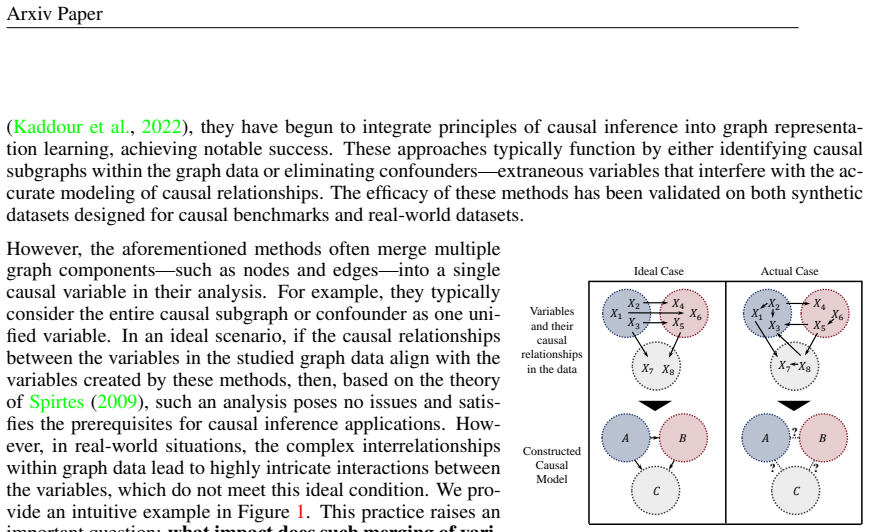
Modeling causal relationships in graph representation learning remains a fundamental challenge. Existing approaches often draw on theories and methods from causal inference to identify causal subgraphs or mitigate confounders. However, due to the inherent complexity of graph-structured data, these approaches frequently aggregate diverse graph elements into single causal variables, an operation that risks violating the core assumptions of causal inference. In this work, we prove that such aggregation compromises causal validity. Building on this conclusion, we propose a theoretical model grounded in the smallest indivisible units of graph data to ensure that the causal validity is guaranteed. With this model, we further analyze the costs of achieving precise causal modeling in graph representation learning and identify the conditions under which the problem can be simplified. To empirically support our theory, we construct a controllable synthetic dataset that reflects realworld causal structures and conduct extensive experiments for validation. Finally, we develop a causal modeling enhancement module that can be seamlessly integrated into existing graph learning pipelines, and we demonstrate its effectiveness through comprehensive comparative experiments.
Editorial analysis
A structured set of objections, weighed in public.
Referee Report
Summary. The manuscript claims that aggregating diverse graph elements into single causal variables in graph representation learning violates core causal inference assumptions (e.g., consistency, positivity). It states a proof of this compromise, introduces a theoretical model based on the smallest indivisible units of graph data to guarantee causal validity, analyzes the costs of precise causal modeling and conditions for simplification, constructs a controllable synthetic dataset reflecting real-world causal structures for empirical validation, and develops a causal modeling enhancement module integrable into existing graph learning pipelines with comparative experiments demonstrating effectiveness.
Significance. If the central proof and decomposition into indivisible units hold without reintroducing aggregation via graph adjacency, the work would usefully caution the field against naive causal aggregation in GRL and supply a practical enhancement module. The construction of a synthetic dataset and integration experiments provide concrete empirical grounding that could be built upon. No machine-checked proofs or parameter-free derivations are present to credit.
major comments (3)
- [Abstract] Abstract: the claim 'we prove that such aggregation compromises causal validity' supplies no derivation steps, listed assumptions (e.g., SUTVA, no interference), or counter-example checks. This is load-bearing for the subsequent theoretical model and all empirical claims.
- [Theoretical model] Theoretical model section: the model is introduced directly from the aggregation-violation conclusion and defined in terms of 'smallest indivisible units' without demonstrating that these units remain causally isolated once embedded in the observed graph (nodes/edges remain coupled by adjacency). This risks circularity, as the decomposition may implicitly reintroduce the same aggregation problem at the structural level.
- [Experiments] Synthetic dataset and experiments: the manuscript states the dataset 'reflects real-world causal structures' but provides no details on how it enforces the claimed causal structures, controls for confounders, or verifies that the indivisible units satisfy standard causal assumptions without further aggregation.
minor comments (1)
- [Abstract] Abstract contains the compound word 'realworld' which should be hyphenated as 'real-world' for standard presentation.
Simulated Author's Rebuttal
We thank the referee for the detailed and constructive review. The comments identify important areas for clarification in the abstract, theoretical model, and experimental details. We address each major comment below and indicate the revisions we will make.
read point-by-point responses
-
Referee: [Abstract] Abstract: the claim 'we prove that such aggregation compromises causal validity' supplies no derivation steps, listed assumptions (e.g., SUTVA, no interference), or counter-example checks. This is load-bearing for the subsequent theoretical model and all empirical claims.
Authors: We agree the abstract is highly condensed. The full derivation, including explicit assumptions (SUTVA, no interference, positivity, consistency) and step-by-step reasoning, appears in Section 3. We will revise the abstract to list the core assumptions and add a parenthetical reference to the proof location. Space constraints preclude a full counter-example in the abstract, but we will include a brief illustrative example in the introduction to support the claim. revision: yes
-
Referee: [Theoretical model] Theoretical model section: the model is introduced directly from the aggregation-violation conclusion and defined in terms of 'smallest indivisible units' without demonstrating that these units remain causally isolated once embedded in the observed graph (nodes/edges remain coupled by adjacency). This risks circularity, as the decomposition may implicitly reintroduce the same aggregation problem at the structural level.
Authors: This is a substantive concern. In Section 4 the model treats individual nodes as the atomic causal units and encodes adjacency as a fixed relational structure separate from the causal variables themselves. Under the maintained no-interference assumption, potential outcomes are defined at the node level without cross-unit aggregation. We will add an explicit subsection proving that the embedding does not re-aggregate causal variables and that isolation holds conditionally on the observed graph structure. revision: partial
-
Referee: [Experiments] Synthetic dataset and experiments: the manuscript states the dataset 'reflects real-world causal structures' but provides no details on how it enforces the claimed causal structures, controls for confounders, or verifies that the indivisible units satisfy standard causal assumptions without further aggregation.
Authors: We accept that the current description is insufficient for reproducibility. In the revised Section 5 we will provide: the exact generative process that instantiates ground-truth causal effects at the node level, the simulation parameters used to control confounders, and verification checks (including statistical tests for positivity, consistency, and absence of interference on the generated units). These additions will directly confirm that no further aggregation occurs. revision: yes
Circularity Check
Theoretical model introduced directly from aggregation-violation proof without independent derivation shown
specific steps
-
self definitional
[Abstract]
"we prove that such aggregation compromises causal validity. Building on this conclusion, we propose a theoretical model grounded in the smallest indivisible units of graph data to ensure that the causal validity is guaranteed."
The model is introduced explicitly as following from the proof's conclusion and is defined using units chosen precisely so that causal validity holds without aggregation. This makes the guarantee tautological to the choice of units rather than an independent derivation from graph structure or external causal assumptions.
full rationale
The paper's central chain is: prove aggregation violates causal assumptions, then build a model on 'smallest indivisible units' that by definition satisfy those assumptions. The abstract presents the model as following immediately from the proof conclusion, and the reader's note flags that the units may simply redefine the problem to avoid aggregation by fiat. No equations or self-citations are quoted that reduce the proof itself to a fit or prior self-result, so the circularity is partial and limited to the transition step rather than the entire derivation. This warrants a moderate score but does not reach 6+ because the proof claim itself is not shown to collapse by construction in the provided text.
Axiom & Free-Parameter Ledger
axioms (1)
- domain assumption Core causal inference assumptions remain valid when applied to smallest indivisible graph units rather than aggregated variables
invented entities (1)
-
theoretical model grounded in smallest indivisible units of graph data
no independent evidence
Reference graph
Works this paper leans on
-
[1]
URLhttp://proceedings.mlr.press/v97/chattopadhyay19a.html. Yongqiang Chen, Yonggang Zhang, Yatao Bian, Han Yang, Kaili Ma, Binghui Xie, Tongliang Liu, Bo Han, and James Cheng. Learning causally invariant representations for out-of-distribution gener- alization on graphs. In Sanmi Koyejo, S. Mohamed, A. Agarwal, Danielle Belgrave, K. Cho, and 10 Arxiv Pape...
work page 2022
-
[2]
Hang Gao, Jiangmeng Li, Wenwen Qiang, Lingyu Si, Bing Xu, Changwen Zheng, and Fuchun Sun
doi: 10.1109/TPAMI.2023.3321097. Hang Gao, Jiangmeng Li, Wenwen Qiang, Lingyu Si, Bing Xu, Changwen Zheng, and Fuchun Sun. Robust causal graph representation learning against confounding effects. InProceedings of the AAAI Conference on Artificial Intelligence, volume 37, pp. 7624–7632, 2023. Hang Gao, Chengyu Yao, Jiangmeng Li, Lingyu Si, Yifan Jin, Fengg...
-
[3]
A survey on explainable artificial intel- ligence (xai): Toward medical xai
OpenReview.net, 2019. URLhttps://openreview.net/forum?id=ryGs6iA5Km. Dingling Yao, Danru Xu, S´ebastien Lachapelle, Sara Magliacane, Perouz Taslakian, Georg Martius, Julius von K ¨ugelgen, and Francesco Locatello. Multi-view causal representation learning with partial ob- servability. InThe Twelfth International Conference on Learning Representations, ICL...
-
[4]
Marinka Zitnik, Monica Agrawal, and Jure Leskovec
URLhttps://doi.org/10.24963/ijcai.2023/524. Marinka Zitnik, Monica Agrawal, and Jure Leskovec. Modeling polypharmacy side effects with graph convolutional networks.Bioinformatics, 34(13):i457–i466, 2018. 15 Arxiv Paper A USAGE OFLARGELANGUAGEMODEL In our paper, we used LLMs to assist with polishing the writing, including correcting grammatical errors and ...
-
[5]
In this case,S i contains causes ofS j, andS j also contains causes ofS i. Suppose we designateS i as the cause and construct a causal pathwayS i →S j. Then, for another variableS k ∈S, ifS k also contains causes ofS j, andS j contains causes ofS k, whileS k is similarly designated as the cause, it is possible that Si andS k are dependent even when condit...
work page 1991
discussion (0)
Sign in with ORCID, Apple, or X to comment. Anyone can read and Pith papers without signing in.