FIRE-CIR: Fine-grained Reasoning for Composed Fashion Image Retrieval
Pith reviewed 2026-05-10 18:07 UTC · model grok-4.3
The pith
FIRE-CIR improves composed fashion image retrieval by generating attribute questions from text to verify changes and re-rank candidates.
A machine-rendered reading of the paper's core claim, the machinery that carries it, and where it could break.
Core claim
FIRE-CIR performs question-driven visual reasoning: it automatically generates attribute-focused visual questions derived from the modification text, verifies the corresponding visual evidence in both reference and candidate images, and leverages this explicit reasoning to re-rank candidate results, thereby outperforming state-of-the-art methods on the Fashion IQ benchmark while also providing interpretable, attribute-level insights into retrieval decisions.
What carries the argument
Question-driven visual reasoning that turns modification text into attribute-specific questions and checks their answers in reference and candidate images to drive re-ranking.
If this is right
- Retrieval accuracy on the Fashion IQ benchmark exceeds that of prior state-of-the-art embedding methods.
- Attribute-level explanations become available for why particular images are kept or discarded.
- Candidate images that violate the modification constraints are filtered during re-ranking.
- Training uses a newly constructed large-scale fashion dataset of single-image and dual-image visual questions.
Where Pith is reading between the lines
- The same question-generation and verification pattern could be tested on composed retrieval tasks outside fashion, such as furniture or product catalogs, provided attribute vocabularies exist.
- Direct integration of the verification step into the initial embedding model rather than post-hoc re-ranking might reduce the two-stage pipeline.
- Human evaluation of the generated questions on a held-out set of modifications would quantify how well they reflect user intent.
Load-bearing premise
Automatically generated attribute questions derived from modification text will reliably capture the intended visual changes without introducing errors or missing key details.
What would settle it
Measuring retrieval accuracy on the Fashion IQ test set after re-ranking and finding no improvement over the initial embedding similarity ranking, or finding that the generated questions frequently fail to match the actual intent of the modification text upon manual review.
Figures


read the original abstract
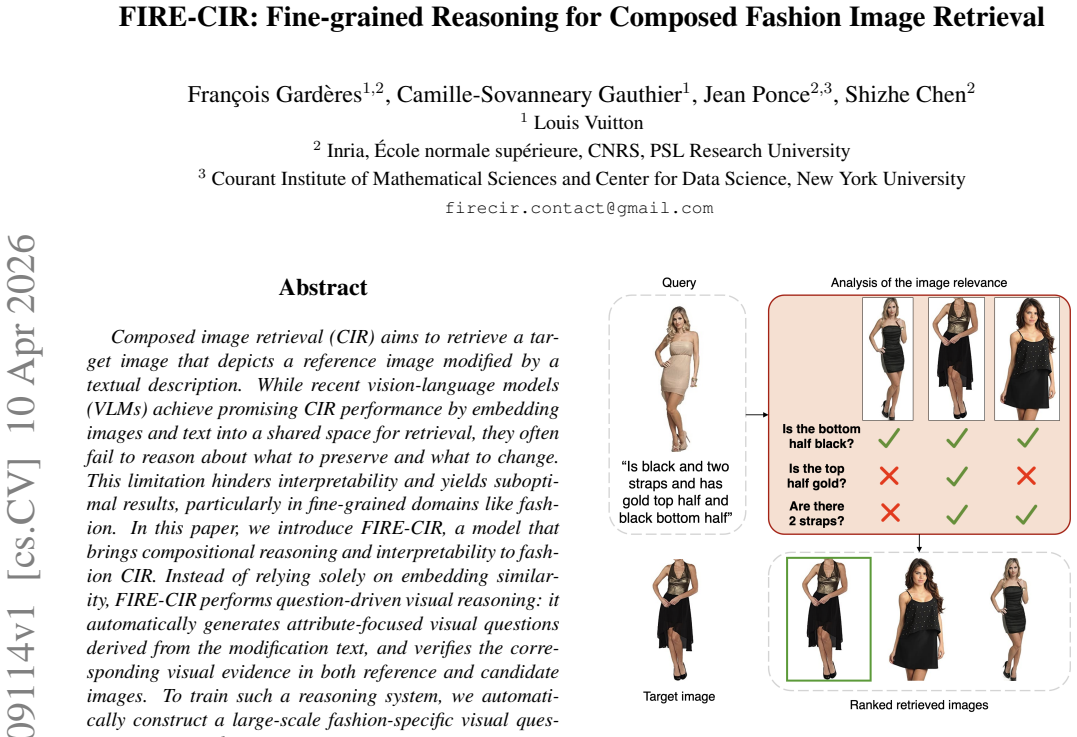
Composed image retrieval (CIR) aims to retrieve a target image that depicts a reference image modified by a textual description. While recent vision-language models (VLMs) achieve promising CIR performance by embedding images and text into a shared space for retrieval, they often fail to reason about what to preserve and what to change. This limitation hinders interpretability and yields suboptimal results, particularly in fine-grained domains like fashion. In this paper, we introduce FIRE-CIR, a model that brings compositional reasoning and interpretability to fashion CIR. Instead of relying solely on embedding similarity, FIRE-CIR performs question-driven visual reasoning: it automatically generates attribute-focused visual questions derived from the modification text, and verifies the corresponding visual evidence in both reference and candidate images. To train such a reasoning system, we automatically construct a large-scale fashion-specific visual question answering dataset, containing questions requiring either single- or dual-image analysis. During retrieval, our model leverages this explicit reasoning to re-rank candidate results, filtering out images inconsistent with the intended modifications. Experimental results on the Fashion IQ benchmark show that FIRE-CIR outperforms state-of-the-art methods in retrieval accuracy. It also provides interpretable, attribute-level insights into retrieval decisions.
Editorial analysis
A structured set of objections, weighed in public.
Referee Report
Summary. The paper introduces FIRE-CIR, a framework for composed fashion image retrieval that moves beyond embedding similarity by performing question-driven visual reasoning. It automatically generates attribute-focused visual questions from the modification text, constructs a large-scale fashion-specific VQA dataset (with single- and dual-image questions), and uses explicit verification of visual evidence in reference and candidate images to re-rank retrieval results. The work claims outperformance over state-of-the-art methods on the Fashion IQ benchmark together with attribute-level interpretability into retrieval decisions.
Significance. If the experimental results and pipeline robustness hold, FIRE-CIR could advance composed image retrieval by adding explicit compositional reasoning and interpretability to vision-language models, particularly valuable in fine-grained domains like fashion where preserving or altering specific attributes matters. The automatic construction of a domain-specific VQA dataset is a scalable contribution that, if validated, enables training of such reasoning systems without manual annotation.
major comments (2)
- [Abstract] Abstract: The central claim that 'FIRE-CIR outperforms state-of-the-art methods in retrieval accuracy' is stated without any quantitative metrics, recall@K values, ablation results, or comparison tables. This absence makes it impossible to evaluate the magnitude or statistical significance of the reported gains, which is load-bearing for the paper's primary contribution.
- [Abstract] Abstract / Dataset Construction: The method depends on automatically generating attribute-focused visual questions from modification text and verifying them in images for re-ranking. No details are supplied on the generation procedure (LLM prompts, rules, or models used), human validation statistics, or error analysis of the constructed VQA dataset. Systematic misses or spurious attributes in this step would directly degrade consistency scores and re-ranking quality, rendering the outperformance claim vulnerable.
minor comments (1)
- [Abstract] The abstract could be strengthened by briefly noting the scale of the automatically constructed VQA dataset or the number of questions per modification to give readers immediate context on the training resources.
Simulated Author's Rebuttal
We thank the referee for the constructive comments on our manuscript. We agree that the abstract would be strengthened by including key quantitative results and a brief overview of the dataset construction process. We will revise the abstract in the next version to address these points while keeping it concise. Our point-by-point responses follow.
read point-by-point responses
-
Referee: [Abstract] Abstract: The central claim that 'FIRE-CIR outperforms state-of-the-art methods in retrieval accuracy' is stated without any quantitative metrics, recall@K values, ablation results, or comparison tables. This absence makes it impossible to evaluate the magnitude or statistical significance of the reported gains, which is load-bearing for the paper's primary contribution.
Authors: We acknowledge that the abstract as currently written states the performance claim at a high level. The full experimental results, including Recall@K metrics, comparisons to state-of-the-art methods, and ablation studies, are presented in Section 4 and the associated tables. To make the abstract self-contained and allow immediate assessment of the gains, we will revise it to incorporate the primary quantitative improvements (e.g., specific Recall@10 and Recall@50 deltas on Fashion IQ) while preserving brevity. revision: yes
-
Referee: [Abstract] Abstract / Dataset Construction: The method depends on automatically generating attribute-focused visual questions from modification text and verifying them in images for re-ranking. No details are supplied on the generation procedure (LLM prompts, rules, or models used), human validation statistics, or error analysis of the constructed VQA dataset. Systematic misses or spurious attributes in this step would directly degrade consistency scores and re-ranking quality, rendering the outperformance claim vulnerable.
Authors: The generation procedure, including the LLM-based attribute extraction from modification text, prompt templates, and fashion-specific rules for question formulation, is described in Section 3.1, with the full VQA dataset construction pipeline in Section 3.2. Human validation statistics and error analysis (including failure modes such as ambiguous attributes) appear in the supplementary material. We agree that a high-level summary of these elements would improve the abstract and mitigate concerns about robustness; we will add a concise description of the automatic construction and validation approach to the revised abstract. revision: yes
Circularity Check
No significant circularity detected in derivation chain
full rationale
The paper introduces FIRE-CIR as an empirical model for composed fashion image retrieval that performs question-driven visual reasoning and re-ranking on an automatically constructed VQA dataset. No equations, first-principles derivations, or predictions are presented anywhere in the abstract or described methodology. Claims of outperformance rest entirely on experimental results on the Fashion IQ benchmark rather than any self-referential reduction of outputs to inputs by construction. The automatic dataset construction is a standard data-preparation step and does not create fitted-input-called-prediction or self-definitional circularity. No load-bearing self-citations or uniqueness theorems are invoked in the provided text.
Axiom & Free-Parameter Ledger
axioms (1)
- domain assumption Vision-language models can reliably generate and answer attribute-focused visual questions about fashion images
Lean theorems connected to this paper
-
IndisputableMonolith/Cost/FunctionalEquation.leanwashburn_uniqueness_aczel unclear?
unclearRelation between the paper passage and the cited Recognition theorem.
automatically generates attribute-focused visual questions derived from the modification text, and verifies the corresponding visual evidence in both reference and candidate images
-
IndisputableMonolith/Foundation/RealityFromDistinction.leanreality_from_one_distinction unclear?
unclearRelation between the paper passage and the cited Recognition theorem.
we automatically construct a large-scale fashion-specific visual question answering dataset
What do these tags mean?
- matches
- The paper's claim is directly supported by a theorem in the formal canon.
- supports
- The theorem supports part of the paper's argument, but the paper may add assumptions or extra steps.
- extends
- The paper goes beyond the formal theorem; the theorem is a base layer rather than the whole result.
- uses
- The paper appears to rely on the theorem as machinery.
- contradicts
- The paper's claim conflicts with a theorem or certificate in the canon.
- unclear
- Pith found a possible connection, but the passage is too broad, indirect, or ambiguous to say the theorem truly supports the claim.
Reference graph
Works this paper leans on
-
[1]
Sentence-level prompts benefit composed im- age retrieval
Yang Bai, Xinxing Xu, Yong Liu, Salman Khan, Fahad Khan, Wangmeng Zuo, Rick Siow Mong Goh, Chun-Mei Feng, et al. Sentence-level prompts benefit composed im- age retrieval. InThe Twelfth International Conference on Learning Representations, 2024. 1, 2, 7
work page 2024
-
[2]
Conditioned and composed image retrieval combining and partially fine-tuning clip-based features
Alberto Baldrati, Marco Bertini, Tiberio Uricchio, and Al- berto Del Bimbo. Conditioned and composed image retrieval combining and partially fine-tuning clip-based features. In Proceedings of the IEEE/CVF Conference on Computer Vi- sion and Pattern Recognition, pages 4959–4968, 2022. 1, 2, 7
work page 2022
-
[3]
Vqa4cir: Boosting composed image retrieval with visual question answering
Chun-Mei Feng, Yang Bai, Tao Luo, Zhen Li, Salman Khan, Wangmeng Zuo, Rick Siow Mong Goh, and Yong Liu. Vqa4cir: Boosting composed image retrieval with visual question answering. InProceedings of the AAAI Conference on Artificial Intelligence, pages 2942–2950, 2025. 2, 3, 4, 7
work page 2025
-
[4]
Improving composed image retrieval via contrastive learning with scal- ing positives and negatives
Zhangchi Feng, Richong Zhang, and Zhijie Nie. Improving composed image retrieval via contrastive learning with scal- ing positives and negatives. InProceedings of the 32nd ACM International Conference on Multimedia, pages 1632–1641,
-
[5]
arXiv preprint arXiv:2507.07135 (2025)
Franc ¸ois Gard`eres, Shizhe Chen, Camille-Sovanneary Gau- thier, and Jean Ponce. Facap: A large-scale fashion dataset for fine-grained composed image retrieval.arXiv preprint arXiv:2507.07135, 2025. 1, 2, 5, 7
-
[6]
Fashionvil: Fashion-focused vision-and- language representation learning
Xiao Han, Licheng Yu, Xiatian Zhu, Li Zhang, Yi-Zhe Song, and Tao Xiang. Fashionvil: Fashion-focused vision-and- language representation learning. InEuropean conference on computer vision, pages 634–651. Springer, 2022. 4
work page 2022
-
[7]
Fame-vil: Multi-tasking vision-language model for heterogeneous fashion tasks
Xiao Han, Xiatian Zhu, Licheng Yu, Li Zhang, Yi-Zhe Song, and Tao Xiang. Fame-vil: Multi-tasking vision-language model for heterogeneous fashion tasks. InProceedings of the IEEE/CVF Conference on Computer Vision and Pattern Recognition, pages 2669–2680, 2023. 4
work page 2023
-
[8]
Lora: Low-rank adaptation of large language models.ICLR, 1(2):3, 2022
Edward J Hu, Yelong Shen, Phillip Wallis, Zeyuan Allen- Zhu, Yuanzhi Li, Shean Wang, Lu Wang, Weizhu Chen, et al. Lora: Low-rank adaptation of large language models.ICLR, 1(2):3, 2022. 5
work page 2022
-
[9]
Collm: A large language model for composed image retrieval
Chuong Huynh, Jinyu Yang, Ashish Tawari, Mubarak Shah, Son Tran, Raffay Hamid, Trishul Chilimbi, and Abhinav Shrivastava. Collm: A large language model for composed image retrieval. InProceedings of the IEEE/CVF Conference on Computer Vision and Pattern Recognition (CVPR), 2025. 5
work page 2025
-
[10]
Junnan Li, Dongxu Li, Caiming Xiong, and Steven Hoi. Blip: Bootstrapping language-image pre-training for unified vision-language understanding and generation. InInterna- tional conference on machine learning, pages 12888–12900. PMLR, 2022. 2
work page 2022
-
[11]
Junnan Li, Dongxu Li, Silvio Savarese, and Steven Hoi. Blip-2: Bootstrapping language-image pre-training with frozen image encoders and large language models. InIn- ternational conference on machine learning, pages 19730– 19742. PMLR, 2023. 2
work page 2023
-
[12]
MM-EMBED: UNIVERSAL MULTIMODAL RETRIEV AL WITH MUL- TIMODAL LLMS
Sheng-Chieh Lin, Chankyu Lee, Mohammad Shoeybi, Jimmy Lin, Bryan Catanzaro, and Wei Ping. MM-EMBED: UNIVERSAL MULTIMODAL RETRIEV AL WITH MUL- TIMODAL LLMS. InThe Thirteenth International Confer- ence on Learning Representations, 2025. 2, 3
work page 2025
-
[13]
Improved baselines with visual instruction tuning
Haotian Liu, Chunyuan Li, Yuheng Li, and Yong Jae Lee. Improved baselines with visual instruction tuning. InPro- ceedings of the IEEE/CVF conference on computer vision and pattern recognition, pages 26296–26306, 2024. 7
work page 2024
-
[14]
Lamra: Large multimodal model as your advanced retrieval assistant
Yikun Liu, Yajie Zhang, Jiayin Cai, Xiaolong Jiang, Yao Hu, Jiangchao Yao, Yanfeng Wang, and Weidi Xie. Lamra: Large multimodal model as your advanced retrieval assistant. In Proceedings of the Computer Vision and Pattern Recognition Conference, pages 4015–4025, 2025. 2, 3
work page 2025
-
[15]
Bi-directional training for composed im- age retrieval via text prompt learning
Zheyuan Liu, Weixuan Sun, Yicong Hong, Damien Teney, and Stephen Gould. Bi-directional training for composed im- age retrieval via text prompt learning. InProceedings of the IEEE/CVF Winter Conference on Applications of Computer Vision, pages 5753–5762, 2024. 1, 2, 3
work page 2024
-
[16]
Zheyuan Liu, Weixuan Sun, Damien Teney, and Stephen Gould. Candidate set re-ranking for composed image re- trieval with dual multi-modal encoder.Transactions on Ma- chine Learning Research, 2024. 2, 7
work page 2024
-
[17]
Pengfei Luo, Jingbo Zhou, Tong Xu, Yuan Xia, Linli Xu, and Enhong Chen. Imagescope: Unifying language-guided im- age retrieval via large multimodal model collective reason- ing. InProceedings of the ACM on Web Conference 2025, page 1666–1682, New York, NY , USA, 2025. Association for Computing Machinery. 2, 3
work page 2025
-
[18]
Thinking fast and slow: Effi- cient text-to-visual retrieval with transformers
Antoine Miech, Jean-Baptiste Alayrac, Ivan Laptev, Josef Sivic, and Andrew Zisserman. Thinking fast and slow: Effi- cient text-to-visual retrieval with transformers. InProceed- ings of the IEEE/CVF conference on computer vision and pattern recognition, pages 9826–9836, 2021. 2
work page 2021
-
[19]
Learning transferable visual models from natural language supervi- sion
Alec Radford, Jong Wook Kim, Chris Hallacy, Aditya Ramesh, Gabriel Goh, Sandhini Agarwal, Girish Sastry, Amanda Askell, Pamela Mishkin, Jack Clark, et al. Learning transferable visual models from natural language supervi- sion. InInternational conference on machine learning, pages 8748–8763. PMLR, 2021. 1, 2
work page 2021
-
[20]
Training- free zero-shot composed image retrieval with local concept reranking, 2024
Shitong Sun, Fanghua Ye, and Shaogang Gong. Training- free zero-shot composed image retrieval with local concept reranking, 2024. 2, 3
work page 2024
-
[21]
Fashion- vqa: A domain-specific visual question answering system
Min Wang, Ata Mahjoubfar, and Anupama Joshi. Fashion- vqa: A domain-specific visual question answering system. InProceedings of the IEEE/CVF Conference on Computer Vision and Pattern Recognition, pages 3514–3519, 2023. 4
work page 2023
-
[22]
Target-guided composed image retrieval
Haokun Wen, Xian Zhang, Xuemeng Song, Yinwei Wei, and Liqiang Nie. Target-guided composed image retrieval. In 9 Proceedings of the 31st ACM International Conference on Multimedia, pages 915–923, 2023. 1, 2
work page 2023
-
[23]
Fashion iq: A new dataset towards retrieving images by natural language feedback
Hui Wu, Yupeng Gao, Xiaoxiao Guo, Ziad Al-Halah, Steven Rennie, Kristen Grauman, and Rogerio Feris. Fashion iq: A new dataset towards retrieving images by natural language feedback. InProceedings of the IEEE/CVF Conference on computer vision and pattern recognition, pages 11307– 11317, 2021. 2, 5
work page 2021
-
[24]
Ren-Di Wu, Yu-Yen Lin, and Huei-Fang Yang. Square: Se- mantic query-augmented fusion and efficient batch reranking for training-free zero-shot composed image retrieval, 2025. 2, 3, 7
work page 2025
-
[25]
Setr: A two-stage semantic- enhanced framework for zero-shot composed image re- trieval, 2025
Yuqi Xiao and Yingying Zhu. Setr: A two-stage semantic- enhanced framework for zero-shot composed image re- trieval, 2025. 2, 3
work page 2025
-
[26]
Yuxin Yang, Yinan Zhou, Yuxin Chen, Ziqi Zhang, Zongyang Ma, Chunfeng Yuan, Bing Li, Lin Song, Jun Gao, Peng Li, et al. Detailfusion: A dual-branch framework with detail enhancement for composed image retrieval.arXiv preprint arXiv:2505.17796, 2025. 1, 2, 7
-
[27]
UniFashion: A unified vision-language model for multimodal fashion retrieval and generation
Xiangyu Zhao, Yuehan Zhang, Wenlong Zhang, and Xiao- Ming Wu. UniFashion: A unified vision-language model for multimodal fashion retrieval and generation. InProceed- ings of the 2024 Conference on Empirical Methods in Natu- ral Language Processing, pages 1490–1507, Miami, Florida, USA, 2024. Association for Computational Linguistics. 2, 4
work page 2024
-
[28]
Progressive learning for image retrieval with hybrid-modality queries
Yida Zhao, Yuqing Song, and Qin Jin. Progressive learning for image retrieval with hybrid-modality queries. InProceed- ings of the 45th International ACM SIGIR Conference on Research and Development in Information Retrieval, pages 1012–1021, 2022. 4
work page 2022
-
[29]
Internvl3: Exploring advanced training and test-time recipes for open-source multimodal models, 2025
Jinguo Zhu, Weiyun Wang, Zhe Chen, Zhaoyang Liu, Shen- glong Ye, Lixin Gu, Hao Tian, Yuchen Duan, Weijie Su, Jie Shao, Zhangwei Gao, Erfei Cui, Xuehui Wang, Yue Cao, Yangzhou Liu, Xingguang Wei, Hongjie Zhang, Haomin Wang, Weiye Xu, Hao Li, Jiahao Wang, Nianchen Deng, Songze Li, Yinan He, Tan Jiang, Jiapeng Luo, Yi Wang, Con- ghui He, Botian Shi, Xingchen...
work page 2025
-
[30]
dress” subset for Figure 6 and Figure 7, and “shirt
Xi Zhu, Zhendong Mao, Chunxiao Liu, Peng Zhang, Bin Wang, and Yongdong Zhang. Overcoming language priors with self-supervised learning for visual question answering. InProceedings of the Twenty-Ninth International Joint Con- ference on Artificial Intelligence, 2021. 4 10 A. Additional FIRE-CIR qualitative examples To further illustrate the reasoning proce...
work page 2021
discussion (0)
Sign in with ORCID, Apple, or X to comment. Anyone can read and Pith papers without signing in.