Recognition: 2 theorem links
· Lean TheoremFavorable half-Heusler structure of synthesized TiCoSb alloy: a theoretical and experimental study
Pith reviewed 2026-05-10 16:39 UTC · model grok-4.3
The pith
TiCoSb half-Heusler alloy crystallizes in one of four candidate structures, identified by matching lowest-energy calculations to X-ray diffraction data, with estimated thermoelectric properties.
A machine-rendered reading of the paper's core claim, the machinery that carries it, and where it could break.
Core claim
The most probable structure of the synthesized TiCoSb half-Heusler alloy is the one that simultaneously minimizes the total energy in full-potential linearized augmented plane-wave calculations and produces the best Rietveld fit to the measured X-ray diffraction pattern; the thermoelectric transport properties are then evaluated for this identified structure.
What carries the argument
Comparison of minimum-energy configurations obtained from FP-LAPW calculations against Rietveld-refined X-ray diffraction patterns for four candidate half-Heusler arrangements.
If this is right
- The identified structure yields specific values for Seebeck coefficient, electrical conductivity, and thermal conductivity that can be used to compute the figure of merit.
- The corroborated structure is the one that forms under the reported synthesis conditions.
- Microstructural data from energy-dispersive X-ray spectroscopy and transmission electron microscopy confirm the stoichiometry and lattice planes expected for the selected half-Heusler arrangement.
- The workflow of testing a small set of candidate structures by both experiment and total-energy calculation can be repeated for related half-Heusler compositions.
Where Pith is reading between the lines
- The same combined refinement-plus-energy-ranking method could be applied to other ternary half-Heusler systems where multiple site arrangements are possible.
- Device-level testing of the identified TiCoSb phase would show whether the calculated transport properties translate into usable power output under realistic temperature gradients.
- If synthesis conditions can be adjusted to favor a different arrangement among the four, the relative stability ordering from the calculations supplies a direct prediction of which phase should appear.
Load-bearing premise
The actual structure formed during synthesis is one of the four arrangements considered and is the one that reaches the lowest calculated energy.
What would settle it
A neutron diffraction measurement or single-crystal X-ray study that reveals atomic positions or site occupancies inconsistent with the lowest-energy structure selected by the combined Rietveld and energy-minimization analysis.
Figures


read the original abstract
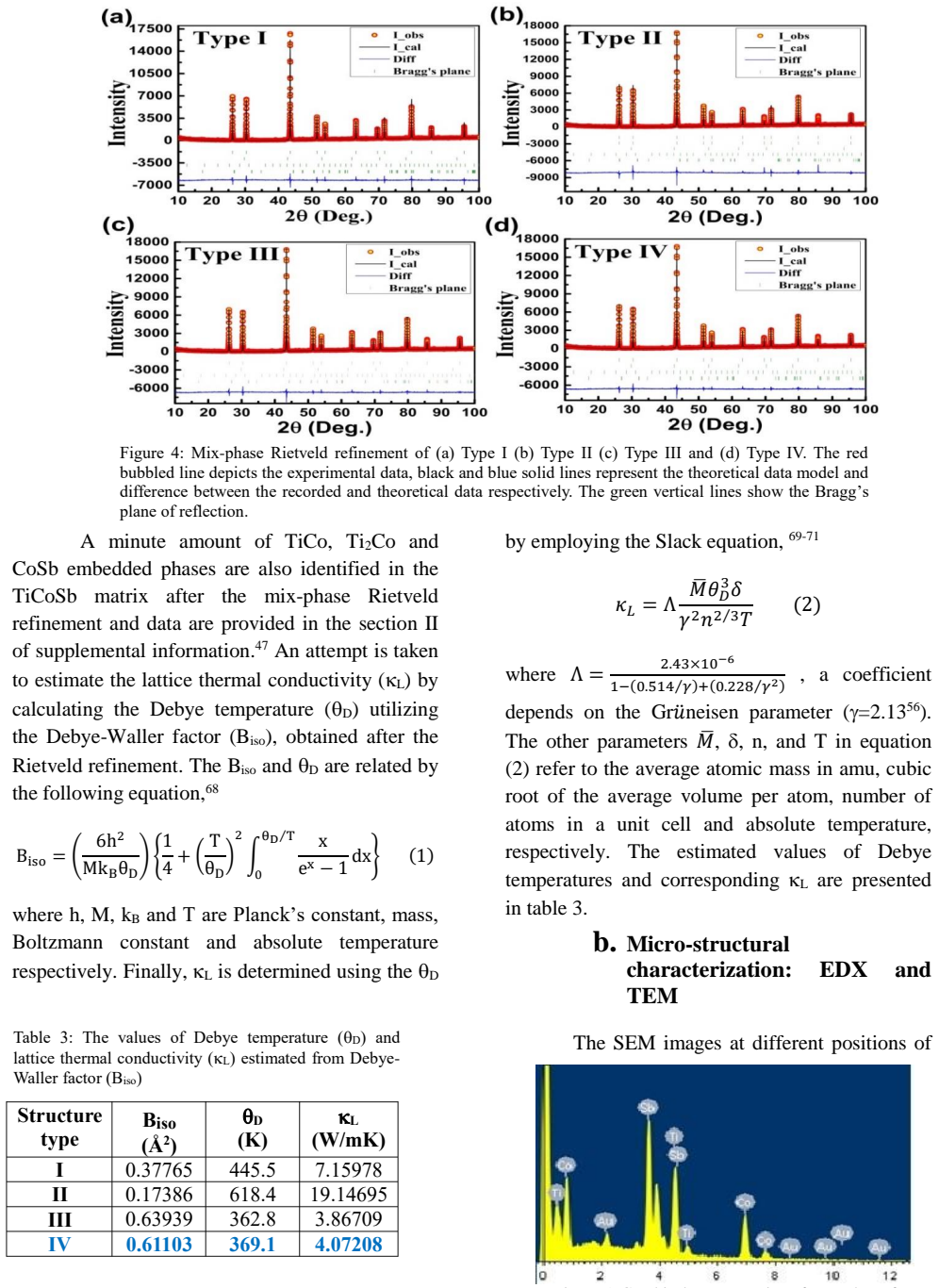
The most favorable structure of the synthesized TiCoSb half-Heusler alloy is explored theoretically and experimentally, and the best structure for thermoelectric conversion is reported. Rietveld refinement of the X-ray diffraction data employing four probable structures of the HH alloy is performed to obtain the best fit and identify the crystallized structure. However, microstructural characterization is performed using the energy dispersive X-ray spectroscopy and transmission electron microscopy to reveal the stoichiometry and Bragg reflection planes of the synthesized polycrystalline lattice structure of TiCoSb HH alloy. Theoretical investigation is performed by implementing the first principle calculation using the Full Potential Linearized Augmented Plane Wave method in the Quantum Espresso software package. The most probable structure is explored by estimating the minimum energy at equilibrium volume and electronic structure of the TiCoSb half-Heusler alloy of the four probable structures considered. The theoretical and experimental data are corroborated, and the most probable structure is identified for the crystallized TiCoSb HH alloy. The thermoelectric properties of the most probable structure are estimated.
Editorial analysis
A structured set of objections, weighed in public.
Referee Report
Summary. The paper investigates the most favorable structure of synthesized TiCoSb half-Heusler alloy by combining experimental Rietveld refinement of XRD data against four candidate structures, supported by EDX and TEM characterization for stoichiometry and lattice planes, with first-principles calculations to rank the structures by minimum energy at equilibrium volume and to compute electronic structure. The authors conclude that theory and experiment corroborate to identify the crystallized structure, for which thermoelectric properties are then estimated.
Significance. If the structure identification holds after correction, the work would contribute to materials design for thermoelectrics by linking a specific half-Heusler phase to estimated transport properties. The dual experimental-theoretical corroboration is a methodological strength when the calculations are on a sound basis.
major comments (1)
- Abstract: the claim that calculations used the 'Full Potential Linearized Augmented Plane Wave method in the Quantum Espresso software package' is factually incorrect. Quantum ESPRESSO implements pseudopotential plane-wave (or PAW) methods and contains no FP-LAPW implementation. Because the central claim rests on reliable minimum-energy ranking of the four structures to corroborate the Rietveld result, this misstatement directly undermines the credibility of the reported energies, volumes, and electronic structures used for identification and subsequent thermoelectric estimates.
minor comments (2)
- Abstract: no numerical values (energy differences, lattice parameters, Seebeck coefficients, or ZT estimates) or error metrics are provided, which makes it impossible to assess the magnitude of the energy ranking or the quality of the thermoelectric predictions.
- The four probable structures are referenced but not explicitly defined (e.g., by space group, Wyckoff positions, or literature citations) in the abstract, hindering immediate evaluation of the refinement and energy comparison.
Simulated Author's Rebuttal
We thank the referee for their careful reading of the manuscript and for identifying the error in the abstract. We address the comment below and will revise the manuscript to correct the misstatement while preserving the integrity of the reported results.
read point-by-point responses
-
Referee: Abstract: the claim that calculations used the 'Full Potential Linearized Augmented Plane Wave method in the Quantum Espresso software package' is factually incorrect. Quantum ESPRESSO implements pseudopotential plane-wave (or PAW) methods and contains no FP-LAPW implementation. Because the central claim rests on reliable minimum-energy ranking of the four structures to corroborate the Rietveld result, this misstatement directly undermines the credibility of the reported energies, volumes, and electronic structures used for identification and subsequent thermoelectric estimates.
Authors: We acknowledge the error in the abstract. Quantum ESPRESSO does not implement the FP-LAPW method, and the statement was a misstatement on our part. The calculations were performed using the plane-wave pseudopotential (PAW) approach as implemented in Quantum ESPRESSO. The full computational parameters, including pseudopotentials, energy cutoffs, and k-point meshes, are detailed in the Methods section of the manuscript. We have verified that the minimum-energy rankings, equilibrium volumes, and electronic structures for the four candidate structures were obtained consistently with these settings. We will revise the abstract (and ensure consistency elsewhere in the text) to correctly describe the method used. This correction does not alter the structure ranking or the thermoelectric property estimates, which remain based on the actual DFT results. revision: yes
Circularity Check
No circularity in derivation chain
full rationale
The paper's central claim rests on two independent lines of evidence: Rietveld refinement of experimental XRD data to rank four candidate structures by fit quality, and separate first-principles total-energy calculations to identify the minimum-energy structure among the same four candidates. These are then compared for corroboration. No equation, parameter fit, or self-citation reduces the theoretical minimum-energy ranking to a tautology of the experimental input or vice versa. The derivation chain contains no self-definitional steps, fitted-input predictions, or load-bearing self-citations.
Axiom & Free-Parameter Ledger
Lean theorems connected to this paper
-
IndisputableMonolith/Cost/FunctionalEquation.leanwashburn_uniqueness_aczel unclear?
unclearRelation between the paper passage and the cited Recognition theorem.
Theoretical investigation is performed by implementing the first principle calculation using the Full Potential Linearized Augmented Plane Wave method in the Quantum Espresso software package. The most probable structure is explored by estimating the minimum energy at equilibrium volume...
-
IndisputableMonolith/Foundation/RealityFromDistinction.leanreality_from_one_distinction unclear?
unclearRelation between the paper passage and the cited Recognition theorem.
The most probable structure is explored by estimating the minimum energy at equilibrium volume and electronic structure of the TiCoSb half-Heusler alloy of the four probable structures considered.
What do these tags mean?
- matches
- The paper's claim is directly supported by a theorem in the formal canon.
- supports
- The theorem supports part of the paper's argument, but the paper may add assumptions or extra steps.
- extends
- The paper goes beyond the formal theorem; the theorem is a base layer rather than the whole result.
- uses
- The paper appears to rely on the theorem as machinery.
- contradicts
- The paper's claim conflicts with a theorem or certificate in the canon.
- unclear
- Pith found a possible connection, but the passage is too broad, indirect, or ambiguous to say the theorem truly supports the claim.
Reference graph
Works this paper leans on
-
[1]
and 4b( 1 2 , 1 2 , 1 2), respectively, and no change in crystal structure owing to the pressure is reported. 1 However, theoretical analysis is also performed to Figure 1: Structure of XY2Z-type Heusler alloy 3 understand the underlying mechanism to enhance the ZT of TiCoSb-based HH alloys. H. C. Kandpal et al. have an alyzed the detailed electronic stru...
-
[2]
The studies mentioned in this section are limited to identifying the atomic positions of the crystallized TiCoSb and corresponding electronic and TE properties
and 4b( 1 2 , 1 2 , 1 2), and (ii) 4c ( 1 4 , 1 4 , 1 4), 4a (0, 0, 0,) and 4d ( 3 4 , 3 4 , 3 4).56 The theoretical and experimental studies of TiCoSb reveal that the atomic positions of the constituent atoms of TiCoSb may be different. The studies mentioned in this section are limited to identifying the atomic positions of the crystallized TiCoSb and co...
-
[3]
The analysis is a ccomplished by utilizing ImageJ software.59 A continuous Debye ring s in figure 6(a), the SAED pattern, of the synthesized TiCoSb compound is observed . A Debye ring is captured whenever the Debye cone, a cone of diffraction formed with the Bragg angles corresponding to the lattice planes, impinges upon the microscopic detector. 72 Howev...
-
[4]
In addition to this, the change in σ (Fig
Figure 13(a) represents the S (T). In addition to this, the change in σ (Fig. 13 (b)), 𝑒 (Supplemental Information fig.S4) and PF (fig. 13(c)) are calculated as a function of temperature. The PF (=S 2σ) (fig. 1 3(c)) shows a significant increase from 500K onwards. V. Conclusion The study reveals the crystal structure of the synthesized TiCoSb HH alloy am...
-
[5]
DOI: https://doi.org/10.1016/j.progsolidstchem.2011.02. 001. 16 (32) Bos, J. -W. G.; Downie, R. A. Half -Heusler thermoelectrics: a complex class of materials. Journal of Physics: Condensed Matter 2014, 26 (43), 433201. DOI: 10.1088/0953 - 8984/26/43/433201. (33) Poon, S. J. Half Heus ler compounds: promising materials for mid -to-high temperature thermoe...
-
[6]
(48) Xia, Y.; Ponnambalam, V.; Bhattacharya, S.; Pope, A
DOI: 10.2320/matertrans.46.1481. (48) Xia, Y.; Ponnambalam, V.; Bhattacharya, S.; Pope, A. L.; Poon, S. J.; Tritt, T. M. Electrical transport properties of TiCoSb half-Heusler phases that exhibit high resistivity. Journal of Physics: Condensed Matte r 2001, 13 (1), 77. DOI: 10.1088/0953-8984/13/1/308. (49) Sekimoto, T.; Kurosaki, K.; Muta, H.; Yamanaka, S...
-
[7]
Favorable half-Heusler structure of synthesized TiCoSb alloy: a theoretical and experimental study
DOI: https://doi.org/10.1016/j.ceramint.2017.12.180. (76) Verma, A. K.; Jain, S.; Johari, K. K.; Candolfi, C.; Lenoir, B.; Walia, S.; Dhakate, S. R.; Gahtori, B. Approaching the minimum lattice thermal conductivity in TiCoSb half -Heusler alloys by intensified point -defect phonon scattering. Materials Advances 2023, 4 (24), 6655- 6664, 10.1039/D3MA00923H...
-
[8]
(4) Yogamalar, R.; Srinivasan, R.; Vinu, A.; Ariga, K.; Bose, A
DOI: 10.1088/0370-1298/62/11/110. (4) Yogamalar, R.; Srinivasan, R.; Vinu, A.; Ariga, K.; Bose, A. C. X -ray peak broadening analysis in ZnO nanoparticles. Solid State Communications 2009, 149 (43), 1919 -1923. DOI: https://doi.org/10.1016/j.ssc.2009.07.043. Figure S3: TEM images of synthesized TiCoSb half -Heusler alloy, captured at different positions...
discussion (0)
Sign in with ORCID, Apple, or X to comment. Anyone can read and Pith papers without signing in.