Recognition: 2 theorem links
· Lean TheoremStochastic-Dimension Frozen Sampled Neural Network for High-Dimensional Gross-Pitaevskii Equations on Unbounded Domains
Pith reviewed 2026-05-10 16:53 UTC · model grok-4.3
The pith
A neural network with stochastic dimension selection and frozen random weights solves high-dimensional Gross-Pitaevskii equations at a cost independent of dimension.
A machine-rendered reading of the paper's core claim, the machinery that carries it, and where it could break.
Core claim
The SD-FSNN approximates solutions to high-dimensional nonlinear Gross-Pitaevskii equations by freezing randomly sampled hidden-layer weights and biases, selecting dimensions stochastically, and embedding a Gaussian ansatz, normalization projection, and energy-conservation constraint; the construction is unbiased in dimension and reduces computational complexity from linear in dimension to dimension-independent while preserving mass and energy.
What carries the argument
The stochastic-dimension frozen sampled neural network (SD-FSNN), which freezes randomly sampled hidden weights and biases, selects dimensions stochastically, and augments the network with a Gaussian-weighted ansatz, normalization projection layer, and energy constraint.
If this is right
- Computational cost remains constant rather than growing with spatial dimension.
- Training requires far less time than iterative gradient-based optimization of all network parameters.
- Mass is exactly preserved at every step through the normalization projection layer.
- Energy dissipation is reduced over long integration intervals by the explicit conservation constraint.
- The method applies uniformly across different interaction strengths without retuning the network architecture.
Where Pith is reading between the lines
- The same frozen-sampling and stochastic-dimension strategy may transfer to other high-dimensional nonlinear Schrödinger-type equations on unbounded domains.
- Because the method never optimizes the hidden parameters, it could serve as a fast surrogate for repeated solves in inverse problems or uncertainty quantification.
- The structure-preserving layers suggest a template for embedding other conservation laws directly into random-feature models for physics.
Load-bearing premise
Random sampling of hidden weights, biases, and dimensions will produce a reliable approximation to the GPE solution operator without problem-specific tuning or unacceptable variance in high dimensions.
What would settle it
Numerical tests in which the SD-FSNN error or variance grows markedly with increasing dimension, or in which mass or energy drifts appreciably during long-time integration, when compared against known exact or reference solutions.
Figures



read the original abstract
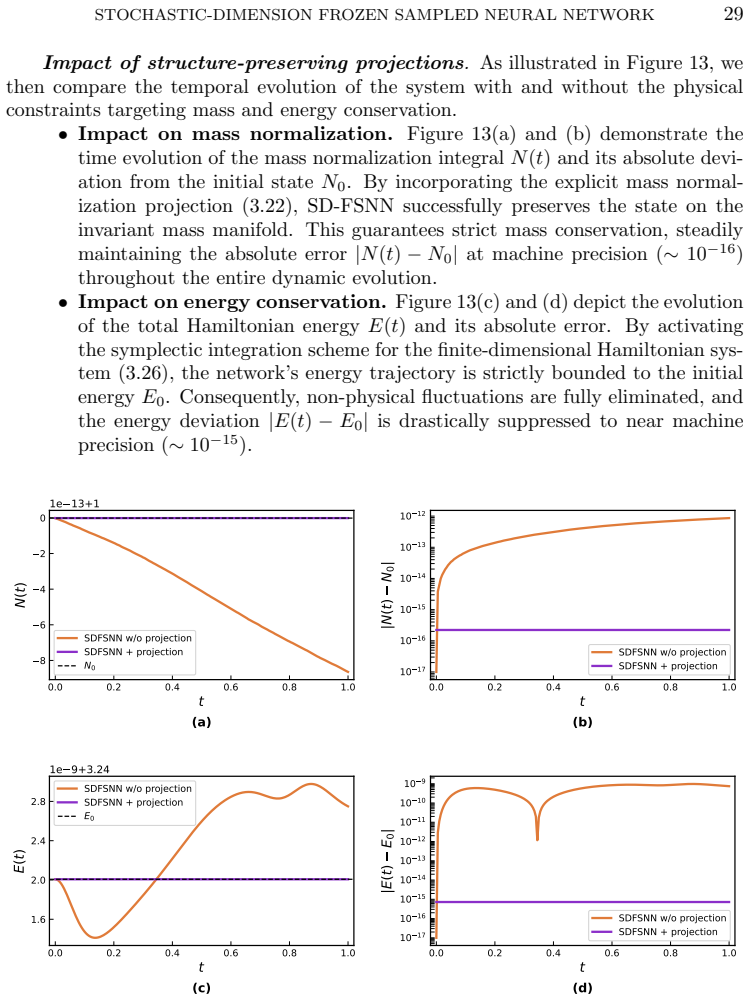
In this paper, we propose a stochastic-dimension frozen sampled neural network (SD-FSNN) for solving a class of high-dimensional Gross-Pitaevskii equations (GPEs) on unbounded domains. SD-FSNN is unbiased across all dimensions, and its computational cost is independent of the dimension, avoiding the exponential growth in computational and memory costs associated with Hermite-basis discretizations. Additionally, we randomly sample the hidden weights and biases of the neural network, significantly outperforming iterative, gradient-based optimization methods in terms of training time and accuracy. Furthermore, we employ a space-time separation strategy, using adaptive ordinary differential equation (ODE) solvers to update the evolution coefficients and incorporate temporal causality. To preserve the structure of the GPEs, we integrate a Gaussian-weighted ansatz into the neural network to enforce exponential decay at infinity, embed a normalization projection layer for mass normalization, and add an energy conservation constraint to mitigate long-time numerical dissipation. Comparative experiments with existing methods demonstrate the superior performance of SD-FSNN across a range of spatial dimensions and interaction parameters. Compared to existing random-feature methods, SD-FSNN reduces the complexity from linear to dimension-independent. Additionally, SD-FSNN achieves better accuracy and faster training compared to general high-dimensional solvers, while focusing specifically on high-dimensional GPEs on unbounded domains.
Editorial analysis
A structured set of objections, weighed in public.
Referee Report
Summary. The paper proposes a stochastic-dimension frozen sampled neural network (SD-FSNN) for solving high-dimensional Gross-Pitaevskii equations (GPEs) on unbounded domains. It claims SD-FSNN is unbiased across all dimensions with computational cost independent of dimension (avoiding exponential costs of Hermite bases), randomly samples hidden weights/biases to outperform iterative gradient-based optimization in training time and accuracy, uses space-time separation with adaptive ODE solvers for evolution coefficients and temporal causality, and incorporates a Gaussian-weighted ansatz, normalization projection layer, and energy conservation constraint to preserve mass and energy. Comparative experiments are said to demonstrate superior performance over existing methods, with complexity reduced from linear to dimension-independent relative to other random-feature approaches.
Significance. If the claims of dimension-independent cost/accuracy and controlled variance hold with supporting evidence, this could advance efficient numerical solution of high-dimensional nonlinear Schrödinger equations relevant to quantum many-body systems and Bose-Einstein condensates. The integration of random-feature sampling with structure-preserving elements (Gaussian decay, mass normalization, energy constraint) addresses the curse of dimensionality in a targeted way for unbounded-domain GPEs.
major comments (3)
- [SD-FSNN architecture and sampling description] The central claim that SD-FSNN is unbiased across dimensions with cost and accuracy independent of d requires that the Monte Carlo-style estimator from random hidden parameters and stochastic dimension selection has error/variance that remains controlled as d grows. For the cubic nonlinearity, random-feature approximations are unbiased only in expectation for linear operators; the nonlinear term couples coordinates, so variance typically scales with d unless neuron count or sampling distribution is explicitly scaled. No analysis or bounds are provided showing the number of samples can stay fixed while error stays O(1) in d.
- [Comparative experiments and results] The abstract states that comparative experiments demonstrate superior performance across dimensions and interaction parameters, but no quantitative error tables, convergence rates, or details on how the stochastic sampling variance is controlled appear in the results. This leaves the accuracy and dimension-independence claims resting on unshown empirical evidence.
- [Structure-preserving components] The Gaussian ansatz and normalization layer enforce decay and mass but do not bound sampling variance in the high-d feature space. No explicit scaling of the number of random features or sampled dimensions with d is given to support the dimension-independent cost claim.
minor comments (2)
- [Abstract] The abstract could more explicitly separate theoretical claims (unbiasedness, dimension independence) from empirical observations.
- [Method notation] Notation for the stochastic dimension selection process and the 'frozen' sampling of weights/biases could be clarified for reproducibility.
Simulated Author's Rebuttal
We thank the referee for the careful reading and valuable comments on our manuscript. We address each major comment below, indicating planned revisions where appropriate to strengthen the presentation of the SD-FSNN approach.
read point-by-point responses
-
Referee: The central claim that SD-FSNN is unbiased across dimensions with cost and accuracy independent of d requires that the Monte Carlo-style estimator from random hidden parameters and stochastic dimension selection has error/variance that remains controlled as d grows. For the cubic nonlinearity, random-feature approximations are unbiased only in expectation for linear operators; the nonlinear term couples coordinates, so variance typically scales with d unless neuron count or sampling distribution is explicitly scaled. No analysis or bounds are provided showing the number of samples can stay fixed while error stays O(1) in d.
Authors: We acknowledge that the manuscript does not include a formal variance bound for the nonlinear term. The stochastic dimension sampling draws a fixed number of coordinates independently of d, and the frozen random features are drawn from a Gaussian distribution chosen to match the expectation of the integral operator. The Gaussian-weighted ansatz and normalization projection further localize the approximation. While unbiasedness holds in expectation, we agree that explicit control of variance for the cubic nonlinearity merits additional discussion. We will add a subsection on sampling variance with supporting empirical plots of error versus d at fixed sample size. revision: yes
-
Referee: The abstract states that comparative experiments demonstrate superior performance across dimensions and interaction parameters, but no quantitative error tables, convergence rates, or details on how the stochastic sampling variance is controlled appear in the results. This leaves the accuracy and dimension-independence claims resting on unshown empirical evidence.
Authors: The current results section relies primarily on figures; we agree that tabulated quantitative metrics would make the claims more transparent. We will expand the experiments section to include tables reporting L2 errors, relative energy drift, and standard deviations over repeated runs for dimensions d = 2 to d = 10 and several interaction strengths, together with a short paragraph quantifying observed variance stability. revision: yes
-
Referee: The Gaussian ansatz and normalization layer enforce decay and mass but do not bound sampling variance in the high-d feature space. No explicit scaling of the number of random features or sampled dimensions with d is given to support the dimension-independent cost claim.
Authors: The dimension independence follows from keeping both the number of random features and the number of stochastically sampled dimensions fixed (independent of ambient d), with the expectation taken over the random selection. The Gaussian ansatz aids localization but is not claimed to bound variance by itself. We will revise the architecture description to state the fixed sample sizes explicitly and add a brief remark explaining why no d-dependent scaling is required, supported by the new variance plots mentioned above. revision: partial
Circularity Check
No circularity: SD-FSNN architecture properties and performance claims are independent of fitted inputs or self-referential definitions
full rationale
The paper introduces SD-FSNN via stochastic dimension selection, frozen random sampling of hidden weights/biases, Gaussian ansatz, normalization projection, and energy constraint. These are architectural choices whose dimension-independence and unbiasedness are asserted as direct consequences of the sampling and projection design rather than derived from any fitted parameter or prior result that loops back to the target GPE solution. No equations reduce a claimed prediction to a fitted quantity by construction, no uniqueness theorem is imported from self-citations, and no ansatz is smuggled via prior work. Comparative experiments against random-feature methods and high-dimensional solvers provide external validation instead of internal renaming or self-definition. The derivation chain remains self-contained.
Axiom & Free-Parameter Ledger
free parameters (2)
- number of sampled dimensions per step
- number of random features / hidden units
axioms (2)
- domain assumption The solution of the GPE decays exponentially at infinity, justifying the Gaussian-weighted ansatz.
- domain assumption Randomly sampled weights and biases provide a sufficiently rich function space for the evolution coefficients.
Lean theorems connected to this paper
-
IndisputableMonolith/Cost/FunctionalEquation.leanwashburn_uniqueness_aczel unclear?
unclearRelation between the paper passage and the cited Recognition theorem.
SD-FSNN ... randomly sample the hidden weights and biases ... stochastic dimension Laplacian estimator f∇²J ... unbiased ... mass normalization projection ... energy conservation constraint
-
IndisputableMonolith/Foundation/DimensionForcing.leanalexander_duality_circle_linking unclear?
unclearRelation between the paper passage and the cited Recognition theorem.
Gaussian-weighted ansatz ... exponential decay at infinity ... space-time separation ... adaptive ODE solvers
What do these tags mean?
- matches
- The paper's claim is directly supported by a theorem in the formal canon.
- supports
- The theorem supports part of the paper's argument, but the paper may add assumptions or extra steps.
- extends
- The paper goes beyond the formal theorem; the theorem is a base layer rather than the whole result.
- uses
- The paper appears to rely on the theorem as machinery.
- contradicts
- The paper's claim conflicts with a theorem or certificate in the canon.
- unclear
- Pith found a possible connection, but the passage is too broad, indirect, or ambiguous to say the theorem truly supports the claim.
Reference graph
Works this paper leans on
-
[1]
[1]J. R. Anglin and W. Ketterle,Bose–einstein condensation of atomic gases, Nature, 416 (2002), pp. 211–218. 34Z. Y. LIANG [2]W. Bao, D. Jaksch, and P. A. Markowich,Numerical solution of the gross–pitaevskii equation for bose–einstein condensation, Journal of Computational Physics, 187 (2003), pp. 318–342. [3]W. Bao, H. Li, and J. Shen,A generalized-lague...
2002
-
[2]
[5]C. Beck, S. Becker, P. Cheridito, A. Jentzen, and A. Neufeld,Deep splitting method for parabolic pdes, SIAM Journal on Scientific Computing, 43 (2021), pp. A3135–A3154. [6]C. Beck, W. E, and A. Jentzen,Machine learning approximation algorithms for high- dimensional fully nonlinear partial differential equations and second-order backward sto- chastic di...
2021
-
[3]
[8]C. Beck, F. Hornung, M. Hutzenthaler, A. Jentzen, and T. Kruse,Overcoming the curse of dimensionality in the numerical approximation of allen–cahn partial differential equations via truncated full-history recursive multilevel picard approximations, Journal of Numerical Mathematics, 28 (2020), pp. 197–222. [9]S. Becker, R. Braunwarth, M. Hutzenthaler, A...
-
[4]
[12]E. L. Bolager, I. Burak, C. Datar, Q. Sun, and F. Dietrich,Sampling weights of deep neural networks, Advances in neural information processing systems, 36 (2023), pp. 63075– 63116. [13]I. Buluta and F. Nori,Quantum simulators, Science, 326 (2009), pp. 108–111. [14]M. M. Cerimele, M. L. Chiofalo, F. Pistella, S. Succi, and M. P. Tosi,Numerical solution...
2023
-
[5]
[15]Q. Chan-Wai-Nam, J. Mikael, and X. Warin,Machine learning for semi linear pdes, Journal of scientific computing, 79 (2019), pp. 1667–1712. [16]P.-H. Chiu, J. C. Wong, C. Ooi, M. H. Dao, and Y.-S. Ong,Can-pinn: A fast physics- informed neural network based on coupled-automatic–numerical differentiation method, Computer Methods in Applied Mechanics and ...
-
[6]
[24]I. M. Georgescu, S. Ashhab, and F. Nori,Quantum simulation, Reviews of Modern Physics, 86 (2014), pp. 153–185, https://doi.org/10.1103/RevModPhys.86.153. [25]M. Greiner, O. Mandel, T. Esslinger, T. W. H ¨ansch, and I. Bloch,Quantum phase transition from a superfluid to a mott insulator in a gas of ultracold atoms, nature, 415 STOCHASTIC-DIMENSION FROZ...
-
[7]
[39]R. Li, H. Ye, D. Jiang, X. Wen, C. Wang, Z. Li, X. Li, D. He, J. Chen, W. Ren, et al.,A computational framework for neural network-based variational monte carlo with forward laplacian, Nature Machine Intelligence, 6 (2024), pp. 209–219. [40]Y. Liao, Z. Lin, J. Liu, Q. Sun, Y. Wang, T. Wu, and H. Xie,Solving schr\”{o}dinger equation using tensor neural...
-
[8]
[51]A. Rahimi and B. Recht,Random features for large-scale kernel machines, Advances in neural information processing systems, 20 (2007). [52]A. Rahimi and B. Recht,Uniform approximation of functions with random bases, in 2008 46th annual allerton conference on communication, control, and computing, IEEE, 2008, pp. 555–561. [53]M. Raissi,Forward–backward ...
discussion (0)
Sign in with ORCID, Apple, or X to comment. Anyone can read and Pith papers without signing in.