Tipiano: Cascaded Piano Hand Motion Synthesis via Fingertip Priors
Pith reviewed 2026-05-10 18:49 UTC · model grok-4.3
The pith
Piano hand motions can be synthesized realistically by first locking fingertip positions from geometry and fingering, then refining the rest of the arm.
A machine-rendered reading of the paper's core claim, the machinery that carries it, and where it could break.
Core claim
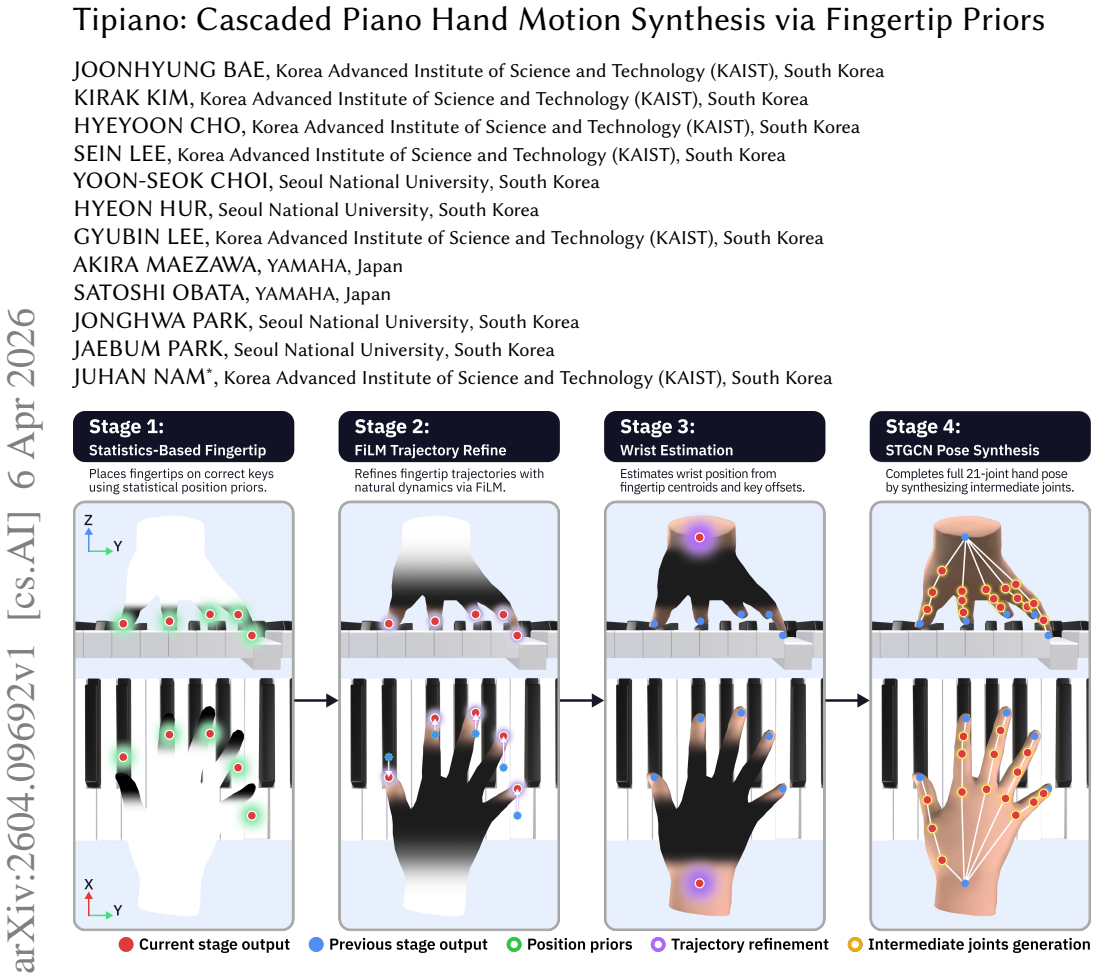
Piano motion exhibits a natural hierarchy: fingertip positions are nearly deterministic given piano geometry and fingering, while wrist and intermediate joints offer stylistic freedom. We present Tipiano, a four-stage framework exploiting this hierarchy: (1) statistics-based fingertip positioning, (2) FiLM-conditioned trajectory refinement, (3) wrist estimation, and (4) STGCN-based pose synthesis. Experiments demonstrate F1 = 0.910, substantially outperforming diffusion baselines (F1 = 0.121), with user study (N=41) confirming quality approaching motion capture.
What carries the argument
Four-stage cascaded pipeline that begins with statistics-based fingertip positioning from piano geometry and fingering, then applies FiLM-conditioned refinement, wrist estimation, and STGCN pose synthesis to produce full hand motion.
If this is right
- Finger positioning accuracy reaches F1 of 0.910, far above diffusion baselines at 0.121.
- User studies with 41 participants rate the resulting motions close to motion-capture quality.
- Professional pianists note anticipatory motion as the main remaining shortfall.
- The released expert-annotated fingerings cover 153 pieces totaling roughly 10 hours.
Where Pith is reading between the lines
- The same fingertip-first decomposition could reduce the data volume needed to train models for other precise hand-object tasks such as typing or string instruments.
- Integrating explicit future-key prediction might close the anticipatory-motion gap identified by experts.
- Because the first stage uses only geometry and fingering, the pipeline could run with minimal training data once a fingering estimator is available.
Load-bearing premise
Fingertip positions remain nearly fixed once the piano keys and chosen fingering are known, with most stylistic variation occurring higher in the arm.
What would settle it
Collect fingertip trajectories from multiple pianists playing identical passages with the same fingering on the same instrument; if fingertip paths diverge substantially beyond measurement noise, the deterministic prior collapses.
Figures


read the original abstract
Synthesizing realistic piano hand motions requires both precision and naturalness. Physics-based methods achieve precision but produce stiff motions; data-driven models learn natural dynamics but struggle with positional accuracy. Piano motion exhibits a natural hierarchy: fingertip positions are nearly deterministic given piano geometry and fingering, while wrist and intermediate joints offer stylistic freedom. We present [OURS], a four-stage framework exploiting this hierarchy: (1) statistics-based fingertip positioning, (2) FiLM-conditioned trajectory refinement, (3) wrist estimation, and (4) STGCN-based pose synthesis. We contribute expert-annotated fingerings for the F\"urElise dataset (153 pieces, ~10 hours). Experiments demonstrate F1 = 0.910, substantially outperforming diffusion baselines (F1 = 0.121), with user study (N=41) confirming quality approaching motion capture. Expert evaluation by professional pianists (N=5) identified anticipatory motion as the key remaining gap, providing concrete directions for future improvement.
Editorial analysis
A structured set of objections, weighed in public.
Referee Report
Summary. The paper claims to present Tipiano, a four-stage cascaded framework for synthesizing realistic piano hand motions by exploiting the natural hierarchy where fingertip positions are nearly deterministic given piano geometry and fingering, while wrist and intermediate joints provide stylistic freedom. The framework consists of statistics-based fingertip positioning, FiLM-conditioned trajectory refinement, wrist estimation, and STGCN-based pose synthesis. It contributes an expert-annotated fingering dataset for 153 Für Elise pieces (~10 hours). Experiments show an F1 score of 0.910, outperforming diffusion baselines (F1 = 0.121), supported by a user study with N=41 participants and expert evaluation by N=5 professional pianists, with anticipatory motion identified as a remaining challenge.
Significance. If the results hold, this work makes a significant contribution to the field of motion synthesis for musical performance by providing a principled way to combine deterministic priors with data-driven models for naturalness. The modular cascade allows for interpretability and targeted improvements. The dataset is a valuable resource. The quantitative and qualitative evaluations strengthen the claims, and the explicit identification of limitations (anticipatory motion) is commendable. This could influence future work in hierarchical motion generation.
major comments (2)
- The hierarchy assumption (fingertip determinism) is load-bearing for the four-stage design and the large performance gap versus diffusion baselines. The manuscript should include quantitative validation, such as measured variance or entropy of fingertip positions for identical notes across the dataset, to confirm the assumption holds strongly enough to justify the statistics-based stage over a learned alternative.
- Experiments section: the F1=0.910 result is central to the claim of substantial outperformance, but the definition of the F1 metric (e.g., what constitutes a true positive for fingertip contact or trajectory accuracy) and any statistical significance testing (p-values, confidence intervals) across the 153 pieces are not detailed; without these, the comparison to the diffusion baseline (F1=0.121) cannot be fully assessed.
minor comments (3)
- Define all acronyms (FiLM, STGCN) at first use and provide a brief description of the STGCN architecture and input features used in stage 4.
- User study (N=41) and expert evaluation (N=5): report the exact rating scales, questions posed to participants, and any inter-rater reliability measures to allow replication and strengthen the qualitative claims.
- Ensure the dataset contribution section includes details on annotation protocol, inter-annotator agreement for the expert fingerings, and release plan (e.g., license, access method).
Simulated Author's Rebuttal
We thank the referee for the positive evaluation, the recommendation for minor revision, and the constructive comments that will strengthen the manuscript. We address each major comment below and will update the paper accordingly.
read point-by-point responses
-
Referee: The hierarchy assumption (fingertip determinism) is load-bearing for the four-stage design and the large performance gap versus diffusion baselines. The manuscript should include quantitative validation, such as measured variance or entropy of fingertip positions for identical notes across the dataset, to confirm the assumption holds strongly enough to justify the statistics-based stage over a learned alternative.
Authors: We agree that explicit quantitative support for the fingertip determinism assumption would strengthen the justification for the cascaded design. In the revised manuscript we will add a dedicated analysis (new subsection in Section 4 or supplementary material) that reports the per-note variance in 3D fingertip coordinates and the entropy of fingertip position distributions for repeated identical note-fingering instances across the 153-piece dataset. These statistics will directly demonstrate the low variability that motivates the statistics-based first stage and help explain the performance difference relative to the diffusion baseline. revision: yes
-
Referee: Experiments section: the F1=0.910 result is central to the claim of substantial outperformance, but the definition of the F1 metric (e.g., what constitutes a true positive for fingertip contact or trajectory accuracy) and any statistical significance testing (p-values, confidence intervals) across the 153 pieces are not detailed; without these, the comparison to the diffusion baseline (F1=0.121) cannot be fully assessed.
Authors: We acknowledge that the current description of the F1 metric and associated statistical tests is insufficiently detailed. In the revised Experiments section we will (1) explicitly define the F1 computation, including the 5 mm Euclidean distance threshold used to determine true positives for fingertip contact and how trajectory accuracy is incorporated, and (2) report statistical significance results: mean F1 with standard deviation across the 153 pieces, p-values from paired t-tests against the diffusion baseline, and 95% confidence intervals. These additions will make the quantitative claims fully reproducible and assessable. revision: yes
Circularity Check
No significant circularity in the derivation chain
full rationale
The paper states an explicit domain assumption (fingertip positions nearly deterministic given geometry and fingering; wrist/joints stylistic) and designs a modular four-stage pipeline around it using standard components (statistics-based positioning, FiLM refinement, wrist estimation, STGCN synthesis). No equations, predictions, or first-principles results are shown to reduce to fitted inputs or self-citations by construction. Evaluation relies on independent baselines, a contributed expert-annotated dataset, and external user/expert studies rather than internal re-derivation. The chain is self-contained with empirical support.
Axiom & Free-Parameter Ledger
free parameters (2)
- FiLM conditioning parameters
- STGCN model weights
axioms (1)
- domain assumption Fingertip positions are nearly deterministic given piano geometry and fingering
Lean theorems connected to this paper
-
IndisputableMonolith/Foundation/AbsoluteFloorClosure.leanreality_from_one_distinction unclear?
unclearRelation between the paper passage and the cited Recognition theorem.
Piano motion exhibits a natural hierarchy: fingertip positions are nearly deterministic given piano geometry and fingering, while wrist and intermediate joints offer stylistic freedom. We present Tipiano, a four-stage framework exploiting this hierarchy: (1) statistics-based fingertip positioning, (2) FiLM-conditioned trajectory refinement, (3) wrist estimation, and (4) STGCN-based pose synthesis.
-
IndisputableMonolith/Cost/FunctionalEquation.leanwashburn_uniqueness_aczel unclear?
unclearRelation between the paper passage and the cited Recognition theorem.
Stage 1: Statistics-Based Fingertip Positioning... Position Prior Construction... Stage 4: STGCN-Based Hand Pose Synthesis
What do these tags mean?
- matches
- The paper's claim is directly supported by a theorem in the formal canon.
- supports
- The theorem supports part of the paper's argument, but the paper may add assumptions or extra steps.
- extends
- The paper goes beyond the formal theorem; the theorem is a base layer rather than the whole result.
- uses
- The paper appears to rely on the theorem as machinery.
- contradicts
- The paper's claim conflicts with a theorem or certificate in the canon.
- unclear
- Pith found a possible connection, but the passage is too broad, indirect, or ambiguous to say the theorem truly supports the claim.
Reference graph
Works this paper leans on
-
[1]
arXiv preprint arXiv:2506.23869 , year=
Scaling Self-Supervised Representation Learning for Symbolic Piano Perfor- mance. InarXiv preprint. https://arxiv.org/abs/2506.23869 Virginia Braun and Victoria Clarke. 2006. Using thematic analysis in psychology. Qualitative research in psychology3, 2 (2006), 77–101. Zicong Fan, Omid Taheri, Dimitrios Tzionas, Muhammed Kocabas, Manuel Kaufmann, Michael J...
-
[2]
InProceedings of the 33rd ACM International Conference on Multimedia(Dublin, Ireland)(MM ’25)
Separate to Collaborate: Dual-Stream Diffusion Model for Coordinated Piano Hand Motion Synthesis. InProceedings of the 33rd ACM International Conference on Multimedia(Dublin, Ireland)(MM ’25). Association for Computing Machinery, New York, NY, USA, 9743–9752. doi:10.1145/3746027.3755097 Nora McDonald, Sarita Schoenebeck, and Andrea Forte. 2019. Reliabilit...
discussion (0)
Sign in with ORCID, Apple, or X to comment. Anyone can read and Pith papers without signing in.