Numerical Modeling of Solvent Diffusion through the Transition Metal Dichalcogenides based Nanomaterials
Pith reviewed 2026-05-10 17:58 UTC · model grok-4.3
The pith
A numerical simulation of solvent diffusion in TMD nanomaterials using modified Fick's law establishes a correlation between peak Shannon entropy and the saturation of average nanoparticle size.
A machine-rendered reading of the paper's core claim, the machinery that carries it, and where it could break.
Core claim
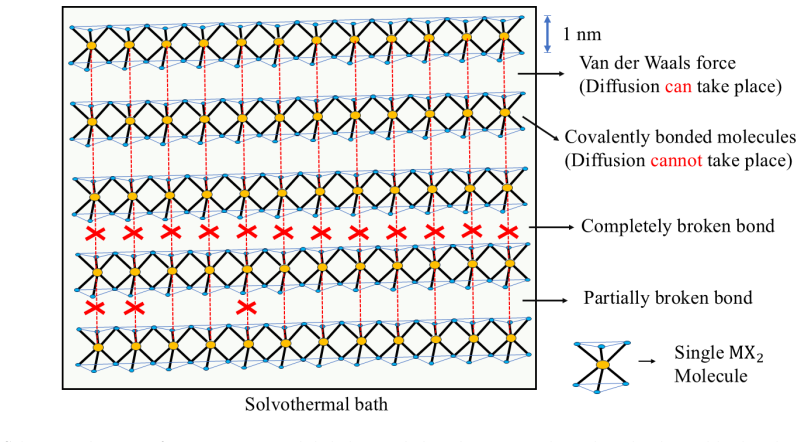
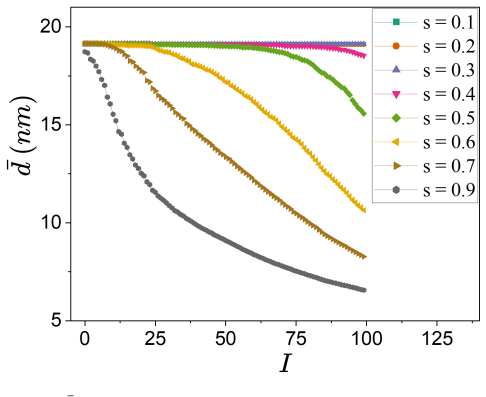
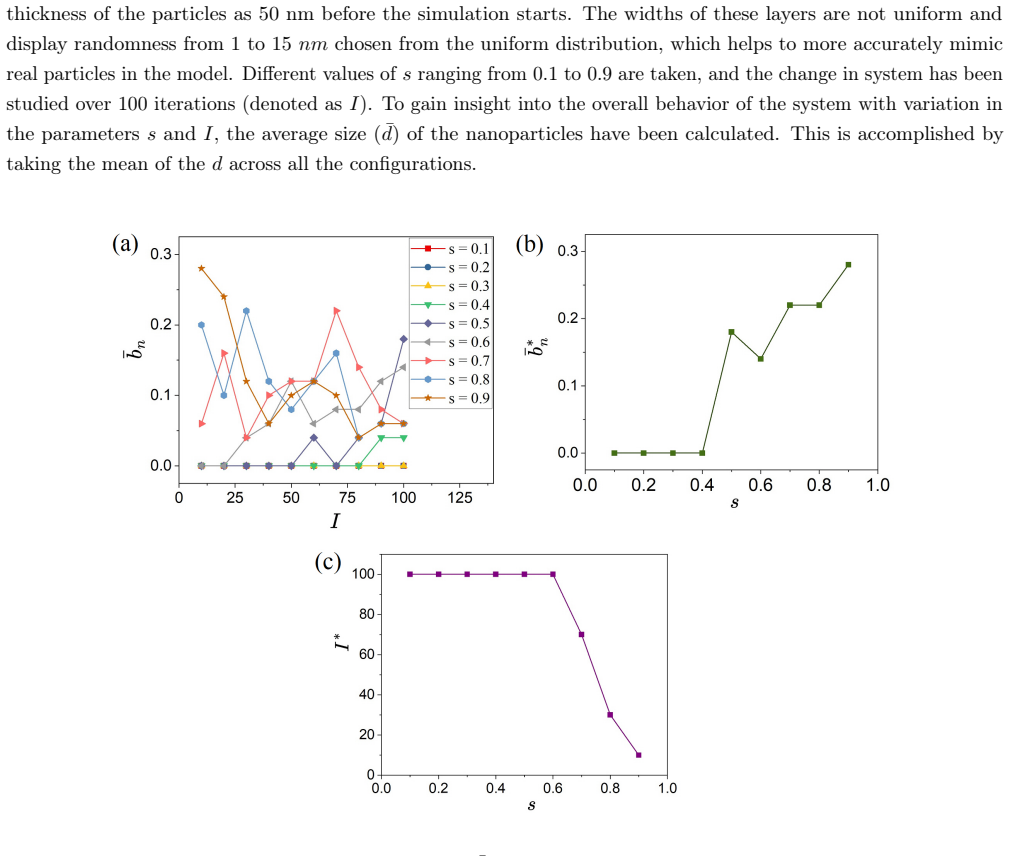
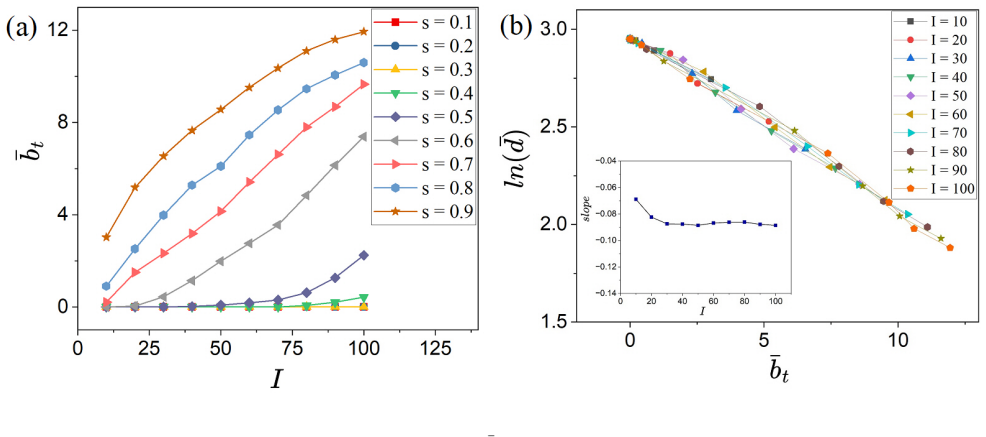
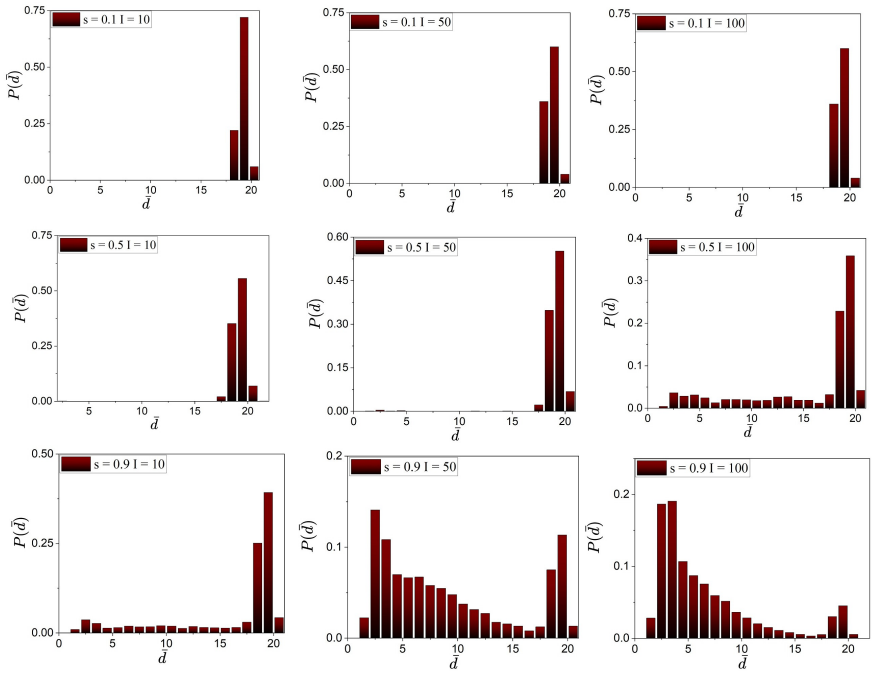
By solving modified Fick's law of diffusion and utilizing the dynamic bond percolation model, this study examines the evolution of a system of nanoparticles. During the simulation, the effects of key parameters, such as the diffusivity variable that determines the diffusion rate, and the number of iterations needed to achieve enhanced nanoparticle size uniformity, have been analyzed. Avalanche statistics and fluctuations in the average nanoparticle size by Shannon entropy have been utilized to gain insight into size evolution. The size distribution observed for different diffusivity variables and iterations predicts the probability of finding nanoparticles of specific sizes. A correlation is
What carries the argument
The modified Fick's law of diffusion combined with the dynamic bond percolation model, which governs solvent movement, layer exfoliation, and the resulting iteration-by-iteration changes in nanoparticle size distribution.
If this is right
- Diffusivity sets both the speed of size reduction and the number of iterations needed to reach uniform nanoparticle sizes.
- An iteration exists at which average particle size stabilizes, after which additional processing produces negligible further change.
- Size distributions at each iteration give the probability of finding particles of any chosen diameter in the ensemble.
- Solvent selectivity, diffusivity, and reaction time together determine the achievable nanoparticle size and uniformity for applications.
Where Pith is reading between the lines
- The identified saturation iteration could serve as a target endpoint for planning solvothermal experiments to obtain consistent TMD particle sizes.
- The same diffusion-plus-percolation framework might be adapted to model exfoliation and size control in other layered materials such as graphene or MXenes.
- Real-time entropy monitoring during synthesis could indicate when the nanoparticle population has reached practical stability.
Load-bearing premise
That the modified Fick's law combined with the dynamic bond percolation model fully captures solvent diffusion and layer exfoliation in TMD nanomaterials without missing other important physical effects.
What would settle it
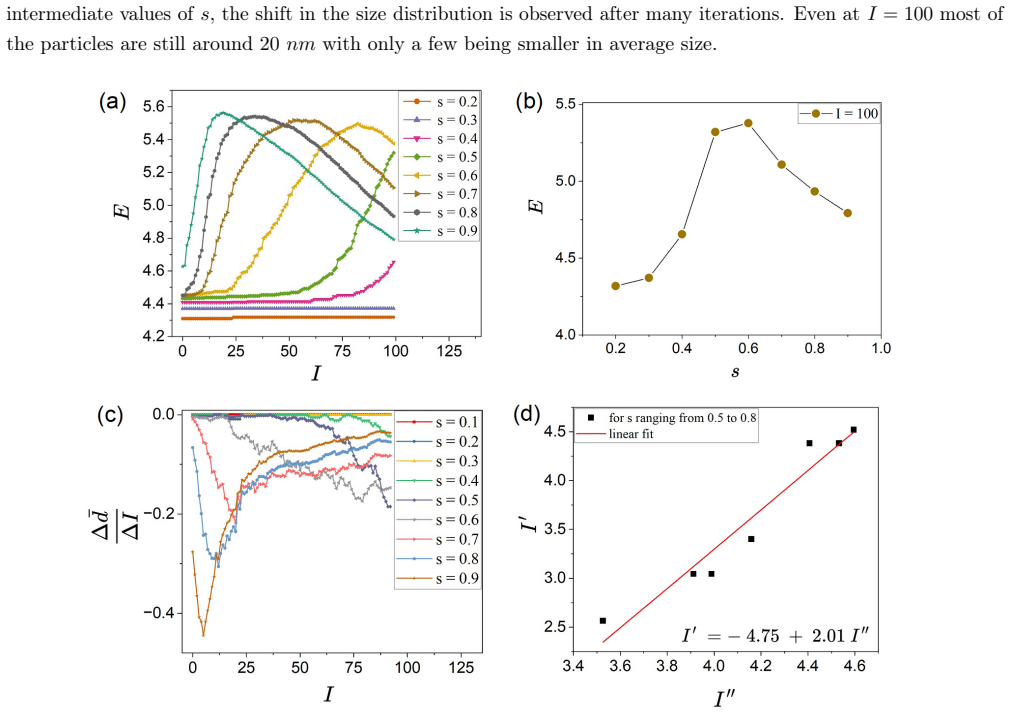
Laboratory measurements of nanoparticle size distributions at successive reaction times that fail to show both the predicted size probabilities for given diffusivities and the coincidence of maximum Shannon entropy with the minimum relative size change.
Figures
read the original abstract
This article presents a numerical simulation of solvent diffusion in transition metal dichalcogenide based nanomaterials during solvothermal reaction, leading to layer exfoliation and, consequently, a reduction in the average nanoparticle size. By solving modified Ficks law of diffusion and utilizing the dynamic bond percolation model, this study examines the evolution of a system of nanoparticles. During the simulation, the effects of key parameters, such as the diffusivity variable that determines the diffusion rate, and the number of iterations needed to achieve enhanced nanoparticle size uniformity, have been analyzed. To gain more insight into the size evolution of the nanoparticles, avalanche statistics, and fluctuations in the average nanoparticle size by Shannon entropy has been utilized. The size distribution observed for different diffusivity variables and iterations has also been studied, which predicts the probability of finding the nanoparticles of specific sizes within the system. A correlation between the iteration for maximum entropy and the minimum of relative change in particle size with iteration has been established, indicating that an iteration exists that takes the system towards saturation in terms of the average size of the nanoparticles. The numerical findings indicate that the experimental parameters, such as solvent selectivity and diffusivity, as well as reaction time, play significant roles in determining nanoparticle size and uniformity, thereby enhancing potential material applications.
Editorial analysis
A structured set of objections, weighed in public.
Referee Report
Summary. The paper presents a numerical simulation of solvent diffusion in transition metal dichalcogenide (TMD) nanomaterials using a modified Fick's law combined with a dynamic bond percolation model. The simulation tracks layer exfoliation and the resulting reduction in average nanoparticle size as a function of a diffusivity variable and iteration count. Shannon entropy is used to quantify fluctuations in size distributions, avalanche statistics are invoked for size evolution, and size distributions are examined for varying parameters. The central result is a reported correlation between the iteration at which Shannon entropy is maximized and the iteration at which the relative change in mean particle size reaches a minimum; this is interpreted as evidence that the system approaches saturation in average nanoparticle size. The abstract concludes that solvent selectivity, diffusivity, and reaction time control nanoparticle uniformity and thus material applications.
Significance. If the correlation survives changes in model details and is shown to be independent of the arbitrary diffusivity variable and iteration count, the work would supply a concrete numerical handle on how reaction time and solvent properties set the endpoint of exfoliation-driven size reduction in TMDs. Such a handle could guide experimental design of solvothermal processes for monodisperse few-layer flakes. At present the absence of any analytic limit, comparison to the unmodified Fick equation, or experimental size-distribution benchmark keeps the significance at the level of a methodological demonstration rather than a predictive physical result.
major comments (4)
- [Numerical Methods] The manuscript never states the explicit functional form of the 'modified Fick's law' or the precise rules of the dynamic bond percolation model (including how the percolation threshold is updated with solvent occupancy). Without these equations it is impossible to judge whether the observed coincidence between peak entropy and minimum size change is a generic feature of diffusion-driven exfoliation or an artifact of the particular discretization and the free diffusivity variable.
- [Results and Discussion] The central claim—that an iteration exists that drives the system toward saturation—is supported only by the correlation between the iteration of maximum Shannon entropy and the minimum of the relative size-change curve. Both quantities are computed from the same set of simulation runs whose only free parameters are the diffusivity variable and the total iteration count; no independent experimental size histogram or analytic steady-state solution is supplied to test whether the correlation persists when the functional form of diffusivity or the percolation update rule is altered.
- [Results] No convergence tests with respect to spatial or temporal discretization, no sensitivity analysis to the two free parameters, and no error bars on the entropy or size-change curves are reported. Because the diffusivity variable directly scales the diffusion rate and the iteration count is both the independent variable and the stopping criterion, the reported saturation behavior risks being an output of the chosen numerical scheme rather than a robust physical prediction.
- [Abstract and Conclusions] The abstract asserts that the numerical findings indicate the importance of 'solvent selectivity and diffusivity' for experimental nanoparticle uniformity, yet the simulation contains no explicit solvent-specific parameter beyond the scalar diffusivity variable and no mapping from simulated size distributions to measurable quantities such as XRD peak widths or AFM height histograms.
minor comments (2)
- [Abstract] The term 'avalanche statistics' is introduced in the abstract but never defined or connected to the entropy or size-change analysis in the text; a brief description of how avalanche sizes are extracted from the simulation would improve clarity.
- [Figure captions] Figure captions should explicitly state the values of the diffusivity variable and the total number of iterations used for each curve so that readers can reproduce the reported correlation.
Simulated Author's Rebuttal
We thank the referee for the constructive and detailed comments on our manuscript. These have prompted us to enhance the description of our numerical methods, provide additional validation, and clarify the implications of our findings. We address each major comment below and have made corresponding revisions to the manuscript.
read point-by-point responses
-
Referee: The manuscript never states the explicit functional form of the 'modified Fick's law' or the precise rules of the dynamic bond percolation model (including how the percolation threshold is updated with solvent occupancy). Without these equations it is impossible to judge whether the observed coincidence between peak entropy and minimum size change is a generic feature of diffusion-driven exfoliation or an artifact of the particular discretization and the free diffusivity variable.
Authors: We agree that the explicit forms of the modified Fick's law and the dynamic bond percolation model were not detailed sufficiently in the original manuscript. In the revised version, we now provide the complete mathematical expressions, including the solvent occupancy-dependent update for the percolation threshold. This addition allows readers to verify that the reported correlation arises from the underlying diffusion and exfoliation mechanics. revision: yes
-
Referee: The central claim—that an iteration exists that drives the system toward saturation—is supported only by the correlation between the iteration of maximum Shannon entropy and the minimum of the relative size-change curve. Both quantities are computed from the same set of simulation runs whose only free parameters are the diffusivity variable and the total iteration count; no independent experimental size histogram or analytic steady-state solution is supplied to test whether the correlation persists when the functional form of diffusivity or the percolation update rule is altered.
Authors: While the correlation is computed from the simulation data, we have now performed additional runs with modified diffusivity functions and altered percolation rules to test its persistence. The correlation holds, supporting our interpretation of saturation. We do not provide an analytic solution or experimental histograms in this numerical work, but the parameter variations offer independent numerical tests of the claim. revision: partial
-
Referee: No convergence tests with respect to spatial or temporal discretization, no sensitivity analysis to the two free parameters, and no error bars on the entropy or size-change curves are reported. Because the diffusivity variable directly scales the diffusion rate and the iteration count is both the independent variable and the stopping criterion, the reported saturation behavior risks being an output of the chosen numerical scheme rather than a robust physical prediction.
Authors: We have incorporated convergence tests for discretization parameters in the supplementary information, along with a comprehensive sensitivity analysis to the diffusivity variable and iteration count. Error bars, calculated from multiple independent simulation runs, have been added to the relevant figures. These revisions confirm that the saturation behavior is not an artifact of the numerical scheme. revision: yes
-
Referee: The abstract asserts that the numerical findings indicate the importance of 'solvent selectivity and diffusivity' for experimental nanoparticle uniformity, yet the simulation contains no explicit solvent-specific parameter beyond the scalar diffusivity variable and no mapping from simulated size distributions to measurable quantities such as XRD peak widths or AFM height histograms.
Authors: The diffusivity variable is intended to represent solvent-specific diffusion rates, and we have updated the abstract and conclusions to make this explicit. We have also added a discussion on how the simulated size distributions can be related to experimental observables like size histograms from AFM. Direct quantitative mappings are not included as this is a modeling study, but the implications for uniformity are clarified. revision: partial
- The provision of an analytic steady-state solution to the model equations or direct experimental benchmarks, since the manuscript is a numerical simulation study without an analytical derivation or experimental data.
Circularity Check
No significant circularity in the numerical modeling derivation.
full rationale
The paper sets up a numerical simulation by solving modified Fick's law together with a dynamic bond percolation model, treating diffusivity and iteration count as explicit input parameters. From the resulting trajectories it computes Shannon entropy on the size distribution and tracks relative changes in mean particle size, then reports an observed correlation between the iteration of peak entropy and the iteration of minimum size change. This correlation is an output of the post-processing step applied to the simulation data rather than a quantity defined in terms of itself or obtained by fitting a parameter to a subset and relabeling the result. No load-bearing self-citations, uniqueness theorems, or ansatzes imported from prior work by the same authors appear in the central claim, and the model equations are not shown to reduce the reported saturation behavior to a tautology. The derivation therefore remains self-contained as a modeling study whose findings are generated by the chosen dynamics rather than presupposed by the inputs.
Axiom & Free-Parameter Ledger
free parameters (2)
- diffusivity variable
- number of iterations
axioms (2)
- domain assumption Modified Fick's law governs solvent diffusion through TMD layers during solvothermal exfoliation
- domain assumption Dynamic bond percolation model accurately represents nanoparticle size evolution
Lean theorems connected to this paper
-
IndisputableMonolith/Cost/FunctionalEquation.leanwashburn_uniqueness_aczel unclear?
unclearRelation between the paper passage and the cited Recognition theorem.
By solving modified Fick’s law of diffusion and utilizing the dynamic bond percolation model... Shannon entropy... correlation between the iteration for maximum entropy and the minimum of relative change in particle size
-
IndisputableMonolith/Foundation/AbsoluteFloorClosure.leanreality_from_one_distinction unclear?
unclearRelation between the paper passage and the cited Recognition theorem.
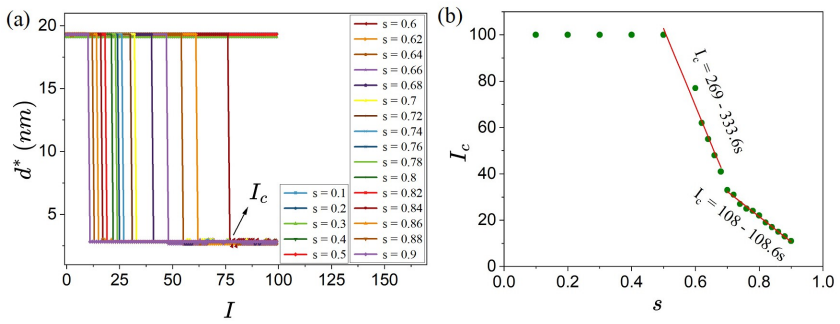
Variation in the average size (d̄) of the nanoparticles with respect to the number of iterations(I) for different diffusivity variables(s)
What do these tags mean?
- matches
- The paper's claim is directly supported by a theorem in the formal canon.
- supports
- The theorem supports part of the paper's argument, but the paper may add assumptions or extra steps.
- extends
- The paper goes beyond the formal theorem; the theorem is a base layer rather than the whole result.
- uses
- The paper appears to rely on the theorem as machinery.
- contradicts
- The paper's claim conflicts with a theorem or certificate in the canon.
- unclear
- Pith found a possible connection, but the passage is too broad, indirect, or ambiguous to say the theorem truly supports the claim.
Reference graph
Works this paper leans on
-
[1]
2D transition metal dichalcogenides
Manzeli, Sajedeh, Dmitry Ovchinnikov, Diego Pasquier, Oleg V. Yazyev, and Andras Kis. "2D transition metal dichalcogenides." Nature Reviews Materials 2, no. 8 (2017): 17033
work page 2017
-
[2]
Kumar, Raj, Chandrani Sarkar, Naveen Bunekar, Yogendra Kumar Mishra, and Ajeet Kaushik. "State-of-the-art transition metal dichalcogenides: Synthesis, functionalization, and biomedical applications." Materials Today (2025)
work page 2025
-
[3]
Cao, Xuanyu, Caiping Ding, Cuiling Zhang, Wei Gu, Yinghan Yan, Xinhao Shi, and Yuezhong Xian. "Transition metal dichalcogenide quantum dots: synthesis, photoluminescence and biological applications." Journal of materials chemistry B 6, no. 48 (2018): 8011-8036
work page 2018
-
[4]
Emerging trends in 2D materials: Beyond graphene for next-generation applications
Uddin, Mohsin, Sumaiya Sumaiya, Syed Muhammad Osama, and Syed Hassan Abbas. "Emerging trends in 2D materials: Beyond graphene for next-generation applications." Mechanics Exploration and Material Innovation 2, no. 1 (2025): 38-48
work page 2025
-
[5]
Size matters: why nanomaterials are different
Roduner, Emil. "Size matters: why nanomaterials are different." Chemical society reviews 35, no. 7 (2006): 583-592
work page 2006
-
[6]
Quantum dots and nanocomposites
Mansur, Herman Sander. "Quantum dots and nanocomposites." Wiley Interdisciplinary Reviews: Nanomedicine and Nanobiotechnology 2, no. 2 (2010): 113-129
work page 2010
-
[7]
Pratap, Surya. "A review on development in synthesis process, characteristics, and biological applications of transition metal dichalcogenides quantum dots." Tissue and Cell (2025): 103156
work page 2025
-
[8]
Properties and applications of quantum dots derived from two- dimensional materials
Abdelsalam, Hazem, and Qin Fang Zhang. "Properties and applications of quantum dots derived from two- dimensional materials." Advances in Physics: X 7, no. 1 (2022): 2048966. 12
work page 2022
-
[9]
Sahu, Geetika, Alle Pawan Kumar Reddy, R. K. Viswakannan, Aritra Chatterjee, Subhadeep Roy, and Souri Banerjee. "Experimental and Numerical Optimization of Mechanical Properties of PVA Nanocomposites With Molybdenum Disulfide Quantum Dots." Polymers for Advanced Technologies 37, no. 1 (2026): e70494
work page 2026
-
[10]
Quantum dots—characterization, preparation and usage in biological systems
Drbohlavova, Jana, Vojtech Adam, Rene Kizek, and Jaromir Hubalek. "Quantum dots—characterization, preparation and usage in biological systems." International journal of molecular sciences 10, no. 2 (2009): 656-673
work page 2009
-
[11]
Synthetic conditions for high-accuracy size control of PbS quantum dots
Zhang, Jianbing, Ryan W. Crisp, Jianbo Gao, Daniel M. Kroupa, Matthew C. Beard, and Joseph M. Luther. "Synthetic conditions for high-accuracy size control of PbS quantum dots." The journal of physical chemistry letters 6, no. 10 (2015): 1830-1833
work page 2015
-
[12]
Dependence of diffusion on temperature and pressure
Mehrer, Helmut. "Dependence of diffusion on temperature and pressure." Diffusion in solids: Fundamentals, methods, materials, diffusion-controlled processes (2007): 127-149
work page 2007
-
[13]
Sahu, Geetika, Chanchal Chakraborty, Subhadeep Roy, and Souri Banerjee. "Dependence of reaction time in hydrothermal synthesis of MoS2 quantum dots: An investigation using optical tools and fractal analysis." Journal of Crystal Growth 627 (2024): 127487
work page 2024
-
[14]
Sahu, Geetika, Chanchal Chakraborty, Subhadeep Roy, and Souri Banerjee. "Non-monotonic growth of MoS2 quantum dots observed through fractal analysis: role of precursor concentration on the overall growth dynamics." Physica Scripta 100, no. 5 (2025): 055931
work page 2025
-
[15]
Becker, John, Krishna Reddy Raghupathi, Jordan St. Pierre, Dan Zhao, and Ranjit T. Koodali. "Tuning of the crystallite and particle sizes of ZnO nanocrystalline materials in solvothermal synthesis and their photocatalytic activity for dye degradation." The Journal of Physical Chemistry C 115, no. 28 (2011): 13844-13850
work page 2011
-
[16]
Ramakrishnan, Venkatraman Madurai, Muthukumarasamy Natarajan, Agilan Santhanam, Vijayshankar Asokan, and Dhayalan Velauthapillai. "Size controlled synthesis of TiO2 nanoparticles by modified solvothermal method towards effective photo catalytic and photovoltaic applications." Materials Research Bulletin 97 (2018): 351-360
work page 2018
-
[17]
Solvothermal reactions: an original route for the synthesis of novel materials
Demazeau, Gérard. "Solvothermal reactions: an original route for the synthesis of novel materials." Journal of Materials Science 43, no. 7 (2008): 2104-2114
work page 2008
-
[18]
Kovács, Zoltán, Csanád Molnár, Urška Lavrenčič Štangar, Vasile-Mircea Cristea, Zsolt Pap, Klara Hernadi, and Lucian Baia. "Optimization method of the solvothermal parameters using Box–Behnken experimental Design—The case study of ZnO structural and catalytic tailoring." Nanomaterials 11, no. 5 (2021): 1334
work page 2021
-
[19]
Harris, Caroline S., A. Nitzan, Mark A. Ratner, and D. F. Shriver. "Particle motion through a dynamically disordered medium: The effects of bond correlation and application to polymer solid electrolytes." Solid State Ionics 18 (1986): 151-155
work page 1986
-
[20]
Exfoliation of MoS2 quantum dots: recent progress and challenges
Ali, Luqman, Fazle Subhan, Muhammad Ayaz, Syed Shams ul Hassan, Clare Chisu Byeon, Jong Su Kim, and Simona Bungau. "Exfoliation of MoS2 quantum dots: recent progress and challenges." Nanomaterials 12, no. 19 (2022): 3465
work page 2022
-
[22]
Druger, Stephen D., Abraham Nitzan, and Mark A. Ratner. "Dynamic bond percolation theory: A microscopic model for diffusion in dynamically disordered systems. I. Definition and one-dimensional case." The Journal of chemical physics 79, no. 6 (1983): 3133-3142. 13
work page 1983
-
[23]
A review on MoS2 properties, synthesis, sensing applications and challenges
Samy, Omnia, Shuwen Zeng, Muhammad Danang Birowosuto, and Amine El Moutaouakil. "A review on MoS2 properties, synthesis, sensing applications and challenges." Crystals 11, no. 4 (2021): 355
work page 2021
-
[24]
MoS2 quantum dots: synthesis, properties and biological applications
Guo, Yongming, and Jianwei Li. "MoS2 quantum dots: synthesis, properties and biological applications." Materials Science and Engineering: C 109 (2020): 110511
work page 2020
-
[25]
Mechanism investigation of synthesizing carbon quantum dots from coal by numerical simulation
Wang, Qi. "Mechanism investigation of synthesizing carbon quantum dots from coal by numerical simulation." PhD diss., 2022
work page 2022
-
[26]
The effects of chain segment motion on ionic diffusion in solid polymer electrolytes
Xu, Gu. "The effects of chain segment motion on ionic diffusion in solid polymer electrolytes." Solid state ionics 50, no. 3-4 (1992): 345-347
work page 1992
-
[27]
Solvent effect on synthesis of indium tin oxide nano-powders by a solvothermal process
Lee, Jin-Seok, and Sung-Churl Choi. "Solvent effect on synthesis of indium tin oxide nano-powders by a solvothermal process." Journal of the European Ceramic Society 25, no. 14 (2005): 3307-3314
work page 2005
-
[28]
Effect of solvent on diffusion: probing with nonpolar solutes
Chan, T. C., Irene Lee, and K. S. Chan. "Effect of solvent on diffusion: probing with nonpolar solutes." The Journal of Physical Chemistry B 118, no. 37 (2014): 10945-10955
work page 2014
-
[29]
Numerical Solution of Diffusion Equation by Finite Difference Method
Rahaman, M. M., M. Sikdar, M. B. Hossain, M. Rahaman, and M. J. Hossain. "Numerical Solution of Diffusion Equation by Finite Difference Method." IOSR J. Math. 11 (2015): 2278-5728
work page 2015
-
[30]
John, Bincy, G. Genifer Silvena, and A. Leo Rajesh. "Influence of reaction time on the structural, optical and electrical performance of copper antimony sulfide nanoparticles using solvothermal method." Physica B: Condensed Matter 537 (2018): 243-250
work page 2018
-
[31]
Wu, Shunnian, WP Cathie Lee, Hashan N. Thenuwara, and Ping Wu. "Quantitative criteria for solvent selection in Liquid-Phase exfoliation: balancing exfoliation and stabilization efficiency." Nanomaterials 15, no. 5 (2025): 370
work page 2025
-
[32]
Liquid exfoliation of defect-free graphene
Coleman, Jonathan N. "Liquid exfoliation of defect-free graphene." Accounts of chemical research 46, no. 1 (2013): 14-22
work page 2013
-
[33]
Loh, G. C., Ravindra Pandey, Yoke Khin Yap, and Shashi P. Karna. "MoS2 quantum dot: Effects of passivation, additional layer, and h-BN substrate on its stability and electronic properties." The Journal of Physical Chemistry C 119, no. 3 (2015): 1565-1574
work page 2015
-
[34]
Abreu, Barbara, Bernardo Almeida, Pedro Ferreira, Ricardo MF Fernandes, Diana M. Fernandes, and Eduardo F. Marques. "A critical assessment of the role of ionic surfactants in the exfoliation and stabilization of 2D nanosheets: The case of the transition metal dichalcogenides MoS2, WS2 and MoSe2." Journal of colloid and interface science 626 (2022): 167-177
work page 2022
-
[35]
Entropy, Shannon’s measure of information and Boltzmann’s H-theorem
Ben-Naim, Arieh. "Entropy, Shannon’s measure of information and Boltzmann’s H-theorem." Entropy 19, no. 2 (2017): 48. 14
work page 2017
discussion (0)
Sign in with ORCID, Apple, or X to comment. Anyone can read and Pith papers without signing in.