Symplectic Constraints in Classical Reaction Dynamics: From Gromov's Camel to Reaction Rates
Pith reviewed 2026-05-10 16:19 UTC · model grok-4.3
The pith
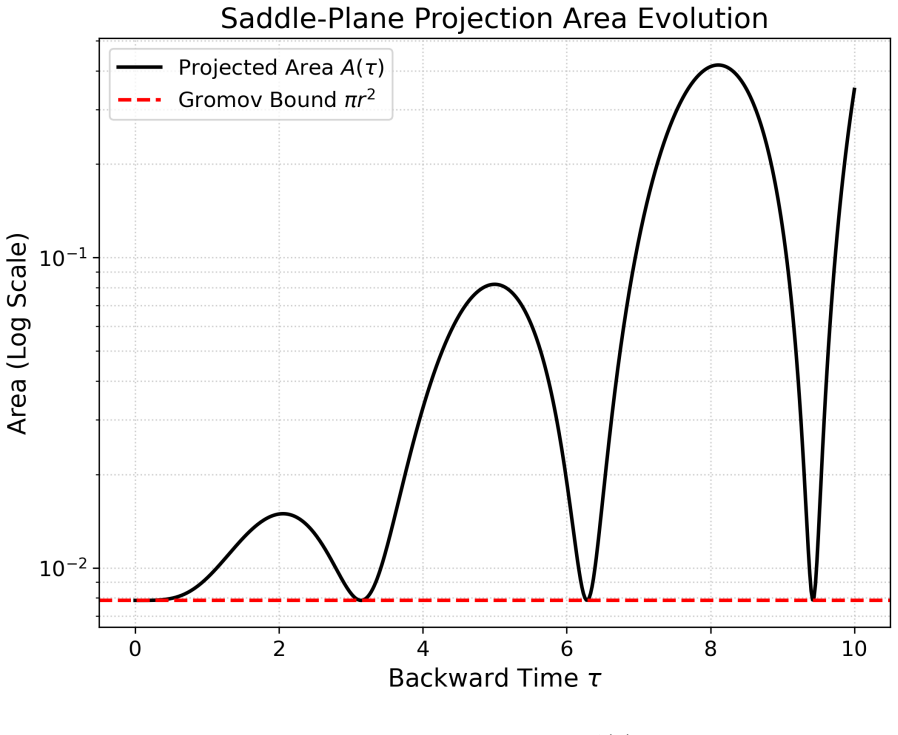
Symplectic width scales from bath actions can induce finite-time delays in classical reaction rates near saddles beyond volume or flux.
A machine-rendered reading of the paper's core claim, the machinery that carries it, and where it could break.
Core claim
The paper formulates candidate symplectic width scales based on transverse bath actions using high-order normal forms for anharmonic systems near the saddle. Backward propagation and bath-localized ensemble computations in these models are consistent with the claim that heavy bias of initial phase-space distributions toward high-action bath boundaries produces severe finite-time dynamical delays. These delays affect reactivity independently of measures based on total phase-space volume or flux alone, pointing to a symplectic-geometric origin for certain reaction bottlenecks.
What carries the argument
Candidate symplectic width scales formulated from transverse bath actions in high-order normal forms for anharmonic systems near the reaction bottleneck.
If this is right
- The geometry of bath modes imposes additional constraints on transport through the transition-state region that volume or flux measures overlook.
- Biasing initial ensembles toward high-action bath boundaries produces observable finite-time delays in reactivity.
- Mode selectivity can arise from symplectic width limits rather than solely from energetic or volumetric factors.
- The precise identification of these width scales with true symplectic capacities remains open and requires further mathematical work.
Where Pith is reading between the lines
- If the width scales prove to be capacities, then Gromov's non-squeezing theorem would supply explicit quantitative bounds on how much reactive ensembles can be compressed while crossing the saddle.
- The same normal-form construction might be applied to other Hamiltonian systems exhibiting index-1 saddles to test for analogous dynamical delays.
Load-bearing premise
The candidate symplectic width scales based on transverse bath actions in high-order normal forms correspond to genuine symplectic capacities of suitably defined reactive neighborhoods.
What would settle it
Direct computation of the symplectic capacity of the reactive neighborhood defined via the anharmonic normal form, followed by comparison to the bath-action width scale, would confirm or refute whether the scales match.
Figures


read the original abstract
We investigate whether ideas from symplectic topology, in particular Gromov's non-squeezing theorem and symplectic capacity, can provide useful geometric insight into classical reaction dynamics near an index-1 saddle. Using Poincar\'e-Birkhoff normal form theory, we describe the phase-space structures that organize transport through the transition-state region, including dividing surfaces, normally hyperbolic invariant manifolds (NHIMs), and the associated bath-action geometry. For quadratic saddle-center and saddle-center-center models, the normal-form geometry identifies natural bath-action area scales associated with the reactive bottleneck. For anharmonic systems (Eckart-Morse and Eckart-Morse-Morse), we formulate corresponding candidate symplectic width scales -- based on transverse bath actions -- using high-order normal forms for bounded local neighborhoods associated with the reaction bottleneck near the saddle. We then present two numerical illustrations: the backward propagation of a locally coupled phase-space ball to examine linear non-squeezing behavior, and a bath-localized ensemble calculation in an anharmonic normal-form model. These computations are consistent with the idea that heavily biasing the initial phase-space distribution of an ensemble toward the high-action boundaries of the bath modes can induce a severe finite-time dynamical delay, influencing reactivity in ways not captured by total phase-space volume or flux alone. The results suggest a new geometric perspective on mode selectivity and reaction bottlenecks, while highlighting open mathematical questions concerning the precise relation between these candidate width scales and genuine symplectic capacities of suitably defined reactive neighborhoods.
Editorial analysis
A structured set of objections, weighed in public.
Referee Report
Summary. The manuscript investigates whether symplectic topology ideas, specifically Gromov's non-squeezing theorem and symplectic capacities, can yield geometric insight into classical reaction dynamics near an index-1 saddle. Using Poincaré-Birkhoff normal form theory, it characterizes phase-space structures (dividing surfaces, NHIMs, bath-action geometry) for quadratic saddle-center and saddle-center-center models, then formulates candidate symplectic width scales based on transverse bath actions in high-order normal forms for anharmonic Eckart-Morse and Eckart-Morse-Morse systems. Two numerical illustrations are presented: backward propagation of a locally coupled phase-space ball to probe linear non-squeezing, and a bath-localized ensemble simulation. These are stated to be consistent with the notion that biasing initial distributions toward high-action bath-mode boundaries induces severe finite-time dynamical delays that affect reactivity beyond what total phase-space volume or flux alone would predict. The work highlights open questions on the precise relation of the candidate scales to genuine symplectic capacities of reactive neighborhoods.
Significance. If the candidate scales can be shown to correspond to true symplectic capacities, the approach would supply a new geometric lens on mode selectivity and reaction bottlenecks that is not reducible to conventional transition-state flux calculations. The explicit framing as exploratory, the use of normal-form constructions for bounded neighborhoods, and the open acknowledgment of unresolved mathematical questions are strengths. The numerical illustrations remain preliminary and qualitative, limiting immediate applicability to quantitative reaction-rate predictions.
major comments (2)
- [numerical illustrations section (abstract and §5)] The central consistency claim (biasing toward high-action bath boundaries induces dynamical delay beyond volume/flux) rests on the two numerical illustrations, yet the manuscript provides no quantitative metrics, error estimates, or direct comparisons (e.g., reactivity fractions or delay times versus unbiased ensembles). This weakens evidential support for the claim that the effect is not captured by total phase-space volume or flux alone.
- [formulation of candidate scales (abstract and §4)] The candidate symplectic width scales are constructed directly from transverse bath actions in the high-order normal forms for the Eckart-Morse models. While labeled 'candidate' and accompanied by open questions, the manuscript does not demonstrate that these scales are independent of the normal-form approximation itself; this leaves open whether they function as genuine symplectic invariants of the reactive neighborhoods or reduce to quantities internal to the same expansion.
minor comments (2)
- [§3 and §4] Notation for the bath-action variables and the precise definition of the 'bounded local neighborhoods' associated with the reaction bottleneck should be introduced earlier and used consistently across the quadratic and anharmonic cases.
- [abstract and introduction] The abstract and introduction would benefit from a brief statement of the precise open mathematical question (relation of candidate scales to true capacities) to guide readers unfamiliar with symplectic topology.
Simulated Author's Rebuttal
We thank the referee for the careful and constructive report, which accurately captures the exploratory scope of the work and its open questions. We address the two major comments point by point below, agreeing where revisions strengthen the manuscript and explaining our position on the formulation of the candidate scales.
read point-by-point responses
-
Referee: [numerical illustrations section (abstract and §5)] The central consistency claim (biasing toward high-action bath boundaries induces dynamical delay beyond volume/flux) rests on the two numerical illustrations, yet the manuscript provides no quantitative metrics, error estimates, or direct comparisons (e.g., reactivity fractions or delay times versus unbiased ensembles). This weakens evidential support for the claim that the effect is not captured by total phase-space volume or flux alone.
Authors: We agree that the numerical illustrations in §5 are qualitative and preliminary, as already indicated by the manuscript's phrasing ('consistent with the idea'). To strengthen the evidential basis, we will revise §5 to include quantitative metrics: reactivity fractions and mean finite-time transit delays for the high-action-biased ensembles versus unbiased controls, computed from 1000-trajectory Monte Carlo runs with standard-error estimates. These additions will directly compare against pure volume/flux predictions and make the consistency claim more robust. revision: yes
-
Referee: [formulation of candidate scales (abstract and §4)] The candidate symplectic width scales are constructed directly from transverse bath actions in the high-order normal forms for the Eckart-Morse models. While labeled 'candidate' and accompanied by open questions, the manuscript does not demonstrate that these scales are independent of the normal-form approximation itself; this leaves open whether they function as genuine symplectic invariants of the reactive neighborhoods or reduce to quantities internal to the same expansion.
Authors: The manuscript already labels the scales 'candidate' and explicitly flags the open question of their relation to genuine symplectic capacities (abstract and end of §4). We do not claim that the scales are proven invariants independent of the normal-form truncation; they are constructed within the local normal-form neighborhood precisely to probe the geometric content suggested by non-squeezing. Establishing full independence would require a direct symplectic-capacity computation on the reactive region, which remains a substantial open problem in symplectic topology for these models. We will add one clarifying sentence in §4 to emphasize that the scales are normal-form motivated candidates rather than asserted invariants. revision: partial
Circularity Check
No significant circularity detected
full rationale
The paper uses standard Poincaré-Birkhoff normal form theory to construct candidate symplectic width scales from transverse bath actions in local neighborhoods of the saddle. These are explicitly labeled 'candidate' scales, with the text noting unresolved questions on their relation to genuine symplectic capacities. The central claim is limited to numerical consistency of two illustrations (backward propagation of a phase-space ball and bath-localized ensemble) with a biasing-induced finite-time delay effect. This consistency is obtained from explicit computations rather than by algebraic reduction to the normal-form definitions. No load-bearing step equates a derived quantity to its input by construction, no self-citation chain is invoked to force uniqueness, and the work does not rename known results or smuggle ansatzes. The derivation chain remains self-contained against external benchmarks.
Axiom & Free-Parameter Ledger
free parameters (1)
- normal form truncation order
axioms (1)
- domain assumption Poincaré-Birkhoff normal form theory accurately captures the phase-space structures organizing transport through the transition-state region near an index-1 saddle.
invented entities (1)
-
candidate symplectic width scales
no independent evidence
Reference graph
Works this paper leans on
-
[1]
Wigner’s dynamical transition state theory in phase space: classical and quantum,
H. Waalkens, R. Schubert, and S. Wiggins, “Wigner’s dynamical transition state theory in phase space: classical and quantum,”Nonlinearity21, R1–R118 (2008)
work page 2008
-
[2]
The geometry of reaction dynamics,
T. Uzer, C. Jaffé, J. Palacian, P. Yanguas, and S. Wiggins, “The geometry of reaction dynamics,”Nonlinearity15, 957–992 (2002)
work page 2002
-
[3]
H. Waalkens, A. Burbanks, and S. Wiggins, “Efficient procedure to compute the microcanonical volume of initial conditions that lead to escape trajectories from a multidimensional potential well,”Phys. Rev. Lett.95, 084301 (2005). 26
work page 2005
-
[4]
H. Waalkens, A. Burbanks, and S. Wiggins, “A formula to compute the microcanoni- cal volume of reactive initial conditions in transition state theory,”J. Phys. A: Math. Gen.38, L759–L768 (2005)
work page 2005
-
[5]
H. Waalkens, A. Burbanks, and S. Wiggins, “Phase space conduits for reaction in multidimensional systems: HCN isomerization in three dimensions,”J. Chem. Phys. 121, 6207–6225 (2004)
work page 2004
-
[6]
Pseudo holomorphic curves in symplectic manifolds,
M. Gromov, “Pseudo holomorphic curves in symplectic manifolds,”Invent. Math.82, 307–347 (1985)
work page 1985
-
[7]
Symplectic topology and Hamiltonian dynamics I,
I. Ekeland and H. Hofer, “Symplectic topology and Hamiltonian dynamics I,”Math. Z.200, 355–378 (1989)
work page 1989
-
[8]
Symplectic topology and Hamiltonian dynamics II,
I. Ekeland and H. Hofer, “Symplectic topology and Hamiltonian dynamics II,”Math. Z.203, 553–567 (1990)
work page 1990
-
[9]
On the algebraic problem concerning the normal forms of linear dynamical systems,
J. Williamson, “On the algebraic problem concerning the normal forms of linear dynamical systems,”Amer. J. Math.58, 141–163 (1936)
work page 1936
-
[10]
H. Hofer and E. Zehnder,Symplectic Invariants and Hamiltonian Dynamics, Birkhäuser, Basel, 1994
work page 1994
-
[11]
de Gosson,Symplectic Geometry and Quantum Mechanics, Operator Theory: Advances and Applications, Vol
M. de Gosson,Symplectic Geometry and Quantum Mechanics, Operator Theory: Advances and Applications, Vol. 166, Birkhäuser, Basel, 2006
work page 2006
-
[12]
Symplectic capacities in two dimensions,
K. F. Siburg, “Symplectic capacities in two dimensions,”Manuscripta Math.78, 149–163 (1993)
work page 1993
-
[13]
Wiggins,Normally Hyperbolic Invariant Manifolds in Dynamical Systems, Springer, New York, 1994
S. Wiggins,Normally Hyperbolic Invariant Manifolds in Dynamical Systems, Springer, New York, 1994
work page 1994
-
[14]
S. Wiggins, V. J. García-Garrido, and M. Katsanikas,Phase Space Structures in Reaction Dynamics: A Dynamical Systems Approach, World Scientific, Singapore, 2025
work page 2025
-
[15]
Impenetrable barriers in phase- space,
S. Wiggins, L. Wiesenfeld, C. Jaffé, and T. Uzer, “Impenetrable barriers in phase- space,”Phys. Rev. Lett.86, 5478–5481 (2001)
work page 2001
-
[16]
Canonical transformations depending on a small parameter,
A. Deprit, “Canonical transformations depending on a small parameter,”Celest. Mech.1, 12–30 (1969)
work page 1969
-
[17]
D. McDuff and D. Salamon,Introduction to Symplectic Topology, 2nd ed., Oxford University Press, 1998
work page 1998
-
[18]
V. I. Arnold,Mathematical Methods of Classical Mechanics, 2nd ed., Springer-Verlag, New York, 1989
work page 1989
-
[19]
R. Abraham and J. E. Marsden,Foundations of Mechanics, 2nd ed., Ben- jamin/Cummings, Reading, MA, 1978
work page 1978
-
[20]
First steps in symplectic topology,
V. I. Arnold, “First steps in symplectic topology,”Russian Math. Surveys41, 1–21 (1986). 27
work page 1986
-
[21]
Microcanonical rates, gap times, and phase space dividing surfaces,
G. S. Ezra, H. Waalkens, and S. Wiggins, “Microcanonical rates, gap times, and phase space dividing surfaces,”J. Chem. Phys.130, 164118 (2009). 28
work page 2009
discussion (0)
Sign in with ORCID, Apple, or X to comment. Anyone can read and Pith papers without signing in.