Topological Magnon-Phonon Hybrid Bands in Ferromagnetic Skyrmion Crystals
Pith reviewed 2026-05-10 16:33 UTC · model grok-4.3
The pith
Coupling magnons to lattice vibrations in skyrmion crystals produces topological hybrid bands with nontrivial Chern numbers.
A machine-rendered reading of the paper's core claim, the machinery that carries it, and where it could break.
Core claim
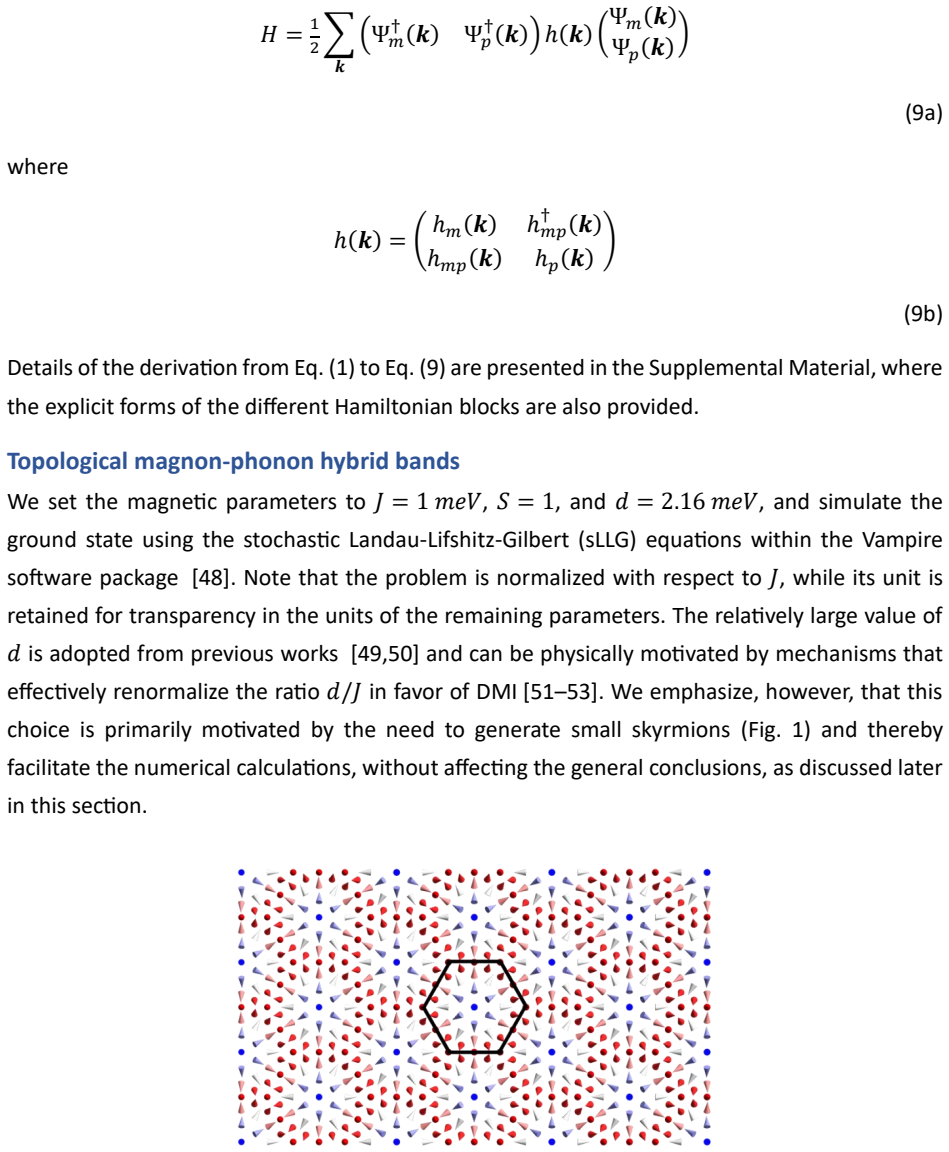
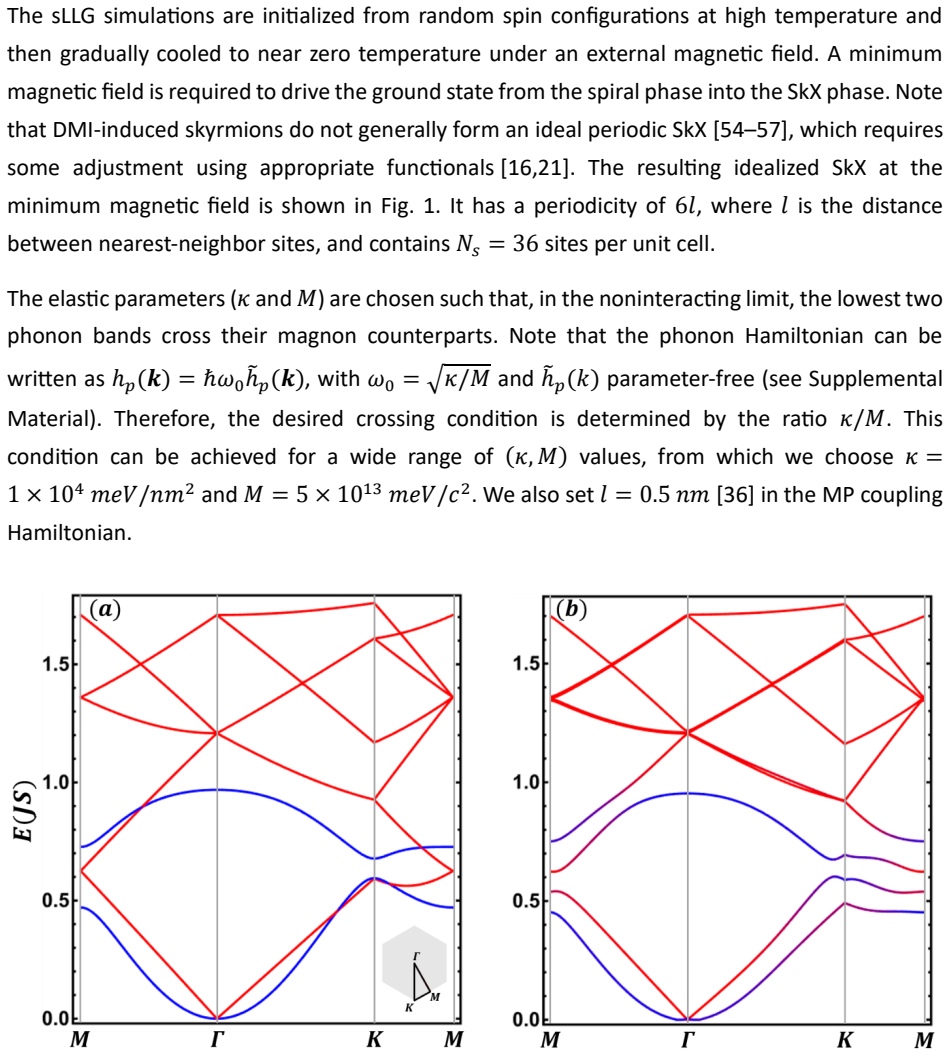
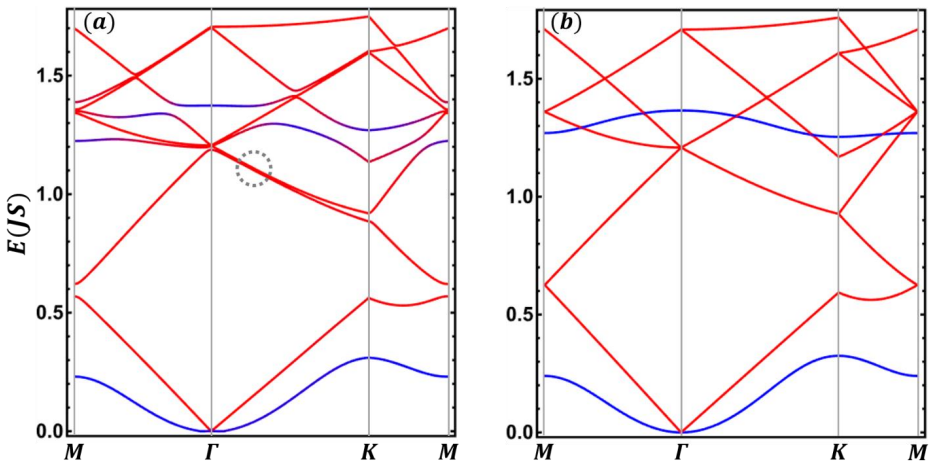
Although the lowest two magnon bands of the bare SkX are topologically trivial, coupling to lattice vibrations reconstructs the low-energy sector and generates topological MP hybrid bands. Starting from a spin-lattice Hamiltonian in which phonons couple to magnons through fluctuations of the DMI vectors, the bosonic Hamiltonian is derived and the hybrid band structure is computed by Bogoliubov diagonalization. MP coupling opens gaps at low-energy magnon-phonon crossings, lifts phonon degeneracies associated with supercell folding, and yields nontrivial Chern numbers for the lowest hybrid bands. The resulting low-energy topology and associated edge states remain robust under magnetic-field,
What carries the argument
The magnon-phonon coupling term arising from fluctuations of the Dzyaloshinskii-Moriya interaction vectors in the spin-lattice Hamiltonian, which is diagonalized via Bogoliubov transformation to produce hybrid bands whose topology is diagnosed by Chern numbers.
If this is right
- The lowest hybrid bands acquire nontrivial Chern numbers and host protected edge states.
- Low-energy topological features and edge states persist across a range of magnetic field strengths.
- Higher-energy hybrid bands can undergo topological phase transitions when the magnetic field is varied.
- The hybridization mechanism extends topological magnon-phonon physics to noncoplanar skyrmion crystals.
Where Pith is reading between the lines
- The field-robust low-energy topology could enable stable topological transport in devices exposed to fluctuating external fields.
- The same coupling mechanism might be tested in other noncoplanar magnetic textures beyond skyrmion crystals.
- Hybrid bands could couple mechanical vibrations directly to magnetic edge modes for new sensing or information-processing schemes.
Load-bearing premise
The magnon-phonon interaction is assumed to arise specifically from DMI vector fluctuations, and the Neel-type skyrmion crystal is assumed to remain stable on the triangular lattice for the chosen parameters.
What would settle it
Observation of trivial (zero) Chern numbers for the lowest hybrid bands or the absence of energy gaps at the predicted magnon-phonon crossing points in the spectrum would falsify the reconstruction into topological hybrids.
Figures
read the original abstract
We investigate magnon-phonon (MP) excitations in a Neel-type two-dimensional ferromagnetic skyrmion crystal (SkX) stabilized on a triangular spin lattice by Dzyaloshinskii-Moriya interaction (DMI). Although the lowest two magnon bands of the bare SkX are topologically trivial, we show that coupling to lattice vibrations reconstructs the low-energy sector and generates topological MP hybrid bands. Starting from a spin-lattice Hamiltonian in which phonons couple to magnons through fluctuations of the DMI vectors, we derive the bosonic Hamiltonian for the SkX and compute the hybrid band structure by Bogoliubov diagonalization. MP coupling opens gaps at low-energy magnon-phonon crossings, lifts phonon degeneracies associated with supercell folding, and yields nontrivial Chern numbers for the lowest hybrid bands. The resulting low-energy topology and associated edge states remain robust under magnetic-field variation, while higher-energy hybrid bands can undergo field-driven topological phase transitions. These results extend topological magnon-phonon hybridization to noncoplanar SkXs.
Editorial analysis
A structured set of objections, weighed in public.
Referee Report
Summary. The manuscript investigates magnon-phonon hybrid excitations in a Néel-type two-dimensional ferromagnetic skyrmion crystal stabilized on a triangular lattice by DMI. Starting from an explicit spin-lattice Hamiltonian, it derives the bosonic Hamiltonian incorporating MP coupling via DMI-vector fluctuations, performs Bogoliubov diagonalization to obtain the hybrid band structure, and computes Chern numbers, finding that MP coupling opens gaps at low-energy crossings, lifts phonon degeneracies from supercell folding, and produces nontrivial Chern numbers for the lowest hybrid bands. These low-energy topological features and associated edge states are reported to remain robust under magnetic-field variation, while higher-energy bands exhibit field-driven topological phase transitions.
Significance. If the central results hold, the work extends the framework of topological magnon-phonon hybridization from collinear or coplanar systems to noncoplanar skyrmion crystals, providing a concrete route to field-tunable topological bands in a realistic spin-lattice setting. The reported robustness of the low-energy topology to magnetic field changes would be a practically relevant feature for potential magnonic applications.
major comments (2)
- [§II] §II (Model Hamiltonian): The Néel-type SkX is posited as the classical ground state for the chosen J, D, and B parameters on the triangular lattice, but no classical energy minimization, Monte Carlo annealing, or direct comparison against competing phases (ferromagnetic, helical, or other SkX variants) is reported. This assumption is load-bearing because the magnon spectrum, the DMI-fluctuation coupling term, and all subsequent hybrid-band topology inherit directly from the assumed spin texture.
- [§III] §III (Bosonic Hamiltonian derivation): The explicit matrix elements of the magnon-phonon coupling arising from DMI-vector fluctuations under the supercell folding are not shown in sufficient detail. Without these, it is difficult to verify how the reported gap openings and degeneracy lifting at the low-energy crossings are obtained or to reproduce the Chern-number calculations.
minor comments (2)
- Figure captions for the hybrid band structures and edge-state plots should explicitly state the magnetic-field values and the supercell size used, to facilitate direct comparison with the robustness claims.
- A brief statement on the convergence of the Bogoliubov diagonalization with respect to the number of phonon modes retained would strengthen the numerical results.
Simulated Author's Rebuttal
We thank the referee for their thorough review and constructive feedback on our manuscript. We have carefully considered the major comments and provide point-by-point responses below, along with indications of revisions to be made in the updated version.
read point-by-point responses
-
Referee: [§II] §II (Model Hamiltonian): The Néel-type SkX is posited as the classical ground state for the chosen J, D, and B parameters on the triangular lattice, but no classical energy minimization, Monte Carlo annealing, or direct comparison against competing phases (ferromagnetic, helical, or other SkX variants) is reported. This assumption is load-bearing because the magnon spectrum, the DMI-fluctuation coupling term, and all subsequent hybrid-band topology inherit directly from the assumed spin texture.
Authors: We appreciate the referee highlighting this important point. The parameters were selected based on established results for Néel skyrmion crystals on triangular lattices stabilized by DMI, as in previous works. However, to address the concern directly, we have performed additional classical Monte Carlo simulations and energy minimization calculations. In the revised manuscript, we include a new subsection or appendix detailing these results, confirming that the Néel-type SkX is indeed the ground state for the chosen parameters, with lower energy than ferromagnetic, helical, or other configurations. This strengthens the foundation of our calculations. revision: yes
-
Referee: [§III] §III (Bosonic Hamiltonian derivation): The explicit matrix elements of the magnon-phonon coupling arising from DMI-vector fluctuations under the supercell folding are not shown in sufficient detail. Without these, it is difficult to verify how the reported gap openings and degeneracy lifting at the low-energy crossings are obtained or to reproduce the Chern-number calculations.
Authors: We agree that providing the explicit matrix elements would improve the clarity and reproducibility of our results. In the revised version, we have expanded the derivation in Section III to include the detailed expressions for the magnon-phonon coupling terms in the bosonic Hamiltonian, accounting for the supercell folding. These matrix elements are now explicitly written out, and we have added further explanations on how they lead to the gap openings and degeneracy lifting. Additionally, the full coupling matrices are provided in the Supplemental Material for completeness. revision: yes
Circularity Check
No circularity: derivation proceeds from explicit Hamiltonian via standard Bogoliubov diagonalization
full rationale
The paper starts from a defined spin-lattice Hamiltonian with explicit MP coupling via DMI vector fluctuations, assumes the Néel SkX configuration as input, derives the bosonic Hamiltonian, and computes hybrid bands and Chern numbers through standard Bogoliubov diagonalization. No predictions reduce to fitted parameters by construction, no self-citation chains bear the central topological claim, and no ansatz or uniqueness theorem is smuggled in. The low-energy topology is an output of the diagonalization, not equivalent to the inputs. The SkX stability assumption is a modeling premise, not a definitional loop.
Axiom & Free-Parameter Ledger
free parameters (2)
- DMI interaction strength
- magnetic field strength
axioms (2)
- domain assumption Neel-type SkX stabilized by DMI on triangular lattice
- domain assumption Phonon-magnon coupling occurs exclusively through DMI vector fluctuations
Reference graph
Works this paper leans on
-
[1]
S. Mühlbauer, B. Binz, F. Jonietz, C. Pfleiderer, A. Rosch, A. Neubauer, R. Georgii, and P . Böni, Skyrmion lattice in a chiral magnet, Science (1979). 323, 915 (2009)
work page 1979
- [2]
-
[3]
O. Petrova and O. Tchernyshyov, Spin waves in a skyrmion crystal, Phys. Rev. B Condens. Matter Mater. Phys. 84, 214433 (2011)
work page 2011
-
[4]
J. Iwasaki, A. J. Beekman, and N. Nagaosa, Theory of magnon-skyrmion scattering in chiral magnets, Phys. Rev. B Condens. Matter Mater. Phys. 89, 064412 (2014)
work page 2014
-
[5]
A. Roldán-Molina, A. S. Nunez, and J. Fernández-Rossier, Topological spin waves in the atomic-scale magnetic skyrmion crystal, New J. Phys. 18, 045015 (2016)
work page 2016
-
[6]
S. K. Kim, K. Nakata, D. Loss, and Y . Tserkovnyak, Tunable Magnonic Thermal Hall Effect in Skyrmion Crystal Phases of Ferrimagnets, Phys. Rev. Lett. 122, 057204 (2019)
work page 2019
-
[7]
T. Weber et al., Topological magnon band structure of emergent Landau levels in a skyrmion lattice, Science (1979). 375, 1025 (2022)
work page 1979
-
[8]
K. A. Van Hoogdalem, Y . Tserkovnyak, and D. Loss, Magnetic texture-induced thermal Hall effects, Phys. Rev. B Condens. Matter Mater. Phys. 87, 024402 (2013)
work page 2013
-
[9]
Mochizuki, Spin-Wave Modes and Their Intense Excitation Effects in Skyrmion Crystals, Phys
M. Mochizuki, Spin-Wave Modes and Their Intense Excitation Effects in Skyrmion Crystals, Phys. Rev. Lett. 108, 017601 (2012)
work page 2012
-
[10]
N. Nagaosa and Y . Tokura, Topological properties and dynamics of magnetic skyrmions, Nature Nanotechnology 2013 8:12 8, 899 (2013)
work page 2013
-
[11]
F. Zhuo, J. Kang, A. Manchon, and Z. Cheng, Topological Phases in Magnonics, Advanced Physics Research 2300054 (2023)
work page 2023
-
[12]
S. A. Díaz, J. Klinovaja, and D. Loss, Topological Magnons and Edge States in Antiferromagnetic Skyrmion Crystals, Phys. Rev. Lett. 122, 187203 (2019)
work page 2019
-
[13]
T. Hirosawa, S. A. Diaz, J. Klinovaja, and D. Loss, Magnonic Quadrupole Topological Insulator in Antiskyrmion Crystals, Phys. Rev. Lett. 125, 207204 (2020)
work page 2020
-
[14]
T. Hirosawa, A. Mook, J. Klinovaja, and D. Loss, Magnetoelectric Cavity Magnonics in Skyrmion Crystals, (2022)
work page 2022
-
[15]
A. Mook, J. Klinovaja, and D. Loss, Quantum damping of skyrmion crystal eigenmodes due to spontaneous quasiparticle decay, Phys. Rev. Res. 2, 033491 (2020)
work page 2020
-
[16]
D. Ghader and B. Jabakhanji, Momentum-space theory for topological magnons in two- dimensional ferromagnetic skyrmion lattices, Phys. Rev. B 110, 184409 (2024)
work page 2024
-
[17]
V. E. Timofeev and D. N. Aristov, Magnon band structure of skyrmion crystals and stereographic projection approach, Phys. Rev. B 105, 024422 (2022)
work page 2022
-
[18]
M. Akazawa, H. Y . Lee, H. Takeda, Y . Fujima, Y . Tokunaga, T. H. Arima, J. H. Han, and M. Yamashita, Topological thermal Hall effect of magnons in magnetic skyrmion lattice, Phys. Rev. Res. 4, 043085 (2022)
work page 2022
-
[19]
H. Takeda et al., Magnon thermal Hall effect via emergent SU(3) flux on the antiferromagnetic skyrmion lattice, Nature Communications 2024 15:1 15, 566 (2024)
work page 2024
-
[20]
V. E. Timofeev, Y . V. Baramygina, and D. N. Aristov, Magnon Topological Transition in Skyrmion Crystal, JETP Lett. 118, 911 (2023)
work page 2023
-
[21]
D. Ghader and B. Jabakhanji, Impact of the honeycomb spin lattice on topological magnons and edge states in ferromagnetic two-dimensional skyrmion crystals, Phys. Rev. B 113, 104430 (2026)
work page 2026
-
[22]
V. E. Timofeev, D. A. Bedyaev, and D. N. Aristov, Topological Transition in Spectrum of Skyrmion Crystal with Uniaxial Anisotropy, JETP Letters 2026 1 (2026)
work page 2026
-
[23]
S. A. Diáz, T. Hirosawa, J. Klinovaja, and D. Loss, Chiral magnonic edge states in ferromagnetic skyrmion crystals controlled by magnetic fields, Phys. Rev. Res. 2, 013231 (2020)
work page 2020
-
[24]
T. Kikkawa, K. Shen, B. Flebus, R. A. Duine, K. I. Uchida, Z. Qiu, G. E. W. Bauer, and E. Saitoh, Magnon Polarons in the Spin Seebeck Effect, Phys. Rev. Lett. 117, 207203 (2016)
work page 2016
- [25]
- [26]
-
[27]
D. A. Bozhko, V. I. Vasyuchka, A. V. Chumak, and A. A. Serga, Magnon-phonon interactions in magnon spintronics (Review article), Low Temperature Physics 46, 383 (2020)
work page 2020
-
[28]
R. Takahashi and N. Nagaosa, Berry Curvature in Magnon-Phonon Hybrid Systems, Phys. Rev. Lett. 117, 217205 (2016)
work page 2016
- [29]
-
[30]
G. Go, S. K. Kim, and K. J. Lee, Topological Magnon-Phonon Hybrid Excitations in Two- Dimensional Ferromagnets with Tunable Chern Numbers, Phys. Rev. Lett. 123, 237207 (2019)
work page 2019
-
[31]
P . Shen and S. K. Kim, Magnetic field control of topological magnon-polaron bands in two- dimensional ferromagnets, Phys. Rev. B 101, 125111 (2020)
work page 2020
-
[32]
S. Park and B. J. Yang, Topological magnetoelastic excitations in noncollinear antiferromagnets, Phys. Rev. B 99, 174435 (2019)
work page 2019
- [33]
- [34]
-
[35]
H. Huang and Z. Tian, Topological phonon-magnon hybrid excitations in a two- dimensional honeycomb ferromagnet, Phys. Rev. B 104, 064305 (2021)
work page 2021
-
[36]
S. Park, N. Nagaosa, and B. J. Yang, Thermal Hall Effect, Spin Nernst Effect, and Spin Density Induced by a Thermal Gradient in Collinear Ferrimagnets from Magnon–Phonon Interaction, Nano Lett. 20, 2741 (2020)
work page 2020
-
[37]
B. Sheikhi, M. Kargarian, and A. Langari, Hybrid topological magnon-phonon modes in ferromagnetic honeycomb and kagome lattices, Phys. Rev. B 104, 045139 (2021)
work page 2021
-
[38]
W. Dong, H. Wang, M. Baggioli, and Y . Liu, Topological magnetic phases and magnon- phonon hybridization in the presence of strong Dzyaloshinskii-Moriya interaction, Phys. Rev. B 113, 064413 (2026)
work page 2026
-
[39]
E. Thingstad, A. Kamra, A. Brataas, and A. Sudbø, Chiral Phonon Transport Induced by Topological Magnons, Phys. Rev. Lett. 122, 107201 (2019)
work page 2019
-
[40]
J. D. Mella, L. E. F. F. Torres, and R. E. Troncoso, Chiral magnon-polaron edge states in Heisenberg-Kitaev magnets, Phys. Rev. B 110, 104433 (2024)
work page 2024
-
[41]
G. Go, H. Yang, J. G. Park, and S. K. Kim, Topological magnon polarons in honeycomb antiferromagnets with spin-flop transition, Phys. Rev. B 109, 184435 (2024)
work page 2024
-
[42]
S. Liu et al., Direct Observation of Magnon-Phonon Strong Coupling in Two-Dimensional Antiferromagnet at High Magnetic Fields, Phys. Rev. Lett. 127, 097401 (2021)
work page 2021
-
[43]
T. T. Mai, K. F. Garrity, A. McCreary, J. Argo, J. R. Simpson, V. Doan-Nguyen, R. V. Aguilar, and A. R. Hight Walker, Magnon-phonon hybridization in 2D antiferromagnet MnPSe3, Sci. Adv. 7, (2021)
work page 2021
-
[44]
J. Luo et al., Evidence for Topological Magnon–Phonon Hybridization in a 2D Antiferromagnet down to the Monolayer Limit, Nano Lett. 23, 2023 (2023)
work page 2023
-
[45]
Bao et al., Direct observation of topological magnon polarons in a multiferroic material, Nat
S. Bao et al., Direct observation of topological magnon polarons in a multiferroic material, Nat. Commun. 14, 6093 (2023)
work page 2023
-
[46]
J. Cui et al., Chirality selective magnon-phonon hybridization and magnon-induced chiral phonons in a layered zigzag antiferromagnet, Nature Communications 2023 14:1 14, 3396 (2023)
work page 2023
-
[47]
J. Haraldsen and R. Fishman, Spin rotation technique for non-collinear magnetic systems: application to the generalizedVillain model, Journal of Physics: Condensed Matter 21, 216001 (2009)
work page 2009
-
[48]
R. F. L. Evans, W. J. Fan, P . Chureemart, T. A. Ostler, M. O. A. Ellis, and R. W. Chantrell, Atomistic spin model simulations of magnetic nanomaterials, Journal of Physics: Condensed Matter 26, 103202 (2014)
work page 2014
-
[49]
K. Mæland and A. Sudbø, Quantum topological phase transitions in skyrmion crystals, Phys. Rev. Res. 4, L032025 (2022)
work page 2022
-
[50]
K. Mæland and A. Sudbø, Quantum fluctuations in the order parameter of quantum skyrmion crystals, Phys. Rev. B 105, 224416 (2022)
work page 2022
-
[51]
E. A. Stepanov, S. A. Nikolaev, C. Dutreix, M. I. Katsnelson, and V. V. Mazurenko, Heisenberg-exchange-free nanoskyrmion mosaic, Journal of Physics: Condensed Matter 31, 17LT01 (2019)
work page 2019
-
[52]
E. A. Stepanov, C. Dutreix, and M. I. Katsnelson, Dynamical and Reversible Control of Topological Spin Textures, Phys. Rev. Lett. 118, 157201 (2017)
work page 2017
-
[53]
V. V. Mazurenko, Y . O. Kvashnin, A. I. Lichtenstein, and M. I. Katsnelson, A DMI Guide to Magnets Micro-World, Journal of Experimental and Theoretical Physics 2021 132:4 132, 506 (2021)
work page 2021
-
[54]
M. Ma, Z. Pan, and F. Ma, Artificial skyrmion in magnetic multilayers, J. Appl. Phys. 132, 043906 (2022)
work page 2022
-
[55]
Y . Li et al., An Artificial Skyrmion Platform with Robust Tunability in Synthetic Antiferromagnetic Multilayers, Adv. Funct. Mater. 30, 1907140 (2020)
work page 2020
-
[56]
B. Jabakhanji and D. Ghader, Designing Layered 2D Skyrmion Lattices in Moiré Magnetic Heterostructures, Adv. Mater. Interfaces 11, 2300188 (2024)
work page 2024
-
[57]
B. Jabakhanji and D. Ghader, Exploring moiré skyrmions in twisted double bilayer and double trilayer ${\mathbf{Cr}}{{\mathbf{I}}_{\mathbf{3}}}$, Journal of Physics: Condensed Matter 37, 075801 (2024)
work page 2024
-
[58]
J. H. P . Colpa, Diagonalization of the quadratic boson hamiltonian, Physica A: Statistical Mechanics and Its Applications 93, 327 (1978)
work page 1978
- [59]
-
[60]
H. Katsura, N. Nagaosa, and P . A. Lee, Theory of the thermal hall effect in quantum magnets, Phys. Rev. Lett. 104, 066403 (2010)
work page 2010
discussion (0)
Sign in with ORCID, Apple, or X to comment. Anyone can read and Pith papers without signing in.