Interplay of disorder and interaction in quantum Hall systems: from fractional quantum Hall liquids to Wigner crystals and amorphous solids
Pith reviewed 2026-05-10 15:42 UTC · model grok-4.3
The pith
Disorder in quantum Hall systems drives a crossover from incompressible liquids to locally ordered solids and then to amorphous states.
A machine-rendered reading of the paper's core claim, the machinery that carries it, and where it could break.
Core claim
The ground state evolves from an incompressible homogeneous fractional quantum Hall liquid to a generic locally ordered solid and eventually to a disordered amorphous solid at large disorder. Random charged impurities lead to longer-range crystalline ordering than short-range random disorder.
What carries the argument
Numerical modeling of classical Wigner crystals with point-charge impurities and of fractional quantum Hall liquids with random short-range potentials, using structure factors to track local and long-range order.
Load-bearing premise
The models treat charged impurities as classical point charges and short-range disorder as random potentials without specifying microscopic details of the host material or screening.
What would settle it
If STM imaging at high impurity density reveals persistent long-range crystalline peaks instead of ring-like or featureless structure factors, the predicted crossover to an amorphous solid would be contradicted.
Figures


read the original abstract
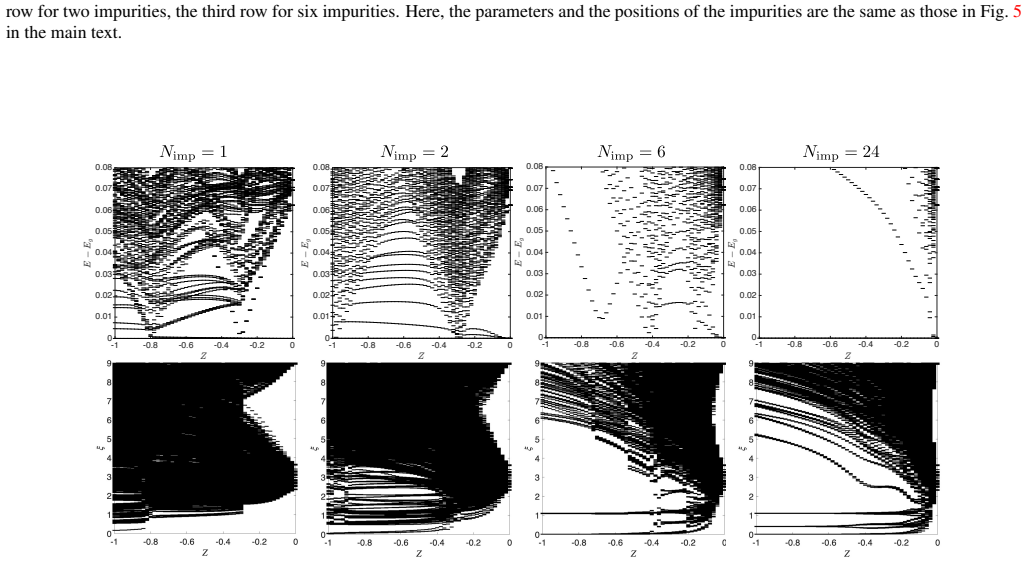
We investigate the interplay of disorder and interaction in two-dimensional electron systems in a strong magnetic field, focusing on the transition between Wigner crystals and fractional quantum Hall liquids. We first study classical Wigner crystals with charged impurities, revealing an evolution from a coherent crystal to local crystalline domains with short-range order and eventually to an amorphous state as impurity concentration increases. We then analyze noninteracting quantum electron crystals created by periodic potentials, showing that their structure factor exhibits both peaks and rings, distinct from classical Wigner crystals. Finally, we explore fractional quantum Hall liquids with random short-range disorder and quenched charged impurities, demonstrating that the ground state can evolve from an incompressible liquid to a localized ordered state and eventually to an amorphous state as disorder strength increases. In general, we find that random charged impurities lead to longer-range crystalline ordering than the short-range random disorder. Our findings highlight the rich interplay between disorder and interaction in quantum Hall systems and provide insights into experimental observations of these phenomena. By qualitative comparison with a recent STM experiment [Nature \textbf{628}, 287 (2024)], we conclude that the 2D system crosses over from an incompressible homogeneous fractional quantum Hall liquid to a generic locally ordered solid and eventually to a disordered amorphous solid at large disorder.
Editorial analysis
A structured set of objections, weighed in public.
Referee Report
Summary. The manuscript examines the interplay between disorder and electron-electron interactions in two-dimensional systems under strong magnetic fields. It reports three complementary numerical studies: classical Wigner crystals with charged impurities evolve from coherent crystals to locally ordered domains and then to amorphous solids with increasing impurity density; noninteracting quantum crystals in periodic potentials exhibit structure factors with both Bragg peaks and rings; and interacting fractional quantum Hall states with added short-range disorder and quenched impurities transition from incompressible liquids to localized ordered states and finally to amorphous solids. The authors find that charged impurities sustain longer-range order than short-range potentials and qualitatively link their results to a recent STM experiment, concluding a disorder-driven crossover from homogeneous FQH liquid to locally ordered solid to amorphous solid.
Significance. If substantiated, these findings illuminate the disorder-interaction competition in quantum Hall regimes, offering a unified picture spanning classical and quantum limits. The multi-method approach (classical Monte Carlo, noninteracting band structure, and exact diagonalization or DMRG for FQH) is a strength, and the direct connection to STM data provides timely experimental relevance. The observation that impurity type affects order range is a useful distinction for future modeling.
major comments (3)
- [Classical Wigner crystals with charged impurities] In the classical Wigner crystal calculations, charged impurities are treated as classical point charges. This choice directly controls the reported evolution from coherent crystal to local domains to amorphous state with rising impurity concentration. Because the effective range of the impurity potential depends on dielectric screening (absent from the model), the impurity densities at which long-range order collapses could shift under realistic GaAs or graphene screening lengths, rendering the sequence model-dependent rather than generic.
- [FQH liquids with random short-range disorder and quenched charged impurities] In the FQH section, the ground-state evolution from incompressible liquid to localized ordered state to amorphous solid is obtained by adding short-range random potentials plus quenched classical impurities. The manuscript does not report system sizes, number of disorder realizations, or quantitative diagnostics (structure-factor peak heights with uncertainties, or compressibility thresholds) used to locate the crossovers. Without these controls, finite-size artifacts cannot be ruled out as the origin of the claimed sequence.
- [Comparison with experiment] The final conclusion that the physical system follows the simulated crossover sequence rests on a qualitative comparison with the STM data of Nature 628, 287 (2024). No correlation lengths, order-parameter values, or other extractable metrics are provided from the simulations to enable a side-by-side quantitative test, leaving the experimental mapping at the level of visual resemblance.
minor comments (2)
- A side-by-side comparison of structure factors or real-space correlation functions for the two disorder types (charged impurities versus short-range potentials) would make the statement that 'random charged impurities lead to longer-range crystalline ordering' more immediately visible.
- Notation for disorder strength (impurity concentration versus potential amplitude) should be standardized across the classical and quantum sections to allow direct comparison of the reported thresholds.
Simulated Author's Rebuttal
We thank the referee for their careful reading of the manuscript and for the constructive comments on the classical, noninteracting, and interacting regimes. We address each major point below, indicating where additional details or discussion will be incorporated in a revised version.
read point-by-point responses
-
Referee: In the classical Wigner crystal calculations, charged impurities are treated as classical point charges. This choice directly controls the reported evolution from coherent crystal to local domains to amorphous state with rising impurity concentration. Because the effective range of the impurity potential depends on dielectric screening (absent from the model), the impurity densities at which long-range order collapses could shift under realistic GaAs or graphene screening lengths, rendering the sequence model-dependent rather than generic.
Authors: We agree that the model employs bare Coulomb interactions without explicit dielectric screening. The reported sequence arises from the competition between impurity pinning and electron repulsion; we expect the same qualitative progression (coherent crystal to domains to amorphous) to hold under screened potentials, although the critical impurity densities will shift. In the revised manuscript we will add a paragraph discussing the role of finite screening length and note that the evolution remains generic for the experimentally relevant regime. revision: partial
-
Referee: In the FQH section, the ground-state evolution from incompressible liquid to localized ordered state to amorphous solid is obtained by adding short-range random potentials plus quenched classical impurities. The manuscript does not report system sizes, number of disorder realizations, or quantitative diagnostics (structure-factor peak heights with uncertainties, or compressibility thresholds) used to locate the crossovers. Without these controls, finite-size artifacts cannot be ruled out as the origin of the claimed sequence.
Authors: We acknowledge that these technical specifications are necessary to evaluate robustness. The exact-diagonalization calculations used systems of up to 20 electrons, with averages over 50–100 disorder realizations (depending on disorder type). Crossovers were located by tracking the decay of the structure-factor peak height and the onset of finite compressibility. In the revised manuscript we will add a methods subsection reporting system sizes, realization counts, and quantitative diagnostics with error bars. revision: yes
-
Referee: The final conclusion that the physical system follows the simulated crossover sequence rests on a qualitative comparison with the STM data of Nature 628, 287 (2024). No correlation lengths, order-parameter values, or other extractable metrics are provided from the simulations to enable a side-by-side quantitative test, leaving the experimental mapping at the level of visual resemblance.
Authors: The comparison is qualitative because a quantitative mapping would require additional modeling of the STM tip and sample-specific parameters, which lies beyond the scope of the present work. We will revise the discussion to stress that the simulated patterns (homogeneous liquid, locally ordered domains, amorphous solid) reproduce the experimental phenomenology, and we will report correlation lengths extracted from the simulated structure factors to facilitate future quantitative comparisons. revision: partial
Circularity Check
No circularity; results from independent numerical simulations of model Hamiltonians
full rationale
The paper derives its claims through direct numerical evolution of three distinct model systems: classical Wigner crystals with point-charge impurities, noninteracting electrons in periodic potentials, and FQH states with added short-range random potentials plus quenched impurities. Transitions (coherent crystal to amorphous, incompressible liquid to localized ordered to amorphous) are observed by varying impurity concentration or disorder strength within each model. The final mapping to the STM experiment is a qualitative comparison only, with no parameter fitting, no equations that reduce outputs to inputs by construction, and no load-bearing self-citations. All steps remain self-contained within the stated model assumptions and numerical procedures.
Axiom & Free-Parameter Ledger
axioms (2)
- domain assumption Electrons in strong magnetic field can be modeled by effective 2D Hamiltonians with Coulomb interactions and added disorder potentials.
- ad hoc to paper Disorder can be represented either as random charged impurities or as short-range random potentials without microscopic lattice details.
Reference graph
Works this paper leans on
-
[1]
In Fig. 1(a), we show the commensurate structure forx= 26andy= 15. An impurity is attractive forZ <0and repulsive forZ >0. Nonetheless, attractive impurities are equivalent to repulsive ones in classical systems after combining with electrons. An attractive impurity of chargeZ <0trapsnelectrons and forms an impurity of effective chargeZ+n. As long as Z+n ...
-
[2]
D. C. Tsui, H. L. Stormer, and A. C. Gossard, Two-dimensional magnetotransport in the extreme quantum limit, Phys. Rev. Lett. 48, 1559 (1982)
work page 1982
-
[3]
H. L. Stormer, The fractional quantum Hall effect, Rev. Mod. 12 Phys.71, 875 (1999)
work page 1999
-
[4]
R. E. Prange and S. M. Girvin, eds.,The Quantum Hall Effect, 2nd ed., Graduate Texts in Contemporary Physics (Springer- Verlag, 1990)
work page 1990
-
[5]
S. Das Sarma and A. Pinczuk, eds.,Perspectives in Quan- tum Hall Effects: Novel Quantum Liquids in Low-Dimensional Semiconductor Structures(John Wiley & Sons, 1997)
work page 1997
-
[6]
B. I. Halperin and J. K. Jain, eds.,Fractional Quantum Hall Effects: New Developments(World Scientific, 2020)
work page 2020
-
[7]
Wigner, On the Interaction of Electrons in Metals, Phys
E. Wigner, On the Interaction of Electrons in Metals, Phys. Rev. 46, 1002 (1934)
work page 1934
-
[8]
R. B. Laughlin, Anomalous quantum hall effect: An incom- pressible quantum fluid with fractionally charged excitations, Phys. Rev. Lett.50, 1395 (1983)
work page 1983
-
[9]
D. Yoshioka, B. I. Halperin, and P. A. Lee, Ground State of Two-Dimensional Electrons in Strong Magnetic Fields and 1 3 Quantized Hall Effect, Phys. Rev. Lett.50, 1219 (1983)
work page 1983
-
[10]
P. K. Lam and S. M. Girvin, Liquid-solid transition and the frac- tional quantum-Hall effect, Phys. Rev. B30, 473 (1984)
work page 1984
-
[11]
D. Levesque, J. J. Weis, and A. H. MacDonald, Crystallization of the incompressible quantum-fluid state of a two-dimensional electron gas in a strong magnetic field, Phys. Rev. B30, 1056 (1984)
work page 1984
- [12]
- [13]
- [14]
-
[15]
K. Yang, F. D. M. Haldane, and E. H. Rezayi, Wigner crystals in the lowest Landau level at low-filling factors, Phys. Rev. B 64, 081301 (2001)
work page 2001
-
[16]
E. Y . Andrei, G. Deville, D. C. Glattli, F. I. B. Williams, E. Paris, and B. Etienne, Observation of a Magnetically Induced Wigner Solid, Phys. Rev. Lett.60, 2765 (1988)
work page 1988
-
[17]
V . J. Goldman, M. Santos, M. Shayegan, and J. E. Cunningham, Evidence for two-dimensional quantum Wigner crystal, Phys. Rev. Lett.65, 2189 (1990)
work page 1990
-
[18]
H. W. Jiang, R. L. Willett, H. L. Stormer, D. C. Tsui, L. N. Pfeiffer, and K. W. West, Quantum liquid versus electron solid aroundν= 1/5Landau-level filling, Phys. Rev. Lett.65, 633 (1990)
work page 1990
- [19]
-
[20]
A. Babbar, Z.-J. Li, and S. Das Sarma, Wigner solid or Anderson solid – 2D electrons in strong disorder (2026), arXiv:2601.03521 [cond-mat.mes-hall]
-
[21]
Disorder-induced strong-field strong-localization in 2D systems
Y . Huang and S. Das Sarma, Disorder-induced strong-field strong-localization in 2D systems (2026), arXiv:2601.09687 [cond-mat.mes-hall]
work page internal anchor Pith review Pith/arXiv arXiv 2026
-
[22]
Y .-C. Tsui, M. He, Y . Hu, E. Lake, T. Wang, K. Watanabe, T. Taniguchi, M. P. Zaletel, and A. Yazdani, Direct observa- tion of a magnetic-field-induced Wigner crystal, Nature628, 287 (2024)
work page 2024
-
[23]
D. N. Sheng, X. Wan, E. H. Rezayi, K. Yang, R. N. Bhatt, and F. D. M. Haldane, Disorder-Driven Collapse of the Mobility Gap and Transition to an Insulator in the Fractional Quantum Hall Effect, Phys. Rev. Lett.90, 256802 (2003)
work page 2003
-
[24]
S. M. Girvin, A. H. MacDonald, and P. M. Platzman, Magneto- roton theory of collective excitations in the fractional quantum Hall effect, Phys. Rev. B33, 2481 (1986)
work page 1986
-
[25]
A. Sterdyniak, N. Regnault, and B. A. Bernevig, Extracting Ex- citations from Model State Entanglement, Phys. Rev. Lett.106, 100405 (2011)
work page 2011
-
[26]
S. Das Sarma, E. H. Hwang, S. Kodiyalam, L. N. Pfeiffer, and K. W. West, Transport in two-dimensional modulation-doped semiconductor structures, Phys. Rev. B91, 205304 (2015)
work page 2015
-
[27]
E. H. Hwang and S. Das Sarma, Limit to two-dimensional mo- bility in modulation-doped GaAs quantum structures: How to achieve a mobility of 100 million, Phys. Rev. B77, 235437 (2008)
work page 2008
- [28]
-
[29]
F. C. Zhang, V . Z. Vulovic, Y . Guo, and S. Das Sarma, Effect of a charged impurity on the fractional quantum Hall effect: Exact numerical treatment of finite systems, Phys. Rev. B32, 6920 (1985)
work page 1985
-
[30]
E. H. Rezayi and F. D. M. Haldane, Incompressible states of the fractionally quantized Hall effect in the presence of impurities: A finite-size study, Phys. Rev. B32, 6924 (1985)
work page 1985
-
[31]
N. Mostaan, N. Goldman, A. ˙Imamo˘glu, and F. Grusdt, Anyon- Trions in Atomically Thin Semiconductor Heterostructures, PRX Quantum7, 010325 (2026)
work page 2026
-
[32]
G. Wagner and T. Neupert, Sensing the binding and unbinding of anyons at impurities, Phys. Rev. Research8, 013263 (2026)
work page 2026
- [33]
-
[34]
Y . Imry and S.-K. Ma, Random-Field Instability of the Or- dered State of Continuous Symmetry, Phys. Rev. Lett.35, 1399 (1975)
work page 1975
-
[35]
A. I. Larkin, Effect of inhomogeneities on the structure of the mixed state of superconductors, Sov. Phys. JETP31, 784 (1970)
work page 1970
-
[36]
A. I. Larkin and Y . N. Ovchinnikov, Pinning in type II super- conductors, J. Low Temp. Phys.34, 409 (1979). Appendix A: Projected density operator in second quantization language In this section, we give the projected density operator in terms of creation and annihilation operators. Let us first consider LLs on a plane. The canonical momenta satisfy[π a,...
work page 1979
-
[37]
Moreover, we consider the guiding center momentaQ=π− ¯r, where we define the Hodge dual¯xa =ϵ abxb. The guiding center momenta satisfy the following commutation relations: [ra, Qb] =iδ ab,[π a, Qb] = 0,[Q a, Qb] =−iϵ ab.(A1) 13 The first commutation relation indicates that the magnetic translationT(x) =e ix·Q translates the position operator as the ordina...
discussion (0)
Sign in with ORCID, Apple, or X to comment. Anyone can read and Pith papers without signing in.