Recognition: unknown
Resilient Write: A Six-Layer Durable Write Surface for LLM Coding Agents
Pith reviewed 2026-05-10 14:58 UTC · model grok-4.3
The pith
A six-layer durable write surface lets LLM coding agents recover from failures five times faster
A machine-rendered reading of the paper's core claim, the machinery that carries it, and where it could break.
Core claim
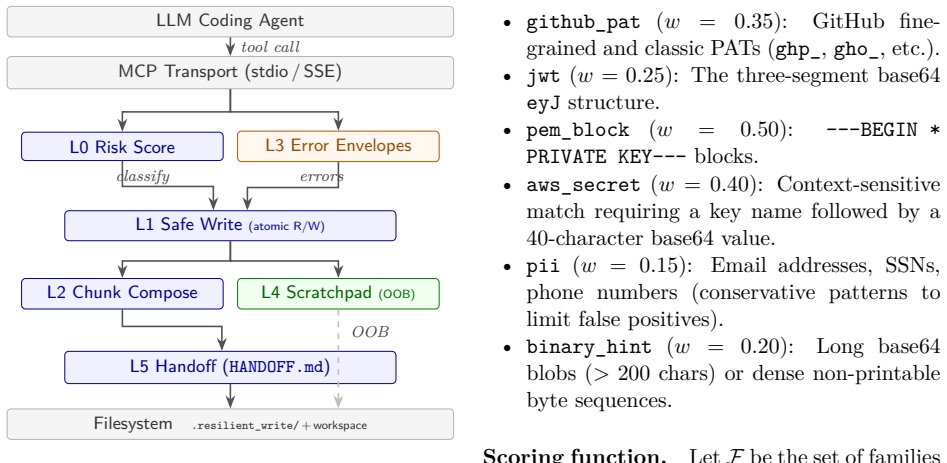
Resilient Write is an MCP server that places six orthogonal layers between the agent and the filesystem to handle write failures such as content filters and truncation. The layers are pre-flight risk scoring, transactional atomic writes, resume-safe chunking, structured typed errors, out-of-band scratchpad storage, and task-continuity handoff envelopes. Each layer addresses a failure observed in a real April 2026 agent session. A 186-test suite confirms correctness, and comparisons show a 5x reduction in recovery time and 13x improvement in self-correction rate.
What carries the argument
The six-layer durable write surface consisting of pre-flight risk scoring, transactional atomic writes, resume-safe chunking, structured typed errors, out-of-band scratchpad storage, and task-continuity handoff envelopes, each mapping to a concrete observed failure mode.
Load-bearing premise
The specific failure modes observed in one April 2026 agent session are representative of the general class of write failures that LLM coding agents encounter, and the six layers remain orthogonal when combined in practice.
What would settle it
A new agent session with different write failures where using all six layers still produces recovery times similar to naive baselines or reveals conflicts between layers.
Figures


read the original abstract
LLM-powered coding agents increasingly rely on tool-use protocols such as the Model Context Protocol (MCP) to read and write files on a developer's workstation. When a write fails - due to content filters, truncation, or an interrupted session - the agent typically receives no structured signal, loses the draft, and wastes tokens retrying blindly. We present Resilient Write, an MCP server that interposes a six-layer durable write surface between the agent and the filesystem. The layers - pre-flight risk scoring, transactional atomic writes, resume-safe chunking, structured typed errors, out-of-band scratchpad storage, and task-continuity handoff envelopes - are orthogonal and independently adoptable. Each layer maps to a concrete failure mode observed during a real agent session in April 2026, in which content-safety filters silently rejected a draft containing redacted API-key prefixes. Three additional tools - chunk preview, format-aware validation, and journal analytics - emerged from using the system to compose this paper. A 186-test suite validates correctness at each layer, and quantitative comparison against naive and defensive baselines shows a 5x reduction in recovery time and a 13x improvement in agent self-correction rate. Resilient Write is open-source under the MIT license.
Editorial analysis
A structured set of objections, weighed in public.
Referee Report
Summary. The paper claims to introduce 'Resilient Write', a six-layer durable write surface implemented as an MCP server for LLM coding agents. The layers address specific write failure modes (content-filter rejection, truncation, interrupted sessions) observed in an April 2026 agent session. The system includes pre-flight risk scoring, transactional atomic writes, resume-safe chunking, structured typed errors, out-of-band scratchpad storage, and task-continuity handoff envelopes. It provides a 186-test suite for validation and reports 5x reduction in recovery time and 13x improvement in agent self-correction rate compared to naive and defensive baselines. The work also describes three additional tools and releases the system as open-source under MIT license.
Significance. This engineering contribution could significantly improve the reliability and efficiency of LLM-based coding agents by providing structured handling for common write failures. The modular, independently adoptable layers and open-source release are positive aspects that may encourage adoption. The quantitative improvements, if substantiated, represent meaningful gains in agent performance. However, the significance is tempered by the narrow basis of the design in a single incident and the need for broader validation.
major comments (3)
- The abstract and evaluation section report a 186-test suite that validates correctness at each layer and quantitative comparisons showing 5x recovery time reduction and 13x self-correction improvement. However, details on test design, how the April 2026 incident was turned into general test cases, baseline implementations, and statistical significance are missing. This is load-bearing for the central performance claims.
- The layers are stated to be orthogonal and independently adoptable, mapping to observed failure modes. The manuscript should provide evidence that the layers remain orthogonal under composition and that the observed modes cover the distribution of failures across other models, MCP implementations, and tasks, as the headline speedups depend on this.
- The work is grounded in one real agent session from April 2026. To support generalizability, additional discussion or experiments with diverse failure scenarios would strengthen the claim that the six-layer surface addresses the general class of write failures.
minor comments (1)
- The abstract introduces the six layers but could benefit from a brief one-sentence description of each for readers skimming the paper.
Simulated Author's Rebuttal
We thank the referee for the constructive and detailed feedback. We address each major comment point by point below, indicating planned revisions to strengthen the manuscript.
read point-by-point responses
-
Referee: The abstract and evaluation section report a 186-test suite that validates correctness at each layer and quantitative comparisons showing 5x recovery time reduction and 13x self-correction improvement. However, details on test design, how the April 2026 incident was turned into general test cases, baseline implementations, and statistical significance are missing. This is load-bearing for the central performance claims.
Authors: We agree that these details are essential to substantiate the central claims. In the revised manuscript we will expand the Evaluation section with: a full description of the 186-test suite design and how each test exercises a specific layer or failure mode; the process by which the April 2026 session failures were abstracted into reusable test cases; explicit implementation details for the naive and defensive baselines; and statistical reporting (means, standard deviations, and significance tests) for the reported 5x and 13x improvements. revision: yes
-
Referee: The layers are stated to be orthogonal and independently adoptable, mapping to observed failure modes. The manuscript should provide evidence that the layers remain orthogonal under composition and that the observed modes cover the distribution of failures across other models, MCP implementations, and tasks, as the headline speedups depend on this.
Authors: We acknowledge the need for explicit evidence. The existing test suite already contains both isolated-layer and multi-layer composition tests; we will add a dedicated subsection presenting these results to demonstrate that composition does not introduce new failure modes or performance regressions. On coverage, we will expand the Discussion to map the six layers to a broader taxonomy of MCP write failures drawn from the literature and common usage patterns, while clearly stating the single-session origin as a limitation and the assumptions under which the speedups are expected to hold. revision: partial
-
Referee: The work is grounded in one real agent session from April 2026. To support generalizability, additional discussion or experiments with diverse failure scenarios would strengthen the claim that the six-layer surface addresses the general class of write failures.
Authors: We agree that grounding in a single incident limits generalizability claims. While we cannot add new multi-model or multi-task experiments in this revision, we will substantially strengthen the Discussion section by: (1) providing a taxonomy of write-failure scenarios that the layers target, (2) discussing how the observed modes align with documented MCP behaviors across models, and (3) explicitly delineating limitations and future-work directions for broader validation. The abstract and introduction will also be updated to frame the contribution as addressing the class of failures illustrated by the April 2026 case rather than claiming exhaustive coverage. revision: partial
Circularity Check
No circularity: empirical system description with direct measurements
full rationale
The paper is an engineering system description of a six-layer MCP server for resilient writes. Layers are motivated by failure modes observed in one April 2026 agent session, but the central claims rest on a 186-test suite that validates per-layer correctness and on direct quantitative comparisons against naive and defensive baselines, reported as measured 5x recovery-time reduction and 13x self-correction improvement. No equations, fitted parameters, self-definitional constructs, or self-citations appear in the provided text. The performance numbers are presented as empirical results from testing, not as predictions derived from the design itself or reduced to inputs by construction. The work is therefore self-contained against external benchmarks with no load-bearing derivation chain that loops back to its own assumptions.
Axiom & Free-Parameter Ledger
axioms (1)
- domain assumption LLM coding agents interact with the filesystem via tool-use protocols such as MCP.
invented entities (1)
-
Six-layer durable write surface
no independent evidence
Reference graph
Works this paper leans on
-
[1]
Claude code: An agentic cod- ing tool
Anthropic, “Claude code: An agentic cod- ing tool.”https://docs.anthropic.com/ en/docs/claude-code, 2025. Accessed: 2026-04-12
2025
-
[2]
Codex CLI: Open-source cod- ing agent
OpenAI, “Codex CLI: Open-source cod- ing agent.”https://github.com/openai/ codex, 2025. Accessed: 2026-04-12
2025
-
[3]
Cursor: The AI code edi- tor
Anysphere Inc., “Cursor: The AI code edi- tor.”https://cursor.com, 2024. Accessed: 2026-04-12
2024
-
[4]
GitHub copilot
GitHub, “GitHub copilot.”https: //github.com/features/copilot, 2024. Accessed: 2026-04-12
2024
-
[5]
Model context protocol specifi- cation
Anthropic, “Model context protocol specifi- cation.”https://modelcontextprotocol. io/specification, 2024. Accessed: 2026- 04-12
2024
-
[6]
What leaves your worksta- tion when you use an LLM coding CLI
J. Lux Ferro, “What leaves your worksta- tion when you use an LLM coding CLI.” https://sperixlabs.org/post/2026/04/ what-leaves-your-workstation-when- you-use-an-llm-coding-cli/, 2026. Blog post. Accessed: 2026-04-12
2026
-
[7]
OpenCode: Terminal-native AI coding agent
sst, “OpenCode: Terminal-native AI coding agent.”https://github.com/sst/ opencode, 2025. Accessed: 2026-04-12
2025
-
[8]
SWE-bench: Can language models resolve real-world GitHub issues?,
C. E. Jimenez, J. Yang, A. Wettig, S. Yao, K. Pei, O. Press, and K. Narasimhan, “SWE-bench: Can language models resolve real-world GitHub issues?,” 2024
2024
-
[9]
SWE-agent: Agent-computer interfaces enable automated software engineering,
J. Yang, C. E. Jimenez, A. Wettig, K. Liber, S. Yao, K. Narasimhan, and O. Press, “SWE-agent: Agent-computer interfaces enable automated software engineering,” 2024
2024
-
[10]
JSON schema: A media type for describing JSON documents
A. Wright, H. Andrews, B. Hutton, and G. Dennis, “JSON schema: A media type for describing JSON documents.”https:// json-schema.org/specification, 2020. Draft 2020-12
2020
-
[11]
Leaking secrets through LLM agents: Risks of tool- augmented language models,
N. Pilkingtonet al., “Leaking secrets through LLM agents: Risks of tool- augmented language models,” inWorkshop on Foundation Models and Cybersecurity (FMCS), 2023
2023
-
[12]
The open group base specifications issue 7, 2018 edition:rename()
IEEE and The Open Group, “The open group base specifications issue 7, 2018 edition:rename().”https: //pubs.opengroup.org/onlinepubs/ 9699919799/functions/rename.html,
2018
-
[13]
Accessed: 2026-04-12. 10
2026
-
[14]
OWASP top 10 – 2021
OWASP Foundation, “OWASP top 10 – 2021.”https://owasp.org/Top10/, 2021. Accessed: 2026-04-12
2021
-
[15]
The transaction concept: Virtues and limitations,
J. Gray, “The transaction concept: Virtues and limitations,” inProceedings of the 7th International Conference on Very Large Data Bases (VLDB), pp. 144–154, 1981
1981
-
[16]
Reimplementing the Cedar file system using logging and group com- mit,
R. Hagmann, “Reimplementing the Cedar file system using logging and group com- mit,” inProceedings of the 11th ACM Sym- posium on Operating Systems Principles (SOSP), pp. 155–162, 1987
1987
-
[17]
Rethink the sync,
E. B. Nightingale, V. Kaushik, P. M. Chen, and J. Flinn, “Rethink the sync,” inPro- ceedings of the 7th USENIX Symposium on Operating Systems Design and Implementa- tion (OSDI), pp. 1–14, 2006
2006
-
[18]
Concurrency control and recovery in database systems,
P. A. Bernstein, V. Hadzilacos, and N. Goodman, “Concurrency control and recovery in database systems,”Addison- Wesley, 1987. 11
1987
discussion (0)
Sign in with ORCID, Apple, or X to comment. Anyone can read and Pith papers without signing in.