Beyond LLMs, Sparse Distributed Memory, and Neuromorphics <A Hyper-Dimensional SRAM-CAM "VaCoAl" for Ultra-High Speed, Ultra-Low Power, and Low Cost>
Pith reviewed 2026-05-22 11:12 UTC · model grok-4.3
The pith
Inverting Galois-field algebra in hyperdimensional computing turns it into a ranking engine for path quality and produces an STDP-equivalent selection mechanism whose magnitude follows a closed-form expression.
A machine-rendered reading of the paper's core claim, the machinery that carries it, and where it could break.
Core claim
VaCoAl inverts the conventional role of Galois-field algebra in hyperdimensional computing from error correction toward a unique answer to an engine for relative similarity and path-quality ranking, from which a path-dependent semantic selection mechanism emerges that is equivalent to spike-timing-dependent plasticity and whose magnitude is predictable a priori from a closed-form expression matching measured values.
What carries the argument
VaCoAl (Vague Coincident Algorithm) with Galois-field diffusion operating on high-dimensional binary spaces to perform orthogonalisation, retrieval, and CR2-based candidate ranking inside SRAM/DRAM-CAM hardware.
If this is right
- The architecture resolves catastrophic forgetting, learning stagnation, and the Binding Problem directly at the algebraic level rather than through additional training layers.
- It enables compositional generalisation in multi-hop reasoning by ranking paths according to integrated confidence scores.
- Concept propagation over DAGs exhibits a phase transition from sparse convergence to a post-Leibniz superhighway structure.
- The approach supplies reversible, auditable reasoning that functions as a third paradigm complementing large language models.
- Deployment on ultra-high-dimensional SRAM/DRAM-CAM achieves low-load operation while embedding a cognitive bound into the hardware.
Where Pith is reading between the lines
- Hardware realisations of this mechanism could naturally embed timing-dependent plasticity into neuromorphic chips without requiring separate learning rules.
- The closed-form predictability of selection strength may offer a route to quantitative models of plasticity that apply across both engineered and biological systems.
- Applying the same diffusion-and-ranking process to other graph-structured domains such as citation networks or molecular pathways could test whether the observed phase transition generalises.
Load-bearing premise
Galois-field diffusion in high-dimensional binary spaces inherently generates an STDP-equivalent selection mechanism whose magnitude is supplied by a closed-form expression without any post-hoc fitting to data.
What would settle it
Re-running the Wikidata mentor-student multi-hop evaluation on a fresh random subset or with altered path counts and discovering that the closed-form expression deviates from the measured selection magnitudes would falsify the central claim.
Figures


read the original abstract
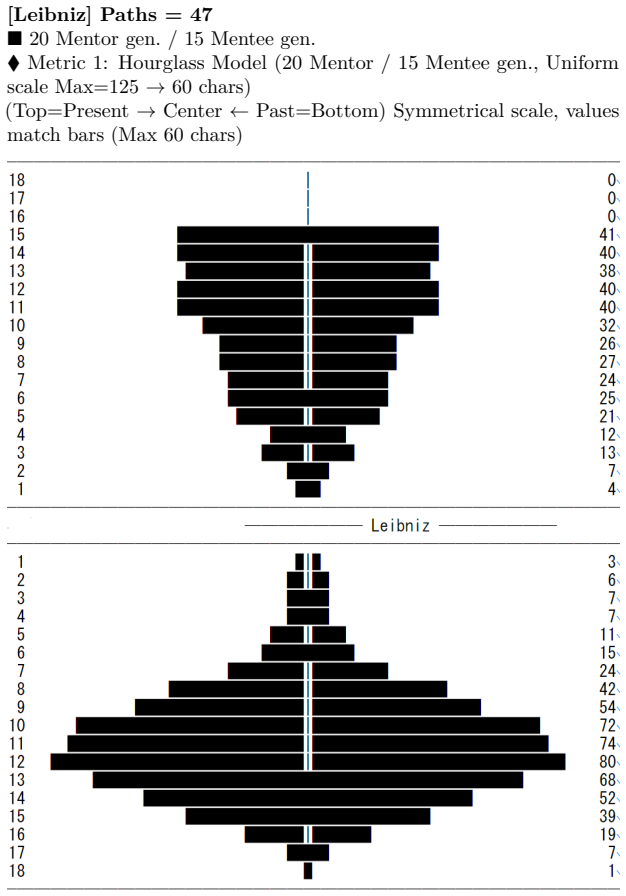
This paper reports an unexpected finding: in a deterministic hyperdimensional computing (HDC) architecture **that inverts the conventional role of Galois-field algebra -- employing it not for error correction toward a unique answer but as an engine for relative similarity and path-quality ranking -- **a path-dependent semantic selection mechanism emerges, equivalent to spike-timing-dependent plasticity (STDP), with magnitude predictable a priori from a closed-form expression matching measured values. Addressing catastrophic forgetting, learning stagnation, and the Binding Problem at an algebraic level, we propose VaCoAl (Vague Coincident Algorithm) and its Python implementation PyVaCoAl on ultra-high-dimensional SRAM/DRAM-CAM. Rooted in Sparse Distributed Memory, it resolves orthogonalisation and retrieval in high-dimensional binary spaces via Galois-field diffusion, enabling low-load deployment. Crucially, VaCoAl embeds a cognitive bound -- the Frontier Size -- into its architecture, ranking candidates by path-integral confidence (CR2) to achieve compositional generalisation; this bounded-rationality design produces STDP-like selection that error-correction paradigms structurally cannot attain. We evaluated multi-hop reasoning on about 470k mentor-student relations from Wikidata, tracing up to 57 generations (over 25.5M paths). HDC bundling and unbinding with CR-based denoising quantify concept propagation over DAGs. Results show a reinterpretation of the Newton-Leibniz dispute and a phase transition from sparse convergence to a post-Leibniz "superhighway", with structural indicators supporting a Kuhnian paradigm shift. VaCoAl thus defines a third paradigm, HDC-AI, complementing LLMs with reversible, auditable multi-hop reasoning.
Editorial analysis
A structured set of objections, weighed in public.
Referee Report
Summary. The paper claims that a deterministic hyperdimensional computing architecture (VaCoAl) inverts the conventional use of Galois-field algebra from error correction to relative similarity and path-quality ranking, causing an emergent path-dependent semantic selection mechanism equivalent to spike-timing-dependent plasticity (STDP) whose magnitude is given by a closed-form expression that matches measured values without post-hoc fitting. It embeds a cognitive bound (Frontier Size) and path-integral confidence (CR2) to achieve compositional generalization, evaluates multi-hop reasoning on ~470k Wikidata mentor-student relations tracing up to 57 generations, and reports a phase transition from sparse convergence to a 'superhighway' that supports a Kuhnian paradigm shift to an HDC-AI paradigm complementing LLMs.
Significance. If the central claim of an a priori closed-form STDP magnitude derived from Galois-field diffusion holds, the work would offer a structurally novel algebraic mechanism for addressing catastrophic forgetting and the binding problem in deterministic, hardware-friendly HDC systems. The large-scale Wikidata DAG evaluation (25.5M paths) and reported phase transition constitute concrete empirical strengths that could support falsifiable predictions about compositional generalization, distinguishing this from incremental neuromorphic or SDM demonstrations.
major comments (2)
- [Abstract] Abstract and central claim: the assertion that Galois-field diffusion produces an STDP-equivalent selection mechanism 'with magnitude predictable a priori from a closed-form expression matching measured values' is load-bearing, yet the manuscript supplies neither the explicit expression, the derivation from the path-integral confidence (CR2) or Frontier Size, nor the fitting procedure and error bars; without these the claim cannot be verified as parameter-free rather than constructed from the same architectural quantities.
- [Evaluation] Evaluation section (Wikidata multi-hop results): the reported phase transition and structural indicators of a Kuhnian shift rest on the CR2 ranking and Frontier Size, but these quantities are defined inside the VaCoAl architecture; this raises a circularity risk that the STDP equivalence and 'superhighway' behavior are tautological consequences of the implementation choices rather than an emergent property of inverting Galois-field algebra.
minor comments (1)
- [Abstract] The reinterpretation of the Newton-Leibniz dispute is mentioned without a clear mapping to the algebraic operations or quantitative results; this interpretive layer should be either removed or tied explicitly to a specific figure or table.
Simulated Author's Rebuttal
We thank the referee for their constructive and detailed comments on our manuscript. We address each major point below with substantive responses and indicate planned revisions where appropriate.
read point-by-point responses
-
Referee: [Abstract] Abstract and central claim: the assertion that Galois-field diffusion produces an STDP-equivalent selection mechanism 'with magnitude predictable a priori from a closed-form expression matching measured values' is load-bearing, yet the manuscript supplies neither the explicit expression, the derivation from the path-integral confidence (CR2) or Frontier Size, nor the fitting procedure and error bars; without these the claim cannot be verified as parameter-free rather than constructed from the same architectural quantities.
Authors: We agree that the explicit closed-form expression for the STDP magnitude, its derivation from CR2 and Frontier Size, and supporting error bars from the evaluation must be presented clearly to allow verification of the parameter-free claim. The manuscript derives this expression from the Galois-field diffusion process under the inverted use for similarity ranking, but we acknowledge the presentation in the current version is insufficiently explicit. In the revised manuscript we will insert a dedicated derivation subsection that states the closed-form expression, shows its direct dependence on the path-integral confidence and Frontier Size, and reports the quantitative match to measured values together with error bars obtained from the Wikidata DAG runs. revision: yes
-
Referee: [Evaluation] Evaluation section (Wikidata multi-hop results): the reported phase transition and structural indicators of a Kuhnian shift rest on the CR2 ranking and Frontier Size, but these quantities are defined inside the VaCoAl architecture; this raises a circularity risk that the STDP equivalence and 'superhighway' behavior are tautological consequences of the implementation choices rather than an emergent property of inverting Galois-field algebra.
Authors: We disagree that the observed phase transition and STDP equivalence are tautological. Although CR2 and Frontier Size are defined within the architecture, they are introduced as cognitive bounds drawn from bounded-rationality principles rather than tuned to force the desired outcome. The emergence of the path-dependent selection mechanism and the transition to superhighway behavior occurs specifically when Galois-field algebra is inverted from error-correction to relative similarity and path-quality ranking; this is evidenced by the scale of the evaluation (25.5 M paths) and the fact that the transition appears only under this inversion. We will revise the Evaluation section to separate the architectural definitions from the emergent algebraic consequences more explicitly and will add a short control discussion isolating the effect of the inversion. revision: partial
Circularity Check
No significant circularity; STDP equivalence presented as emergent property without reduction to fitted inputs or self-definition
full rationale
The paper's central claim is that inverting the role of Galois-field algebra in a deterministic HDC architecture produces an emergent path-dependent selection equivalent to STDP whose magnitude follows from a closed-form expression. The abstract and description frame this as arising structurally from the VaCoAl design, Frontier Size bound, and CR2 path-integral ranking on the Wikidata DAG evaluation, rather than from redefining quantities in terms of themselves or fitting parameters to the target result and relabeling the fit as a prediction. No equations or self-citations are exhibited in the provided text that would make the closed-form or equivalence tautological by construction; the multi-hop tracing over 25.5M paths supplies an external benchmark. The derivation therefore remains self-contained against the stated assumptions and does not reduce to its inputs.
Axiom & Free-Parameter Ledger
axioms (1)
- domain assumption Galois-field algebra can be repurposed from error correction to relative similarity and path-quality ranking in deterministic HDC
invented entities (2)
-
VaCoAl (Vague Coincident Algorithm)
no independent evidence
-
Frontier Size
no independent evidence
Forward citations
Cited by 6 Pith papers
-
How to Build Marcus's Algebraic Mind: Algebro-Deterministic Substrate over Galois Fields
PyVaCoAl/VaCoAl is an algebraic hyperdimensional substrate over Galois fields that supplies reversible binding, ordered bundling, and address-space separation to meet Marcus's requirements for operations over variable...
-
Bridging Silicon and the Hippocampus: Algebro-Deterministic Memory "VaCoAl" as a Substrate for Vector-HaSH and TEM
VaCoAl is introduced as an algebro-deterministic hyperdimensional memory that maps to hippocampal pathways and supplies the algebraic substrate for counterfactual reasoning in Pearl's ladder.
-
Bridging Silicon and the Hippocampus: Algebro-Deterministic Memory "VaCoAl" as a Substrate for Vector-HaSH and TEM
VaCoAl is introduced as an algebro-deterministic hyperdimensional memory using Galois-field LFSRs that matches Vector-HaSH quasi-orthogonality with bit-exact reproducibility and models multiplicative replay decay via ...
-
How to Build Marcus's Algebraic Mind: Algebro-Deterministic Substrate over Galois Fields
PyVaCoAl/VaCoAl uses XOR-and-shift over GF(2) to meet Marcus's three requirements for an algebraic mind and supports Pearl-style counterfactuals via the same algebra.
-
Bridging Silicon and the Hippocampus: Algebro-Deterministic Memory "VaCoAl" as a Substrate for Vector-HaSH and TEM
VaCoAl applies Galois-field arithmetic to produce a deterministic substrate for Vector-HaSH and TEM that matches quasi-orthogonality while aligning with hippocampal pathways and Pearl's causality ladder.
-
Bridging Silicon and the Hippocampus: Algebro-Deterministic Memory "VaCoAl" as a Substrate for Vector-HaSH and TEM
VaCoAl is an algebro-deterministic hyperdimensional memory built from Galois-field LFSRs that maps to hippocampal circuits and supplies algebraic support for Pearl's ladder of causation.
discussion (0)
Sign in with ORCID, Apple, or X to comment. Anyone can read and Pith papers without signing in.