How to Build Marcus's Algebraic Mind: Algebro-Deterministic Substrate over Galois Fields
Pith reviewed 2026-05-22 08:39 UTC · model grok-4.3
The pith
XOR-and-shift over GF(2) supplies reversible variable binding, non-commutative bundling, and individual-kind separation to meet Marcus's three cognitive requirements.
A machine-rendered reading of the paper's core claim, the machinery that carries it, and where it could break.
Core claim
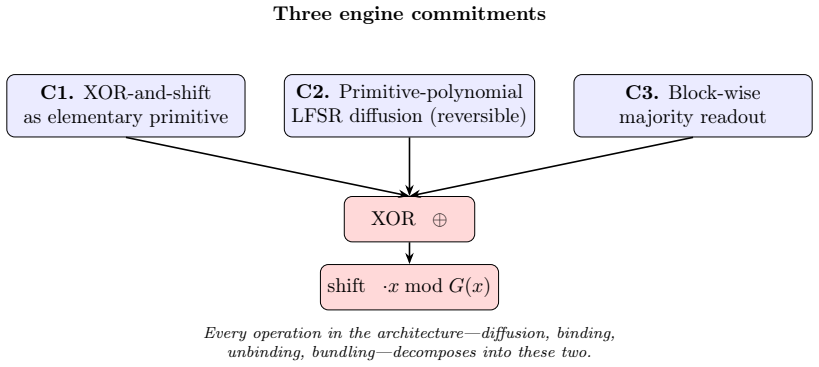
PyVaCoAl/VaCoAl is a hyperdimensional computing architecture organized end-to-end around the single algebraic primitive of XOR-and-shift over GF(2) implemented by primitive-polynomial linear-feedback shift registers. It supports reversible variable binding via Bind(R,F) = R XOR shift(F), non-commutative compositional bundling that distinguishes ordered structures, and address-space individual/kind separation under the same algebra, thereby supplying a functional neural substrate that meets Marcus's specifications more closely than the tensor products, circular convolution, or temporal synchrony available in 2001.
What carries the argument
The XOR-and-shift operation over GF(2) realized by primitive-polynomial linear-feedback shift registers, which indexes algebraic register sets and performs binding and bundling.
If this is right
- Reversible binding recovers the original filler from the bound representation without information loss.
- Non-commutative bundling produces distinct representations for 'the dog bites the man' and 'the man bites the dog'.
- Individual and kind representations occupy separate subspaces within one shared address algebra.
- The same substrate extends directly to Pearl's rung-3 counterfactual reasoning.
- The treelet conjecture is realized as an algebraic register set indexed by a primitive generator polynomial.
Where Pith is reading between the lines
- The architecture suggests a possible biological homologue in the dentate gyrus-CA3 circuit with mossy-fiber targeting supplying the required microcircuitry.
- Hardware realizations using linear-feedback shift registers could be tested for scaling limits on recursive depth.
- The approach invites direct comparison of representational capacity against vector-symbolic architectures on benchmark tasks for variable binding and order sensitivity.
Load-bearing premise
The single primitive of XOR-and-shift over GF(2) is by itself sufficient to produce recursively structured representations, individual-kind separation, and counterfactual reasoning without extra mechanisms.
What would settle it
A concrete demonstration that the binding operation Bind(R,F) = R XOR shift(F) either loses information on repeated application or fails to preserve order distinctions under non-commutative bundling would falsify the central claim.
Figures
read the original abstract
In The Algebraic Mind, Gary Marcus identified three components essential for any adequate cognitive architecture: operations over variables, recursively structured representations, and a distinction between mental representations of individuals and kinds. He argued that standard multilayer perceptrons supported none of these, acknowledging that a neural implementation using registers and treelets, constructed via developmental programs rather than gradient descent, remained a programmatic conjecture. Twenty-five years later, the required substrate is now available. Our newly developed PyVaCoAl/VaCoAl is a hyperdimensional computing architecture organized end-to-end around a single algebraic primitive: XOR-and-shift over GF(2), implemented by primitive-polynomial linear-feedback shift registers. The architecture supports reversible variable binding via Bind(R,F) = R XOR shift(F), non-commutative compositional bundling that distinguishes "the dog bites the man" from "the man bites the dog," and address-space individual/kind separation under the same algebra. A companion perspective argues that the dentate gyrus-CA3 circuit is a biological homologue of this same engine, with developmentally specified mossy-fiber targeting supplying the innate microcircuitry Marcus anticipated. In this paper, we map the correspondence between Marcus's three pillars and the operational commitments of PyVaCoAl/VaCoAl. We reinterpret the treelet as an algebraic register set indexed by a primitive generator polynomial, arguing that this architecture provides a functional neural substrate meeting Marcus's specifications far more closely than the tensor products, circular convolution, or temporal synchrony available in 2001. We also demonstrate how this substrate naturally extends to Pearl's rung-3 counterfactual reasoning, a capability the original treelet program did not directly target.
Editorial analysis
A structured set of objections, weighed in public.
Referee Report
Summary. The paper claims that PyVaCoAl/VaCoAl, a hyperdimensional computing architecture built around the single primitive Bind(R,F) = R XOR shift(F) over GF(2) using primitive-polynomial LFSRs, supplies a functional substrate for Marcus's three pillars (variable binding, recursively structured representations, and individual/kind distinction) that outperforms tensor products or circular convolution, while also extending naturally to Pearl rung-3 counterfactual reasoning; it further proposes the dentate gyrus-CA3 circuit as a biological homologue via developmentally specified mossy-fiber targeting.
Significance. If the algebraic sufficiency were demonstrated with explicit constructions, the work would supply a concrete, parameter-light implementation of Marcus's 2001 conjecture, offering a unified algebraic account that integrates reversible binding, non-commutative composition, and address-space separation under one primitive; this could meaningfully advance the symbolic-neural integration literature beyond the mechanisms available at the time of The Algebraic Mind.
major comments (3)
- [Abstract; section on recursive representations] Abstract and the section mapping Marcus's pillars to the architecture: the central claim that the XOR-and-shift primitive alone delivers recursively structured representations is asserted by reinterpreting treelets as algebraic register sets indexed by generator polynomials, yet no explicit derivation, closure proof, or worked example of nested Bind operations is supplied, leaving the recursive capability as a reinterpretation rather than a demonstrated property.
- [Section on counterfactual reasoning] Section on extension to counterfactual reasoning: the manuscript states that the substrate 'naturally extends' to Pearl's rung-3 counterfactuals, but provides no construction showing how interventions, do-operators, or counterfactual evaluation are encoded and computed using only the Bind primitive and LFSR shifts, which is load-bearing for the claim of meeting Marcus's specifications plus additional capability.
- [Section on individual/kind separation] Section on individual/kind separation: the address-space separation under the same algebra is presented as supporting the distinction between individuals and kinds, but without a concrete mapping, example binding sequence, or verification that the separation is preserved under composition and recursion, the claim remains unanchored.
minor comments (1)
- [Methods] The definition of the shift operation and its interaction with the primitive polynomial could be accompanied by a small numerical example early in the methods to clarify reversibility and non-commutativity for readers unfamiliar with LFSR implementations.
Simulated Author's Rebuttal
We thank the referee for their constructive comments on our manuscript. We address each of the major points raised and have made revisions to incorporate explicit examples and derivations where they were previously conceptual.
read point-by-point responses
-
Referee: Abstract and the section mapping Marcus's pillars to the architecture: the central claim that the XOR-and-shift primitive alone delivers recursively structured representations is asserted by reinterpreting treelets as algebraic register sets indexed by generator polynomials, yet no explicit derivation, closure proof, or worked example of nested Bind operations is supplied, leaving the recursive capability as a reinterpretation rather than a demonstrated property.
Authors: We agree that an explicit worked example would strengthen the presentation. In the revised manuscript, we have added a detailed example of nested Bind operations using the XOR-and-shift primitive, along with a proof sketch showing closure under recursion for tree-like structures represented as register sets indexed by generator polynomials. This demonstrates that recursive representations are supported directly by the algebra. revision: yes
-
Referee: Section on extension to counterfactual reasoning: the manuscript states that the substrate 'naturally extends' to Pearl's rung-3 counterfactuals, but provides no construction showing how interventions, do-operators, or counterfactual evaluation are encoded and computed using only the Bind primitive and LFSR shifts, which is load-bearing for the claim of meeting Marcus's specifications plus additional capability.
Authors: The reversibility of the Bind operation (via unbinding with the same shift) allows for interventions by replacing fillers in the representation. We have now included a concrete construction in the revised section, showing step-by-step how a do-operator is simulated by unbinding and rebinding, and how counterfactuals are evaluated by comparing the original and intervened representations using the same primitive. revision: yes
-
Referee: Section on individual/kind separation: the address-space separation under the same algebra is presented as supporting the distinction between individuals and kinds, but without a concrete mapping, example binding sequence, or verification that the separation is preserved under composition and recursion, the claim remains unanchored.
Authors: We acknowledge the need for a concrete example. The revision now includes an example binding sequence that maps individuals to specific address subspaces and kinds to others, with verification that the separation holds after multiple compositions and recursive bindings, using the non-commutative properties of the shift operation. revision: yes
Circularity Check
No significant circularity; derivation is self-contained via algebraic definitions
full rationale
The paper defines its core operations (Bind(R,F) = R XOR shift(F) over GF(2) via LFSRs) and then maps their algebraic properties directly onto Marcus's three pillars and Pearl's rung-3 reasoning. This is a constructive proposal rather than a reduction of outputs to inputs by construction. No quoted step equates a claimed capability to a fitted parameter, a self-citation chain, or a renamed prior result; the reinterpretation of treelets as register sets is presented as an explicit correspondence, not as an unverified uniqueness theorem or ansatz smuggled from prior work. The architecture's sufficiency claims rest on the stated properties of XOR-and-shift, which are independently verifiable from the algebra itself.
Axiom & Free-Parameter Ledger
free parameters (1)
- primitive polynomial
axioms (1)
- domain assumption XOR-and-shift over GF(2) implements reversible variable binding, non-commutative bundling, and individual/kind separation
Lean theorems connected to this paper
-
IndisputableMonolith/Cost/FunctionalEquation.leanwashburn_uniqueness_aczel echoes?
echoesECHOES: this paper passage has the same mathematical shape or conceptual pattern as the Recognition theorem, but is not a direct formal dependency.
single algebraic primitive: XOR-and-shift over GF(2), implemented by primitive-polynomial linear-feedback shift registers... Bind(R, F) = R ⊕ shift(F)
-
IndisputableMonolith/Foundation/ArithmeticFromLogic.leanembed_injective echoes?
echoesECHOES: this paper passage has the same mathematical shape or conceptual pattern as the Recognition theorem, but is not a direct formal dependency.
reversible variable binding... non-commutative compositional bundling... address-space individual/kind separation
-
IndisputableMonolith/Foundation/ArithmeticOf.leanlogicNatPeano refines?
refinesRelation between the paper passage and the cited Recognition theorem.
treelet as an algebraic register set indexed by a primitive generator polynomial
What do these tags mean?
- matches
- The paper's claim is directly supported by a theorem in the formal canon.
- supports
- The theorem supports part of the paper's argument, but the paper may add assumptions or extra steps.
- extends
- The paper goes beyond the formal theorem; the theorem is a base layer rather than the whole result.
- uses
- The paper appears to rely on the theorem as machinery.
- contradicts
- The paper's claim conflicts with a theorem or certificate in the canon.
- unclear
- Pith found a possible connection, but the passage is too broad, indirect, or ambiguous to say the theorem truly supports the claim.
Reference graph
Works this paper leans on
-
[1]
Acsády, L., Kamondi, A., Sík, A., Freund, T., & Buzsáki, G. (1998). GABAergic cells are the major postsynaptic targets of mossy fibers in the rat hippocampus.Journal of Neuroscience, 18(9), 3386–3403
work page 1998
-
[2]
G., Martinez-Canabal, A., Restivo, L., et al
Akers, K. G., Martinez-Canabal, A., Restivo, L., et al. (2014). Hippocampal neurogenesis regulates forgetting during adulthood and infancy.Science, 344(6184), 598–602
work page 2014
-
[3]
Benavides-Piccione, R., Regalado-Reyes, M., Fernaud-Espinosa, I., etal.(2020).Differential structureofhippocampalCA1pyramidalneuronsinthehumanandmouse.Cerebral Cortex, 30(2), 730–752
work page 2020
-
[4]
Chamberland, S., Timofeeva, Y., Evstratova, A., Volynski, K., & Tóth, K. (2018). Ac- tion potential counting at giant mossy fiber terminals gates information transfer in the hippocampus.Proceedings of the National Academy of Sciences, 115(28), 7434–7439
work page 2018
-
[5]
H. Chuma, K. Otsuka, and Y. Sato, “Beyond LLMs, sparse distributed memory, and neu- romorphics: A hyper-dimensional SRAM-CAM ‘VaCoAl’ for ultra-high speed, ultra-low power, and low cost,” arXiv preprint arXiv:2604.11665, 2026a
work page internal anchor Pith review Pith/arXiv arXiv
-
[6]
H. Chuma, K. Otsuka, and Y. Sato, “Bridging Silicon and the Hippocampus: Algebro- DeterministicMemory"VaCoAl"asaSubstrateforVector-HaSHandTEM,” arXivpreprint arXiv:2605.15652, 2026b
work page internal anchor Pith review Pith/arXiv arXiv
-
[7]
Diamantaki, M., Frey, M., Berens, P., Preston-Ferrer, P., & Burgalossi, A. (2016). Sparse activity of identified dentate granule cells during spatial exploration.eLife, 5, e20252
work page 2016
-
[8]
Galimberti, I., Gogolla, N., Alberi, S., Santos, A. F., Muller, D., & Caroni, P. (2006). Long-term rearrangements of hippocampal mossy fiber terminal connectivity in the adult regulated by experience.Neuron, 50(5), 749–763
work page 2006
-
[9]
(1997).Cells, Embryos, and Evolution
Gerhart, J., & Kirschner, M. (1997).Cells, Embryos, and Evolution. Oxford: Blackwell Science
work page 1997
-
[10]
Gidon, A., Zolnik, T. A., Fidzinski, P., et al. (2020). Dendritic action potentials and com- putation in human layer 2/3 cortical neurons.Science, 367(6473), 83–87
work page 2020
-
[11]
J., Schlögl, A., Frotscher, M., & Jonas, P
Guzman, S. J., Schlögl, A., Frotscher, M., & Jonas, P. (2016). Synaptic mechanisms of pattern completion in the hippocampal CA3 network.Science, 353(6304), 1117–1123
work page 2016
-
[12]
Henze, D. A., Wittner, L., & Buzsáki, G. (2002). Single granule cells reliably discharge targets in the hippocampal CA3 network in vivo.Nature Neuroscience, 5(8), 790–795
work page 2002
-
[13]
Kempermann, G., Gage, F. H., Aigner, L., et al. (2018). Human adult neurogenesis: Evi- dence and remaining questions.Cell Stem Cell, 23(1), 25–30
work page 2018
-
[14]
Krueppel, R., Remy, S., & Beck, H. (2011). Dendritic integration in hippocampal dentate granule cells.Neuron, 71(3), 512–528. 17
work page 2011
-
[15]
Leutgeb, J. K., Leutgeb, S., Moser, M. B., & Moser, E. I. (2007). Pattern separation in the dentate gyrus and CA3 of the hippocampus.Science, 315(5814), 961–966
work page 2007
-
[16]
Love, B. C. (1999). Utilizing time: Asynchronous binding.Advances in Neural Information Processing Systems, 11
work page 1999
-
[17]
Marcus, G. F. (2001).The Algebraic Mind: Integrating Connectionism and Cognitive Sci- ence. Cambridge, MA: MIT Press
work page 2001
-
[18]
Mullally, S. L., & Maguire, E. A. (2014). Memory, imagination, and predicting the future: A common brain mechanism?The Neuroscientist, 20(3), 220–234
work page 2014
-
[19]
(2009).Causality: Models, Reasoning, and Inference(2nd ed.)
Pearl, J. (2009).Causality: Models, Reasoning, and Inference(2nd ed.). Cambridge: Cam- bridge University Press
work page 2009
-
[20]
(2018).The Book of Why: The New Science of Cause and Effect
Pearl, J., & Mackenzie, D. (2018).The Book of Why: The New Science of Cause and Effect. New York: Basic Books
work page 2018
-
[21]
Pernia-Andrade, A. J., & Jonas, P. (2014). Theta-gamma-modulated synaptic currents in hippocampal granule cells in vivo define a mechanism for network oscillations.Neuron, 81(1), 140–152
work page 2014
-
[22]
Plate, T. A. (1995). Holographic reduced representations.IEEE Transactions on Neural Networks, 6(3), 623–641
work page 1995
-
[23]
Rollenhagen, A., & Lübke, J. H. R. (2010). The mossy fiber bouton: the “common” or the “unique” synapse?Frontiers in Synaptic Neuroscience, 2, 2
work page 2010
-
[24]
Rolls, E. T. (2023). The hippocampus, ventromedial prefrontal cortex, and episodic and semantic memory.Progress in Neurobiology, 217, 102334
work page 2023
-
[25]
Shastri, L., & Ajjanagadde, V. (1993). From simple associations to systematic reasoning: A connectionist representation of rules, variables, and dynamic bindings using temporal synchrony.Behavioral and Brain Sciences, 16(3), 417–451
work page 1993
-
[26]
Smolensky, P. (1990). Tensor product variable binding and the representation of symbolic structures in connectionist systems.Artificial Intelligence, 46(1–2), 159–216
work page 1990
-
[27]
Südhof, T. C. (2008). Neuroligins and neurexins link synaptic function to cognitive disease. Nature, 455(7215), 903–911
work page 2008
-
[28]
P., Borges-Merjane, C., & Jonas, P
Vyleta, N. P., Borges-Merjane, C., & Jonas, P. (2016). Plasticity-dependent, full detonation at hippocampal mossy fiber–CA3 pyramidal neuron synapses.eLife, 5, e17977
work page 2016
-
[29]
Wilke, S. A., Antonios, J. K., Bushong, E. A., et al. (2013). Deconstructing complexity: Serial block-face electron microscopic analysis of the hippocampal mossy fiber synapse. Journal of Neuroscience, 33(2), 507–522. 18
work page 2013
discussion (0)
Sign in with ORCID, Apple, or X to comment. Anyone can read and Pith papers without signing in.