Recognition: unknown
Astrophysical Signatures of Einstein-Skyrme Anti-de Sitter Black Holes: Epicyclic Frequencies and QPO Constraints
Pith reviewed 2026-05-10 15:23 UTC · model grok-4.3
The pith
Einstein-Skyrme AdS black holes fit observed QPO pairs with Skyrme parameter Q near 0.6.
A machine-rendered reading of the paper's core claim, the machinery that carries it, and where it could break.
Core claim
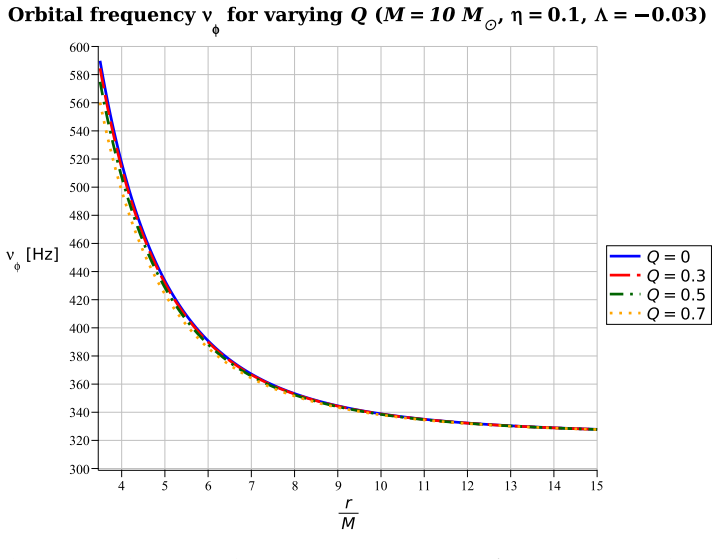
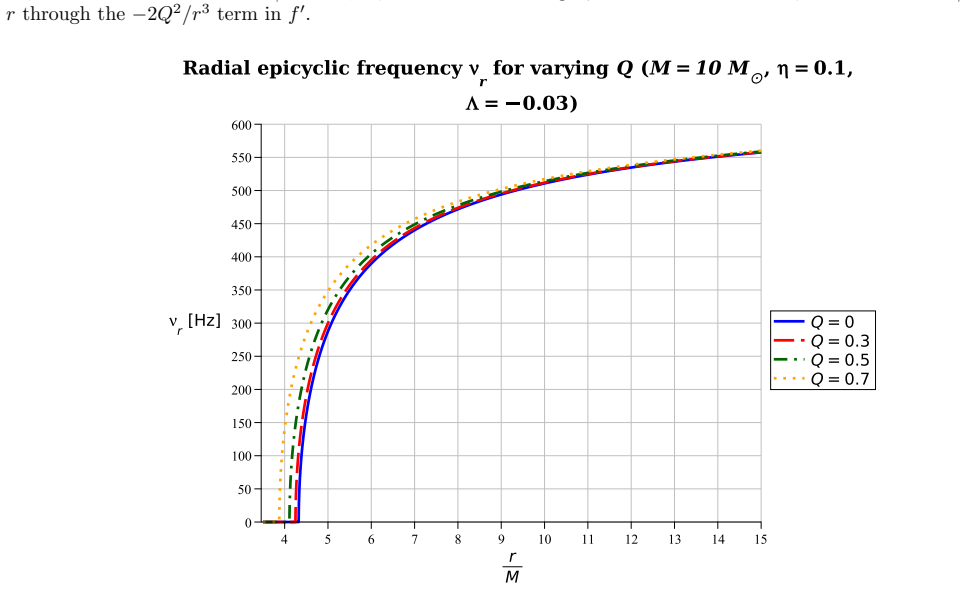
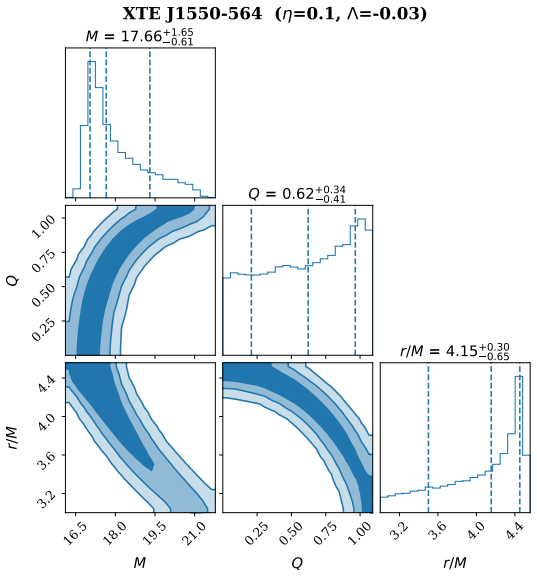
In the Einstein-Skyrme anti-de Sitter black hole spacetime, the epicyclic frequencies exhibit a distinctive behavior where the radial epicyclic frequency grows at large radii and surpasses the orbital frequency, causing the periastron precession frequency to change sign. Markov chain Monte Carlo analysis of quasi-periodic oscillation data from XTE J1550-564, GRO J1655-40, Sgr A*, and M82 X-1 shows that the model accommodates the observations with Q approximately 0.6, orbital radii near 4.2 M, and masses consistent with independent estimates.
What carries the argument
The lapse function f(r) of the static spherically symmetric ES-AdS black hole, depending on the Skyrme coupling η, the charge-like parameter Q from the Skyrme term, and the negative cosmological constant Λ, which determines the horizon structure and enables calculation of the effective potential, ISCO, and epicyclic frequencies.
If this is right
- The periastron precession frequency changes sign at large orbital radii due to the AdS term.
- The radiative efficiency at the ISCO exceeds unity, rendering the standard Novikov-Thorne formula negative.
- Posterior distributions from MCMC fits to QPO data converge to Q approximately 0.6 across multiple sources.
- Orbital radii cluster near 4.2 times the black hole mass with masses matching independent estimates.
Where Pith is reading between the lines
- Confirmation would allow astrophysical QPO data to constrain Skyrme model parameters independently of particle-physics experiments.
- The sign reversal in precession frequency could distinguish AdS black holes from their asymptotically flat counterparts in future observations.
- High-precision QPO measurements from additional sources could test whether the fitted value Q near 0.6 is universal for this family of solutions.
Load-bearing premise
The relativistic precession model correctly maps the derived epicyclic frequencies to the observed QPO pairs without significant contributions from disk physics, magnetic fields, or non-geodesic effects.
What would settle it
Detection of twin-peak QPOs from a source where the required Skyrme parameter Q differs substantially from 0.6, or direct observation of epicyclic frequencies showing no increase in radial frequency at large radii.
Figures





read the original abstract
We study the geodesic motion and epicyclic oscillations of massive test particles around a static, spherically symmetric black hole (BH) solution of the Einstein--Skyrme (ES) theory in Anti-de Sitter (AdS) spacetime. The lapse function of this BH depends on the Skyrme coupling $\eta$, a charge-like parameter $Q$ inherited from the Skyrme term, and the cosmological constant $\Lambda<0$. We first map out the horizon structure and identify three regimes-non-extremal BH (NEBH), extremal BH (EBH), and naked BH (NBH)-showing that the NEBH $\to$ EBH $\to$ NBH transition is governed by $Q$ rather than $\eta$, which enters $f(r)$ only as a constant shift. We then derive the effective potential (EP), locate the innermost stable circular orbit (ISCO), and compute the radiative efficiency, finding that $\mathcal{E}_{\rm ISCO}>1$ in AdS renders the standard Novikov-Thorne formula negative. The corrected radial epicyclic frequency $\Omega_r$ reveals a distinctive AdS signature: $\nu_r$ grows at large $r$ and overtakes the orbital frequency $\nu_\phi$, causing the periastron precession frequency $\nu_p = \nu_\varphi - \nu_r$ to change sign-a feature absent in asymptotically flat geometries. Adopting the relativistic precession (RP) model for quasi-periodic oscillations (QPOs), we perform a Markov chain Monte Carlo (MCMC) analysis using twin-peak QPO data from XTE~J1550-564, GRO~J1655-40, Sgr~A$^*$, and M82~X-1. The posteriors converge to $Q\approx 0.6$ across all sources, with orbital radii near $r\approx 4.2\,M$ and masses consistent with independent estimates, demonstrating that the ES-AdS BH accommodates the observed frequency pairs within physically motivated parameter ranges.
Editorial analysis
A structured set of objections, weighed in public.
Referee Report
Summary. The manuscript studies geodesic motion and epicyclic oscillations of test particles around static spherically symmetric Einstein-Skyrme black holes in AdS spacetime. It maps the horizon structure (NEBH, EBH, NBH regimes), derives the effective potential and ISCO location, computes radiative efficiency (noting the AdS correction when E_ISCO > 1), obtains the radial and orbital epicyclic frequencies (highlighting the AdS-specific sign change in the periastron precession frequency ν_p), and applies the relativistic precession model to perform MCMC fits of twin-peak QPO data from XTE J1550-564, GRO J1655-40, Sgr A*, and M82 X-1, reporting convergence to Q ≈ 0.6 at r ≈ 4.2 M with masses consistent with independent estimates.
Significance. If the frequency derivations are accurate and the RP-model mapping is justified, the work supplies astrophysical constraints on the Skyrme charge-like parameter Q and isolates a distinctive AdS signature in the epicyclic frequencies that is absent in asymptotically flat spacetimes. The multi-source MCMC analysis yielding consistent posteriors constitutes a concrete technical contribution, as does the explicit handling of the effective potential and the E_ISCO > 1 correction.
major comments (2)
- [QPO constraints and MCMC analysis] QPO constraints section: The headline result that the ES-AdS solution accommodates the observed frequency pairs rests on an MCMC fit of Q (and implicitly r) to the same twin-peak QPO data used to demonstrate accommodation. While the posteriors converge to Q ≈ 0.6 across sources, this match is achieved by construction; the manuscript should either provide an out-of-sample test or compare the inferred Q against independent bounds on the Skyrme parameter to establish that the accommodation is non-trivial.
- [Relativistic precession model application] Application of the relativistic precession model: The identification of observed upper/lower QPO frequencies with ν_φ and ν_φ − ν_r assumes that non-geodesic contributions (disk hydrodynamics, magnetic torques, pressure support) are negligible at the fitted radii r ≈ 4.2 M. No quantitative estimate of the possible frequency shifts from these effects relative to the reported posterior width is supplied; if such shifts exceed the posterior uncertainty, the inferred Q no longer reflects the spacetime parameters alone.
minor comments (2)
- [Effective potential and frequency derivations] Clarify the precise functional form of the lapse function f(r) (including the constant shift from η) when it is substituted into the effective potential and the epicyclic-frequency expressions; cross-check that all AdS corrections are retained consistently.
- [MCMC results] The statement that masses remain consistent with independent estimates should be supported by explicit numerical comparison (with uncertainties) rather than a qualitative remark.
Simulated Author's Rebuttal
We thank the referee for the thorough review and valuable comments, which have prompted us to clarify key aspects of our analysis. We address each major comment point by point below, providing our responses and indicating the revisions made to the manuscript.
read point-by-point responses
-
Referee: QPO constraints section: The headline result that the ES-AdS solution accommodates the observed frequency pairs rests on an MCMC fit of Q (and implicitly r) to the same twin-peak QPO data used to demonstrate accommodation. While the posteriors converge to Q ≈ 0.6 across sources, this match is achieved by construction; the manuscript should either provide an out-of-sample test or compare the inferred Q against independent bounds on the Skyrme parameter to establish that the accommodation is non-trivial.
Authors: We appreciate the referee's observation on the nature of the MCMC fitting procedure. The analysis does fit the model to the observed frequency pairs for each source, but the non-trivial element lies in the fact that a single value of the Skyrme parameter Q ≈ 0.6 emerges consistently from four independent sources with differing masses, accretion rates, and observed QPO properties. This cross-source convergence tests the model's ability to describe the data uniformly without source-specific tuning of Q. In addition, the inferred masses remain consistent with independent observational estimates for each object. As the Einstein-Skyrme AdS solution represents a specific theoretical framework without existing astrophysical constraints on Q from other phenomena, no direct comparison to external bounds is feasible at present. We have revised the manuscript to include an expanded discussion of this multi-source consistency as evidence of robustness and to explicitly note the current absence of independent bounds on Q as a topic for future study. revision: partial
-
Referee: Application of the relativistic precession model: The identification of observed upper/lower QPO frequencies with ν_φ and ν_φ − ν_r assumes that non-geodesic contributions (disk hydrodynamics, magnetic torques, pressure support) are negligible at the fitted radii r ≈ 4.2 M. No quantitative estimate of the possible frequency shifts from these effects relative to the reported posterior width is supplied; if such shifts exceed the posterior uncertainty, the inferred Q no longer reflects the spacetime parameters alone.
Authors: We agree that the relativistic precession model relies on the assumption that geodesic epicyclic frequencies dominate over non-geodesic effects at the relevant radii. Our work follows the standard application of this model as employed in the broader QPO literature. At the fitted radii r ≈ 4.2 M (exterior to the ISCO), the geodesic contribution is expected to provide the leading-order description. In the revised manuscript we have added a qualitative discussion of possible frequency shifts arising from disk hydrodynamics, magnetic torques, and pressure support, referencing typical magnitudes reported in related studies of similar systems. A precise, source-specific quantitative estimate of these shifts would require dedicated magnetohydrodynamic simulations in the Einstein-Skyrme AdS background, which exceeds the scope of the present geodesic-focused analysis. We have therefore highlighted this as a systematic uncertainty and a direction for subsequent work. revision: partial
Circularity Check
No significant circularity; frequency derivations and parameter fitting are independent steps
full rationale
The paper first derives the effective potential, ISCO, and epicyclic frequencies (Ω_r, Ω_φ, ν_p) directly from the ES-AdS lapse function f(r) containing parameters η, Q, and Λ. These expressions are obtained from geodesic equations and do not reference QPO observations. The subsequent MCMC step fits Q (and r, M) to twin-peak QPO data under the separate RP model assumption; this is standard parameter estimation that constrains the model rather than re-deriving the frequencies from the data. No equation reduces to its input by construction, no self-citation chain bears the central claim, and the accommodation statement is simply the outcome of a successful fit with masses cross-checked against independent estimates. The RP model assumption itself is an external modeling choice, not an internal definitional loop.
Axiom & Free-Parameter Ledger
free parameters (3)
- Q =
0.6
- η
- Λ
axioms (2)
- domain assumption Test particles follow geodesics in the given spacetime metric
- domain assumption Relativistic precession model maps epicyclic frequencies directly to observed QPO pairs
Reference graph
Works this paper leans on
-
[1]
Akiyamaet al.(Event Horizon Telescope), Astrophys
K. Akiyamaet al.(Event Horizon Telescope), Astrophys. J. Lett.875, L1 (2019)
2019
-
[2]
Akiyamaet al.(Event Horizon Telescope), Astrophys
K. Akiyamaet al.(Event Horizon Telescope), Astrophys. J. Lett.875, L6 (2019)
2019
-
[3]
Akiyamaet al.(Event Horizon Telescope), Astrophys
K. Akiyamaet al.(Event Horizon Telescope), Astrophys. J. Lett.930, L12 (2022)
2022
-
[4]
Akiyamaet al.(Event Horizon Telescope), Astrophys
K. Akiyamaet al.(Event Horizon Telescope), Astrophys. J. Lett.930, L17 (2022)
2022
-
[5]
B. P. Abbottet al.(LIGO Scientific and Virgo), Phys. Rev. Lett.116, 061102 (2016)
2016
-
[6]
Abbottet al.(LIGO Scientific, Virgo, and KAGRA), Phys
R. Abbottet al.(LIGO Scientific, Virgo, and KAGRA), Phys. Rev. X13, 041039 (2023)
2023
-
[7]
van der Klis, Ann
M. van der Klis, Ann. Rev. Astron. Astrophys.38, 717 (2000)
2000
-
[8]
R. A. Remillard and J. E. McClintock, Ann. Rev. Astron. Astrophys.44, 49 (2006)
2006
-
[9]
T. H. R. Skyrme, Proc. Roy. Soc. Lond. A260, 127 (1961)
1961
-
[10]
T. H. R. Skyrme, Nucl. Phys.31, 556 (1962)
1962
-
[11]
Witten, Nucl
E. Witten, Nucl. Phys. B223, 422 (1983)
1983
-
[12]
G. S. Adkins, C. R. Nappi, and E. Witten, Nucl. Phys. B228, 552 (1983)
1983
-
[13]
Luckock and I
H. Luckock and I. Moss, Phys. Lett. B176, 341 (1986)
1986
-
[14]
S. Droz, M. Heusler, and N. Straumann, Phys. Lett. B268, 371 (1991)
1991
-
[15]
Kleihaus, J
B. Kleihaus, J. Kunz, and A. Sood, Phys. Lett. B352, 247 (1995)
1995
-
[16]
Nelmes and B
S. Nelmes and B. M. A. G. Piette, Phys. Rev. D84, 085017 (2011). 4This statement is provided in accordance with the general transparency principles adopted by major publishers concern- ing the use of generative AI in scientific writing. See Elsevier:https://www.elsevier.com/about/policies-and-standards/ generative-ai-policies-for-journals; Springer Nature...
2011
-
[17]
C. Adam, N. Grandi, P. Klimas, J. Sanchez-Guillen, and A. Wereszczynski, Gen. Relativ. Grav.42, 2663 (2010)
2010
-
[18]
S. B. Gudnason and M. Nitta, JHEP2017(09), 028
-
[19]
Canfora, S
F. Canfora, S. H. Oh, and P. Salgado-Rebolledo, Phys. Rev. D96, 084038 (2017)
2017
-
[20]
Brihaye and T
Y. Brihaye and T. Delsate, Mod. Phys. Lett. A21, 2043 (2006)
2043
-
[21]
Canfora and H
F. Canfora and H. Maeda, Phys. Rev. D87, 084049 (2013)
2013
-
[22]
Canfora, F
F. Canfora, F. Correa, and J. Zanelli, Phys. Rev. D90, 085002 (2014)
2014
-
[23]
Canfora, E
F. Canfora, E. F. Eiroa, and C. M. Sendra, Eur. Phys. J. C78, 9 (2018)
2018
-
[24]
J. M. Maldacena, Adv. Theor. Math. Phys.2, 231 (1998)
1998
-
[25]
Witten, Adv
E. Witten, Adv. Theor. Math. Phys.2, 253 (1998)
1998
-
[26]
Kubizˇ n´ ak and R
D. Kubizˇ n´ ak and R. B. Mann, JHEP2012(07), 033
-
[27]
Gunasekaran, D
S. Gunasekaran, D. Kubizˇ n´ ak, and R. B. Mann, JHEP2012(11), 110
-
[28]
S. W. Hawking and D. N. Page, Commun. Math. Phys.87, 577 (1983)
1983
-
[29]
Stuchl´ ık and S
Z. Stuchl´ ık and S. Hled´ ık, Phys. Rev. D60, 044006 (1999)
1999
-
[30]
N. Cruz, M. Olivares, and J. R. Villanueva, Class. Quant. Grav.22, 1167 (2005)
2005
-
[31]
M. A. Abramowicz and W. Kluzn´ ıak, Astron. Astrophys.374, L19 (2001)
2001
-
[32]
T¨ or¨ ok, M
G. T¨ or¨ ok, M. A. Abramowicz, W. Kluzn´ ıak, and Z. Stuchl´ ık, Astron. Astrophys.436, 1 (2005)
2005
-
[33]
Stella and M
L. Stella and M. Vietri, Astrophys. J. Lett.492, L59 (1998)
1998
-
[34]
Stella and M
L. Stella and M. Vietri, Phys. Rev. Lett.82, 17 (1999)
1999
-
[35]
Rezzolla, S
L. Rezzolla, S. Yoshida, T. J. Maccarone, and O. Zanotti, Mon. Not. Roy. Astron. Soc.344, L37 (2003)
2003
-
[36]
Bambi, Astrophys
C. Bambi, Astrophys. J.761, 174 (2012)
2012
-
[37]
Rayimbaev, A
J. Rayimbaev, A. Abdujabbarov, M. Jamil, B. Ahmedov, and W.-B. Han, Phys. Rev. D102, 084016 (2020)
2020
-
[38]
Boshkayev, A
K. Boshkayev, A. Idrissov, O. Luongo, and M. Muccino, Phys. Rev. D108, 044063 (2023)
2023
-
[39]
Boos and F
J. Boos and F. Wunsch, JCAP2026(03), 020
-
[40]
Koloˇ s, M
M. Koloˇ s, M. Shahzadi, and Z. Stuchl´ ık, Eur. Phys. J C80, 133 (2020)
2020
-
[41]
Shahzadi, M
M. Shahzadi, M. Koloˇ s, Z. Stuchl´ ık, A. Tursunov, and B. Ahmedov, Eur. Phys. J C81, 1067 (2021)
2021
-
[42]
Mustafa, A
G. Mustafa, A. Ditta, T. Naseer, S. K. Maurya, P. Channuie, A. A. Ibraheem, and F. Atamurotov, Eur. Phys. J C85, 575 (2025)
2025
-
[43]
Ashraf, A
A. Ashraf, A. Ditta, T. Naseer, S. K. Maurya, P. Channuie, A. A. Ibraheem, and F. Atamurotov, Eur. Phys. J C85, 633 (2025)
2025
-
[44]
Ashraf, A
A. Ashraf, A. Ditta, A. Bouzenada, S. K. Maurya, P. Channuie, A. A. Ibraheem, and F. Atamurotov, Eur. Phys. J C85, 383 (2025)
2025
-
[45]
Stuchl´ ık, S
Z. Stuchl´ ık, S. Konar, J. C. Miller, and S. Hled´ ık, Astron. Astrophys.489, 963 (2008)
2008
-
[46]
Stuchl´ ık, A
Z. Stuchl´ ık, A. Kotrlov´ a, and G. T¨ or¨ ok, Proc. IAU8, 315 (2012)
2012
-
[47]
Stuchl´ ık, A
Z. Stuchl´ ık, A. Kotrlov´ a, and G. T¨ or¨ ok, Astron. Astrophys.552, A10 (2013)
2013
-
[48]
Kotrlov´ a, G
A. Kotrlov´ a, G. T¨ or¨ ok, E.ˇSr´ amkov´ a, K. Goluchov´ a, and Z. Stuchl´ ık, Astronomy & Astrophysics572, A79 (2014)
2014
-
[49]
Stuchl´ ık and M
Z. Stuchl´ ık and M. Koloˇ s, Eur. Phys. J C76, 32 (2016)
2016
-
[50]
Stuchl´ ık and J
Z. Stuchl´ ık and J. Vrba, Universe7, 279 (2021)
2021
-
[51]
Shaymatov, J
S. Shaymatov, J. Vrba, D. Malafarina, B. Ahmedov, and Z. Stuchl´ ık, Phys. Dark Univ.30, 100648 (2020)
2020
- [52]
-
[53]
A. Davlataliev, J. Rayimbaev, A. Abdujabbarov, and R. Karimov, (2025), 2603.11500
-
[54]
Ahmed, A
F. Ahmed, A. Al-Badawi, and I. Sakallı, Phys. Dark Univ.48, 101925 (2025)
2025
-
[55]
Toshmatov, Z
B. Toshmatov, Z. Stuchl´ ık, and B. Ahmedov, Phys. Rev. D95, 084037 (2017). 25
2017
- [56]
-
[57]
Alloqulov, J
M. Alloqulov, J. Rayimbaev, A. Abdujabbarov, and B. Ahmedov, Phys. Rev. D107, 024016 (2023)
2023
- [58]
- [59]
-
[60]
Aydiner, E
E. Aydiner, E. Sucu, and ˙I. Sakallı, Phys. Dark Univ.50, 102164 (2025)
2025
-
[61]
Franchini, P
N. Franchini, P. Pani, A. Maselli, L. Gualtieri, C. A. R. Herdeiro, E. Radu, and V. Ferrari, Phys. Rev. D95, 124025 (2017)
2017
-
[62]
Al-Badawi, F
A. Al-Badawi, F. Ahmed, O. D¨ onmez, F. Do˘ gan, B. Pourhassan, ızzet Sakallı, and Y. Sekhmani, Phys. Dark Univ.51, 102206 (2026)
2026
-
[63]
Ghorani, S
E. Ghorani, S. Mitra, J. Rayimbaev, B. Puli¸ ce, F. Atamurotov, A. Abdujabbarov, and D. Demir, Eur. Phys. J. C84, 1122 (2024)
2024
-
[64]
R. A. Remillard, M. P. Muno, J. E. McClintock, and J. A. Orosz, Astrophys. J.580, 1030 (2002)
2002
-
[65]
T. E. Strohmayer, Astrophys. J. Lett.552, L49 (2001)
2001
-
[66]
D. R. Pasham, T. E. Strohmayer, and R. F. Mushotzky, Nature513, 74 (2014)
2014
-
[67]
Genzel, R
R. Genzel, R. Sch¨ odel, T. Ott,et al., Nature425, 934 (2003)
2003
- [68]
- [69]
-
[70]
Ahmed, A
F. Ahmed, A. Al-Badawi, and I. Sakallı, Phys. Dark Univ.49, 101988 (2025)
2025
-
[71]
Koloˇ s, A
M. Koloˇ s, A. Tursunov, and Z. Stuchl´ ık, Eur. Phys. J C77, 860 (2017)
2017
-
[72]
Barriola and A
M. Barriola and A. Vilenkin, Phys. Rev. Lett.63, 341 (1989)
1989
-
[73]
Chandrasekhar,The Mathematical Theory of Black Holes(Oxford University Press, Oxford, 1984)
S. Chandrasekhar,The Mathematical Theory of Black Holes(Oxford University Press, Oxford, 1984)
1984
-
[74]
R. M. Wald,General Relativity(University of Chicago Press, Chicago, 1984)
1984
-
[75]
I. D. Novikov and K. S. Thorne, Black Holes (Les Astres Occlus) , 343 (1973), edited by C. DeWitt and B. S. DeWitt, Gordon and Breach
1973
-
[76]
D. N. Page and K. S. Thorne, Astrophys. J.191, 499 (1974)
1974
-
[77]
Stuchl´ ık and S
Z. Stuchl´ ık and S. Hled´ ık, Class. Quantum Grav.17, 4541 (2000)
2000
-
[78]
T¨ or¨ ok and Z
G. T¨ or¨ ok and Z. Stuchl´ ık, Astron. Astrophys.437, 775 (2005)
2005
-
[79]
Koloˇ s, Z
M. Koloˇ s, Z. Stuchl´ ık, and A. Tursunov, Class. Quantum Grav.32, 165009 (2015)
2015
-
[80]
Tursunov, Z
A. Tursunov, Z. Stuchl´ ık, and M. Koloˇ s, Phys. Rev. D93, 084012 (2016)
2016
discussion (0)
Sign in with ORCID, Apple, or X to comment. Anyone can read and Pith papers without signing in.