Dynamics of density fluctuations in atomic nuclei
Pith reviewed 2026-05-10 15:02 UTC · model grok-4.3
The pith
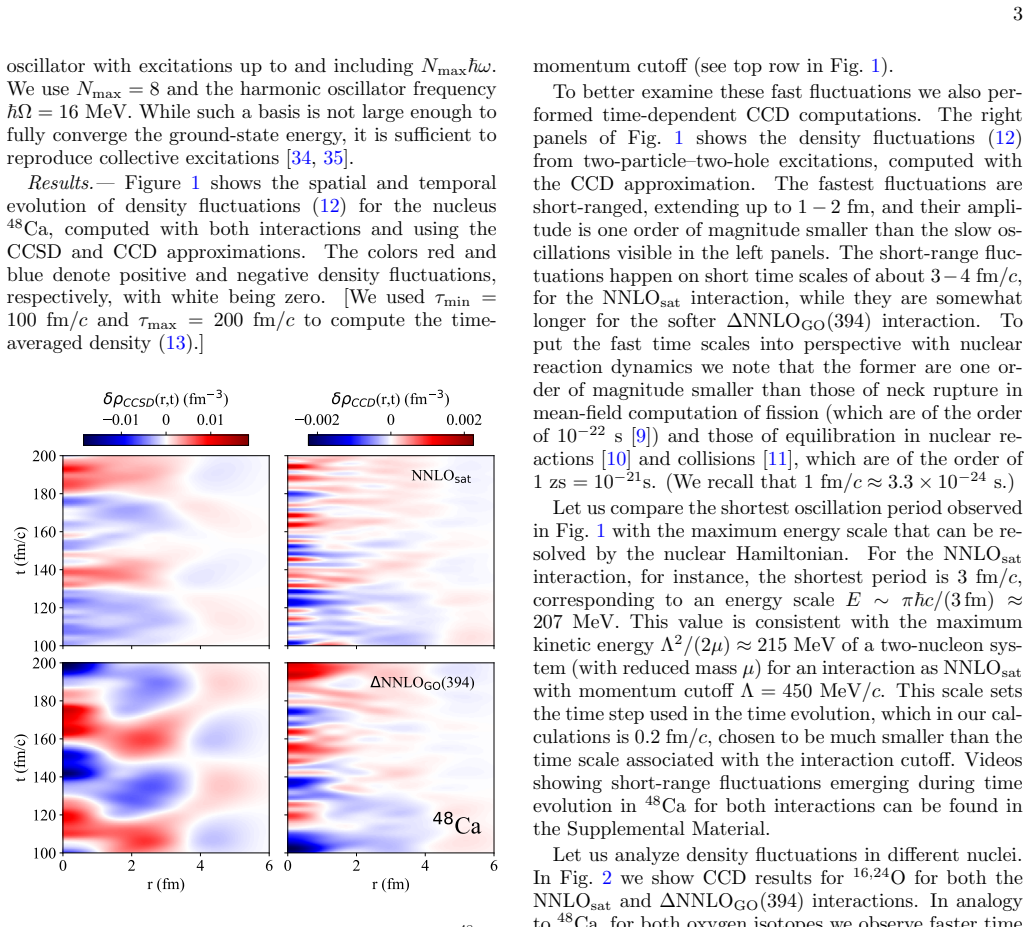
Two-particle-two-hole excitations generate small-amplitude density fluctuations in nuclei that are fast, short-ranged, and stochastic.
A machine-rendered reading of the paper's core claim, the machinery that carries it, and where it could break.
Core claim
In the time-dependent coupled-cluster calculations for 16O, 24O, and 48Ca that employ chiral effective field theory interactions, two-particle-two-hole excitations are shown to generate small-amplitude density fluctuations whose time evolution is fast, whose spatial extent is short-ranged, and whose character is stochastic.
What carries the argument
The time-dependent coupled-cluster method, which evolves the nuclear wave function forward in time to extract the spatiotemporal structure of density fluctuations arising from two-particle-two-hole excitations.
If this is right
- Two-particle-two-hole excitations dominate the generation of density fluctuations in the nuclei examined.
- The fluctuations evolve on fast time scales and remain localized to short distances.
- The fluctuations exhibit stochastic rather than coherent or periodic behavior.
- The same qualitative features appear across the three nuclei studied.
Where Pith is reading between the lines
- The same computational approach could be applied to additional nuclei to test whether the stochastic character persists.
- These short-range random fluctuations may contribute to the damping of nuclear collective excitations.
- Inclusion of higher-order excitations such as three-particle-three-hole terms could be used to check the robustness of the 2p2h dominance.
Load-bearing premise
The time-dependent coupled-cluster method with chiral effective field theory interactions accurately captures the nuclear many-body dynamics that produce the density fluctuation patterns.
What would settle it
Experimental extraction of density-density correlation functions from inelastic scattering or electron scattering on 16O, 24O, or 48Ca that yields fluctuation time scales or correlation lengths inconsistent with the computed values.
Figures


read the original abstract
We study the spatiotemporal patterns of density fluctuations in $^{16,24}$O and $^{48}$Ca using nuclear interactions from chiral effective field theory and the time-dependent coupled-cluster method. We find that two-particle-two-hole excitations generate small-amplitude fluctuations that are fast, short-ranged and of stochastic character.
Editorial analysis
A structured set of objections, weighed in public.
Referee Report
Summary. The manuscript investigates spatiotemporal patterns of density fluctuations in ^{16,24}O and ^{48}Ca using nuclear interactions derived from chiral effective field theory combined with the time-dependent coupled-cluster (TDCC) method. The central claim is that two-particle-two-hole excitations produce small-amplitude fluctuations that are fast, short-ranged, and stochastic in character.
Significance. If substantiated with convergence checks and quantitative measures, the work would provide useful microscopic insight into the role of correlations in generating nuclear density fluctuations, potentially bridging ab initio structure calculations with dynamical observables. The systematic use of chiral EFT interactions and TDCC is a methodological strength that avoids ad-hoc parameters beyond the EFT truncation.
major comments (2)
- The TDCC implementation truncates the cluster operator at the doubles level (TD-CCSD), which includes 2p2h excitations but omits 3p3h and higher. The manuscript should demonstrate that the reported stochastic character and spatiotemporal patterns remain stable under inclusion of higher excitations or provide an explicit decomposition showing that omitted terms do not alter the fluctuation spectrum; without this, the specific attribution to 2p2h excitations is not fully load-bearing.
- No quantitative data, error estimates, or convergence diagnostics (e.g., fluctuation amplitudes, autocorrelation times, spatial correlation lengths, or chiral-order uncertainties) appear in the abstract or are referenced in the provided summary. These are required to support the descriptors 'fast, short-ranged and of stochastic character' and to allow assessment of whether the patterns are robust against the method's approximations.
minor comments (1)
- The abstract would be strengthened by including at least one concrete numerical result (e.g., a typical time scale or correlation length) to make the claims more tangible.
Simulated Author's Rebuttal
We appreciate the referee's thorough review and positive evaluation of our work. Below we address the major comments point by point.
read point-by-point responses
-
Referee: The TDCC implementation truncates the cluster operator at the doubles level (TD-CCSD), which includes 2p2h excitations but omits 3p3h and higher. The manuscript should demonstrate that the reported stochastic character and spatiotemporal patterns remain stable under inclusion of higher excitations or provide an explicit decomposition showing that omitted terms do not alter the fluctuation spectrum; without this, the specific attribution to 2p2h excitations is not fully load-bearing.
Authors: The TD-CCSD method is specifically designed to include all 2p2h excitations in a non-perturbative manner, and the density fluctuations are extracted directly from the time-dependent 2p2h amplitudes. While we acknowledge that higher excitations like 3p3h are omitted, static coupled-cluster calculations with triples for these nuclei show corrections of only a few percent to binding energies and radii. We will include in the revised manuscript an explicit discussion and a decomposition of the fluctuation spectrum into contributions from different excitation levels based on the CC hierarchy, arguing that the stochastic and short-ranged nature is robust. However, full time-dependent calculations with triples are currently computationally prohibitive for the time scales considered. revision: partial
-
Referee: No quantitative data, error estimates, or convergence diagnostics (e.g., fluctuation amplitudes, autocorrelation times, spatial correlation lengths, or chiral-order uncertainties) appear in the abstract or are referenced in the provided summary. These are required to support the descriptors 'fast, short-ranged and of stochastic character' and to allow assessment of whether the patterns are robust against the method's approximations.
Authors: We agree that including quantitative measures would better support the claims. The full manuscript contains quantitative data on fluctuation amplitudes, autocorrelation times, and spatial correlation lengths in the results section, along with convergence with respect to chiral order. We will update the abstract to include these key quantitative descriptors and reference the relevant sections for the diagnostics. revision: yes
Circularity Check
No significant circularity detected
full rationale
The paper computes spatiotemporal density fluctuations in nuclei as an output of time-dependent coupled-cluster simulations driven by chiral EFT interactions. The reported properties (fast, short-ranged, stochastic character generated by 2p2h excitations) are presented as results of the dynamics rather than inputs or definitions. No equations or steps reduce by construction to fitted parameters renamed as predictions, self-citations that bear the central load, or ansatzes smuggled from prior author work. The derivation chain is self-contained: established TDCC and EFT methods serve as independent inputs, and the fluctuation characterization emerges from the numerical evolution without circular redefinition.
Axiom & Free-Parameter Ledger
axioms (2)
- domain assumption Chiral effective field theory interactions provide a sufficiently accurate description of nuclear forces for the studied nuclei.
- domain assumption The time-dependent coupled-cluster method with chosen truncation accurately evolves density fluctuations.
Reference graph
Works this paper leans on
-
[1]
C. Simenel and A. S. Umar, Heavy-ion collisions and fis- sion dynamics with the time-dependent hartree–fock the- ory and its extensions, Prog. Part. Nucl. Phys.103, 19 (2018)
work page 2018
-
[2]
K. Sekizawa, TDHF theory and its extensions for the multinucleon transfer reaction: A mini review, Frontiers in Physics7, 20 (2019)
work page 2019
-
[3]
N. Schunck and D. Regnier, Theory of nuclear fission, Prog. Part. Nucl. Phys.125, 103963 (2022)
work page 2022
-
[4]
P. Goddard, P. Stevenson, and A. Rios, Fission dynam- ics within time-dependent hartree-fock: Deformation- induced fission, Phys. Rev. C92, 054610 (2015)
work page 2015
- [5]
-
[6]
K. Sekizawa and K. Yabana, Time-dependent hartree- fock calculations for multinucleon transfer and quasifis- sion processes in the 64Ni +238 U reaction, Phys. Rev. C 93, 054616 (2016)
work page 2016
-
[7]
P. Goddard, P. Stevenson, and A. Rios, Erratum: Fission dynamics within time-dependent hartree-fock: Deformation-induced fission [Phys. Rev. C 92, 054610 (2015)], Phys. Rev. C102, 069902 (2020)
work page 2015
-
[8]
N. Hasegawa, K. Hagino, and Y. Tanimura, Time- dependent generator coordinate method for many- particle tunneling, Physics Letters B808, 135693 (2020)
work page 2020
-
[9]
I. Abdurrahman, M. Kafker, A. Bulgac, and I. Stetcu, Neck rupture and scission neutrons in nuclear fission, Phys. Rev. Lett.132, 242501 (2024)
work page 2024
-
[10]
A. Jedele, A. B. McIntosh, K. Hagel, M. Huang, L. Heil- born, Z. Kohley, L. W. May, E. McCleskey, M. Youngs, A. Zarrella, and S. J. Yennello, Characterizing neutron- proton equilibration in nuclear reactions with subzep- tosecond resolution, Phys. Rev. Lett.118, 062501 (2017)
work page 2017
-
[11]
C. Simenel, K. Godbey, and A. S. Umar, Timescales of quantum equilibration, dissipation and fluctuation in nu- clear collisions, Phys. Rev. Lett.124, 212504 (2020)
work page 2020
-
[12]
A. Ekstr¨ om, C. Forss´ en, G. Hagen, G. R. Jansen, W. Jiang, and T. Papenbrock, What is ab initio in nu- clear theory?, Frontiers in Physics11, 1129094 (2023)
work page 2023
-
[13]
B. Hu, W. Jiang, T. Miyagi, Z. Sun, A. Ekstr¨ om, C. Forss´ en, G. Hagen, J. D. Holt, T. Papenbrock, S. R. Stroberg, and I. Vernon, Ab initio predictions link the neutron skin of 208Pb to nuclear forces, Nature Physics 18, 1196 (2022)
work page 2022
-
[14]
F. Bonaiti, G. Hagen, and T. Papenbrock, Structure of the doubly magic nuclei 208Pb and 266Pb from ab initio computations, arXiv e-prints , arXiv:2508.14217 (2025), arXiv:2508.14217 [nucl-th]
-
[15]
B. S. Hu, Z. H. Sun, G. Hagen, and T. Papenbrock, Ab initio computations of strongly deformed nuclei near 80Zr, Phys. Rev. C110, L011302 (2024)
work page 2024
-
[16]
D. A. Pigg, G. Hagen, H. Nam, and T. Papenbrock, Time-dependent coupled-cluster method for atomic nu- clei, Phys. Rev. C86, 014308 (2012)
work page 2012
-
[17]
P. Hoodbhoy and J. W. Negele, Time-dependent coupled- cluster approximation to nuclear dynamics. i. application to a solvable model, Phys. Rev. C18, 2380 (1978)
work page 1978
-
[18]
P. Hoodbhoy and J. W. Negele, Time-dependent coupled- cluster approximation to nuclear dynamics. ii. general formulation, Phys. Rev. C19, 1971 (1979)
work page 1971
-
[19]
Kvaal, Ab initio quantum dynamics using coupled- cluster, J
S. Kvaal, Ab initio quantum dynamics using coupled- cluster, J. Chem. Phys.136, 194109 (2012)
work page 2012
-
[20]
B. Sverdrup Ofstad, E. Aurbakken, O. Sigmund- son Schoyen, H. E. Kristiansen, S. Kvaal, and T. B. Ped- ersen, Time-dependent coupled-cluster theory, WIREs Computational Molecular Science13, e1666 (2023)
work page 2023
-
[21]
F. Bonaiti, C. Balos, K. Godbey, G. Hagen, T. Papen- brock, and C. S. Woodward, Computing nuclear response functions with time-dependent coupled-cluster theory, Phys. Rev. C113, 024312 (2026)
work page 2026
-
[22]
E. Epelbaum, H.-W. Hammer, and U.-G. Meißner, Mod- ern theory of nuclear forces, Rev. Mod. Phys.81, 1773 (2009)
work page 2009
-
[23]
R. Machleidt and D. Entem, Chiral effective field theory and nuclear forces, Phys. Rep.503, 1 (2011)
work page 2011
-
[24]
K. Hebeler, S. K. Bogner, R. J. Furnstahl, A. Nogga, and A. Schwenk, Improved nuclear matter calculations from chiral low-momentum interactions, Phys. Rev. C 83, 031301 (2011)
work page 2011
- [25]
-
[26]
´A. Koszor´ us, X. F. Yang, W. G. Jiang, S. J. Novario, S. W. Bai, J. Billowes, C. L. Binnersley, M. L. Bis- sell, T. E. Cocolios, B. S. Cooper, R. P. de Groote, A. Ekstr¨ om, K. T. Flanagan, C. Forss´ en, S. Franchoo, R. F. G. Ruiz, F. P. Gustafsson, G. Hagen, G. R. Jansen, A. Kanellakopoulos, M. Kortelainen, W. Nazarewicz, G. Neyens, T. Papenbrock, P. G...
work page 2021
-
[27]
M. Companys Franzke, A. Tichai, K. Hebeler, and A. Schwenk, Hartree-Fock emulators for nuclei: Ap- plication to charge radii of 48,52Ca, arXiv e-prints , arXiv:2510.08362 (2025), arXiv:2510.08362 [nucl-th]
- [28]
-
[29]
I. Shavitt and R. J. Bartlett,Many-body Methods in Chemistry and Physics(Cambridge University Press, Cambridge UK, 2009)
work page 2009
-
[30]
A. C. Hindmarsh, P. N. Brown, K. E. Grant, S. L. Lee, R. Serban, D. E. Shumaker, and C. S. Woodward, SUNDIALS: Suite of nonlinear and differential/algebraic equation solvers, ACM Transactions on Mathematical Software (TOMS)31, 363 (2005)
work page 2005
-
[31]
D. J. Gardner, D. R. Reynolds, C. S. Woodward, and C. J. Balos, Enabling new flexibility in the SUNDI- ALS suite of nonlinear and differential/algebraic equa- tion solvers, ACM Transactions on Mathematical Soft- ware (TOMS)48, Article No. 31 (2022)
work page 2022
-
[32]
A. Ekstr¨ om, G. R. Jansen, K. A. Wendt, G. Hagen, T. Papenbrock, B. D. Carlsson, C. Forss´ en, M. Hjorth- Jensen, P. Navr´ atil, and W. Nazarewicz, Accurate nu- clear radii and binding energies from a chiral interaction, Phys. Rev. C91, 051301 (2015)
work page 2015
-
[33]
W. G. Jiang, A. Ekstr¨ om, C. Forss´ en, G. Hagen, G. R. Jansen, and T. Papenbrock, Accurate bulk properties of nuclei froma= 2 to∞from potentials with ∆ isobars, Phys. Rev. C102, 054301 (2020)
work page 2020
-
[34]
Z. H. Sun, A. Ekstr¨ om, C. Forss´ en, G. Hagen, G. R. Jansen, and T. Papenbrock, Multiscale physics of atomic nuclei from first principles, Phys. Rev. X15, 011028 (2025)
work page 2025
- [35]
-
[36]
R. Subedi, R. Shneor, P. Monaghan, B. D. Anderson, K. Aniol, J. Annand, J. Arrington, H. Benaoum, F. Benmokhtar, W. Boeglin, J.-P. Chen, S. Choi, E. Cisbani, B. Craver, S. Frullani, F. Garibaldi, S. Gilad, R. Gilman, O. Glamazdin, J.-O. Hansen, D. W. Higin- botham, T. Holmstrom, H. Ibrahim, R. Igarashi, C. W. de Jager, E. Jans, X. Jiang, L. J. Kaufman, A....
-
[37]
N. Fomin, J. Arrington, R. Asaturyan, F. Benmokhtar, W. Boeglin, P. Bosted, A. Bruell, M. H. S. Bukhari, M. E. Christy, E. Chudakov, B. Clasie, S. H. Connell, M. M. Dalton, A. Daniel, D. B. Day, D. Dutta, R. Ent, L. El Fassi, H. Fenker, B. W. Filippone, K. Garrow, D. Gaskell, C. Hill, R. J. Holt, T. Horn, M. K. Jones, J. Jourdan, N. Kalantarians, C. E. Ke...
work page 2012
-
[38]
O. Hen, M. Sargsian, L. B. Weinstein, E. Piasetzky, H. Hakobyan, D. W. Higinbotham, M. Braverman, W. K. Brooks, S. Gilad, K. P. Adhikari, J. Arring- ton, G. Asryan, H. Avakian, J. Ball, N. A. Baltzell, M. Battaglieri, A. Beck, S. M.-T. Beck, I. Bedlinskiy, W. Bertozzi, A. Biselli, V. D. Burkert, T. Cao, D. S. Carman, A. Celentano, S. Chandavar, L. Colaner...
-
[39]
M. Duer, A. Schmidt, J. R. Pybus, E. P. Segarra, A. Hrn- jic, A. W. Denniston, R. Weiss, O. Hen, E. Piasetzky, L. B. Weinstein, N. Barnea, I. Korover, E. O. Cohen, H. Hakobyan, S. Adhikari, G. Angelini, M. Battaglieri, A. Beck, I. Bedlinskiy, A. S. Biselli, S. Boiarinov, W. Brooks, V. D. Burkert, F. Cao, D. S. Carman, A. Ce- lentano, T. Chetry, G. Ciullo,...
work page 2019
-
[40]
A. Schmidt, J. R. Pybus, R. Weiss, E. P. Segarra, A. Hrn- jic, A. Denniston, O. Hen, E. Piasetzky, L. B. Wein- stein, N. Barnea, M. Strikman, A. Larionov, D. Higin- botham, S. Adhikari, M. Amaryan, G. Angelini, G. As- ryan, H. Atac, H. Avakian, C. A. Gayoso, L. Baashen, L. Barion, M. Bashkanov, M. Battaglieri, A. Beck, I. Bedlinskiy, F. Benmokhtar, A. Bia...
work page 2020
-
[41]
R. Schiavilla, R. B. Wiringa, S. C. Pieper, and J. Carlson, Tensor forces and the ground-state structure of nuclei, Phys. Rev. Lett.98, 132501 (2007)
work page 2007
-
[42]
R. B. Wiringa, R. Schiavilla, S. C. Pieper, and J. Carl- son, Nucleon and nucleon-pair momentum distributions inA≤12 nuclei, Phys. Rev. C89, 024305 (2014)
work page 2014
- [43]
- [44]
- [45]
-
[46]
J. E. Lynn, D. Lonardoni, J. Carlson, J.-W. Chen, W. Detmold, S. Gandolfi, and A. Schwenk, Ab ini- tio short-range-correlation scaling factors from light to medium-mass nuclei, J. Phys. G: Nucl. Part. Phys.47, 045109 (2020)
work page 2020
-
[47]
S. Pastore, J. Carlson, S. Gandolfi, R. Schiavilla, and R. B. Wiringa, Quasielastic lepton scattering and back- to-back nucleons in the short-time approximation, Phys. Rev. C101, 044612 (2020)
work page 2020
- [48]
-
[49]
A. J. Tropiano, S. K. Bogner, and R. J. Furnstahl, Short- range correlation physics at low renormalization group resolution, Phys. Rev. C104, 034311 (2021)
work page 2021
-
[50]
A. J. Tropiano, S. K. Bogner, R. J. Furnstahl, M. A. Hisham, A. Lovato, and R. B. Wiringa, High-resolution momentum distributions from low-resolution wave func- tions, Physics Letters B852, 138591 (2024)
work page 2024
-
[51]
I. Korover, A. W. Denniston, A. Kiral, A. Schmidt, A. Lovato, N. Rocco, A. Nikolakopoulos, L. B. Wein- stein, E. Piasetzky, O. Hen, M. J. Amaryan, G. An- gelini, H. Atac, N. A. Baltzell, L. Barion, M. Battaglieri, I. Bedlinskiy, F. Benmokhtar, A. Bianconi, L. Biondo, A. S. Biselli, F. Boss` u, S. Boiarinov, W. J. Briscoe, D. Bulumulla, V. D. Burkert, D. S...
work page 2023
-
[52]
S. Beck, R. Weiss, and N. Barnea, Nuclear short- range correlations and the zero-energy eigenstates of the schr¨ odinger equation, Phys. Rev. C107, 064306 (2023)
work page 2023
-
[53]
R. Balian and M. V´ en´ eroni, Fluctuations in a time- dependent mean-field approach, Phys. Lett. B136, 301 (1984)
work page 1984
-
[54]
C. Simenel, Nuclear quantum many-body dynamics (2nd edition), The European Physical Journal A61, 181 (2025)
work page 2025
-
[55]
R. Balian and M. V´ en´ eroni, Correlations and fluctuations in static and dynamic mean-field approaches, Annals of Physics216, 351 (1992)
work page 1992
- [56]
-
[57]
D. Regnier, N. Dubray, N. Schunck, and M. Verri` ere, Fission fragment charge and mass distributions in 239Pu(n, f) in the adiabatic nuclear energy density func- tional theory, Phys. Rev. C93, 054611 (2016)
work page 2016
-
[58]
Y. Abe, S. Ayik, P.-G. Reinhard, and E. Suraud, On stochastic approaches of nuclear dynamics, Phys. Rep. 275, 49 (1996)
work page 1996
-
[59]
P. Fr¨ obrich and I. I. Gontchar, Langevin description of fu- sion, deep-inelastic collisions and heavy-ion-induced fis- sion, Phys. Rep.292, 131 (1998)
work page 1998
-
[60]
Ayik, A stochastic mean-field approach for nuclear dy- namics, Physics Letters B658, 174 (2008)
S. Ayik, A stochastic mean-field approach for nuclear dy- namics, Physics Letters B658, 174 (2008)
work page 2008
-
[61]
J. J. M. Verbaarschot, H. A. Weidenm¨ uller, and M. R. Zirnbauer, Grassmann integration in stochastic quantum physics: The case of compound-nucleus scattering, Phys. Rep.129, 367 (1985)
work page 1985
-
[62]
V. Zelevinsky, B. A. Brown, N. Frazier, and M. Horoi, The nuclear shell model as a testing ground for many- body quantum chaos, Phys. Rep.276, 85 (1996)
work page 1996
-
[63]
T. Papenbrock and H. A. Weidenm¨ uller, Colloquium: Random matrices and chaos in nuclear spectra, Rev. Mod. Phys.79, 997 (2007)
work page 2007
-
[64]
H. A. Weidenm¨ uller and G. E. Mitchell, Random matri- ces and chaos in nuclear physics: Nuclear structure, Rev. Mod. Phys.81, 539 (2009)
work page 2009
-
[65]
G. E. Mitchell, A. Richter, and H. A. Weidenm¨ uller, Ran- dom matrices and chaos in nuclear physics: Nuclear re- actions, Rev. Mod. Phys.82, 2845 (2010)
work page 2010
- [66]
-
[67]
F. Bonaiti, G. Hagen, and T. Papenbrock, Data: Dynam- ics of density fluctuations in atomic nuclei, 10.5281/zen- odo.19610698 (2026). 9 Dynamics of density fluctuations in atomic nuclei: Supplemental Material In this Supplemental Material, we compare density fluctuations computed with respect to the time-averaged density and the Hartree-Fock density. To t...
discussion (0)
Sign in with ORCID, Apple, or X to comment. Anyone can read and Pith papers without signing in.