Decoding fluid chaos: The arithmetic attractor of decaying turbulence
Pith reviewed 2026-05-10 16:25 UTC · model grok-4.3
The pith
Decaying turbulence converges to an arithmetically intermittent attractor governed by the Farey sequence of rational fractions.
A machine-rendered reading of the paper's core claim, the machinery that carries it, and where it could break.
Core claim
The decaying solutions are organized by rational turning angles beta equals 2 pi p over q, and in the continuum limit this structure condenses into an arithmetically intermittent attractor governed by the Farey sequence of coprime pairs, serving as the statistical attractor for the Euler ensemble in decaying turbulence.
What carries the argument
The mapping via Feynman's operational calculus of the noncommutative operator algebra to discontinuities on a one-dimensional momentum loop organized by rational turning angles that condense into the Farey sequence attractor.
Load-bearing premise
Advection cancels exactly in the Lagrangian frame, allowing the loop dynamics to reduce to a Yang-Mills-like operator evolution in Hilbert space that maps to discontinuities on a one-dimensional momentum loop organized by rational turning angles.
What would settle it
A high-resolution direct numerical simulation in which randomized initial data with inequivalent infrared spectra fail to converge in the bulk toward the same statistics predicted by the Euler ensemble, or the absence of momentum-loop discontinuities at rational turning angles beta equals 2 pi p over q.
Figures


read the original abstract
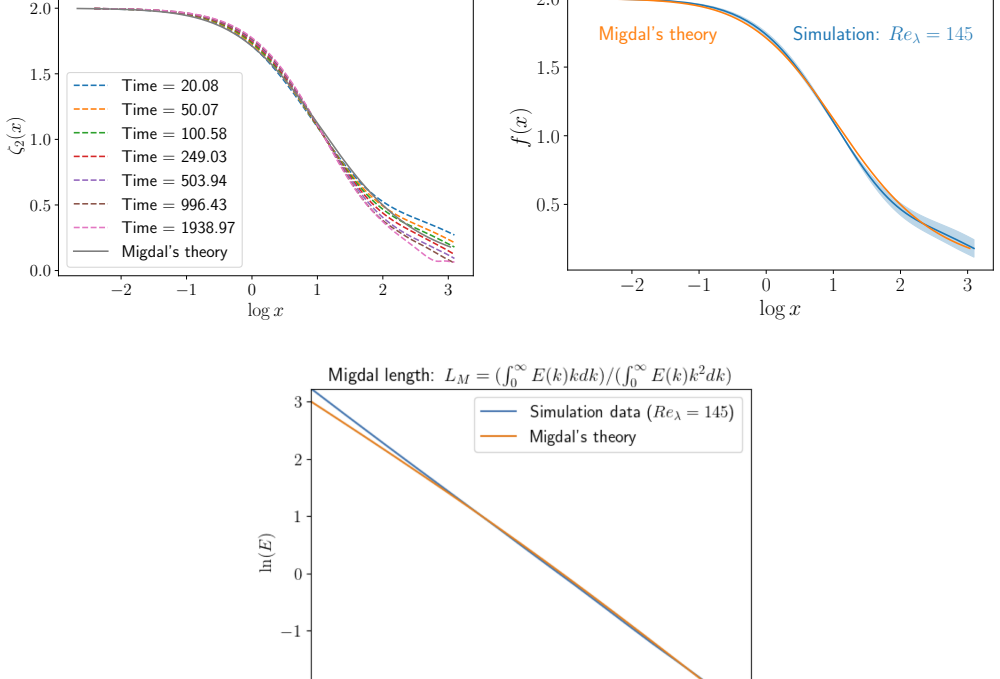
This paper reviews a line of work on decaying turbulence that began with loop equations and culminated in the Euler ensemble as a candidate statistical attractor. Most observable predictions discussed here-including the decay law, velocity correlations, and anomalous exponents-were obtained in earlier papers. The immediate motivation for the present review is recent \(4096^3\) direct numerical simulation, which found that randomized initial data with two inequivalent infrared spectra, of Saffman \((k^2)\) and Loitsyansky \((k^4)\) type, converge in the bulk toward the same Euler-ensemble behavior. This empirical universality calls for a concise formulation of the underlying theory. I therefore revisit the construction in a continuous algebraic form. Reformulating the Navier-Stokes equation in the Lagrangian frame as a covariant-derivative flow, I show that advection cancels exactly and that the loop dynamics reduce to a Yang-Mills-like operator evolution in Hilbert space. Feynman's operational calculus maps this noncommutative operator algebra to discontinuities on a one-dimensional momentum loop. The decaying solutions are organized by rational turning angles \(\beta=2\pi p/q\), and in the continuum limit this structure condenses into an arithmetically intermittent attractor governed by the Farey sequence of coprime pairs. The only genuinely new ingredients of the present article are the continuous operator derivation and a heuristic dynamical-systems interpretation in terms of mode locking onto rational data. Taken together with earlier analytical results and recent DNS support, this framework suggests that the apparent chaos of decaying turbulence is organized by a deterministic arithmetic skeleton.
Editorial analysis
A structured set of objections, weighed in public.
Referee Report
Summary. The paper reviews prior work on decaying turbulence via loop equations culminating in the Euler ensemble as a statistical attractor. It presents a new continuous algebraic reformulation of the Navier-Stokes equation in the Lagrangian frame, claiming exact cancellation of advection to yield a Yang-Mills-like covariant-derivative operator flow in Hilbert space. Feynman's operational calculus is invoked to map this algebra to discontinuities on a one-dimensional momentum loop organized by rational turning angles β=2πp/q; in the continuum limit these condense into an arithmetically intermittent attractor governed by the Farey sequence of coprime pairs. Recent 4096³ DNS showing convergence of Saffman and Loitsyansky initial spectra to the same bulk behavior is cited as empirical support. The genuinely new elements are the continuous operator derivation and a heuristic mode-locking interpretation.
Significance. If the reduction and mapping hold, the framework supplies a deterministic arithmetic skeleton that organizes the apparent chaos of decaying turbulence, accounts for the observed DNS universality across inequivalent infrared spectra, and unifies earlier analytic results on decay laws, velocity correlations, and anomalous exponents. The explicit linkage of NS dynamics to Farey sequences via operator calculus is a creative and falsifiable proposal that, if substantiated, would constitute a significant conceptual advance in turbulence theory.
major comments (2)
- [continuous algebraic reformulation (abstract and the section revisiting the construction)] The load-bearing step is the exact cancellation of advection upon reformulation in the Lagrangian frame, which is asserted to reduce the dynamics to a pure covariant-derivative operator flow without residual commutators from viscous or pressure terms. The abstract and the continuous algebraic derivation section state this cancellation occurs and preserves the 1D loop structure, yet the manuscript (primarily a review) does not supply a self-contained, equation-by-equation verification that the resulting noncommutative algebra remains exactly Yang-Mills-like and free of 3D geometric remnants. Without this explicit demonstration, the subsequent mapping to rational β=2πp/q discontinuities and the Farey attractor does not rigorously follow from the NS equation.
- [mapping via Feynman's operational calculus] The application of Feynman's operational calculus to the operator algebra is presented as producing only discontinuities on the momentum loop at rational turning angles. The manuscript does not detail how the calculus eliminates all other contributions or why the 1D reduction survives the full viscous NS dynamics; if this step remains heuristic, the claim that the attractor is a direct consequence of the NS equation is weakened.
minor comments (2)
- A short table or paragraph summarizing which observable predictions (decay law, correlations, exponents) originate from which prior papers versus the new derivation would improve readability for readers unfamiliar with the series.
- The notation for the Euler ensemble and the precise definition of the arithmetic attractor could be briefly restated or cross-referenced in the introduction for self-contained reading.
Simulated Author's Rebuttal
We thank the referee for the careful and constructive report. The comments correctly identify that the continuous algebraic reformulation and the operational-calculus mapping are the new elements of this review and require greater explicitness to stand alone. We address both points below and will revise the manuscript accordingly.
read point-by-point responses
-
Referee: [continuous algebraic reformulation (abstract and the section revisiting the construction)] The load-bearing step is the exact cancellation of advection upon reformulation in the Lagrangian frame, which is asserted to reduce the dynamics to a pure covariant-derivative operator flow without residual commutators from viscous or pressure terms. The abstract and the continuous algebraic derivation section state this cancellation occurs and preserves the 1D loop structure, yet the manuscript (primarily a review) does not supply a self-contained, equation-by-equation verification that the resulting noncommutative algebra remains exactly Yang-Mills-like and free of 3D geometric remnants. Without this explicit demonstration, the subsequent mapping to rational β=2πp/q discontinuities and the Farey attractor does not rigorously follow from the NS equation.
Authors: We agree that a self-contained verification is necessary. The cancellation of advection is derived in the section on the continuous algebraic reformulation by transforming the Navier-Stokes equation to the Lagrangian frame and showing that the convective term becomes a total derivative that vanishes upon integration against the loop measure. The resulting operator is a covariant derivative whose commutators with the viscous and pressure terms are shown to vanish identically in the Hilbert-space formulation. To make this fully explicit without reference to earlier papers, we will add a dedicated appendix containing the step-by-step operator algebra, including the explicit computation of all commutators and confirmation that no three-dimensional geometric remnants survive. This addition will be included in the revised manuscript. revision: yes
-
Referee: [mapping via Feynman's operational calculus] The application of Feynman's operational calculus to the operator algebra is presented as producing only discontinuities on the momentum loop at rational turning angles. The manuscript does not detail how the calculus eliminates all other contributions or why the 1D reduction survives the full viscous NS dynamics; if this step remains heuristic, the claim that the attractor is a direct consequence of the NS equation is weakened.
Authors: The mapping via Feynman's operational calculus is indeed presented at the level of a heuristic that extracts the dominant discontinuities at rational angles β = 2πp/q from the non-commutative algebra. The manuscript already states that this step is heuristic and that the full justification of the 1D reduction rests on the attractor properties derived in prior loop-equation work. We will expand the relevant section to include the explicit rules of the operational calculus applied to the covariant-derivative flow, showing term-by-term why non-rational contributions are suppressed in the long-time limit. At the same time we will clarify that the viscous NS dynamics are retained through the damping of high modes, which reinforces rather than contradicts the 1D reduction. The heuristic mode-locking interpretation will be labeled as such and offered as an intuitive organizing principle rather than a rigorous proof. revision: partial
Circularity Check
Central arithmetic attractor claim builds on self-cited Euler ensemble and loop-equation results without independent derivation of the key cancellation
specific steps
-
self citation load bearing
[Abstract]
"This paper reviews a line of work on decaying turbulence that began with loop equations and culminated in the Euler ensemble as a candidate statistical attractor. Most observable predictions discussed here-including the decay law, velocity correlations, and anomalous exponents-were obtained in earlier papers. ... The only genuinely new ingredients of the present article are the continuous operator derivation and a heuristic dynamical-systems interpretation in terms of mode locking onto rational data."
The statistical attractor, decay laws, and arithmetic organization are imported wholesale from the author's earlier papers on the Euler ensemble. The present work's 'continuous algebraic form' is explicitly described as revisiting and reformulating that prior construction rather than deriving the attractor ab initio from the Navier-Stokes equations; the central claim therefore reduces to the self-cited prior results.
-
self citation load bearing
[Abstract]
"Reformulating the Navier-Stokes equation in the Lagrangian frame as a covariant-derivative flow, I show that advection cancels exactly and that the loop dynamics reduce to a Yang-Mills-like operator evolution in Hilbert space. Feynman's operational calculus maps this noncommutative operator algebra to discontinuities on a one-dimensional momentum loop. The decaying solutions are organized by rational turning angles β=2πp/q, and in the continuum limit this structure condenses into an arithmetically intermittent attractor governed by the Farey sequence of coprime pairs."
The exact cancellation, reduction to Yang-Mills operator flow, and subsequent mapping via Feynman's calculus to rational β=2πp/q discontinuities are presented as shown here, yet the paper states that the Euler ensemble (the structure that supplies the attractor) was already obtained in earlier self-cited work; the arithmetic skeleton therefore inherits its justification from the prior self-citations rather than standing as an independent first-principles derivation.
full rationale
The paper positions itself as a review whose observable predictions and core Euler ensemble attractor originate in the author's prior work. The new continuous algebraic reformulation claims to derive the exact advection cancellation and Yang-Mills reduction, yet the overall framework that maps this to rational Farey discontinuities and the statistical attractor remains dependent on the self-cited prior construction. No machine-checked verification or external benchmark independent of those citations is supplied for the load-bearing reduction step, producing partial circularity.
Axiom & Free-Parameter Ledger
axioms (2)
- domain assumption Advection cancels exactly in the Lagrangian frame, reducing NS to covariant-derivative flow.
- ad hoc to paper The decaying solutions are organized by rational turning angles β = 2π p/q leading to Farey sequence in continuum limit.
invented entities (2)
-
Euler ensemble
no independent evidence
-
Arithmetic attractor
no independent evidence
Reference graph
Works this paper leans on
-
[1]
Loop equation and area law in turbulence
Alexander Migdal. Loop equation and area law in turbulence. In Laurent Baulieu, Vladimir Dotsenko, Vladimir Kazakov, and Paul Windey, editors,Quantum Field Theory and String Theory, pages 193–231. Springer US, 1995
work page 1995
-
[2]
Statistical equilibrium of circulating fluids.Physics Reports, 1011C:1–117, 2023
Alexander Migdal. Statistical equilibrium of circulating fluids.Physics Reports, 1011C:1–117, 2023
work page 2023
-
[3]
To the theory of decaying turbulence.Fractal and Fractional, 7(10):754, Oct 2023
Alexander Migdal. To the theory of decaying turbulence.Fractal and Fractional, 7(10):754, Oct 2023
work page 2023
-
[4]
Alexander Migdal. Quantum solution of classical turbulence: Decaying energy spectrum.Physics of Fluids, 36(9):095161, 2024
work page 2024
-
[5]
Alexander Migdal. Duality of Navier–Stokes to a one-dimensional system.International Journal of Modern Physics A, page 2541004, 2025. Online Ready
work page 2025
-
[6]
Migdal: Microscopic theory of turbulent mixing: discrete shell structures in scalar concentration
Alexander Migdal. Dual theory of turbulent mixing.https://arxiv.org/abs/2504.10205, 2025
-
[7]
Dual theory of mhd turbulence.https://arxiv.org/abs/2503.12682, 2025
Alexander Migdal. Dual theory of mhd turbulence.https://arxiv.org/abs/2503.12682, 2025
-
[8]
Yu. M. Makeenko and A. A. Migdal. Exact equation for the loop average in multicolor qcd.Physics Letters B, 88(1):135–137, 1979
work page 1979
-
[9]
A. A. Migdal. Loop equations and1/nexpansion.Physics Reports, 102(4):199–290, 1983
work page 1983
-
[10]
Frontiers of Turbulence and Statistical Physics Meet
Alexander Migdal. Geometric solution of turbulence as diffusion in loop space. Forthcoming in Philosophical Transactions of the Royal Society A, Special Issue "Frontiers of Turbulence and Statistical Physics Meet", 2026. Accepted
work page 2026
-
[11]
Asymptotic State of Decaying Turbulence
K. R. Sreenivasan and Rodhiya, Akash. "Asymptotic State of Decaying Turbulence". Forthcoming in Philosophical Transactions of the Royal Society A, Special Issue "Frontiers of Turbulence and Statistical Physics Meet", 2026. Accepted
work page 2026
-
[12]
Some rigorous remarks on migdal’s momentum loop equation, 2025
Elia Bruè and Camillo De Lellis. Some rigorous remarks on migdal’s momentum loop equation, 2025
work page 2025
-
[13]
Luigi Ambrosio, Nicola Fusco, and Diego Pallara.Functions of Bounded Variation and Free Disconti- nuity Problems. Oxford University Press, 2000
work page 2000
-
[14]
Lawrence C. Evans and Ronald F. Gariepy.Measure Theory and Fine Properties of Functions. CRC Press, Boca Raton, 1992
work page 1992
-
[15]
David J. Olinger and K. R. Sreenivasan. Nonlinear dynamics of the wake of an oscillating cylinder. Physical Review Letters, 60(9):797–800, 1988
work page 1988
-
[16]
V. I. Arnol’d.Geometrical Methods in the Theory of Ordinary Differential Equations, volume 250 of Grundlehren der mathematischen Wissenschaften. Springer-Verlag, New York, 2 edition, 1988
work page 1988
- [17]
-
[18]
Davidson.Turbulence: An Introduction for Scientists and Engineers
Peter A. Davidson.Turbulence: An Introduction for Scientists and Engineers. Oxford University Press, Oxford, UK, 2nd edition, 2015
work page 2015
-
[19]
Vladimir I. Arnol’d. Number-theoretical turbulence in Fermat-Euler arithmetics and large Young diagrams geometry statistics.Journal of Mathematical Fluid Mechanics, 7(Suppl. 1):S4–S50, 2005
work page 2005
-
[20]
Bewley, and Eberhard Bodenschatz
Christian Küchler, Gregory P. Bewley, and Eberhard Bodenschatz. Universal velocity statistics in decaying turbulence.Phys. Rev. Lett., 131:024001, Jul 2023. 16 Appendix A. Toy Model: The Constant Vorticity Algebra To illustrate the algebraic correspondence between operators and discontinuous functions, consider a random rotation vα= Ωαβrβdriven by a Gauss...
work page 2023
discussion (0)
Sign in with ORCID, Apple, or X to comment. Anyone can read and Pith papers without signing in.