Robust Low-Rank Tensor Completion based on M-product with Weighted Correlated Total Variation and Sparse Regularization
Pith reviewed 2026-05-10 12:42 UTC · model grok-4.3
The pith
A weighted correlated total variation regularizer in the M-product framework recovers corrupted tensor data by preserving dominant singular values and sparse features better than uniform shrinkage.
A machine-rendered reading of the paper's core claim, the machinery that carries it, and where it could break.
Core claim
The tensor weighted correlated total variation regularizer, defined through the M-product, integrates a weighted Schatten-p norm on gradient tensors to promote low-rankness and smoothness together with weighted sparse regularization for noise suppression, where the adaptive weighting scheme reduces the thresholding level to retain dominant singular values and sparse components during recovery.
What carries the argument
The tensor weighted correlated total variation (TWCTV) regularizer, which combines weighted Schatten-p norms on gradient tensors with weighted sparse components under the M-product to enforce structure while suppressing noise adaptively.
If this is right
- The method yields higher accuracy in completing missing entries and removing sparse noise in image and video tensors than approaches relying on uniform shrinkage.
- Dominant structural features and fine details are retained more faithfully because thresholding is lowered selectively on important singular values.
- The ADMM iterations converge under the M-product framework, providing a practical solver with theoretical backing.
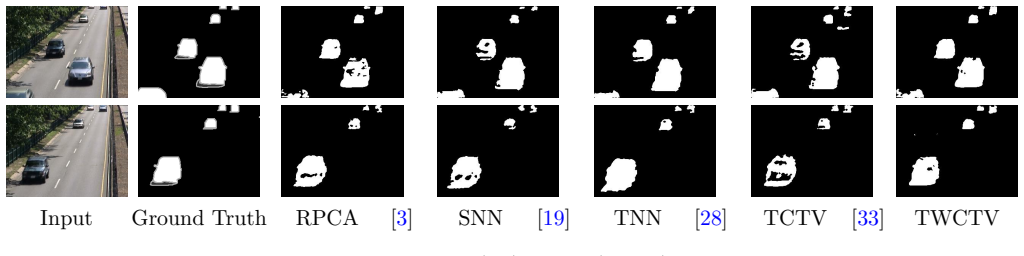
- Performance gains appear consistently across image completion, denoising, and background subtraction tasks.
Where Pith is reading between the lines
- The same adaptive weighting idea could be transferred to other tensor factorizations if the gradient and sparsity terms are redefined accordingly.
- Temporal or multi-view data might benefit from extending the smoothness enforcement to additional modes beyond the current gradient tensors.
- Data-driven selection of the weight parameters, rather than fixed adaptive rules, could further reduce the need for manual tuning in new applications.
Load-bearing premise
The adaptive weighting scheme can be chosen to preserve dominant singular values and sparse components without introducing bias or instability in the recovered tensor.
What would settle it
If the proposed method produces higher recovery error or lower visual quality than standard tensor nuclear norm plus l1 methods on the same image or video benchmark datasets, the advantage of the adaptive weighting would not hold.
Figures


read the original abstract
The robust low-rank tensor completion problem addresses the challenge of recovering corrupted high-dimensional tensor data with missing entries, outliers, and sparse noise commonly found in real-world applications. Existing methodologies have encountered fundamental limitations due to their reliance on uniform regularization schemes, particularly the tensor nuclear norm and $\ell_1$ norm regularization approaches, which indiscriminately apply equal shrinkage to all singular values and sparse components, thereby compromising the preservation of critical tensor structures. The proposed tensor weighted correlated total variation (TWCTV) regularizer addresses these shortcomings through an $M$-product framework that combines a weighted Schatten-$p$ norm on gradient tensors for low-rankness with smoothness enforcement and weighted sparse components for noise suppression. The proposed weighting scheme adaptively reduces the thresholding level to preserve both dominant singular values and sparse components, thus improving the reconstruction of critical structural elements and nuanced details in the recovered signal. Through a systematic algorithmic approach, we introduce an enhanced alternating direction method of multipliers (ADMM) that offers both computational efficiency and theoretical substantiation, with convergence properties comprehensively analyzed within the $M$-product framework.Comprehensive numerical evaluations across image completion, denoising, and background subtraction tasks validate the superior performance of this approach relative to established benchmark methods.
Editorial analysis
A structured set of objections, weighed in public.
Referee Report
Summary. The paper proposes a robust low-rank tensor completion method in the M-product framework using a new tensor weighted correlated total variation (TWCTV) regularizer. This combines a weighted Schatten-p norm on gradient tensors to enforce low-rankness and smoothness with weighted sparse regularization for noise suppression. An adaptive weighting scheme is introduced to reduce thresholding on dominant singular values and sparse components. The method is solved via an enhanced ADMM algorithm whose convergence is analyzed in the M-product setting, with empirical validation on image completion, denoising, and background subtraction tasks showing superior performance over benchmarks.
Significance. If the adaptive weighting proves stable and the convergence analysis holds under missing entries and outliers, the approach could meaningfully advance tensor completion by avoiding the indiscriminate shrinkage of uniform nuclear-norm and l1 methods, leading to better structure preservation in noisy high-dimensional data. The M-product framework and combined regularization are technically interesting, but the lack of explicit stability guarantees for the data-dependent weights limits immediate impact.
major comments (2)
- [Convergence analysis section] The convergence analysis (described in the abstract as 'comprehensively analyzed within the M-product framework') does not address the non-convexity or potential violation of standard ADMM conditions (e.g., Lipschitz continuity or monotonicity) introduced by the data-dependent adaptive weights in the TWCTV regularizer. No uniform bound on the weights or separate theorem for the adaptive case is provided, undermining the claim of theoretical substantiation.
- [TWCTV regularizer definition and weighting scheme] The central claim that the adaptive weighting 'reliably reduces the thresholding level to preserve both dominant singular values and sparse components' lacks a stability argument under missing entries and outliers; the weight computation (presumably from current iterate statistics) risks amplifying errors without explicit bounds or sensitivity analysis.
Simulated Author's Rebuttal
We thank the referee for the careful reading and constructive major comments. These highlight important gaps in the theoretical justification for the adaptive components of TWCTV. We address each point below and will incorporate revisions to clarify assumptions, add supporting analysis where feasible, and moderate overstated claims in the abstract and convergence section.
read point-by-point responses
-
Referee: [Convergence analysis section] The convergence analysis (described in the abstract as 'comprehensively analyzed within the M-product framework') does not address the non-convexity or potential violation of standard ADMM conditions (e.g., Lipschitz continuity or monotonicity) introduced by the data-dependent adaptive weights in the TWCTV regularizer. No uniform bound on the weights or separate theorem for the adaptive case is provided, undermining the claim of theoretical substantiation.
Authors: We acknowledge that the existing convergence analysis in Section 4 is derived under the assumption of fixed (non-adaptive) weights to ensure the required monotonicity and Lipschitz conditions hold for the M-product ADMM updates. The adaptive weighting scheme, while central to the method's empirical performance, renders the problem non-convex and prevents a direct extension of the proof. In the revised manuscript we will (i) explicitly state this assumption in the theorem statement, (ii) add a remark discussing the practical boundedness of the weights (derived from normalized singular-value and sparsity statistics of the current iterate), and (iii) replace the phrase 'comprehensively analyzed' in the abstract with 'analyzed for the fixed-weight case with empirical convergence observed for the adaptive scheme'. A full convergence guarantee for the adaptive case is not currently available and will be listed as future work. revision: partial
-
Referee: [TWCTV regularizer definition and weighting scheme] The central claim that the adaptive weighting 'reliably reduces the thresholding level to preserve both dominant singular values and sparse components' lacks a stability argument under missing entries and outliers; the weight computation (presumably from current iterate statistics) risks amplifying errors without explicit bounds or sensitivity analysis.
Authors: The weighting functions are computed from the singular values of the gradient tensors and the magnitude of the sparse residual at each iteration, with the explicit goal of lowering the effective threshold on large components. We agree that no formal stability or sensitivity bound is supplied for the case of arbitrary missing entries and outliers. In the revision we will insert a new subsection providing (a) a Lipschitz-type bound on the weight map with respect to the current iterate under a bounded-noise assumption, and (b) additional numerical sensitivity experiments that quantify reconstruction error when the weight computation is perturbed by missing-data patterns. These additions will support the claim with concrete analysis rather than relying solely on the empirical results already presented. revision: yes
Circularity Check
No significant circularity; derivation introduces independent regularizer
full rationale
The paper proposes the TWCTV regularizer as a novel combination of weighted Schatten-p norm on gradient tensors, smoothness, and sparse terms within the M-product framework. The adaptive weighting is presented as a design choice that reduces thresholding for dominant components, not as a data-fit that forces the completion output to equal the input by construction. Convergence analysis is claimed within the M-product ADMM setting, and validation occurs on separate tasks (image completion, denoising, background subtraction). No quoted equations reduce the claimed recovery to a tautology or self-citation chain; the central contribution remains an independent modeling choice evaluated externally.
Axiom & Free-Parameter Ledger
free parameters (2)
- Schatten-p exponent
- adaptive weighting factors
axioms (2)
- domain assumption M-product framework obeys the algebraic properties needed for the ADMM updates and convergence analysis
- domain assumption The tensor data admit a low-rank plus sparse decomposition under the chosen regularizer
invented entities (1)
-
TWCTV regularizer
no independent evidence
Reference graph
Works this paper leans on
-
[1]
S. Boyd, N. Parikh, E. Chu, B. Peleato, and J. Eckstein. Distributed optimization and statistical learning via the alternating direction method of multipliers. Found. Trends Mach. Learn. , 3(1):1–122, 2011
work page 2011
-
[2]
M. Brazell, N. Li, C. Navasca, and C. Tamon. Solving multilinear systems via tensor inversion. SIAM J. Matrix Anal. Appl., 34(2):542–570, 2013
work page 2013
-
[3]
E. J. Candès, X. Li, Y. Ma, and J. Wright. Robust principal component analysis? J. ACM , 58(3):Art. 11, 37, 2011
work page 2011
-
[4]
E. J. Candès, M. B. Wakin, and S. P. Boyd. Enhancing sparsity by reweighted ℓ1 minimization. J. Fourier Anal. Appl., 14(5-6):877–905, 2008
work page 2008
-
[5]
L. Chen, X. Jiang, X. Liu, and Z. Zhou. Robust low-rank tensor recovery via nonconvex singular value mini- mization. IEEE Trans. Image Process. , 29:9044–9059, 2020
work page 2020
-
[6]
Y. Chen, S. Wang, and Y. Zhou. Tensor nuclear norm-based low-rank approximation with total variation regularization. IEEE J. Sel. Top. Signal Process. , 12(6):1364–1377, 2018
work page 2018
-
[7]
A. Cichocki, D. Mandic, L. De Lathauwer, G. Zhou, Q. Zhao, C. Caiafa, and H. A. PHAN. Tensor decompositions for signal processing applications: From two-way to multiway component analysis. IEEE Signal Process. Mag. , 32(2):145–163, 2015
work page 2015
-
[8]
W. He, H. Zhang, L. Zhang, and H. Shen. Total-variation-regularized low-rank matrix factorization for hyper- spectral image restoration. IEEE J. Sel. Top. Signal Process. , 54(1):178–188, 2016
work page 2016
-
[9]
Y. Hu, X. Hu, and X. Yang. On convergence of iterative thresholding algorithms to approximate sparse solution for composite nonconvex optimization. Math. Program., 211(1-2):181–206, 2025. 30
work page 2025
- [10]
-
[11]
Y. Ji, Q. Wang, X. Li, and J. Liu. A survey on tensor techniques and applications in machine learning. IEEE Access, 7:162950–162990, 2019
work page 2019
-
[12]
E. Kernfeld, M. Kilmer, and S. Aeron. Tensor-tensor products with invertible linear transforms. Linear Algebra Appl., 485:545–570, 2015
work page 2015
-
[13]
M. E. Kilmer, K. Braman, N. Hao, and R. C. Hoover. Third-order tensors as operators on matrices: a theoretical and computational framework with applications in imaging. SIAM J. Matrix Anal. Appl. , 34(1):148–172, 2013
work page 2013
-
[14]
M. E. Kilmer, L. Horesh, H. A vron, and E. Newman. Tensor-tensor algebra for optimal representation and compression of multiway data. Proc. Natl. Acad. Sci. U. S. A , 118(28):e2015851118, 2021
work page 2021
-
[15]
M. E. Kilmer and C. D. Martin. Factorization strategies for third-order tensors. Linear Algebra Appl. , 435(3):641–658, 2011
work page 2011
-
[16]
T. G. Kolda and B. W. Bader. Tensor decompositions and applications. SIAM Rev. , 51(3):455–500, 2009
work page 2009
-
[17]
H. Kong, X. Xie, and Z. Lin. t-schatten-p norm for low-rank tensor recovery. IEEE J. Sel. Top. Signal Process. , 12(6):1405–1419, 2018
work page 2018
-
[18]
X. Li, Y. Ye, and X. Xu. Low-rank tensor completion with total variation for visual data inpainting. In Proceedings of the Thirty-First AAAI Conference on Artificial Intelligence , pages 2210–2216. Association for the Advancement of Artificial Intelligence, 2017. DOI: https://doi.org/10.1609/aaai.v31i1.10776
-
[19]
J. Liu, P. Musialski, P. Wonka, and J. Ye. Tensor completion for estimating missing values in visual data. IEEE Trans. Pattern Anal. Mach. Intell. , 35(1):208–220, 2013
work page 2013
-
[20]
Y. Liu, F. Shang, L. Jiao, J. Cheng, and H. Cheng. Trace norm regularized candecomp/parafac decomposition with missing data. IEEE Trans. Cybern. , 45(11):2437–2448, 2015
work page 2015
-
[21]
C. Lu, J. Feng, Y. Chen, W. Liu, Z. Lin, and S. Yan. Tensor robust principal component analysis with a new tensor nuclear norm. IEEE Trans. Pattern Anal. Mach. Intell. , 42(4):925–938, 2020
work page 2020
-
[22]
Z. Lu. Iterative reweighted minimization methods for lp regularized unconstrained nonlinear programming. Math. Program., 147(1-2):277–307, 2014
work page 2014
-
[23]
M. K. Ng, R. H. Chan, and W.-C. Tang. A fast algorithm for deblurring models with neumann boundary conditions. SIAM J. Sci. Comput. , 21(3):851–866, 1999
work page 1999
-
[24]
C. Pan, C. Ling, H. He, L. Qi, and Y. Xu. A low-rank and sparse enhanced Tucker decomposition approach for tensor completion. Appl. Math. Comput. , 465:Paper No. 128432, 15, 2024
work page 2024
-
[25]
K. Pena-Pena, D. L. Lau, and G. R. Arce. t-hgsp: Hypergraph signal processing using t-product tensor decom- positions. IEEE Trans. Signal Inf. Process. Netw. , 9:329–345, 2023
work page 2023
-
[27]
W. Qin, H. Wang, F. Zhang, W. Ma, J. Wang, and T. Huang. Nonconvex robust high-order tensor completion using randomized low-rank approximation. IEEE Trans. Image Process. , 33:2835–2850, 2024
work page 2024
-
[28]
W. Qin, H. Wang, F. Zhang, J. Wang, X. Luo, and T. Huang. Low-rank high-order tensor completion with applications in visual data. IEEE Trans. Image Process. , 31:2433–2448, 2022
work page 2022
-
[29]
D. Qiu, M. Bai, M. K. Ng, and X. Zhang. Robust low-rank tensor completion via transformed tensor nuclear norm with total variation regularization. Neurocomputing, 435:197–215, 2021
work page 2021
-
[30]
A. Sobral and E. hadi Zahzah. Matrix and tensor completion algorithms for background model initialization: A comparative evaluation. Pattern Recognit. Lett., 96:22–33, 2017
work page 2017
-
[31]
G. Song, M. K. Ng, and X. Zhang. Robust tensor completion using transformed tensor singular value decom- position. Numer. Linear Algebra Appl. , 27(3):e2299, 2020
work page 2020
-
[32]
Q. Song, H. Ge, J. Caverlee, and X. Hu. Tensor completion algorithms in big data analytics. ACM Trans. Knowl. Discov. Data , 13(1), 2019
work page 2019
-
[33]
H. Wang, J. Peng, W. Qin, J. Wang, and D. Meng. Guaranteed tensor recovery fused low-rankness and smoothness. IEEE Trans. Pattern Anal. Mach. Intell. , 45(9):10990 – 11007, 2023
work page 2023
-
[34]
H. Wang, F. Zhang, J. Wang, T. Huang, J. Huang, and X. Liu. Generalized nonconvex approach for low-tubal- rank tensor recovery. IEEE Trans. Neural Netw. Learn. Syst. , 33(8):3305–3319, 2022
work page 2022
-
[35]
Q. Wang, X. Zhang, Y. Wu, L. Tang, and Z. Zha. Nonconvex weighted ℓp minimization based group sparse representation framework for image denoising. IEEE Signal Process. Lett. , 24(11):1686–1690, 2017
work page 2017
-
[36]
Y. Wang, P.-M. Jodoin, F. Porikli, J. Konrad, Y. Benezeth, and P. Ishwar. Cdnet 2014: An expanded change de- tection benchmark dataset. In Proceedings of the IEEE Conference on Computer Vision and Pattern Recognition Workshops, pages 387–394. IEEE, 2014. DOI: https://doi.org/10.1109/CVPRW.2014.126
-
[37]
Y. Wang, J. Peng, Q. Zhao, Y. Leung, X.-L. Zhao, and D. Meng. Hyperspectral image restoration via to- tal variation regularized low-rank tensor decomposition. IEEE J. Sel. Top. Appl. Earth Obs. Remote Sens. , 11(4):1227–1243, 2018
work page 2018
-
[38]
Y. Wang, J. Yang, W. Yin, and Y. Zhang. A new alternating minimization algorithm for total variation image reconstruction. SIAM J. Imaging Sci. , 1(3):248–272, 2008. 31
work page 2008
-
[39]
Q. Xie, Q. Zhao, D. Meng, and Z. Xu. Kronecker-basis-representation based tensor sparsity and its applications to tensor recovery. IEEE Trans. Pattern Anal. Mach. Intell. , 40(8):1888–1902, 2018
work page 1902
- [40]
-
[41]
F. Yang, B. Zheng, R. Zhao, and G. Liu. Robust low-rank tensor recovery using a self-adaptive learnable weighted tensor total variation method. Numer. Linear Algebra Appl. , 32(2):e70013, 2025
work page 2025
- [42]
-
[43]
Q. Yu, X. Zhang, and Z.-H. Huang. Tensor factorization-based method for tensor completion with spatio- temporal characterization. J. Optim. Theory Appl. , 199(1):337–362, 2023
work page 2023
-
[44]
X.-T. Yuan and B.-G. Hu. Robust feature extraction via information theoretic learning. In Proceedings of the 26th Annual International Conference on Machine Learning , ICML ’09, pages 1193–1200, New York, NY, USA,
-
[45]
Association for Computing Machinery, Association for Computing Machinery. DOI: https://doi.org/ 10.1145/1553374.1553526
-
[46]
Z. Zha, X. Yuan, B. Wen, J. Zhou, J. Zhang, and C. Zhu. A benchmark for sparse coding: When group sparsity meets rank minimization. IEEE Trans. Image Process. , 29:5094–5109, 2020
work page 2020
- [47]
-
[48]
Q. Zhao, L. Zhang, and A. Cichocki. Bayesian cp factorization of incomplete tensors with automatic rank determination. IEEE Trans. Pattern Anal. Mach. Intell. , 37(9):1751–1763, 2015
work page 2015
-
[49]
Y.-B. Zhao and D. Li. Reweighted ℓ1-minimization for sparse solutions to underdetermined linear systems. SIAM J. Optim. , 22(3):1065–1088, 2012
work page 2012
-
[50]
G. Zhou, A. Cichocki, Q. Zhao, and S. Xie. Efficient nonnegative tucker decompositions: Algorithms and uniqueness. IEEE Trans. Image Process. , 24(12):4990–5003, 2015. 32
work page 2015
discussion (0)
Sign in with ORCID, Apple, or X to comment. Anyone can read and Pith papers without signing in.