Look One Step Ahead: Forward-Looking Incentive Design with Strategic Privacy for Proactive Service Provisioning over Air-Ground Integrated Edge Networks
Pith reviewed 2026-05-10 12:21 UTC · model grok-4.3
The pith
LOSA decomposes UAV-vehicle service matching into a privacy-aware look-ahead phase and a lightweight execution phase to form binding one-step-ahead agreements.
A machine-rendered reading of the paper's core claim, the machinery that carries it, and where it could break.
Core claim
LOSA decomposes proactive service provisioning into a privacy-aware look-ahead phase that allows adaptive privacy budget adjustment and establishes binding one-step-ahead agreements through double auction with trajectory similarity clustering and preference lists, paired with a lightweight real-time execution phase that enforces the pre-agreements to resolve conflicts. The mechanism guarantees truthfulness, individual rationality, and budget balance while delivering superior privacy protection and lower transaction latency than baselines on real-world vehicle trajectory datasets.
What carries the argument
The two-phase LOSA design, where the look-ahead phase creates one-step-ahead agreements (OSAAs) via double auction and clustering to hedge mobility uncertainty, and the execution phase enforces them without re-negotiation.
If this is right
- The double auction in the look-ahead phase guarantees truthfulness, individual rationality, and budget balance for all participants.
- Adaptive privacy budget adjustment based on historical utility improves trajectory privacy compared to fixed-budget or real-time disclosure methods.
- Pre-established OSAAs and preference lists allow conflict resolution in the execution phase without costly re-negotiations, lowering overall transaction latency.
- Trajectory similarity clustering hedges against mobility uncertainty while still enabling proactive matching.
Where Pith is reading between the lines
- The phase separation could extend to other mobile edge systems where partial future states like travel times are forecastable from historical patterns.
- Historical-utility-based privacy tuning might apply to other strategic settings that mix auctions with differential privacy.
- If the predictability assumption holds in practice, similar forward-looking designs could reduce re-negotiation overhead in dynamic resource markets beyond UAV services.
Load-bearing premise
Vehicle travel times between intersections remain sufficiently predictable to support accurate one-step-ahead agreements without excessive uncertainty.
What would settle it
A dataset or simulation in which vehicle travel times between intersections show high random variance, causing the look-ahead agreements to produce worse matching accuracy, higher effective latency, or increased privacy leakage than a pure real-time baseline.
Figures



read the original abstract
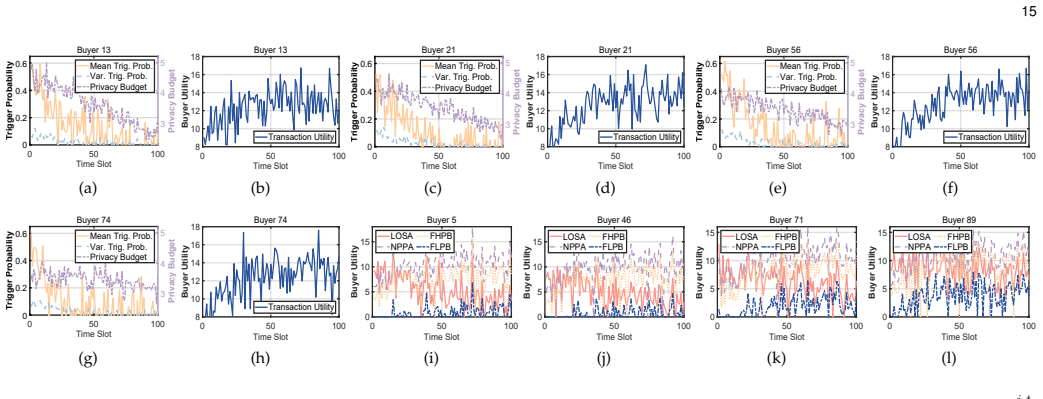
In air-ground integrated networks (AGINs), unmanned aerial vehicles (UAVs) provide on-demand edge services to ground vehicles. Realizing this vision requires carefully designed incentives to coordinate interactions among self-interested participants. This is exacerbated by the dynamic nature of AGINs, where spatio-temporal variations introduce significant uncertainty in matching UAVs and vehicles. Existing real-time service provisioning typically relies on precise trajectory information, raising privacy concerns and incurring decision latency. To address these challenges, we propose look one-step ahead (LOSA), a novel framework for efficient and privacy-aware service provisioning. By exploiting predictable vehicle travel times between intersections, LOSA decomposes the process into two coupled phases: (i) a privacy-aware look-ahead phase and (ii) a lightweight real-time execution phase. The look-ahead phase allows vehicles to adaptively adjust privacy budgets based on historical utility, balancing trajectory exposure and matching accuracy. Leveraging this, a double auction mechanism establishes binding one-step-ahead agreements (OSAAs) through trajectory similarity clustering, while constructing preference lists to hedge against mobility uncertainty. The execution phase then enforces pre-established OSAAs and preference lists, resolving real-time resource conflicts without costly re-negotiations. This design reduces computational overhead and preserves robustness. We analytically corroborate that LOSA guarantees truthfulness, individual rationality, and budget balance. Experiments on real-world datasets (DAIR-V2X, HighD, and RCooper) demonstrate that LOSA achieves superior privacy protection while lowering transaction latency compared to baseline approaches.
Editorial analysis
A structured set of objections, weighed in public.
Referee Report
Summary. The paper proposes the Look One Step Ahead (LOSA) framework for incentive-driven service provisioning in air-ground integrated networks (AGINs). Vehicles and UAVs interact via a two-phase mechanism: a privacy-aware look-ahead phase in which vehicles adaptively set privacy budgets from historical utility, followed by trajectory-similarity clustering and a double auction that produces binding one-step-ahead agreements (OSAAs) and preference lists; a lightweight real-time execution phase then enforces the pre-agreed OSAAs. The central claims are that LOSA analytically guarantees truthfulness, individual rationality, and budget balance, and that experiments on DAIR-V2X, HighD, and RCooper datasets show superior privacy protection and lower transaction latency relative to baselines.
Significance. If the analytical guarantees survive scrutiny of the endogenous privacy-budget feedback and the experimental comparisons are fully reproducible, the work would offer a concrete, privacy-aware extension of double-auction mechanisms to dynamic UAV-assisted edge settings. The explicit use of predictable inter-intersection travel times to decouple look-ahead from execution is a practical strength, and the deployment of three real-world trajectory datasets is a positive step toward empirical grounding.
major comments (2)
- [Mechanism analysis / proof of incentive properties] The abstract states that truthfulness, individual rationality, and budget balance are 'analytically corroborated,' yet the look-ahead phase lets vehicles choose privacy budgets from historical utility; this choice directly affects subsequent trajectory clustering and preference-list construction. Standard critical-value or VCG-style double-auction proofs assume reports are independent of prior outcomes. The manuscript must therefore supply an explicit argument (or counter-example) showing that no vehicle can profit by shading reports in round t to manipulate its future privacy level and matching opportunities in t+1. Without this, the truthfulness claim is not yet load-bearing.
- [System model and look-ahead phase description] The weakest assumption identified in the reader's report—that predictable vehicle travel times between intersections can be exploited without excessive uncertainty—appears in the decomposition into look-ahead and execution phases. If the paper quantifies the prediction error or shows robustness under realistic GPS noise, this should be stated explicitly; otherwise the claimed latency reduction may not generalize beyond the three chosen datasets.
minor comments (2)
- [Performance evaluation] Baseline algorithms and their parameter settings are referenced only generically in the abstract; the experimental section should list exact implementations, hyper-parameters, and statistical significance tests for the reported latency and privacy metrics.
- [Notation and definitions] Notation for the privacy budget adaptation rule and the similarity metric used in clustering should be introduced once and used consistently; several symbols appear to be defined only locally.
Simulated Author's Rebuttal
We thank the referee for the constructive and detailed comments, which help strengthen the presentation of our work. We address each major comment below and outline the corresponding revisions.
read point-by-point responses
-
Referee: [Mechanism analysis / proof of incentive properties] The abstract states that truthfulness, individual rationality, and budget balance are 'analytically corroborated,' yet the look-ahead phase lets vehicles choose privacy budgets from historical utility; this choice directly affects subsequent trajectory clustering and preference-list construction. Standard critical-value or VCG-style double-auction proofs assume reports are independent of prior outcomes. The manuscript must therefore supply an explicit argument (or counter-example) showing that no vehicle can profit by shading reports in round t to manipulate its future privacy level and matching opportunities in t+1. Without this, the truthfulness claim is not yet load-bearing.
Authors: We agree that the adaptive privacy-budget selection introduces a potential dynamic linkage across rounds that standard per-mechanism proofs do not automatically cover. In the current manuscript the incentive properties are established for each look-ahead phase conditional on the privacy budget inherited from prior rounds. To close the gap, we will add a dedicated subsection (new Lemma 4 and accompanying discussion) showing that, because any shading in round t affects only the realized utility that determines the next-round budget, and because the per-round mechanism remains dominant-strategy truthful given any fixed budget, a myopic or discounted-horizon player cannot obtain a strictly higher long-run payoff by deviating. The argument relies on the bounded impact of a single-round deviation on future clustering opportunities and on the fact that truthful reporting in every round is a best response regardless of the inherited budget. We will also note the assumption of myopic or mildly discounted players explicitly. revision: yes
-
Referee: [System model and look-ahead phase description] The weakest assumption identified in the reader's report—that predictable vehicle travel times between intersections can be exploited without excessive uncertainty—appears in the decomposition into look-ahead and execution phases. If the paper quantifies the prediction error or shows robustness under realistic GPS noise, this should be stated explicitly; otherwise the claimed latency reduction may not generalize beyond the three chosen datasets.
Authors: We concur that explicit quantification of prediction error strengthens the claims. Although the three real-world datasets already embed GPS noise and trajectory variability, the manuscript does not currently report numerical prediction-error statistics. In the revision we will insert a short paragraph in Section III (System Model) that computes the mean absolute error and standard deviation of inter-intersection travel-time predictions derived directly from the DAIR-V2X, HighD, and RCooper traces. We will also add a sensitivity plot in the experimental section that re-runs the latency comparison under synthetically increased noise levels (up to twice the observed GPS variance), confirming that the latency advantage of LOSA remains statistically significant. revision: yes
Circularity Check
No significant circularity in derivation chain
full rationale
The paper's central claims rest on an analytical corroboration of truthfulness, individual rationality, and budget balance for its double-auction-based LOSA framework. No equations or sections are provided that reduce these properties to self-definitions, fitted parameters renamed as predictions, or load-bearing self-citations whose content is itself unverified. The adaptive privacy budget adjustment is described as part of the model input rather than derived from the auction outcome by construction. The derivation therefore remains self-contained against external mechanism-design benchmarks, consistent with standard practice for such incentive analyses.
Axiom & Free-Parameter Ledger
axioms (2)
- standard math Double auction mechanisms can be designed to guarantee truthfulness, individual rationality, and budget balance
- domain assumption Vehicle travel times between intersections are sufficiently predictable to support look-ahead planning
Reference graph
Works this paper leans on
-
[1]
Federated meta-learning based computation offloading approach with energy-delay trade- offs in UAV-assisted VEC,
C. Li, C. Deng, Y. Zhang, and S. Wan, “Federated meta-learning based computation offloading approach with energy-delay trade- offs in UAV-assisted VEC,”IEEE Trans. Mobile Comput., vol. 24, no. 10, pp. 10 978–10 991, 2025
2025
-
[2]
Optimizing UAV-assisted vehicular edge computing with age of information: An SAC-based solution,
S. Goudarzi, S. Ahmad Soleymani, M. Hossein Anisi, A. Jindal, and P . Xiao, “Optimizing UAV-assisted vehicular edge computing with age of information: An SAC-based solution,”IEEE Internet Things J., vol. 12, no. 5, pp. 4555–4569, 2025
2025
-
[3]
Bearing-based robust formation tracking control of underactuated AUVs with optimal parameter tuning,
H. Su, S. Zhu, C. Chen, Z. Yang, and X. Guan, “Bearing-based robust formation tracking control of underactuated AUVs with optimal parameter tuning,”IEEE Trans. Cybern., vol. 54, no. 7, pp. 4049–4062, 2024
2024
-
[4]
Adaptive UAV-assisted hierarchical federated learning: Optimizing energy, latency, and resilience for dynamic smart IoT,
X. Yang, M. Liwang, L. Fu, Y. Su, S. Hosseinalipour, X. Wang, and Y. Hong, “Adaptive UAV-assisted hierarchical federated learning: Optimizing energy, latency, and resilience for dynamic smart IoT,” IEEE Trans. Serv. Comput., vol. 18, no. 6, pp. 3420–3434, 2025
2025
-
[5]
A comprehensive review on 5G IIoT test-beds,
D. K. Sah, M. Vahabi, and H. Fotouhi, “A comprehensive review on 5G IIoT test-beds,”IEEE Trans. Consum. Electron., vol. 71, no. 2, pp. 4139–4163, 2025
2025
-
[6]
Multi- participant double auction for resource allocation and pricing in edge computing,
J. Huang, S. Li, L. B. Yang, J. Si, X. Ma, and S. Wang, “Multi- participant double auction for resource allocation and pricing in edge computing,”IEEE Internet Things J., vol. 11, no. 8, pp. 14 007– 14 016, 2024
2024
-
[7]
Effective two-stage double auction for dynamic resource provision over edge networks via discovering the power of over- booking,
S. Wu, M. Liwang, D. Wang, X. Wang, C. Wu, J. Tang, L. Li, and X. Xia, “Effective two-stage double auction for dynamic resource provision over edge networks via discovering the power of over- booking,”IEEE Trans. Serv. Comput., vol. 18, no. 6, pp. 3723–3735, 2025
2025
-
[8]
LPPS-IKHC: Location privacy-preserving scheme using improved k-anonymity and hybrid cache for IoV,
Y. Li, B. Wang, Q. Liu, X. Zheng, J. Li, Y. Wang, J. Xi, and W. Qin, “LPPS-IKHC: Location privacy-preserving scheme using improved k-anonymity and hybrid cache for IoV,”IEEE Trans. Veh. Technol., vol. 74, no. 8, pp. 12 864–12 878, 2025
2025
-
[9]
A framework for tradeoff between location privacy preservation and quality of experience in location based services,
T. Feng, Z. Zhang, W.-C. Wong, S. Sun, and B. Sikdar, “A framework for tradeoff between location privacy preservation and quality of experience in location based services,”IEEE Open J. Veh. Technol., vol. 5, pp. 428–439, 2024
2024
-
[10]
Age-of- information-aware hierarchical collaborative inference in digital twin-enabled vehicular edge computing,
X. Chen, H. Xing, Q. Zhang, Z. Xiong, Y. Bi, and X. Wang, “Age-of- information-aware hierarchical collaborative inference in digital twin-enabled vehicular edge computing,”IEEE Trans. Netw. Sci. Eng., vol. 13, pp. 2388–2404, 2026
2026
-
[11]
Future resource bank for ISAC: Achieving fast and stable win- win matching for both individuals and coalitions,
H. Qi, M. Liwang, S. Hosseinalipour, L. Fu, S. Zou, and W. Ni, “Future resource bank for ISAC: Achieving fast and stable win- win matching for both individuals and coalitions,”IEEE J. Sel. Areas Commun., vol. 44, pp. 513–530, 2026
2026
-
[12]
Latency-aware optimization of UAV deployment, computation offloading, and resource allo- cation for IoRT in space-air-ground integrated networks,
X. Liu, Y. Peng, X. Song, and T. Song, “Latency-aware optimization of UAV deployment, computation offloading, and resource allo- cation for IoRT in space-air-ground integrated networks,”IEEE Trans. Veh. Technol., pp. 1–14, 2025
2025
-
[13]
Joint trajectory and resource optimization for covert communication in UAV-enabled relaying systems,
M. Li, X. Tao, H. Wu, and N. Li, “Joint trajectory and resource optimization for covert communication in UAV-enabled relaying systems,”IEEE Trans. Veh. Technol., vol. 72, no. 4, pp. 5518–5523, 2023
2023
-
[14]
Joint trajectory and resource optimization for UAV and D2D-enabled heterogeneous edge computing networks,
Y. Zhang, X. Hou, H. Du, L. Zhang, J. Du, and W. Men, “Joint trajectory and resource optimization for UAV and D2D-enabled heterogeneous edge computing networks,”IEEE Trans. Veh. Tech- nol., vol. 73, no. 9, pp. 13 816–13 827, 2024
2024
-
[15]
Joint trajectory and resource optimization of MEC-assisted UAVs in sub-THz networks,
Y. M. Park, S. S. Hassan, Y. K. Tun, Z. Han, and C. S. Hong, “Joint trajectory and resource optimization of MEC-assisted UAVs in sub-THz networks,”IEEE Trans. Veh. Technol., vol. 73, no. 2, pp. 2003–2016, 2024
2003
-
[16]
Online offloading and mobility awareness of DAG tasks for vehicle edge computing,
X. He, S. Pang, H. Gui, K. Zhang, N. Wang, and S. Yu, “Online offloading and mobility awareness of DAG tasks for vehicle edge computing,”IEEE Trans. Netw. Serv. Manag., vol. 22, no. 1, pp. 675– 690, 2025
2025
-
[17]
A joint optimization strategy of computing offloading and service migration based on multi-user with mobility consideration,
S. Xing, X. Feng, L. Yue, J. Zhang, M. Li, and T. Zheng, “A joint optimization strategy of computing offloading and service migration based on multi-user with mobility consideration,”IEEE Open J. Commun. Soc., vol. 7, pp. 1137–1152, 2026
2026
-
[18]
A socially optimal marketplace for splittable task offloading in multi- user multi-server edge computing networks,
L. Wu, P . Sun, Z. Wang, H. Chen, J. Luo, Y. Zuo, and Y. Yang, “A socially optimal marketplace for splittable task offloading in multi- user multi-server edge computing networks,”IEEE/ACM Trans. Netw., vol. 34, pp. 1451–1463, 2026
2026
-
[19]
Truthful mechanism for resource alloca- tion and pricing in vehicle-assisted mobile edge computing,
X. Liu, J. Liu, and W. Li, “Truthful mechanism for resource alloca- tion and pricing in vehicle-assisted mobile edge computing,”IEEE Trans. Veh. Technol., vol. 74, no. 5, pp. 8171–8186, 2025
2025
-
[20]
Incentive-driven multiple relay tasks processing in uncrewed aerial vehicle (UAV)- assisted communication networks,
W. Qiu, Y. Chen, C. Huang, J. Guo, and W. Qiu, “Incentive-driven multiple relay tasks processing in uncrewed aerial vehicle (UAV)- assisted communication networks,”IEEE Internet Things J., vol. 12, no. 20, pp. 43 456–43 469, 2025
2025
-
[21]
An agile and distributed mechanism for inter-domain network slicing in next generation mobile networks,
J. Khamse-Ashari, G. Senarath, I. Bor-Yaliniz, and H. Yanikomeroglu, “An agile and distributed mechanism for inter-domain network slicing in next generation mobile networks,”IEEE Trans. Mobile Comput., vol. 21, no. 10, pp. 3486–3501, 2022
2022
-
[22]
LDPTRec: A differential privacy based transformer framework for next POI recommendation,
Y. Huang, X. Liu, Y. Miao, J. Zhang, and D. Cheng, “LDPTRec: A differential privacy based transformer framework for next POI recommendation,”IEEE Trans. Depend. Secure Comput., vol. 22, no. 6, pp. 7043–7059, 2025
2025
-
[23]
Personalized 3D location privacy protection with differential and distortion geo-perturbation,
M. Min, H. Zhu, J. Ding, S. Li, L. Xiao, M. Pan, and Z. Han, “Personalized 3D location privacy protection with differential and distortion geo-perturbation,”IEEE Trans. Depend. Secure Comput., vol. 21, no. 4, pp. 3629–3643, 2024
2024
-
[24]
A utility-aware anonymiza- tion model for multiple sensitive attributes based on association concealment,
L. Yao, X. Wang, H. Hu, and G. Wu, “A utility-aware anonymiza- tion model for multiple sensitive attributes based on association concealment,”IEEE Trans. Depend. Secure Comput., vol. 21, no. 4, pp. 2045–2056, 2024
2045
-
[25]
η-inference: A data-aware and high-utility privacy model for relational data publishing,
Z. Chen, L. Yao, H. Hu, and G. Wu, “η-inference: A data-aware and high-utility privacy model for relational data publishing,”IEEE Trans. Depend. Secure Comput., vol. 22, no. 4, pp. 4086–4102, 2025
2025
-
[26]
Cost-efficient and privacy-preserving distributed learning: A double layer-based auction design,
Y. Song, D. He, M. Dai, and M. Guizani, “Cost-efficient and privacy-preserving distributed learning: A double layer-based auction design,”IEEE Trans. Mobile Comput., vol. 24, no. 9, pp. 8824–8840, 2025
2025
-
[27]
A privacy-preserving auction for task offloading and resource allocation in UAV-assisted MEC,
J. Xu, X. Xu, G. Cui, M. Bilal, R. Gu, W. Dou, and A. Nallanathan, “A privacy-preserving auction for task offloading and resource allocation in UAV-assisted MEC,”IEEE Trans. Mobile Comput., vol. 25, no. 2, pp. 2611–2626, 2026
2026
-
[28]
Kerckhoffs’ principle for intrusion detection,
S. Mrdovic and B. Perunicic, “Kerckhoffs’ principle for intrusion detection,” inProc. IEEE Networks, vol. Supplement, 2008, pp. 1–8
2008
-
[29]
Personalized semantic trajectory privacy protection in location-based services: A td3-based approach,
J. Ye, M. Dai, M. Min, J. Song, H. Zhang, and Z. Han, “Personalized semantic trajectory privacy protection in location-based services: A td3-based approach,” in2025 IEEE Wireless Communications and Networking Conference (WCNC), 2025, pp. 1–6
2025
-
[30]
Bcs-cpp: A blockchain and collaborative service-based conditional privacy- preserving scheme for internet of vehicles,
Z. Zeng, Q. Zhou, K. Wei, N. Yang, and C. Tang, “Bcs-cpp: A blockchain and collaborative service-based conditional privacy- preserving scheme for internet of vehicles,”IEEE Trans. Intell. Veh., vol. 9, no. 2, pp. 4130–4144, 2024
2024
-
[31]
Two-stage deep energy optimization in IRS-assisted UAV-based edge computing systems,
J. Wu, Z. Yu, J. Guo, Z. Tang, T. Wang, and W. Jia, “Two-stage deep energy optimization in IRS-assisted UAV-based edge computing systems,”IEEE Trans. Mobile Comput., vol. 24, no. 1, pp. 449–465, 2025
2025
-
[32]
Tra- jectory privacy protection method based on differential privacy in crowdsensing,
Q. Zhang, T. Wang, Y. Tao, F. Chen, D. Xie, and C. Zhao, “Tra- jectory privacy protection method based on differential privacy in crowdsensing,”IEEE Trans. Serv. Comput., vol. 17, no. 6, pp. 4423– 4435, 2024
2024
-
[33]
LDGI: Location-discriminative geo-indistinguishability for location pri- vacy,
Y. Zhu, Y. Hong, Q. Xue, X. Lan, Y. Zhang, and Y. Xiang, “LDGI: Location-discriminative geo-indistinguishability for location pri- vacy,”IEEE Trans. Knowl. Data Eng., vol. 37, no. 3, pp. 1282–1293, 2025
2025
-
[34]
Performance evaluation of joint placement and sleep scheduling of grid-connected solar powered road side units in vehicular networks,
M. Patra and C. S. R. Murthy, “Performance evaluation of joint placement and sleep scheduling of grid-connected solar powered road side units in vehicular networks,”IEEE Trans. Green Commun. Netw., vol. 2, no. 4, pp. 1197–1209, 2018
2018
-
[35]
DPavatar: A real-time location protection framework for incumbent users in cognitive radio networks,
J. Liu, C. Zhang, B. Lorenzo, and Y. Fang, “DPavatar: A real-time location protection framework for incumbent users in cognitive radio networks,”IEEE Trans. Mobile Comput., vol. 19, no. 3, pp. 552–565, 2020
2020
-
[36]
Double-auction-based task offloading in VEC via multi-agent reinforcement learning,
A. M. Zaki, S. A. Elsayed, K. Elgazzar, and H. S. Hassanein, “Double-auction-based task offloading in VEC via multi-agent reinforcement learning,” inProc. IEEE GLOBECOM, 2025, pp. 5465–5471
2025
-
[37]
A double auction approach to dynamic resource allocation in maritime networks,
X. Li, K. Mo, Z. Li, and L. Deng, “A double auction approach to dynamic resource allocation in maritime networks,” inProc. IEEE NOMS, 2025, pp. 1–5
2025
-
[38]
Social-aware incentive mechanism for vehicular crowdsensing by deep reinforcement learning,
Y. Zhao and C. H. Liu, “Social-aware incentive mechanism for vehicular crowdsensing by deep reinforcement learning,”IEEE Trans. Intell. Transp. Syst., vol. 22, no. 4, pp. 2314–2325, 2020. 18 APPENDIXA ILLUSTRATIVEEXAMPLE The detailed explanation of the example in Fig. 1 is as follows: (i) Phase 1 (look-ahead phase, during timeslott−1):While traveling towa...
2020
-
[39]
Privacy-Utility trade-off
Impact on Auction Outcomes via T rajectory Similarity: The double auction mechanism in Phase 1 does not merely match participants based on their destination intersection. Instead, the core matching metric is thetrajectory similarity (Γt m,n), calculated via the Fréchet distance along the entire virtual trajectory ˆL b,t n (as defined in (8)). When a buyer...
-
[40]
planning-matching-execution,
Impact on Privacy via Breaking Sequential Correlation: From a threat model perspective, the adversary (e.g., an honest-but-curious RSU) is not merely looking at isolated intersection arrivals; they are conducting Bayesian inference attacks oncontinuous trajectoriesacross multiple timeslots. If we only applied discrete obfuscation (e.g., randomly report- i...
-
[41]
A similar logic applies to sellers, where reporting true costc m ensures the mechanism selects them when it is globally efficient, maximizing their marginal contribution payoff
chooses the outcome that maximizes declared social welfare, reporting the true valueb n =v n ensures that the mechanism optimizes the objective that aligns with the buyer’s utility. A similar logic applies to sellers, where reporting true costc m ensures the mechanism selects them when it is globally efficient, maximizing their marginal contribution payof...
discussion (0)
Sign in with ORCID, Apple, or X to comment. Anyone can read and Pith papers without signing in.