Empirical Prediction of Pedestrian Comfort in Mobile Robot Pedestrian Encounters
Pith reviewed 2026-05-10 13:40 UTC · model grok-4.3
The pith
A composite estimator using all kinematic variables predicts pedestrian comfort in mobile robot encounters with the highest accuracy and an odds ratio of 3.67.
A machine-rendered reading of the paper's core claim, the machinery that carries it, and where it could break.
Core claim
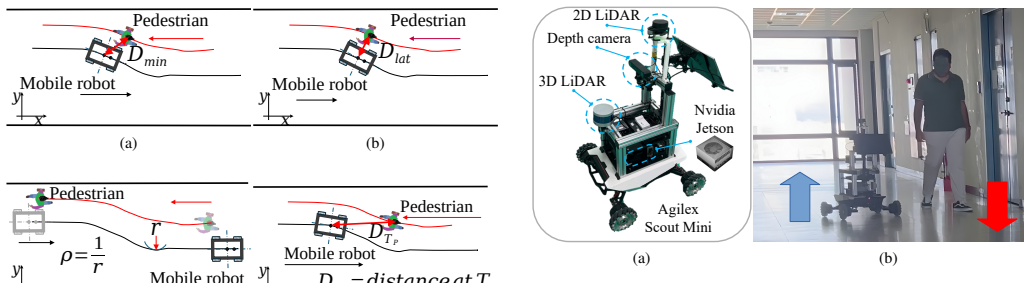
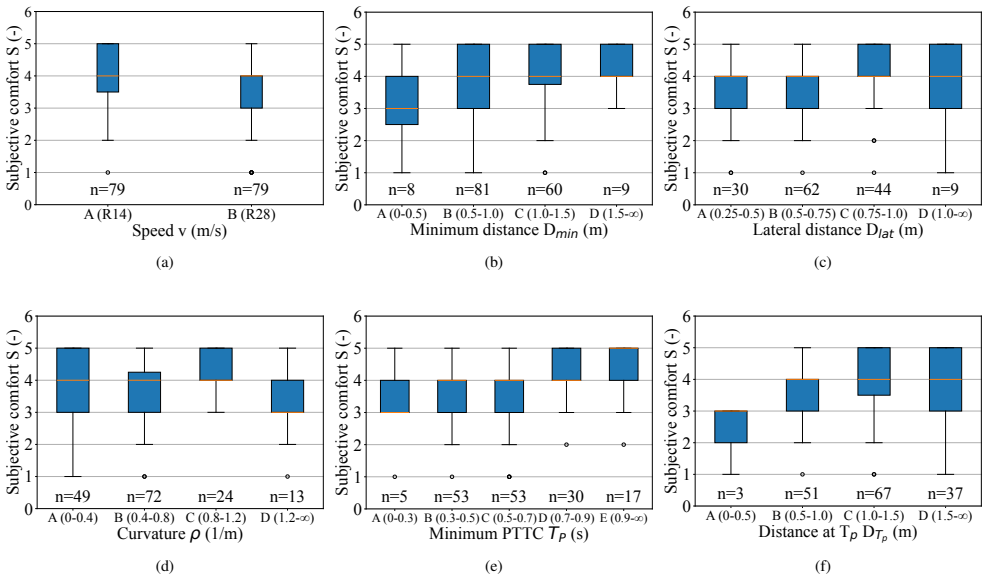
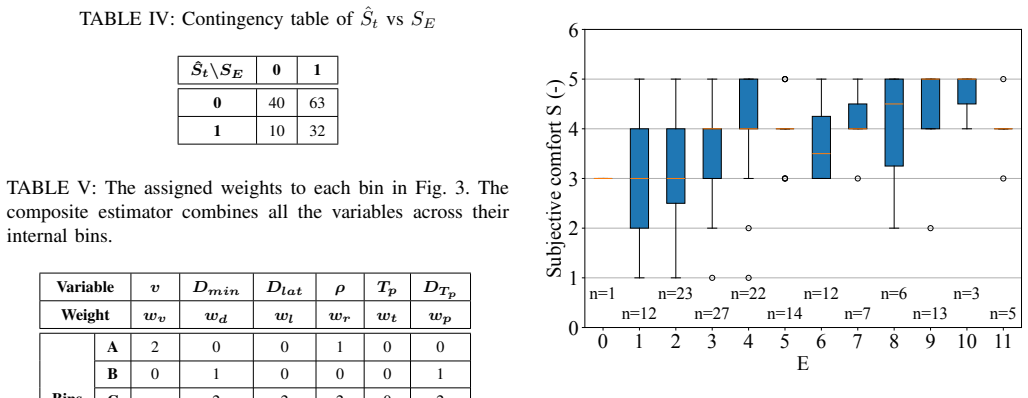
Through one-on-one experimental trials with a mobile robot and volunteers, statistical analysis reveals moderate but significant correlations between most kinematic variables and pedestrians' reported comfort. Three comfort estimators are designed: one based on minimum distance, one on minimum projected time-to-collision, and a composite estimator employing all studied kinematic variables. The composite estimator achieves the highest prediction rate and classifying performance, with an odds ratio of 3.67, meaning when it identifies a pedestrian as comfortable, it is almost 4 times more likely that the pedestrian is actually comfortable.
What carries the argument
The composite comfort estimator that integrates multiple kinematic variables from robot-pedestrian interactions to predict subjective comfort levels.
If this is right
- The composite predictor can be integrated into path planning algorithms for mobile robots to improve social compliance.
- Single-variable predictors like minimum distance or time-to-collision provide baseline but lower performance comfort estimation.
- Quantifying comfort enables robots to respond to pedestrian emotions beyond mere collision avoidance.
- Empirical data from controlled trials supports the use of kinematic-comfort relationships in robot design.
Where Pith is reading between the lines
- This approach could be extended to multi-pedestrian scenarios in crowded public spaces to test generalization beyond one-on-one encounters.
- Combining the comfort predictor with existing collision avoidance systems might create more holistic navigation strategies for robots.
- Future validation could replace or supplement self-reports with physiological sensors to reduce reliance on subjective measures.
Load-bearing premise
The controlled one-on-one experimental trials with volunteers produce kinematic-comfort relationships that generalize to real-world public pedestrian-robot encounters, and that subjective self-reports reliably capture true comfort.
What would settle it
In uncontrolled public settings, the composite predictor's classification of comfortable versus uncomfortable pedestrians fails to match actual self-reports at a rate significantly higher than single-variable predictors or chance.
Figures
read the original abstract
Mobile robots joining public spaces like sidewalks must care for pedestrian comfort. Many studies consider pedestrians' objective safety, for example, by developing collision avoidance algorithms, but not enough studies take the pedestrian's subjective safety or comfort into consideration. Quantifying comfort is a major challenge that hinders mobile robots from understanding and responding to human emotions. We empirically look into the relationship between the mobile robot-pedestrian interaction kinematics and subjective comfort. We perform one-on-one experimental trials, each involving a mobile robot and a volunteer. Statistical analysis of pedestrians' reported comfort versus the kinematic variables shows moderate but significant correlations for most variables. Based on these empirical findings, we design three comfort estimators/predictors derived from the minimum distance, the minimum projected time-to-collision, and a composite estimator. The composite estimator employs all studied kinematic variables and reaches the highest prediction rate and classifying performance among the predictors. The composite predictor has an odds ratio of 3.67. In simple terms, when it identifies a pedestrian as comfortable, it is almost 4 times more likely that the pedestrian is comfortable rather than uncomfortable. The study provides a comfort quantifier for incorporating pedestrian feelings into path planners for more socially compliant robots.
Editorial analysis
A structured set of objections, weighed in public.
Referee Report
Summary. The manuscript claims that kinematic variables in one-on-one mobile robot-pedestrian encounters show moderate but significant correlations with self-reported comfort, based on controlled volunteer trials. Three estimators are derived (minimum distance, minimum projected time-to-collision, and a composite using all variables); the composite reaches the highest prediction rate and classification performance, with an odds ratio of 3.67, and is positioned as a quantifier for comfort-aware path planning in socially compliant robots.
Significance. If the reported correlations and estimator performance hold under scrutiny, the work provides a concrete, interpretable metric (odds ratio) that could help shift robot navigation from purely collision-avoidance to comfort-sensitive behavior. The empirical, data-driven approach and focus on subjective experience are positive contributions to human-robot interaction. However, the controlled single-pedestrian lab setting limits claims of direct deployability without further evidence of generalization.
major comments (2)
- Results section (composite estimator description): The composite predictor is constructed from the full set of kinematic variables measured in the same trials and evaluated on that data, yielding the highest performance and odds ratio of 3.67. This introduces circularity; the reported classifying performance may partly reflect the fitting process rather than independent prediction. Cross-validation, hold-out testing, or reporting of free parameters and regularization is required to support the claim of superior predictive utility.
- Abstract and conclusion: The assertion that the study 'provides a comfort quantifier for incorporating pedestrian feelings into path planners' rests on the untested assumption that relationships from controlled one-on-one volunteer trials generalize to public, multi-agent encounters. No external validation, field data, or multi-pedestrian experiments are described, which is load-bearing for the practical conclusion.
minor comments (2)
- Abstract: The number of participants, total trials, exact correlation coefficients, p-values, and any multiple-comparison corrections are not stated, making it difficult to evaluate the reliability of the 'moderate but significant correlations' and the odds ratio.
- Methods: Provide the precise definitions and formulas for all kinematic variables (including how minimum projected time-to-collision is computed) and the exact procedure for fitting the composite estimator coefficients.
Simulated Author's Rebuttal
We thank the referee for the constructive and detailed feedback on our manuscript. We address each major comment below and have revised the paper to improve its rigor and precision.
read point-by-point responses
-
Referee: Results section (composite estimator description): The composite predictor is constructed from the full set of kinematic variables measured in the same trials and evaluated on that data, yielding the highest performance and odds ratio of 3.67. This introduces circularity; the reported classifying performance may partly reflect the fitting process rather than independent prediction. Cross-validation, hold-out testing, or reporting of free parameters and regularization is required to support the claim of superior predictive utility.
Authors: We agree that evaluating the composite estimator on the same data used for fitting can introduce optimism bias in the reported performance. In the revised manuscript, we will add k-fold cross-validation results for the composite logistic regression model to provide a more reliable estimate of predictive performance. We will also explicitly report the model's free parameters, feature selection process, and any regularization applied, allowing readers to assess the risk of overfitting. revision: yes
-
Referee: Abstract and conclusion: The assertion that the study 'provides a comfort quantifier for incorporating pedestrian feelings into path planners' rests on the untested assumption that relationships from controlled one-on-one volunteer trials generalize to public, multi-agent encounters. No external validation, field data, or multi-pedestrian experiments are described, which is load-bearing for the practical conclusion.
Authors: We acknowledge the limitation: our data come exclusively from controlled one-on-one laboratory trials with volunteers, and we have no direct evidence of generalization to real-world multi-pedestrian settings. We will revise the abstract and conclusion to state that the quantifier is derived from these specific conditions and serves as an empirical foundation for future comfort-aware planners. We will also expand the limitations discussion to highlight the need for external validation in public environments. revision: yes
Circularity Check
Composite estimator performance is fitted to the same trial data it evaluates
specific steps
-
fitted input called prediction
[Abstract]
"Based on these empirical findings, we design three comfort estimators/predictors derived from the minimum distance, the minimum projected time-to-collision, and a composite estimator. The composite estimator employs all studied kinematic variables and reaches the highest prediction rate and classifying performance among the predictors. The composite predictor has an odds ratio of 3.67."
The composite is explicitly built from all kinematic variables collected in the trials; its 'prediction rate,' 'classifying performance,' and odds ratio are then reported as results. Because these metrics are computed on the identical dataset used to derive the estimator, the claimed superiority and quantitative performance reduce to the fitting process itself rather than an independent test of predictive power.
full rationale
The paper conducts controlled one-on-one trials, measures kinematic variables, reports moderate correlations with self-reported comfort, and then constructs three estimators (including a composite using all variables) whose prediction/classification performance and odds ratio are computed on that same dataset. This matches the 'fitted input called prediction' pattern: the reported superiority and odds ratio of 3.67 are direct outputs of fitting to the observed data rather than independent out-of-sample prediction. No self-citations, uniqueness theorems, or definitional loops are present; the empirical correlations themselves are non-circular observations. The central claim therefore has independent empirical content but the performance numbers are statistically forced by construction.
Axiom & Free-Parameter Ledger
free parameters (1)
- composite estimator coefficients
axioms (2)
- domain assumption Self-reported comfort scores provide a valid and consistent ground truth for subjective experience
- domain assumption Kinematic variables measured in controlled trials capture the relevant dynamics of real pedestrian-robot encounters
Reference graph
Works this paper leans on
-
[1]
T. Furlanis, T. Kanda, and D. Br ˇsˇci´c, “Robots as moral environments,” AI & Society, vol. 39, no. 4, pp. 1749–1767, 2024
work page 2024
-
[2]
Robot navigation in constrained pedestrian environments using reinforcement learning,
C. P ´erez-D’Arpino, C. Liu, P. Goebel, R. Mart ´ın-Mart´ın, and S. Savarese, “Robot navigation in constrained pedestrian environments using reinforcement learning,” in2021 IEEE International Conference on Robotics and Automation (ICRA), 2021, pp. 1140–1146
work page 2021
-
[3]
SocNavGym: A reinforcement learning gym for social navigation,
A. Kapoor, S. Swamy, P. Bachiller, and L. J. Manso, “SocNavGym: A reinforcement learning gym for social navigation,” in2023 32nd IEEE International Conference on Robot and Human Interactive Communica- tion (RO-MAN), 2023, pp. 2010–2017
work page 2023
-
[4]
M. Shiomi, F. Zanlungo, K. Hayashi, and T. Kanda, “Towards a socially acceptable collision avoidance for a mobile robot navigating among pedestrians using a pedestrian model,”International Journal of Social Robotics, vol. 6, pp. 443–455, 2014
work page 2014
-
[5]
Time-to-collision based social force model for intelligent agents on shared public spaces,
A. Jafari and Y .-C. Liu, “Time-to-collision based social force model for intelligent agents on shared public spaces,”International Journal of Social Robotics, vol. 16, pp. 1953–1968, 2024
work page 1953
-
[6]
T. Kanda and H. Ishiguro,Human-robot interaction in social robotics. CRC Press, 2017
work page 2017
-
[7]
C. Bartneck, T. Belpaeme, F. Eyssel, T. Kanda, M. Keijsers, and S. ˇSabanovi´c,Human-Robot Interaction: An Introduction. Cambridge University Press, 2024
work page 2024
-
[8]
Come closer: The effects of robot personality on human proxemics behaviours,
M. Moujahid, D. A. Robb, C. Dondrup, and H. Hastie, “Come closer: The effects of robot personality on human proxemics behaviours,” in2023 32nd IEEE International Conference on Robot and Human Interactive Communication (RO-MAN), 2023, pp. 2610–2616
work page 2023
-
[9]
Pedestrians and robots: A novel dataset for learning distinct social navigation forces,
S. Agrawal, N. Ostermann-Myrau, N. Dengler, and M. Bennewitz, “Pedestrians and robots: A novel dataset for learning distinct social navigation forces,” 2025. [Online]. Available: https://arxiv.org/abs/2503.16481
-
[10]
X. Lu, A. Faragasso, Y . Wang, A. Yamashita, and H. Asama, “Group- aware robot navigation in crowds using spatio-temporal graph attention network with deep reinforcement learning,”IEEE Robotics and Automa- tion Letters, vol. 10, no. 4, pp. 4140–4147, 2025
work page 2025
-
[11]
A system for the notation of proxemic behavior,
E. T. Hall, “A system for the notation of proxemic behavior,”American Anthropologist, vol. 65, no. 5, pp. 1003–1026, 1963
work page 1963
-
[12]
Understanding dynamic human-robot proxemics in the case of four- legged canine-inspired robots,
X. Xu, Z. Meng, E. Li, M. Khamis, P. G. Zhao, and R. Bretin, “Understanding dynamic human-robot proxemics in the case of four- legged canine-inspired robots,” in2025 IEEE International Conference on Robotics and Automation (ICRA), 2025, pp. 7808–7814
work page 2025
-
[13]
ASFM: Augmented social force model for legged robot social navigation,
S. Ægidius, R. Chac ´on-Quesada, A. M. Delfaki, D. Kanoulas, and Y . Demiris, “ASFM: Augmented social force model for legged robot social navigation,” in2024 IEEE-RAS 23rd International Conference on Humanoid Robots (Humanoids), 2024, pp. 37–44
work page 2024
-
[14]
The effect of robot speed on comfortable passing distances,
M. M. E. Neggers, R. H. Cuijpers, P. A. M. Ruijten, and W. A. IJs- selsteijn, “The effect of robot speed on comfortable passing distances,” Frontiers in Robotics and AI, vol. 9, 2022
work page 2022
-
[15]
Determining shape and size of personal space of a human when passed by a robot,
——, “Determining shape and size of personal space of a human when passed by a robot,”International Journal of Social Robotics, vol. 14, no. 2, pp. 561–572, 2022
work page 2022
-
[16]
Human-robot interaction: Proximity and speed—slowly back away from the robot!
K. R. MacArthur, K. Stowers, and P. A. Hancock, “Human-robot interaction: Proximity and speed—slowly back away from the robot!” inAdvances in Human Factors in Robots and Unmanned Systems, P. Savage-Knepshield and J. Chen, Eds., 2017, pp. 365–374
work page 2017
-
[17]
H. Song, P. Preuschoff, B. Grzeschik, and A. M. Rosenthal-von der P¨utten, “No need for speed? the impact of delivery robot speed on passersby’s perceived comfort and safety and preferred signaling dis- tance,”International Journal of Social Robotics, vol. 17, no. 7, pp. 1277–1288, 2025
work page 2025
-
[18]
B. Greenberg, U. Gonz ´alez-Bravo, J. Yi, and J. Feldman, “Effects of mobile robot passing-motion path curvature on human affective states in a hallway environment,”International Journal of Social Robotics, 2025
work page 2025
-
[19]
Perceived time-to-collision as public space users’ discomfort metric,
A. Jafari and Y .-C. Liu, “Perceived time-to-collision as public space users’ discomfort metric,” 2023, paper presented at the 22nd World Congress of the International Federation of Automatic Control, Yoko- hama, Japan, 9–14 July 2023
work page 2023
-
[20]
Pedestrians’ safety using projected time-to-collision to electric scooters,
——, “Pedestrians’ safety using projected time-to-collision to electric scooters,”Nature Communications, vol. 15, p. 5701, 2024
work page 2024
-
[21]
N. E. Neef, S. Zabel, M. Lauckner, and S. Otto, “What is appropriate? on the assessment of human-robot proxemics for casual encounters in closed environments,”International Journal of Social Robotics, vol. 15, no. 6, pp. 953–967, 2023
work page 2023
-
[22]
B. Greenberg, M. Grossi, S. L. Karri, J. Yi, J. Feldman, and K. Stromswold, “Experimental evaluation of the impact of robot path shape and speed on human affective states in a hallway-passing sce- nario,” poster presented at the Workshop on Advances in Social Navi- gation, ICRA 2025. Non-archival
work page 2025
-
[23]
Principles and guidelines for evaluating social robot navigation algorithms,
A. Francis, C. P ´erez-D’Arpino, C. Li, F. Xia, A. Alahi, R. Alami, A. Bera, A. Biswas, J. Biswas, R. Chandra, H.-T. L. Chiang, M. Everett, S. Ha, J. Hart, J. P. How, H. Karnan, T.-W. E. Lee, L. J. Manso, R. Mirsky, S. Pirk, P. T. Singamaneni, P. Stone, A. V . Taylor, P. Traut- man, N. Tsoi, M. V ´azquez, X. Xiao, P. Xu, N. Yokoyama, A. Toshev, and R. Mar...
work page 2025
-
[24]
A systematic review of attitudes, anxiety, acceptance, and trust towards social robots,
S. Naneva, M. Sarda Gou, T. L. Webb, and T. J. Prescott, “A systematic review of attitudes, anxiety, acceptance, and trust towards social robots,” International Journal of Social Robotics, vol. 12, no. 6, pp. 1179–1201, 2020
work page 2020
-
[25]
Evaluation of passing distance for social robots,
E. Pacchierotti, H. I. Christensen, and P. Jensfelt, “Evaluation of passing distance for social robots,” inROMAN 2006 - The 15th IEEE Inter- national Symposium on Robot and Human Interactive Communication, 2006, pp. 315–320
work page 2006
discussion (0)
Sign in with ORCID, Apple, or X to comment. Anyone can read and Pith papers without signing in.