Scattering lengths beyond the nuclear scale and the Efimov effect
Pith reviewed 2026-05-10 12:29 UTC · model grok-4.3
The pith
Neutron interactions with unstable nuclei can generate scattering lengths orders of magnitude larger than nuclear sizes, enabling Efimov trimers in nuclei.
A machine-rendered reading of the paper's core claim, the machinery that carries it, and where it could break.
Core claim
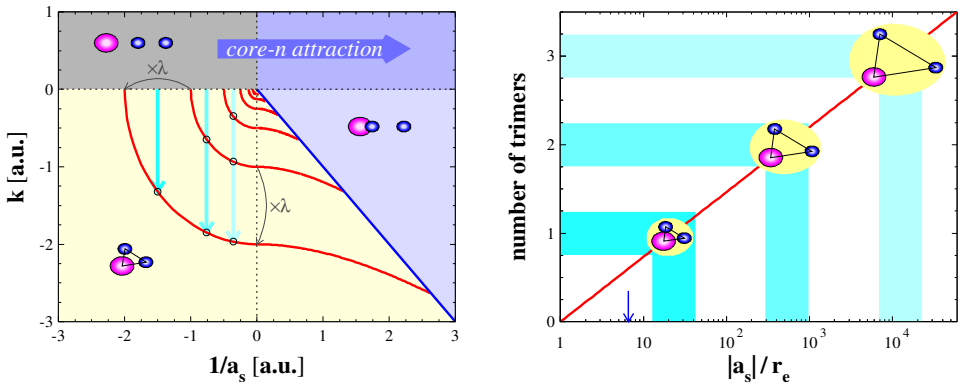
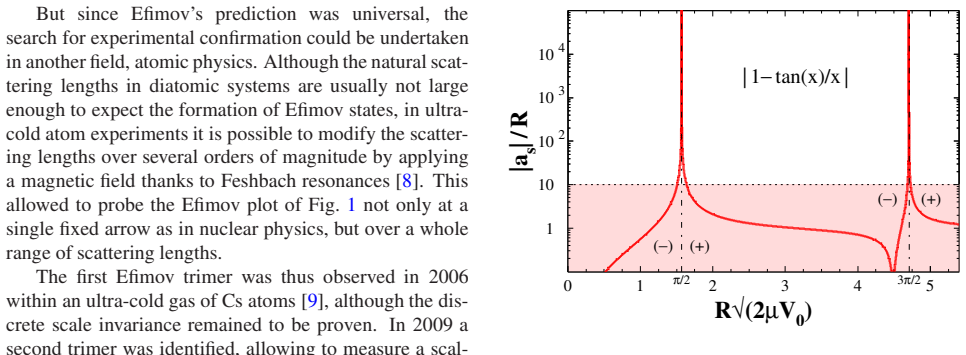
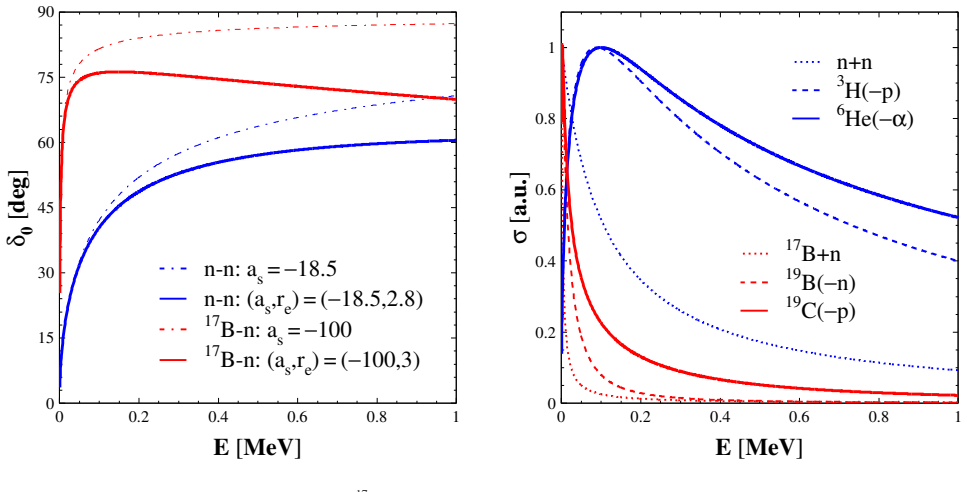
The interaction of neutrons and nuclei at low energies may produce scattering lengths several orders of magnitude larger than the effective range of the interaction. Such lengths lie well beyond the nuclear scale and, if present, open the possibility of observing the Efimov effect in nuclei through systems such as 17B-n and the resulting 19B trimer.
What carries the argument
The large neutron-17B scattering length that would turn 19B into a 17B-n-n Efimov trimer.
If this is right
- The Efimov effect becomes experimentally accessible inside nuclei rather than only in atoms.
- The ground state of 19B can be reinterpreted as an Efimov trimer whose binding is governed by the large 17B-n scattering length.
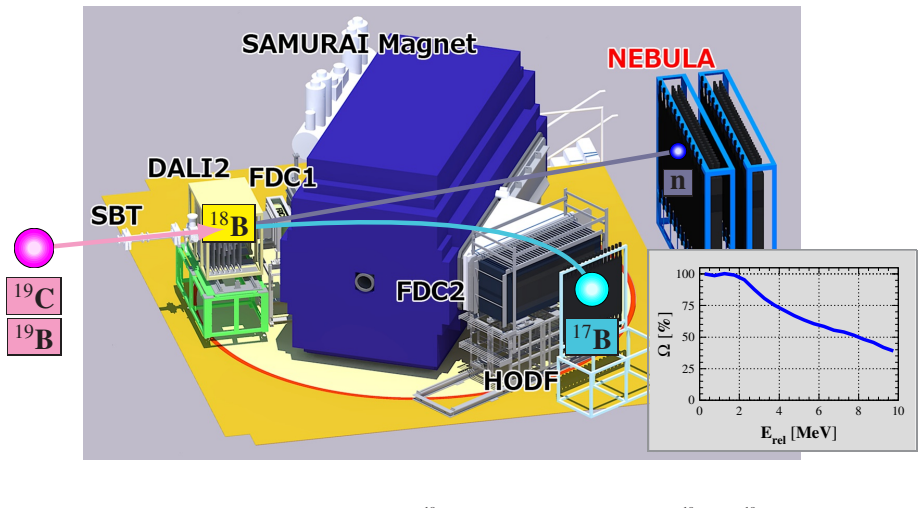
- Nucleon-removal reactions from heavier beams provide a practical route to populate and study these neutron-nucleus systems.
- Universal three-body scaling laws from atomic physics would apply directly to selected nuclear states.
Where Pith is reading between the lines
- Confirmation would create a new laboratory for testing few-body universality across energy scales.
- Similar large scattering lengths may exist in other neutron-rich unstable nuclei, expanding the list of candidate Efimov systems.
- Future radioactive-beam facilities could systematically search for such states by varying the neutron excess of the target nucleus.
Load-bearing premise
Scattering lengths in real neutron-unstable-nucleus systems can actually reach values many times larger than the nuclear interaction range.
What would settle it
A direct measurement of the 17B-n scattering length showing it remains comparable in size to the nuclear radius rather than orders of magnitude larger.
Figures
read the original abstract
The interaction of neutrons and nuclei at low energies may potentially lead to scattering lengths several orders of magnitude larger than the effective range of the interaction, well beyond the nuclear scale. If such cases existed, they could lead to the observation of the Efimov effect in nuclei, a remarkable universal phenomenon that has been observed only in atoms. The interaction parameters of neutrons scattering off unstable nuclei can be explored in neutron-nucleus systems created after the fast removal of a few nucleons from a slightly heavier beam. The case of the $^{17}$B-$n$ system is considered, and the implications of its potentially huge scattering length on the structure of $^{19}$B as a $^{17}$B-$n$-$n$ Efimov trimer are discussed.
Editorial analysis
A structured set of objections, weighed in public.
Referee Report
Summary. The manuscript proposes that low-energy neutron scattering from unstable nuclei can produce scattering lengths orders of magnitude larger than the nuclear interaction range. It argues that such fine-tuning, if realized, would permit observation of the Efimov effect in nuclei, a phenomenon previously seen only in atomic systems. The text identifies neutron-nucleus systems formed by fast nucleon removal from heavier beams as an experimental route and singles out the ^{17}B-n case, discussing its possible consequences for the structure of ^{19}B as a ^{17}B-n-n Efimov trimer.
Significance. If the central hypothesis were substantiated by concrete calculations or data, the work would open a new window on universal three-body physics at nuclear scales and suggest a practical method for accessing large scattering lengths via radioactive-beam experiments. The idea of linking post-removal neutron-nucleus systems to Efimov trimers is conceptually novel. At present, however, the manuscript offers only a qualitative possibility without quantitative support, so its immediate significance is limited to stimulating further theoretical or experimental investigation.
major comments (1)
- The case of the ^{17}B-n system: the claim that this system can exhibit a scattering length several orders of magnitude larger than the effective range is presented without any explicit potential, phase-shift calculation, extrapolation from known binding energies, or numerical estimate. This assumption is load-bearing for the subsequent discussion of ^{19}B as an Efimov trimer; its absence leaves the central conjecture unsupported.
minor comments (1)
- The abstract and main text use the phrase 'several orders of magnitude larger' without a quantitative definition of the nuclear scale or effective range in the specific systems considered; adding a brief numerical comparison would improve clarity.
Simulated Author's Rebuttal
We thank the referee for the careful reading and for identifying the need for greater clarity on the evidential basis of our central proposal. The manuscript is an exploratory theoretical note intended to highlight a possible connection between large neutron-nucleus scattering lengths and the Efimov effect, together with an experimental pathway. We address the single major comment below.
read point-by-point responses
-
Referee: The case of the ^{17}B-n system: the claim that this system can exhibit a scattering length several orders of magnitude larger than the effective range is presented without any explicit potential, phase-shift calculation, extrapolation from known binding energies, or numerical estimate. This assumption is load-bearing for the subsequent discussion of ^{19}B as an Efimov trimer; its absence leaves the central conjecture unsupported.
Authors: We agree that the manuscript contains no explicit potential, phase-shift analysis, or numerical estimate for the ^{17}B-n scattering length. The work is framed as a conceptual proposal: it notes that fine-tuning of the neutron-nucleus interaction in certain unstable systems could in principle produce scattering lengths far larger than the nuclear range, and it identifies fast nucleon removal as a route to access the resulting three-body physics. The discussion of ^{19}B is explicitly conditional on the scattering length being large. Because the paper does not attempt a quantitative prediction but rather seeks to stimulate further theoretical and experimental study, we did not include such modeling. We will revise the text to state more explicitly that the large-scattering-length scenario is a hypothesis whose realization remains to be verified by future calculations or data, thereby clarifying the conditional nature of the Efimov-trimer discussion. revision: partial
Circularity Check
No significant circularity: hypothesis presented without self-referential derivation
full rationale
The paper advances a speculative possibility that neutron-nucleus scattering lengths can become orders of magnitude larger than the nuclear range (e.g., in the 17B-n system after nucleon removal) and explores the consequent implications for an Efimov trimer in 19B. No derivation chain, equations, or fitted parameters are supplied that reduce the central claim to its own inputs by construction. The abstract and discussion rest on an untested existence assumption rather than a closed loop of self-definition, fitted-input prediction, or load-bearing self-citation. No load-bearing steps matching the enumerated circularity patterns are present; the text is self-contained as a discussion of a hypothetical scenario.
Axiom & Free-Parameter Ledger
axioms (1)
- domain assumption Efimov effect occurs in three-body systems when the two-body scattering length greatly exceeds the interaction range
Reference graph
Works this paper leans on
-
[1]
E. Braaten and H.W . Hammer, Universality in few- body systems with large scattering length , Phys. Rep. 428, 259 (2006)
work page 2006
-
[2]
Efimov, Energy levels arising from resonant two- body forces in a three-body system , Phys
V . Efimov, Energy levels arising from resonant two- body forces in a three-body system , Phys. Lett. 33B, 563 (1970)
work page 1970
-
[3]
Hornyak, Nuclear structure (Academic Press, New Y ork, 1975), pp
W .F. Hornyak, Nuclear structure (Academic Press, New Y ork, 1975), pp. 63-73
work page 1975
-
[4]
P . Naidon and S. Endo, Efimov physics: a review , Rep. Prog. Phys. 80, 056001 (2017)
work page 2017
-
[5]
Efimov, Energy levels of three resonantly interact- ing particles, Nuc
V . Efimov, Energy levels of three resonantly interact- ing particles, Nuc. Phys. A210, 157 (1973)
work page 1973
-
[6]
S. Endo et al. , Three-body forces and Efimov physics in nuclei and atoms , Eur. Phys. J. A 61, 9 (2025)
work page 2025
-
[7]
F.M. Marqués and J. Carbonell, The quest for light multineutron systems, Eur. Phys. J. A 57, 105 (2021)
work page 2021
-
[8]
C. Chin et al. , Feshbach resonances in ultracold gases, Rev. Mod. Phys. 82, 1225 (2010)
work page 2010
-
[9]
T. Kraemer et al., Evidence for Efimov quantum states in an ultracold gas of caesium atoms , Nature 440, 315 (2006)
work page 2006
-
[10]
Huang et al., Observation of the second triatomic resonance in Efimov’s scenario , Phys
B. Huang et al., Observation of the second triatomic resonance in Efimov’s scenario , Phys. Rev. Lett. 112, 190401 (2014)
work page 2014
-
[11]
G. Barontini et al. , Observation of heteronuclear atomic Efimov resonances , Phys. Rev. Lett. 103, 043201 (2009)
work page 2009
-
[12]
Pires et al., Observation of Efimov resonances in a mixture with extreme mass imbalance , Phys
R. Pires et al., Observation of Efimov resonances in a mixture with extreme mass imbalance , Phys. Rev. Lett. 112, 250404 (2014)
work page 2014
-
[13]
Tung et al., Geometric scaling of Efimov states in a 6Li-133Cs mixture, Phys
S.K. Tung et al., Geometric scaling of Efimov states in a 6Li-133Cs mixture, Phys. Rev. Lett.113, 113 (2014)
work page 2014
-
[14]
J. Carbonell et al., Low-energy neutron scattering on light nuclei and 19B as a 17B-n-n three-body system in the unitary limit, SciPost Phys. Proc. 3, 008 (2020)
work page 2020
-
[15]
A. Spyrou et al. , First evidence for a virtual 18B ground state, Phys. Lett. B 683, 129 (2010)
work page 2010
-
[16]
K.J. Cook et al. , Halo structure of the neutron- dripline nucleus 19B, Phys. Rev. Lett. 124, 212503 (2020)
work page 2020
-
[17]
E. Hiyama et al. , Modeling 19B as a 17B-n-n three- body system in the unitary limit , Phys. Rev. C 100, 011603R (2019)
work page 2019
-
[18]
T. Suzuki et al. , Nuclear radii of 17, 19B and 14Be, Nucl. Phys. A 658, 313 (1999)
work page 1999
-
[19]
E. Oliveira, The structure of the most neutron-rich Boron isotopes, PhD thesis (2025), Normandie Univer- sité, https://theses.hal.science/tel-05455987v1
work page 2025
-
[20]
Kondo et al., Nucleus 26O: a barely unbound sys- tem beyond the drip line , Phys
Y . Kondo et al., Nucleus 26O: a barely unbound sys- tem beyond the drip line , Phys. Rev. Lett. 116, 102503 (2016)
work page 2016
-
[21]
S. Leblond et al. , First observation of 20B and 21B, Phys. Rev. Lett. 121, 262502 (2018)
work page 2018
-
[22]
Wang et al., The AME 2020 atomic mass evalua- tion, Chinese Phys
M. Wang et al., The AME 2020 atomic mass evalua- tion, Chinese Phys. C 45, 030003 (2021)
work page 2020
discussion (0)
Sign in with ORCID, Apple, or X to comment. Anyone can read and Pith papers without signing in.