Long-range spin-polarized Josephson effect in ballistic S/F/S junctions with precessing magnetization
Pith reviewed 2026-05-10 11:55 UTC · model grok-4.3
The pith
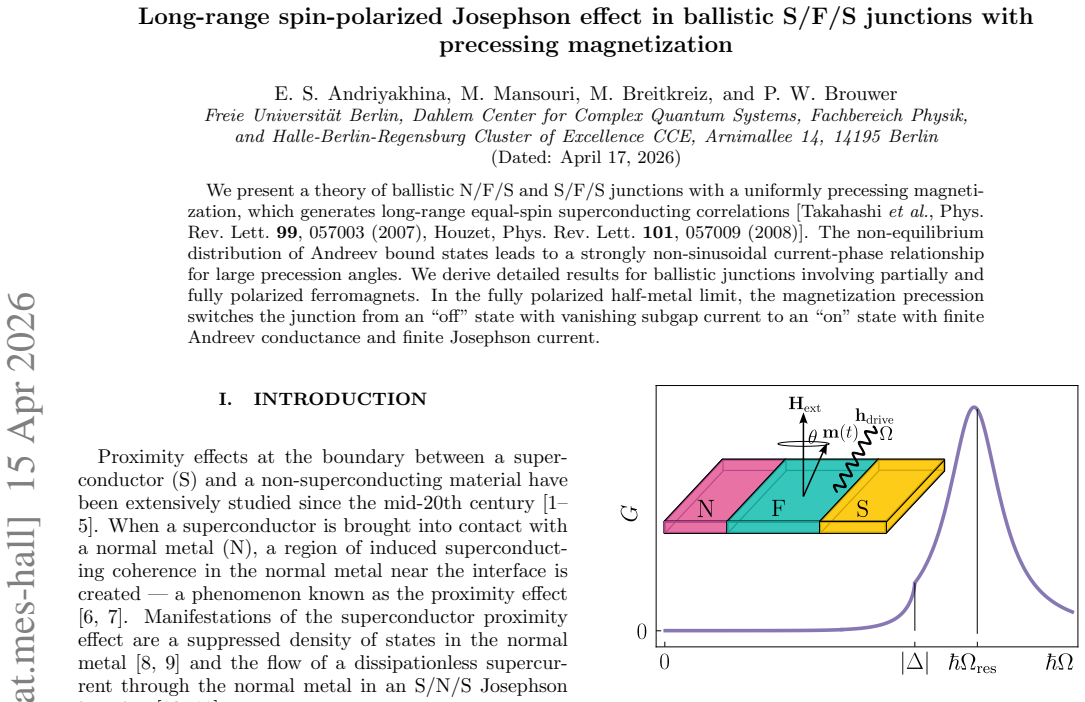
In half-metal S/F/S junctions, uniform magnetization precession switches the device from an off state with no subgap current to an on state with finite Andreev conductance and Josephson current.
A machine-rendered reading of the paper's core claim, the machinery that carries it, and where it could break.
Core claim
Uniform precession of the magnetization in a ballistic S/F/S junction generates long-range spin-polarized triplet correlations. The non-equilibrium Andreev bound states lead to a non-sinusoidal current-phase relation. In the fully polarized half-metal case, the precession switches the junction from an off state with no subgap current to an on state with finite Josephson current.
What carries the argument
The non-equilibrium distribution of Andreev bound states sustained by uniformly precessing magnetization, which produces long-range equal-spin triplet superconducting correlations.
If this is right
- Detailed expressions for the current-phase relation are obtained for both partially and fully polarized ferromagnets.
- The current-phase relation deviates strongly from sinusoidal form when precession angles are large.
- Finite Andreev conductance and Josephson current appear in the half-metal limit only when precession is active.
- The long-range spin-polarized supercurrent relies on the absence of relaxation inside the ballistic junction.
Where Pith is reading between the lines
- The switching mechanism could be used to build magnetically tunable superconducting elements whose on/off state is controlled by external driving of the ferromagnet.
- Adding phenomenological damping to the precession would introduce an upper limit on the frequency window where the on state remains accessible.
- Spatially nonuniform precession patterns could produce position-dependent supercurrents or interference effects not captured by the uniform-drive model.
Load-bearing premise
The ferromagnet magnetization precesses uniformly at constant frequency with no damping or spatial variation, and the junction is perfectly ballistic with no disorder or relaxation.
What would settle it
Measure the subgap current across a half-metal S/F/S junction: it should remain zero in the absence of precession but become finite once the magnetization precesses at constant frequency.
Figures


read the original abstract
We present a theory of ballistic N/F/S and S/F/S junctions with a uniformly precessing magnetization, which generates long-range equal-spin superconducting correlations [Takahashi et al., Phys. Rev. Lett. 99, 057003 (2007), Houzet, Phys. Rev. Lett. 101, 057009 (2008)]. The non-equilibrium distribution of Andreev bound states leads to a strongly non-sinusoidal current-phase relationship for large precession angles. We derive detailed results for ballistic junctions involving partially and fully polarized ferromagnets. In the fully polarized half-metal limit, the magnetization precession switches the junction from an "off" state with vanishing subgap current to an "on" state with finite Andreev conductance and finite Josephson current.
Editorial analysis
A structured set of objections, weighed in public.
Referee Report
Summary. The manuscript develops a theory of ballistic N/F/S and S/F/S junctions with a uniformly precessing magnetization in the ferromagnet. It shows that this generates long-range equal-spin triplet correlations, leading to a non-sinusoidal current-phase relationship. In the half-metal limit, precession switches the junction from an off state with no subgap current to an on state with finite Andreev conductance and Josephson current through non-equilibrium Andreev bound states.
Significance. This is significant for superconducting spintronics as it predicts controllable long-range spin-polarized Josephson effects via magnetization dynamics in ballistic half-metal junctions. The derivation using time-dependent methods provides a clear, internally consistent mechanism without free parameters, offering testable predictions for current-phase relations and conductance switching.
minor comments (2)
- [Abstract] It would be helpful to mention the specific method used (e.g., time-dependent BdG equations or scattering approach) in the abstract for immediate context.
- A figure illustrating the time-dependent magnetization precession and resulting Andreev bound state spectrum would enhance the presentation of the on/off switching effect.
Simulated Author's Rebuttal
We thank the referee for their positive and accurate summary of our manuscript on long-range spin-polarized Josephson effects in ballistic S/F/S junctions with precessing magnetization. We appreciate the recognition of its significance for superconducting spintronics and the recommendation for minor revision. No specific major comments were provided in the report.
Circularity Check
No significant circularity in derivation chain
full rationale
The manuscript derives the long-range spin-polarized Josephson effect by solving the time-dependent Bogoliubov-de Gennes equation (or equivalent scattering formalism) for ballistic S/F/S junctions under uniform precession. The off-to-on switching in the half-metal limit is obtained directly from the resulting non-equilibrium Andreev bound-state occupation and equal-spin triplet correlations; this is a computed outcome of the model assumptions rather than a tautology, fit, or reduction to self-citation. The cited Takahashi/Houzet works are external prior literature establishing the correlation mechanism, not load-bearing self-references by the present authors. No parameters are fitted to data and then relabeled as predictions, no ansatze are smuggled, and no uniqueness theorems are invoked to force the result. The derivation remains self-contained within standard superconducting transport theory.
Axiom & Free-Parameter Ledger
axioms (2)
- standard math BCS mean-field superconductivity and Andreev bound-state formation at S/F interfaces
- domain assumption Uniform, undamped precession of the magnetization vector at constant frequency
Reference graph
Works this paper leans on
-
[1]
0,else (50) Note thatf ss′(k,0) = 0, because the Andreev reflection amplitudes vanish at ˜E= 0
and ˜f(k;ω) is the similar to the anomalous Green function in the quasiclassical theory [69, 72], ˜fss′(k;ω) = 2× res,hs′(ω), k <0,Imω >0, −res′,hs(−ω), k >0,Imω <0. 0,else (50) Note thatf ss′(k,0) = 0, because the Andreev reflection amplitudes vanish at ˜E= 0. Equation (50) combines the results for both the retarded and advanced Green functions. ...
-
[2]
off”-state without current to an “on
The black and pink circles mark the points where the occupationn ±,σ of a bound state changes abruptly. Around these points, the current can undergo a sudden change both in the non-precessing case (around the black circle) and in the regime where features distinguishing non-precessing and precessing junctions appear (both black and pink circles), see Fig....
-
[3]
R. Holm and W. Meissner, Messungen mit hilfe von fl¨ ussigem helium. xiii., Zeitschrift f¨ ur Physik74, 715 (1932)
work page 1932
-
[4]
Meissner, Superconductivity of contacts with inter- posed barriers, Phys
H. Meissner, Superconductivity of contacts with inter- posed barriers, Phys. Rev.117, 672 (1960)
work page 1960
-
[5]
Josephson, Possible new effects in superconductive tunnelling, Physics Letters1, 251 (1962)
B. Josephson, Possible new effects in superconductive tunnelling, Physics Letters1, 251 (1962)
work page 1962
- [6]
-
[7]
N. R. Werthamer, Theory of the superconducting transi- tion temperature and energy gap function of superposed metal films, Phys. Rev.132, 2440 (1963)
work page 1963
-
[8]
P. G. de Gennes, Boundary effects in superconductors, Rev. Mod. Phys.36, 225 (1964)
work page 1964
-
[9]
B. Pannetier and H. Courtois, Andreev reflection and proximity effect, J. Low Temp. Phys.118(2000)
work page 2000
-
[10]
G. Deutscher and P. G. de Gennes, Proximity effects., pp 1005-34 of Superconductivity. Vols. 1 and 2. Parks, R. D. (ed.). New York, Marcel Dekker, Inc., 1969. (1969)
work page 1969
-
[11]
S. Gu´ eron, H. Pothier, N. O. Birge, D. Esteve, and M. H. Devoret, Superconducting proximity effect probed on a mesoscopic length scale, Phys. Rev. Lett.77, 3025 (1996)
work page 1996
-
[12]
O. Kulik, Macroscopic quantization and the proximity effect in S-N-S junctions, Soviet Physics JETP30, 944 (1970), russian original published in 1969
work page 1970
-
[13]
L. D. Jackel, R. A. Buhrman, and W. W. Webb, Direct measurement of current-phase relations in superconduct- ing weak links, Phys. Rev. B10, 2782 (1974)
work page 1974
-
[14]
J. D. Sau, R. M. Lutchyn, S. Tewari, and S. Das Sarma, Generic new platform for topological quantum compu- tation using semiconductor heterostructures, Phys. Rev. Lett.104, 040502 (2010)
work page 2010
-
[15]
Alicea, Majorana fermions in a tunable semiconductor device, Phys
J. Alicea, Majorana fermions in a tunable semiconductor device, Phys. Rev. B81, 125318 (2010)
work page 2010
-
[16]
R. M. Lutchyn, J. D. Sau, and S. Das Sarma, Ma- jorana fermions and a topological phase transition in semiconductor-superconductor heterostructures, Phys. Rev. Lett.105, 077001 (2010)
work page 2010
-
[17]
Y. Oreg, G. Refael, and F. von Oppen, Helical liquids and majorana bound states in quantum wires, Phys. Rev. Lett.105, 177002 (2010)
work page 2010
-
[18]
A. C. Potter and P. A. Lee, Multichannel generalization of Kitaev’s majorana end states and a practical route to realize them in thin films, Phys. Rev. Lett.105, 227003 (2010)
work page 2010
-
[19]
M. Duckheim and P. W. Brouwer, Andreev reflection from noncentrosymmetric superconductors and majo- rana bound-state generation in half-metallic ferromag- nets, Phys. Rev. B83, 054513 (2011)
work page 2011
-
[20]
X.-L. Qi and S.-C. Zhang, Topological insulators and su- perconductors, Rev. Mod. Phys.83, 1057 (2011)
work page 2011
-
[21]
G. Xu, H. Weng, Z. Wang, X. Dai, and Z. Fang, Chern semimetal and the quantized anomalous hall effect in HgCr2Se4, Phys. Rev. Lett.107, 186806 (2011)
work page 2011
-
[22]
F. S. Bergeret, A. F. Volkov, and K. B. Efetov, Long- range proximity effects in superconductor-ferromagnet structures, Phys. Rev. Lett.86, 4096 (2001)
work page 2001
-
[23]
A. Kadigrobov, R. I. Shekhter, and M. Jonson, Quantum spin fluctuations as a source of long-range proximity ef- fects in diffusive ferromagnet-superconductor structures, Europhysics Letters54, 394 (2001)
work page 2001
-
[24]
M. Eschrig, J. Kopu, J. C. Cuevas, and G. Sch¨ on, The- ory of half-metal/superconductor heterostructures, Phys. Rev. Lett.90, 137003 (2003)
work page 2003
-
[25]
M. Krawiec, B. L. Gy¨ orffy, and J. F. Annett, Current- carrying Andreev bound states in a superconductor- ferromagnet proximity system, Phys. Rev. B70, 134519 (2004)
work page 2004
-
[26]
F. S. Bergeret, A. F. Volkov, and K. B. Efetov, Odd 16 triplet superconductivity and related phenomena in superconductor-ferromagnet structures, Rev. Mod. Phys. 77, 1321 (2005)
work page 2005
-
[27]
R. S. Keizer, S. T. B. Goennenwein, T. M. Klapwijk, G. Miao, G. Xiao, and A. Gupta, A spin triplet super- current through the half-metallic ferromagnet CrO2, Na- ture439, 825 (2006), received 22 July 2005; Accepted 29 November 2005; Issue date 16 February 2006
work page 2006
- [28]
-
[29]
M. Houzet and A. I. Buzdin, Long range triplet Joseph- son effect through a ferromagnetic trilayer, Phys. Rev. B 76, 060504 (2007)
work page 2007
-
[30]
V. Braude and Y. V. Nazarov, Fully developed triplet proximity effect, Phys. Rev. Lett.98, 077003 (2007)
work page 2007
-
[31]
T. S. Khaire, M. A. Khasawneh, W. P. Pratt, and N. O. Birge, Observation of spin-triplet superconductivity in Co-based Josephson junctions, Phys. Rev. Lett.104, 137002 (2010)
work page 2010
-
[32]
M. S. Anwar, F. Czeschka, M. Hesselberth, M. Porcu, and J. Aarts, Long-range supercurrents through half-metallic ferromagnetic CrO2, Phys. Rev. B82, 100501 (2010)
work page 2010
-
[33]
D. Sprungmann, K. Westerholt, H. Zabel, M. Weides, and H. Kohlstedt, Evidence for triplet superconductivity in Josephson junctions with barriers of the ferromagnetic Heusler alloy Cu2MnAl, Phys. Rev. B82, 060505 (2010)
work page 2010
-
[34]
J. Wang, M. Singh, M. Tian, and et al., Interplay be- tween superconductivity and ferromagnetism in crys- talline nanowires, Nature Physics6, 389 (2010)
work page 2010
-
[35]
J. W. A. Robinson, J. D. S. Witt, and M. G. Blamire, Controlled injection of spin-triplet supercurrents into a strong ferromagnet, Science329, 59 (2010)
work page 2010
-
[36]
F. H¨ ubler, M. J. Wolf, T. Scherer, D. Wang, D. Beck- mann, and H. v. L¨ ohneysen, Observation of Andreev bound states at spin-active interfaces, Phys. Rev. Lett. 109, 087004 (2012)
work page 2012
-
[37]
E. C. Gingrich, P. Quarterman, Y. Wang, R. Loloee, W. P. Pratt, and N. O. Birge, Spin-triplet supercurrent in Co/Ni multilayer Josephson junctions with perpendic- ular anisotropy, Phys. Rev. B86, 224506 (2012)
work page 2012
-
[38]
M. S. Anwar, M. Veldhorst, A. Brinkman, and J. Aarts, Long range supercurrents in ferromagnetic CrO 2 using a multilayer contact structure, Applied Physics Letters 100, 052602 (2012)
work page 2012
-
[39]
N. Banerjee, J. W. A. Robinson, and M. G. Blamire, Re- versible control of spin-polarized supercurrents in ferro- magnetic Josephson junctions, Nature Communications 5, 4771 (2014)
work page 2014
-
[40]
M. Eschrig, Spin-polarized supercurrents for spintron- ics: a review of current progress, Reports on Progress in Physics78, 104501 (2015)
work page 2015
-
[41]
J. Linder and J. W. A. Robinson, Superconducting spin- tronics, Nature Physics11, 307 (2015)
work page 2015
-
[42]
G. Yang, C. Ciccarelli, and J. W. A. Robinson, Boost- ing spintronics with superconductivity, APL Materials9, 050703 (2021)
work page 2021
-
[43]
A. I. Buzdin, L. N. Bulaevskii, and S. V. Panyukov, Critical-current oscillations as a function of the exchange field and thickness of the ferromagnetic metal (F) in an S-F-S Josephson junction, JETP Letters35, 178 (1982)
work page 1982
-
[44]
A. I. Buzdin, Proximity effects in superconductor- ferromagnet heterostructures, Rev. Mod. Phys.77, 935 (2005)
work page 2005
-
[45]
A. F. Volkov and K. B. Efetov, Odd spin-triplet supercon- ductivity in a multilayered superconductor-ferromagnet Josephson junction, Phys. Rev. B81, 144522 (2010)
work page 2010
-
[46]
Fogelstr¨ om, Josephson currents through spin-active interfaces, Phys
M. Fogelstr¨ om, Josephson currents through spin-active interfaces, Phys. Rev. B62, 11812 (2000)
work page 2000
-
[47]
J. N. Kupferschmidt and P. W. Brouwer, Andreev reflection at half-metal/superconductor interfaces with nonuniform magnetization, Phys. Rev. B83, 014512 (2011)
work page 2011
-
[48]
A. Y. Chaou, G. Lemut, F. von Oppen, and P. W. Brouwer, Proximity superconductivity in chiral kagome antiferromagnets, arXiv preprint arXiv:2508.08372 10.48550/arXiv.2508.08372 (2025)
-
[49]
K. R. Jeon, B. K. Hazra, K. Cho, and et al., Long-range supercurrents through a chiral non-collinear antiferro- magnet in lateral Josephson junctions, Nature Materials 20, 1358 (2021)
work page 2021
-
[50]
K. R. Jeon, B. K. Hazra, J. K. Kim, and et al., Chi- ral antiferromagnetic Josephson junctions as spin-triplet supercurrent spin valves and d.c. SQUIDs, Nature Nan- otechnology18, 747 (2023)
work page 2023
-
[51]
S. Takahashi, S. Hikino, M. Mori, J. Martinek, and S. Maekawa, Supercurrent pumping in Josephson junc- tions with a half-metallic ferromagnet, Phys. Rev. Lett. 99, 057003 (2007)
work page 2007
-
[52]
Houzet, Ferromagnetic Josephson junction with pre- cessing magnetization, Phys
M. Houzet, Ferromagnetic Josephson junction with pre- cessing magnetization, Phys. Rev. Lett.101, 057009 (2008)
work page 2008
- [53]
-
[54]
V. Braude and Y. M. Blanter, Triplet Josephson effect with magnetic feedback in a superconductor-ferromagnet heterostructure, Phys. Rev. Lett.100, 207001 (2008)
work page 2008
- [55]
-
[56]
C. Holmqvist, S. Teber, and M. Fogelstr¨ om, Nonequilib- rium effects in a Josephson junction coupled to a precess- ing spin, Phys. Rev. B83, 104521 (2011)
work page 2011
-
[57]
C. Holmqvist, W. Belzig, and M. Fogelstr¨ om, Spin- precession-assisted supercurrent in a superconducting quantum point contact coupled to a single-molecule mag- net, Phys. Rev. B86, 054519 (2012)
work page 2012
-
[58]
C. Holmqvist, M. Fogelstr¨ om, and W. Belzig, Spin- polarized Shapiro steps and spin-precession-assisted mul- tiple Andreev reflection, Phys. Rev. B90, 014516 (2014)
work page 2014
-
[59]
K. V. Kulikov, D. V. Anghel, M. Nashaat, M. Dolineanu, M. Sameh, and Y. M. Shukrinov, Resonance phenomena in a nanomagnet coupled to a Josephson junction under external periodic drive, Phys. Rev. B109, 014429 (2024)
work page 2024
-
[60]
K. R. Jeon, C. Ciccarelli, A. J. Ferguson, and et al., En- hanced spin pumping into superconductors provides ev- idence for superconducting pure spin currents, Nature Materials17, 499 (2018)
work page 2018
- [61]
-
[62]
A. K. Chan, M. Cubukcu, X. Montiel,et al., Con- trolling spin pumping into superconducting Nb by proximity-induced spin-triplet Cooper pairs, Communi- 17 cations Physics6, 287 (2023)
work page 2023
-
[63]
C. W. J. Beenakker, Universal limit of critical-current fluctuations in mesoscopic Josephson junctions, Phys. Rev. Lett.67, 3836 (1991)
work page 1991
- [64]
- [65]
-
[66]
A. F. Andreev, The thermal conductivity of the interme- diate state in superconductors, Soviet Physics JETP19, 1228 (1964)
work page 1964
-
[67]
G. Tkachov, E. McCann, and V. I. Fal’ko, Subgap trans- port in ferromagnet-superconductor junctions due to magnon-assisted Andreev reflection, Phys. Rev. B65, 024519 (2001)
work page 2001
- [68]
-
[69]
G. E. Blonder, M. Tinkham, and T. M. Klapwijk, Tran- sition from metallic to tunneling regimes in supercon- ducting microconstrictions: Excess current, charge im- balance, and supercurrent conversion, Phys. Rev. B25, 4515 (1982)
work page 1982
-
[70]
M. J. M. de Jong and C. W. J. Beenakker, Andreev re- flection in ferromagnet-superconductor junctions, Phys. Rev. Lett.74, 1657 (1995)
work page 1995
-
[71]
W. L. McMillan, Theory of superconductor—normal- metal interfaces, Phys. Rev.175, 559 (1968)
work page 1968
-
[72]
L. P. Gor’kov, On the energy spectrum of superconduc- tors, Soviet Physics JETP7, 505 (1958)
work page 1958
-
[73]
L. P. Gor’kov, Microscopic derivation of the Ginzburg- Landau equations in the theory of superconductivity, So- viet Physics JETP9, 1364 (1959)
work page 1959
-
[74]
J. Rammer and H. Smith, Quantum field-theoretical methods in transport theory of metals, Rev. Mod. Phys. 58, 323 (1986)
work page 1986
-
[75]
J. Cayssol and G. Montambaux, Exchange-induced or- dinary reflection in a single-channel superconductor- ferromagnet-superconductor junction, Phys. Rev. B70, 224520 (2004)
work page 2004
-
[76]
C. Liu, C. K. A. Mewes, M. Chshiev, T. Mewes, and W. H. Butler, Origin of low Gilbert damping in half met- als, Applied Physics Letters95, 022509 (2009)
work page 2009
- [77]
-
[78]
A. C. Anderson, C. B. Satterthwaite, and S. C. Smith, Thermal conductivity of superconducting niobium, Phys. Rev. B3, 3762 (1971)
work page 1971
-
[79]
E. S. Andriyakhina, M. Mansouri, M. Breitkreiz, and P. W. Brouwer, Precessing S/F/S Josephson current solver (2026). 18 A: S/HM/S Junction: current carried by the continuum spectrum In this appendix, we provide the explicit expression for the contributionj σ( ˜E) from the continuous part of the spectrum for small tilt angleθ. We first consider energies|∆|...
work page 2026
discussion (0)
Sign in with ORCID, Apple, or X to comment. Anyone can read and Pith papers without signing in.