Blocking of 2D bistable reaction-diffusion fronts by obstacles
Pith reviewed 2026-05-10 09:39 UTC · model grok-4.3
The pith
The integral of the reaction term provides an effective driving force that, combined with the one-dimensional traveling wave solution, yields an analytical model for predicting when bistable fronts are blocked by two-dimensional obstacles.
A machine-rendered reading of the paper's core claim, the machinery that carries it, and where it could break.
Core claim
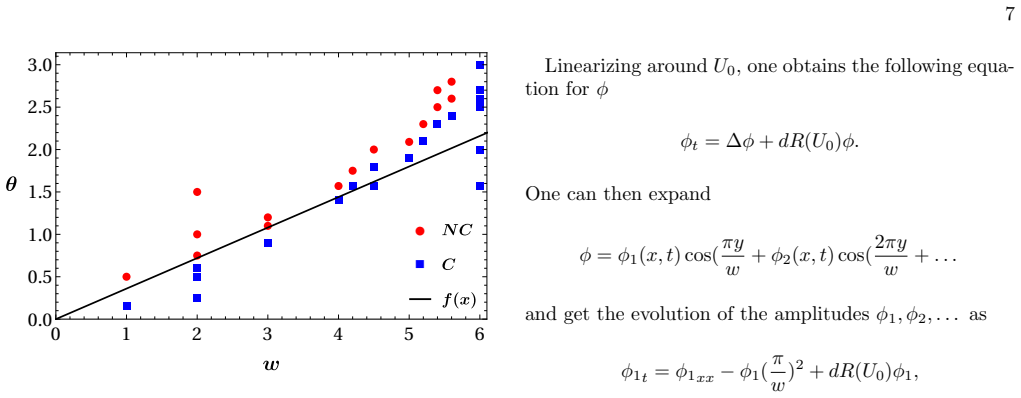
Using a conservation law approach, the integral of the reaction term is shown to act as an effective driving force for the front. This insight, combined with the exact one-dimensional traveling wave solution, allows construction of a reduced analytical model that predicts blocking thresholds. Explicit conditions are obtained for front propagation in a waveguide connected to a conical region of angle theta, valid for widths w less than 4. The model captures the influence of both geometry and nonlinearity and agrees with numerical simulations. The analysis is extended to checkerboard-like obstacles with simple heuristic rules.
What carries the argument
the reduced analytical model obtained by treating the integral of the reaction term as an effective driving force and combining it with the one-dimensional traveling wave solution
If this is right
- Explicit conditions for front propagation or blocking in waveguide-to-conical geometries when width w < 4.
- The reduced model incorporates effects of both geometry (angle theta) and the nonlinearity of the bistable reaction.
- Predictions show good quantitative agreement with direct numerical simulations of the 2D system.
- Simple heuristic rules can be derived for front propagation through more complex checkerboard-like obstacle patterns.
Where Pith is reading between the lines
- Similar reductions might apply to other obstacle shapes or to three-dimensional fronts.
- The effective driving force concept could help design obstacle configurations to control or stop fronts in applications like flame propagation or biological invasion.
- Testing the model on wider waveguides (w > 4) or different nonlinearities would reveal the limits of the reduction.
Load-bearing premise
The integral of the reaction term can be treated as an effective driving force that reduces the two-dimensional problem to the one-dimensional traveling wave solution, remaining valid for waveguide-conical geometries when the width is less than 4.
What would settle it
Numerical simulation of a specific waveguide-cone setup with w less than 4 where the front either propagates or blocks contrary to the explicit condition derived from the reduced model.
Figures




read the original abstract
We investigate numerically the blocking of two-dimensional bistable reaction diffusion fronts by geometric obstacles. Our goal is to derive quantitative criteria for front propagation in the presence of spatial heterogeneities. Using a conservation law approach, we show that the integral of the reaction term acts as an effective driving force for the front. Combining this insight with the exact one-dimensional traveling wave solution, we construct a reduced analytical model that predicts blocking thresholds. In particular, we obtain explicit conditions for front propagation in a waveguide connected to a conical region of angle theta, valid for widths w less than 4. The model captures the influence of both geometry and nonlinearity, and shows good agreement with numerical simulations. Finally, we extend the analysis to more complex geometries, including checkerboard-like obstacles, and derive simple heuristic rules governing front propagation. ~
Editorial analysis
A structured set of objections, weighed in public.
Referee Report
Summary. The paper numerically studies blocking of 2D bistable reaction-diffusion fronts by geometric obstacles. It derives a conservation-law identity showing that the integral of the reaction term acts as an effective driving force, then combines this with the exact 1D traveling-wave solution to construct a reduced analytical model. The model yields explicit blocking thresholds for a waveguide connected to a conical region of angle theta, stated to hold for widths w < 4; it also provides heuristic rules for more complex obstacles such as checkerboards and reports good agreement with direct numerical simulations.
Significance. If the reduced model remains accurate in the stated regime, the work supplies a practical analytical tool that incorporates both geometry and nonlinearity to predict propagation thresholds, which is useful for applications involving heterogeneous media. The explicit conditions and numerical agreement constitute a clear strength, though the scope is restricted to w < 4 and the extension to complex geometries relies on heuristics.
major comments (2)
- [Derivation of the reduced model (waveguide-conical geometry)] The central reduction treats the reaction integral as an effective driving force inserted into the 1D traveling-wave ODE to obtain explicit thresholds for the waveguide-to-cone transition. However, this step implicitly assumes that the front normal velocity and profile remain close to the planar 1D solution after entering the conical region. No a-priori estimate is given showing that curvature-driven (mean-curvature) contributions from the 2D Laplacian and transverse diffusion remain O(ε) small up to w = 4, so the validity bound rests on an unproven regime.
- [Numerical simulations and comparison] The numerical validation is cited as showing 'good agreement,' yet the manuscript does not report quantitative error measures (e.g., relative discrepancy in predicted versus observed blocking thresholds) or the precise range of w and theta values tested. Without these, it is difficult to assess how close the simulations come to the w = 4 boundary where 2D corrections are expected to grow.
minor comments (2)
- [Abstract] The abstract states the model is 'valid for widths w less than 4' without specifying the nondimensionalization of w or the precise definition of the conical angle theta; these should be stated explicitly at first use.
- [Model formulation] Notation for the reaction term f(u) and the traveling-wave speed c should be introduced consistently in the main text before being used in the reduced-model equations.
Simulated Author's Rebuttal
We thank the referee for the careful reading and constructive comments on our manuscript. The points raised regarding the justification of the reduced model's validity range and the quantitative presentation of numerical comparisons are well taken. We address each major comment in detail below and indicate the revisions made to the manuscript.
read point-by-point responses
-
Referee: The central reduction treats the reaction integral as an effective driving force inserted into the 1D traveling-wave ODE to obtain explicit thresholds for the waveguide-to-cone transition. However, this step implicitly assumes that the front normal velocity and profile remain close to the planar 1D solution after entering the conical region. No a-priori estimate is given showing that curvature-driven (mean-curvature) contributions from the 2D Laplacian and transverse diffusion remain O(ε) small up to w = 4, so the validity bound rests on an unproven regime.
Authors: We agree that the reduced model relies on the front profile remaining close to the 1D traveling-wave solution, an assumption that is not supported by a rigorous a-priori estimate of curvature effects. The bound w < 4 is determined empirically from the regime in which the model predictions remain consistent with direct 2D simulations. In the revised manuscript we have added a paragraph in Section 3 explicitly stating that the validity range is heuristic and based on numerical evidence rather than a proven smallness of mean-curvature corrections. We have also included additional simulation data for w approaching 4 to illustrate the gradual growth of discrepancies. revision: partial
-
Referee: The numerical validation is cited as showing 'good agreement,' yet the manuscript does not report quantitative error measures (e.g., relative discrepancy in predicted versus observed blocking thresholds) or the precise range of w and theta values tested. Without these, it is difficult to assess how close the simulations come to the w = 4 boundary where 2D corrections are expected to grow.
Authors: We concur that quantitative error measures and explicit parameter ranges would improve the assessment of the model's accuracy. In the revised version we have added a table (new Table 1) that reports the relative discrepancy between predicted and observed blocking thresholds for w ranging from 0.5 to 3.8 and theta from 15° to 75°. The table shows that the maximum relative error stays below 6 % for w ≤ 3.5 and rises to approximately 11 % near w = 3.8 for the largest angles tested. The text in Section 4 now states these ranges explicitly. revision: yes
Circularity Check
Derivation from conservation law plus exact 1D TW is self-contained; no reduction to fitted inputs or self-citations
full rationale
The paper derives an effective driving force from the integral of the reaction term via a conservation-law identity, then inserts the known exact 1D traveling-wave profile to obtain explicit blocking thresholds for the waveguide-cone geometry when w<4. This construction is independent of the numerical simulations used only for validation; the thresholds are not obtained by fitting parameters to the same data that later tests them, nor does any step rename a fitted quantity as a prediction. No self-citations appear in the load-bearing steps, and the w<4 regime is presented as an a-priori applicability limit rather than a result forced by definition. The central claim therefore remains non-circular.
Axiom & Free-Parameter Ledger
free parameters (1)
- width validity bound
axioms (1)
- domain assumption The integral of the reaction term acts as an effective driving force for the front
Reference graph
Works this paper leans on
-
[1]
By contrast, if the waveguide opens up abruptly, they proved that there can be blocking
proved that a bistable front will always propagate in a waveguide with decreasing cross section. By contrast, if the waveguide opens up abruptly, they proved that there can be blocking. They consider ”blocked” solutions and show that these can exist in some configurations. In this article, we use a direct argument based on conservation laws derived from t...
-
[2]
We interpretRas an effective driving force governing front propagation
First, a front will move in the transition regionωif ∂t( R ω udxdy)>0 i.e., ifR≡ R ω R(u)dxdy >0. We interpretRas an effective driving force governing front propagation. R≡ Z ω R(u)dxdy.(10)
-
[3]
If a front moving insideωis such thatR= 0 at some instant, then it will stop
-
[4]
This argument can be made general, in particular we can describe complex transition regions. To obtain quantitative results on the simple geometry we considered, one should evaluate the right hand side of equation (9). To this end, we introduce an approximate form of the solution. The simplest assumption is that the kink has noydependence so that we can u...
-
[5]
We give more details in the next subsection
where we considered how 2D corrections affect sine- Gordon kinks for Josephson junctions. We give more details in the next subsection. B. Two-dimensional effects in a waveguide We consider a waveguide of cross-sectionwextending fromy=−w/2 toy=w/2 and the equation ut = ∆u+R(u).(20) Following [13], we decomposeuas u=U 0(x, t) +ϕ(x, y, t), whereU 0 is such t...
-
[6]
A. C. Scott, Nonlinear Science, Emergence and Dynamics of Coherent Structures (Oxford University Press, USA, 2003)
work page 2003
-
[7]
J. D. Murray, Mathematical biology, Springer (2003)
work page 2003
-
[8]
V. Volpert and S. Petrovskii, Reaction–diffusion waves in biology, Physics of Life Reviews 6 (2009) 267–310
work page 2009
-
[9]
J.-G. Caputo and B. Sarels, Reaction-diffusion front crossing a local defect, Phys. Rev. E 84, 041108 (2011)
work page 2011
- [10]
-
[11]
H. Berestycki, F. Hamel and H. Matano, Front propagation through a perforated wall, https://arxiv.org/abs/2406.04688
-
[12]
G. Chapuisat and E. Grenier, Existence and nonexis- tence of traveling wave solutions for a bistable reac- tion–diffusion equation in an infinite cylinder whose di- ameter is suddenly increased, Commun. Partial Differ. Equ., 30(10–12), 1805–1816 (2005)
work page 2005
-
[13]
H. Berestycki, J. Bouhours and G. Chapuisat, ”Front blocking and propagation in cylinders with varying cross section”, Calculus of Variations and Partial Differential Equations, Springer, (2016)
work page 2016
-
[14]
https://tel.archives-ouvertes.fr/tel-01070608 10
Juliette Bouhours, ”Reaction diffusion equation in het- erogeneous media : persistance, propagation and effect of the geometry”, General Mathematics, Universit´ e Pierre et Marie Curie - Paris VI, (2014). https://tel.archives-ouvertes.fr/tel-01070608 10
work page 2014
-
[15]
H. Berestycki and P. L. Lions, Une methode locale pour l’existence de solutions positives de problemes semi- lineaires elliptiques dansR N, J. Anal. Math. 38, 144–187 (1980)
work page 1980
-
[16]
J. C. Strikwerda, and Y. Nagel, Finite Difference Meth- ods for Polar Coordinate Systems (No. MRCTSR2934), (1986)
work page 1986
-
[17]
J. G. Caputo, ”Phi 4 model in higher dimensions”, in ”A Dynamical Perspective on the phi4 Model: Past, Present and Future”, P. Kevrekides and J. Cuevas Eds, Springer verlag , (2019)
work page 2019
-
[18]
J. G. Caputo, N. Flytzanis, Y. Gaididei and M. Vavalis, Two-dimensional effects in Josephson junctions: I static properties, Phys. Rev. E,54, No. 2, 2092-2101, (1996). VI. APPENDIX: INTEGRALS From [4] we recall the following integrals. Noting U(z) = 1 1 + exp(z), R(U) =U(1−U)(U−a), we have Z +∞ y R[U(z)]dz= 1 2(1 + exp(y))2 − a 1 + exp(y), Z +∞ −∞ R[U(z)]...
work page 2092
discussion (0)
Sign in with ORCID, Apple, or X to comment. Anyone can read and Pith papers without signing in.