Preference Estimation via Opponent Modeling in Multi-Agent Negotiation
Pith reviewed 2026-05-10 09:41 UTC · model grok-4.3
The pith
Integrating LLMs to convert negotiation utterances into probabilities improves opponent preference estimates and full agreement rates.
A machine-rendered reading of the paper's core claim, the machinery that carries it, and where it could break.
Core claim
The central claim is that converting qualitative cues extracted by LLMs from natural language utterances into probabilistic formats enables consistent dynamic Bayesian belief tracking, which in turn raises both preference estimation accuracy and the full agreement rate on a multi-party negotiation benchmark compared with numerical-only baselines.
What carries the argument
LLM-driven extraction of qualitative utterance cues converted into probabilistic formats for dynamic Bayesian opponent modeling
If this is right
- Higher full agreement rates become reachable in multi-issue, multi-party settings without exhaustive numerical probing.
- Preference estimates remain stable even when opponents express priorities only in natural language.
- The framework can track belief updates dynamically as new utterances arrive during ongoing talks.
- Integration of semantic understanding with probabilistic reasoning reduces incompleteness in opponent models.
Where Pith is reading between the lines
- The same cue-to-probability conversion step could be tested in non-negotiation domains such as collaborative planning or dispute mediation where language carries unstated constraints.
- If the conversion step proves robust, real-time AI agents might adapt offers mid-negotiation solely from observed dialogue rather than explicit queries.
- Extending the approach to larger numbers of agents would require checking whether the Bayesian update step remains tractable when the number of qualitative cues grows.
Load-bearing premise
Large language models can extract qualitative cues from utterances and convert them into unbiased probability distributions that a Bayesian tracker can use without introducing systematic errors.
What would settle it
A controlled test on the same multi-party benchmark in which the hybrid method produces lower full-agreement rates or higher preference-estimation error than a numerical-only Bayesian baseline would falsify the central claim.
Figures

read the original abstract
Automated negotiation in complex, multi-party and multi-issue settings critically depends on accurate opponent modeling. However, conventional numerical-only approaches fail to capture the qualitative information embedded in natural language interactions, resulting in unstable and incomplete preference estimation. Although Large Language Models (LLMs) enable rich semantic understanding of utterances, it remains challenging to quantitatively incorporate such information into a consistent opponent modeling. To tackle this issue, we propose a novel preference estimation method integrating natural language information into a structured Bayesian opponent modeling framework. Our approach leverages LLMs to extract qualitative cues from utterances and converts them into probabilistic formats for dynamic belief tracking. Experimental results on a multi-party benchmark demonstrate that our framework improves the full agreement rate and preference estimation accuracy by integrating probabilistic reasoning with natural language understanding.
Editorial analysis
A structured set of objections, weighed in public.
Referee Report
Summary. The paper proposes a preference estimation framework for multi-agent negotiation that uses LLMs to extract qualitative cues from natural language utterances and converts them into probabilistic formats for integration into a dynamic Bayesian opponent model. It claims this hybrid approach improves full agreement rates and preference estimation accuracy over conventional numerical-only methods on a multi-party benchmark.
Significance. If the conversion from LLM cues to calibrated probabilities is shown to be unbiased and the Bayesian layer demonstrably adds value beyond semantic features, the work could advance opponent modeling by enabling more robust handling of qualitative information in complex negotiations, with potential applications in automated bargaining systems.
major comments (2)
- [Method] The central claim requires that LLM-extracted cues are mapped to unbiased, dynamically updatable probabilities whose integration improves both agreement rate and estimation accuracy. However, no explicit mapping function, calibration procedure, or bias-validation experiment is described for turning qualitative cues into prior/posterior parameters (see the method description following the abstract). Without this, gains on the benchmark cannot be attributed to the probabilistic reasoning layer rather than LLM semantics alone.
- [Experiments] Experimental results are asserted to demonstrate improvements in full agreement rate and preference estimation accuracy, yet no baselines, quantitative metrics (e.g., exact accuracy definition), error bars, statistical tests, or data details are supplied in the abstract or referenced sections, preventing verification that the hybrid method outperforms numerical approaches.
minor comments (1)
- [Method] Notation for the Bayesian belief update and the LLM-to-probability conversion should be formalized with equations to improve clarity and reproducibility.
Simulated Author's Rebuttal
We thank the referee for the constructive feedback on our manuscript. We address the major comments point by point below, agreeing where clarification is needed and outlining the revisions we will implement.
read point-by-point responses
-
Referee: [Method] The central claim requires that LLM-extracted cues are mapped to unbiased, dynamically updatable probabilities whose integration improves both agreement rate and estimation accuracy. However, no explicit mapping function, calibration procedure, or bias-validation experiment is described for turning qualitative cues into prior/posterior parameters (see the method description following the abstract). Without this, gains on the benchmark cannot be attributed to the probabilistic reasoning layer rather than LLM semantics alone.
Authors: We agree that the conversion process from LLM-extracted cues to probabilistic parameters requires a more explicit and formal treatment to substantiate the contribution of the Bayesian layer. While the manuscript describes the overall framework, we will revise the method section to include a precise mathematical definition of the mapping function, the specific calibration procedure employed to produce unbiased probabilities, and results from a dedicated bias-validation experiment. These additions will allow readers to clearly distinguish the value added by the dynamic Bayesian tracking from the LLM semantic features alone. revision: yes
-
Referee: [Experiments] Experimental results are asserted to demonstrate improvements in full agreement rate and preference estimation accuracy, yet no baselines, quantitative metrics (e.g., exact accuracy definition), error bars, statistical tests, or data details are supplied in the abstract or referenced sections, preventing verification that the hybrid method outperforms numerical approaches.
Authors: We acknowledge that the experimental reporting in the current version lacks sufficient detail for independent verification. In the revised manuscript we will add: (i) an exact definition of the preference estimation accuracy metric, (ii) a complete list of baselines with implementation details, (iii) quantitative results accompanied by error bars, (iv) statistical significance tests, and (v) expanded data details including benchmark statistics and experimental protocol. These changes will enable direct assessment of whether the hybrid approach outperforms numerical-only methods. revision: yes
Circularity Check
No circularity: method described at high level without equations or self-referential reductions
full rationale
The provided abstract and description outline a proposed integration of LLM-based cue extraction with Bayesian belief tracking for opponent modeling, but contain no equations, derivations, fitted parameters, or self-citations that could reduce a claimed prediction or result to its own inputs by construction. The central claim rests on experimental improvements from the combined framework rather than any mathematical step that is definitionally equivalent to the inputs. Absent specific load-bearing reductions in the text, the derivation chain is self-contained as a descriptive proposal.
Axiom & Free-Parameter Ledger
axioms (1)
- domain assumption LLMs can accurately extract qualitative cues from negotiation utterances and convert them into probabilistic formats without significant bias or information loss.
Reference graph
Works this paper leans on
-
[1]
ToMBench: Benchmarking Theory of Mind in Large Language Models. InProceedings of the 62nd Annual Meeting of the Association for Compu- tational Linguistics (V olume 1: Long Papers), pages 15959–15983, Bangkok, Thailand. Association for Computational Linguistics. Yao Fu, Hao Peng, Tushar Khot, and Mirella Lapata
-
[2]
Improving Language model Negotiation with Self-Play and In-Context Learning from AI Feedback. Preprint, arXiv:2305.10142. He He, Jordan Boyd-Graber, Kevin Kwok, and Hal Daumé, III. 2016. Opponent Modeling in Deep Re- inforcement Learning. InProceedings of The 33rd International Conference on Machine Learning, vol- ume 48 ofProceedings of Machine Learning ...
-
[3]
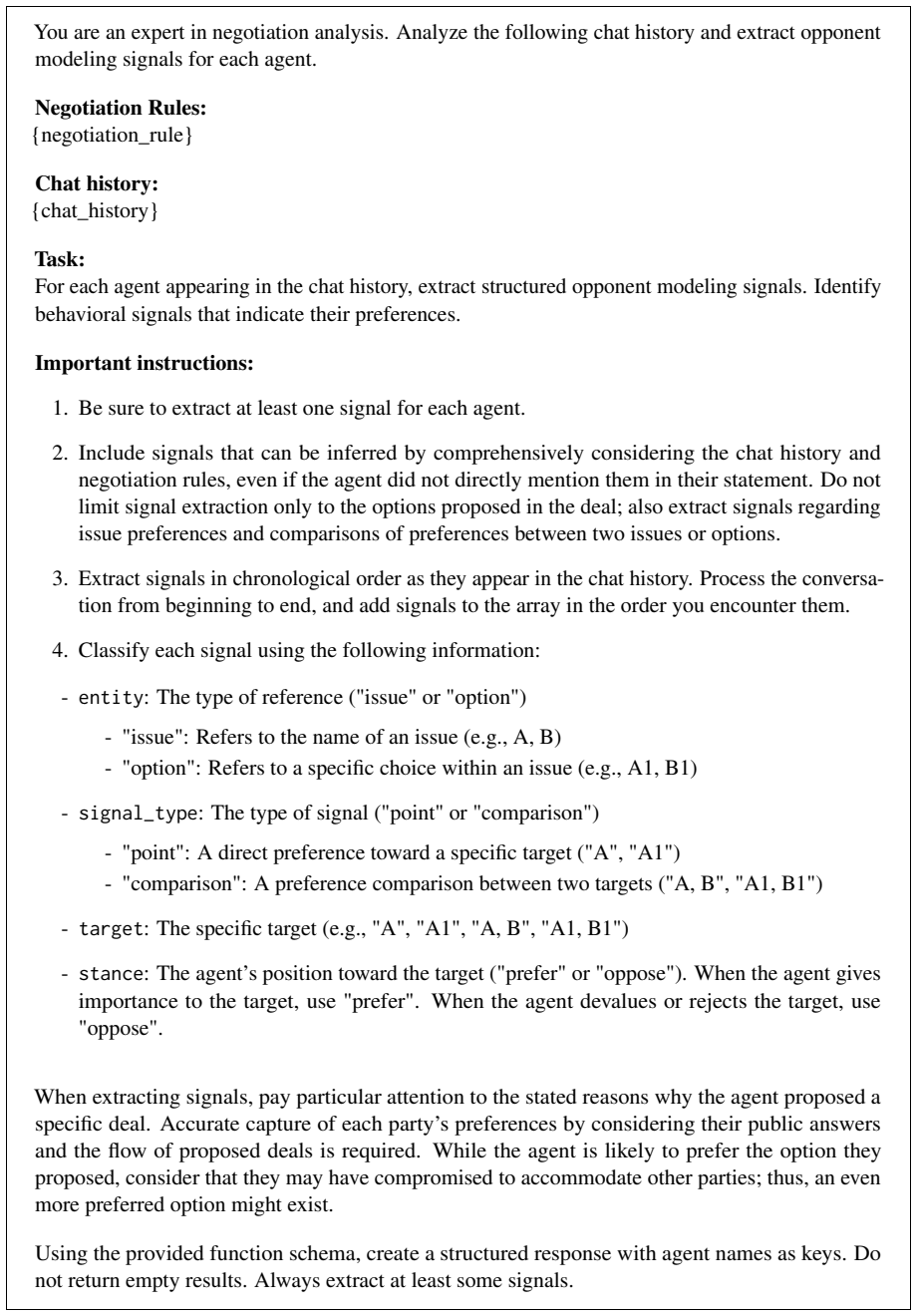
Be sure to extract at least one signal for each agent
-
[4]
Include signals that can be inferred by comprehensively considering the chat history and negotiation rules, even if the agent did not directly mention them in their statement. Do not limit signal extraction only to the options proposed in the deal; also extract signals regarding issue preferences and comparisons of preferences between two issues or options
-
[5]
Extract signals in chronological order as they appear in the chat history. Process the conversa- tion from beginning to end, and add signals to the array in the order you encounter them
-
[6]
Classify each signal using the following information: -entity: The type of reference ("issue" or "option") - "issue": Refers to the name of an issue (e.g., A, B) - "option": Refers to a specific choice within an issue (e.g., A1, B1) -signal_type: The type of signal ("point" or "comparison") - "point": A direct preference toward a specific target ("A", "A1...
discussion (0)
Sign in with ORCID, Apple, or X to comment. Anyone can read and Pith papers without signing in.