Current-Induced Dynamics and Instability Pathways of Skyrmioniums in Chiral Magnets
Pith reviewed 2026-05-10 09:13 UTC · model grok-4.3
The pith
Skyrmioniums exhibit finite transverse velocity under currents despite zero net topological charge due to imbalance between inner core and outer ring.
A machine-rendered reading of the paper's core claim, the machinery that carries it, and where it could break.
Core claim
Skyrmioniums possess zero total topological charge yet exhibit a finite transverse velocity under applied currents. This skyrmionium Hall effect originates from an imbalance between positive and negative topological contributions of the inner skyrmion and surrounding ring, which typically occupy different areas. Current-induced deformations further enhance this imbalance, yielding Hall angles comparable to those of skyrmions. At higher current densities, skyrmioniums undergo distinct instabilities depending on magnetic field and uniaxial anisotropy, including elongation, collapse into a skyrmion, transformation into a topologically trivial droplet, and expansion into stripe textures.
What carries the argument
The composite skyrmionium structure with opposing topological contributions from core and ring, analyzed via the generalized Thiele equation for rigid-body motion and micromagnetic simulations tracking local topological charge evolution.
If this is right
- Skyrmioniums can be steered transversely by currents at angles comparable to skyrmions, allowing similar transport control.
- Current density thresholds trigger specific transformations between skyrmionium, skyrmion, droplet, and stripe states.
- Mixed skyrmion-skyrmionium lattices support elastic transport, soliton exchange, and polymorphic transitions under drive.
- Pulsed currents enable access to dynamical regimes not reachable by steady driving.
Where Pith is reading between the lines
- The area-dependent imbalance mechanism may generalize to other compensated topological objects in magnets or other condensed-matter systems.
- The mapped phase diagrams could guide experiments seeking current-controlled switching between magnetic textures.
- Collective dynamics in meta-matter lattices suggest routes for encoding information in the arrangement and shape of multiple skyrmioniums.
Load-bearing premise
The generalized Thiele equation remains quantitatively accurate for the deformed, non-rigid skyrmionium shapes that appear under finite current, and the micromagnetic parameters chosen for the simulations faithfully represent real chiral magnets.
What would settle it
Experimental observation that an isolated skyrmionium under moderate current density shows strictly longitudinal motion with zero transverse component, or that the predicted instability thresholds in current-field phase diagrams are absent.
Figures


read the original abstract
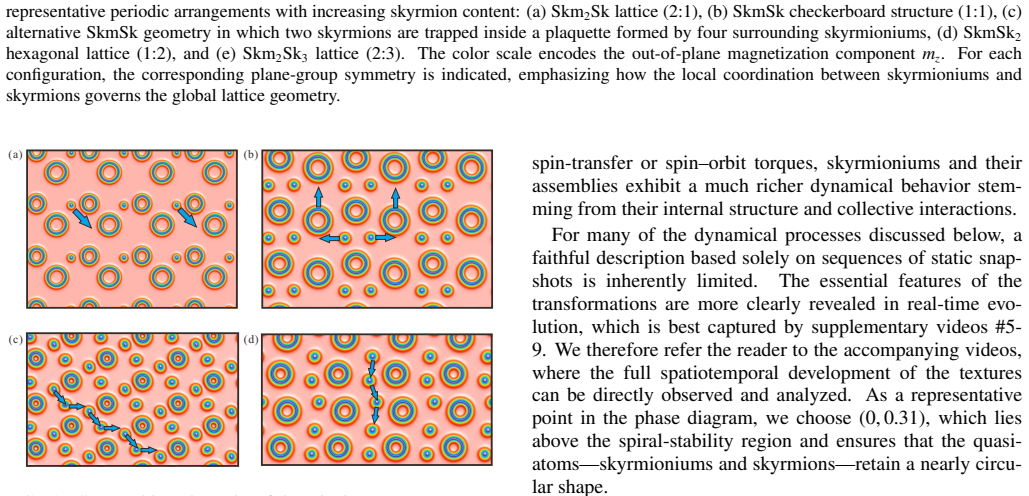
We present a comprehensive study of current-driven dynamics, transformations, and instabilities of skyrmioniums in chiral magnetic films, considering both isolated objects and collective states forming skyrmionium-based meta-matter. Using micromagnetic simulations combined with an analytical description based on the generalized Thiele equation, we clarify how the internal structure of skyrmioniums governs their nonequilibrium response to electric currents. Despite having zero total topological charge, skyrmioniums exhibit a finite transverse velocity under applied currents. We show that this skyrmionium Hall effect originates from an imbalance between positive and negative topological contributions of the inner skyrmion and surrounding ring, which typically occupy different areas. Current-induced deformations further enhance this imbalance, yielding Hall angles comparable to those of skyrmions. At higher current densities, skyrmioniums undergo distinct instabilities depending on magnetic field and uniaxial anisotropy, including elongation, collapse into a skyrmion, transformation into a topologically trivial droplet, and expansion into stripe textures. We map these regimes in current--field and current--anisotropy phase diagrams and resolve their microscopic pathways via the evolution of topological charge and local rotational measures. Beyond isolated textures, mixed skyrmion--skyrmionium lattices display rich collective dynamics, including elastic transport, polymorphic transitions, soliton exchange, and stripe formation. Pulsed currents provide additional control, enabling access to regimes beyond continuous driving. Our results establish skyrmioniums and their meta-matter as tunable nonequilibrium systems probing the topological energy landscape far from equilibrium.
Editorial analysis
A structured set of objections, weighed in public.
Referee Report
Summary. The manuscript studies current-driven dynamics and instabilities of skyrmioniums in chiral magnets via micromagnetic simulations and the generalized Thiele equation. It claims that, despite zero net topological charge, skyrmioniums exhibit a finite transverse (Hall) velocity arising from an imbalance in the positive and negative topological contributions of the inner skyrmion and outer ring, which is further enhanced by current-induced deformations. The work maps instability pathways (elongation, collapse, droplet formation, stripe expansion) in current-field and current-anisotropy diagrams, resolves them via topological charge and rotational measures, and extends the analysis to collective dynamics in skyrmion-skyrmionium lattices, including polymorphic transitions and pulsed-current control.
Significance. If the central claims hold, the results establish skyrmioniums as tunable nonequilibrium systems whose internal topological structure controls transport and stability far from equilibrium, with potential implications for spintronic devices and meta-materials. Strengths include the combined use of LLG simulations and Thiele analytics, the resolution of microscopic instability pathways through local topological measures, and the exploration of collective lattice behaviors. The phase diagrams provide concrete, falsifiable predictions for experimental follow-up.
major comments (1)
- [Analytical description and comparison with simulations] The explanation of the skyrmionium Hall effect (finite transverse velocity from topological imbalance) is derived in the analytical section using the generalized Thiele equation. However, the simulations show pronounced non-rigid deformations (elongation, area changes) already at moderate current densities before instabilities. No direct quantitative benchmark is reported that extracts deformed magnetization profiles from LLG trajectories, inserts them into the Thiele framework, and compares the resulting velocity predictions against the same LLG runs. Without this test, it remains unclear whether the Thiele description remains quantitatively accurate or is only qualitatively consistent when higher-order deformation modes become important.
Simulated Author's Rebuttal
We thank the referee for the careful reading of our manuscript and the constructive feedback. The positive assessment of the overall significance is appreciated. Below we address the major comment point by point, indicating where revisions will be made to strengthen the work.
read point-by-point responses
-
Referee: The explanation of the skyrmionium Hall effect (finite transverse velocity from topological imbalance) is derived in the analytical section using the generalized Thiele equation. However, the simulations show pronounced non-rigid deformations (elongation, area changes) already at moderate current densities before instabilities. No direct quantitative benchmark is reported that extracts deformed magnetization profiles from LLG trajectories, inserts them into the Thiele framework, and compares the resulting velocity predictions against the same LLG runs. Without this test, it remains unclear whether the Thiele description remains quantitatively accurate or is only qualitatively consistent when higher-order deformation modes become important.
Authors: We agree that a direct quantitative benchmark using deformed profiles would provide stronger validation of the Thiele approach beyond the rigid-body limit. In the original manuscript the generalized Thiele equation was applied under the assumption of rigid translation to derive the Hall velocity analytically from the topological imbalance, with qualitative consistency shown against LLG velocities. To address the referee's point we will extract instantaneous magnetization configurations from the LLG trajectories at several sub-critical current densities, compute the corresponding Thiele tensors (including the deformed topological charge density and dissipative tensor) directly from those profiles, and compare the resulting velocity predictions against the velocities measured in the same LLG runs. This comparison will be added as a new panel or supplementary figure in the revised manuscript, together with a discussion of the current-density range where the rigid approximation remains quantitatively accurate. revision: yes
Circularity Check
No significant circularity in skyrmionium Hall effect derivation
full rationale
The paper derives the finite transverse velocity (skyrmionium Hall effect) from an imbalance in topological charge contributions between the inner skyrmion and outer ring, computed directly from the spin texture in both micromagnetic simulations (LLG evolution under current) and the generalized Thiele equation projection. These two methods are independent: simulations provide numerical trajectories without fitting to the final claim, while Thiele supplies analytical insight into the velocity components without reducing to self-defined inputs or fitted parameters renamed as predictions. No self-citation load-bearing steps, uniqueness theorems, or ansatzes appear in the central chain; the phase diagrams and instability pathways follow from direct simulation outputs. The derivation is self-contained against external benchmarks.
Axiom & Free-Parameter Ledger
axioms (2)
- domain assumption Applicability of the generalized Thiele equation to current-driven, deformable skyrmioniums
- domain assumption Standard micromagnetic model for Dzyaloshinskii-Moriya interaction and uniaxial anisotropy in chiral films
Reference graph
Works this paper leans on
-
[1]
7(a) forh= 0.34 andI=5.9×10 12,A/m 2
Collapse of a skyrmionium into a skyrmion A representative example of the transformation of a skyrmionium into a skyrmion is shown in Fig. 7(a) forh= 0.34 andI=5.9×10 12,A/m 2. The process is illustrated by a sequence of snapshots displaying color maps of them z com- ponent of the magnetization, with black arrows indicating the in-plane (xy) projections (...
-
[2]
Transformation of a skyrmionium into a droplet The skyrmionium instability with respect to the droplet [66–68] proceeds through the same initial stages as those de- picted and described in Fig. 7, at the same magnetic field but at a slightly larger current density. The red-shaded region IV in Fig. 5(a) corresponds to this transformation. Instead of the co...
-
[3]
offers an alternative perspective on the internal structure of skyrmioniums. Rather than viewing a skyrmionium as two nested skyrmions, it may be interpreted as a swirled droplet state which, via the annihilation of its tips carrying oppo- site winding numbers (and topological charges), can trans- form back into a skyrmionium. Although both the skyrmio- n...
-
[4]
We therefore refer the reader to the accompanying videos, where the full spatiotemporal development of the textures can be directly observed and analyzed. As a representative point in the phase diagram, we choose (0,0.31), which lies above the spiral-stability region and ensures that the quasi- atoms—skyrmioniums and skyrmions—retain a nearly circu- lar s...
-
[5]
are inherently time dependent and involve collective mo- tion, internal deformation, and topological rearrangements that cannot be fully captured by static figures alone. To com- plement the results presented in the main text, we therefore provide a set of Supplementary Videos visualizing the real- time evolution of the magnetization textures. Unless stat...
-
[6]
N. Manton and P. Sutcliffe,Topological solitons(Cambridge University Press, 2004)
work page 2004
-
[7]
Y . M. Shnir,Topological and non-topological solitons in scalar field theories(Cambridge University Press, 2018)
work page 2018
- [8]
-
[9]
R. Rajaraman,Solitons and Instantons: An Introduction to Soli- tons and Instantons in Quantum Field Theory(North-Holland, Amsterdam, 1982)
work page 1982
-
[10]
A. O. Leonov and K. Nakamura, Phys. Rev. Mater.10, 036001 (2026)
work page 2026
-
[11]
A. N. Bogdanov and D. Yablonskii, Zh. Eksp. Teor. Fiz95, 178 (1989)
work page 1989
-
[12]
A. Bogdanov and A. Hubert, Journal of magnetism and mag- netic materials138, 255 (1994)
work page 1994
- [13]
- [14]
-
[15]
R. Bott and L. W. Tu,Differential forms in algebraic topology, V ol. 82 (Springer Science & Business Media, 2013)
work page 2013
-
[16]
A. A. Kovalev and S. Sandhoefner, Frontiers in Physics6, 98 (2018)
work page 2018
-
[17]
J. V . Selinger,Introduction to topological defects and solitons: in liquid crystals, magnets, and related materials(Springer, 2024)
work page 2024
-
[18]
N. Romming, C. Hanneken, M. Menzel, J. E. Bickel, B. Wolter, K. V on Bergmann, A. Kubetzka, and R. Wiesendanger, Science 341, 636 (2013)
work page 2013
-
[19]
A. Bogdanov and A. Hubert, Journal of magnetism and mag- netic materials195, 182 (1999)
work page 1999
- [20]
- [21]
-
[22]
Wiesendanger, Nature Reviews Materials1, 1 (2016)
R. Wiesendanger, Nature Reviews Materials1, 1 (2016)
work page 2016
-
[23]
J. Sampaio, V . Cros, S. Rohart, A. Thiaville, and A. Fert, Nature nanotechnology8, 839 (2013)
work page 2013
-
[24]
R. Tomasello, E. Martinez, R. Zivieri, L. Torres, M. Carpentieri, and G. Finocchio, Scientific reports4, 6784 (2014)
work page 2014
- [25]
-
[26]
D. Cort ´es-Ortu˜no, W. Wang, M. Beg, R. A. Pepper, M.-A. Bisotti, R. Carey, M. V ousden, T. Kluyver, O. Hovorka, and H. Fangohr, Scientific reports7, 4060 (2017)
work page 2017
- [27]
-
[28]
F. Jonietz, S. M ¨uhlbauer, C. Pfleiderer, A. Neubauer, W. M¨unzer, A. Bauer, T. Adams, R. Georgii, P. B ¨oni, R. A. Duine,et al., Science330, 1648 (2010)
work page 2010
-
[29]
Paikaray, Journal of Physics D: Applied Physics58, 305001 (2025)
B. Paikaray, Journal of Physics D: Applied Physics58, 305001 (2025)
work page 2025
-
[30]
K. M. Song, J.-S. Jeong, B. Pan, X. Zhang, J. Xia, S. Cha, T.-E. Park, K. Kim, S. Finizio, J. Raabe,et al., Nature Electronics3, 148 (2020)
work page 2020
-
[31]
W. Kang, Y . Huang, C. Zheng, W. Lv, N. Lei, Y . Zhang, X. Zhang, Y . Zhou, and W. Zhao, Scientific reports6, 23164 (2016)
work page 2016
-
[32]
A. Fert, V . Cros, and J. Sampaio, Nature nanotechnology8, 152 (2013)
work page 2013
-
[33]
D. Toscano, J. Mendonc ¸a, A. Miranda, C. De Araujo, F. Sato, P. Coura, and S. Leonel, Journal of Magnetism and Magnetic Materials504, 166655 (2020)
work page 2020
-
[34]
B. G ¨obel, A. Mook, J. Henk, and I. Mertig, Physical Review B 99, 020405 (2019)
work page 2019
-
[35]
M.-W. Yoo, V . Cros, and J.-V . Kim, Physical Review B95, 184423 (2017)
work page 2017
- [36]
-
[37]
J. M. Higgins, R. Ding, J. P. DeGrave, and S. Jin, Nano letters 10, 1605 (2010)
work page 2010
-
[38]
A. Butenko, A. Leonov, A. Bogdanov, and U. R ¨oßler, Phys- ical Review B—Condensed Matter and Materials Physics80, 134410 (2009)
work page 2009
-
[39]
M. Ponsudana, R. Amuda, R. Madhumathi, A. Brinda, and N. Kanimozhi, Physica B: Condensed Matter618, 413144 (2021)
work page 2021
-
[40]
N. Kent, R. Streubel, C.-H. Lambert, A. Ceballos, S.-G. Je, S. Dhuey, M.-Y . Im, F. B ¨uttner, F. Hellman, S. Salahuddin, 20 et al., Applied Physics Letters115(2019)
work page 2019
- [41]
- [42]
- [43]
-
[44]
M. Finazzi, M. Savoini, A. Khorsand, A. Tsukamoto, A. Itoh, L. Duo, A. Kirilyuk, T. Rasing, and M. Ezawa, Physical review letters110, 177205 (2013)
work page 2013
-
[45]
S. Qiu, L. Zhao, L. Fang, W. Jiang, W. Xu, Z. Zhu, and J. Liu, Applied Physics Letters125(2024)
work page 2024
-
[46]
E. M. Jefremovas, N. Kent, J. Marqu´es-March´an, M. G. Fischer, A. Asenjo, and M. Kl¨aui, Applied Physics Letters125(2024)
work page 2024
- [47]
-
[48]
S. Yang, Y . Zhao, K. Wu, Z. Chu, X. Xu, X. Li, J. Åkerman, and Y . Zhou, Nature Communications14, 3406 (2023)
work page 2023
-
[49]
L. Powalla, M. T. Birch, K. Litzius, S. Wintz, F. S. Yasin, L. A. Turnbull, F. Schulz, D. A. Mayoh, G. Balakrishnan, M. Weigand,et al., Advanced Materials35, 2208930 (2023)
work page 2023
-
[50]
J. Hagemeister, A. Siemens, L. R ´ozsa, E. Y . Vedmedenko, and R. Wiesendanger, Physical Review B97, 174436 (2018)
work page 2018
- [51]
-
[52]
A. G. Kolesnikov, M. E. Stebliy, A. S. Samardak, and A. V . Ognev, Scientific reports8, 16966 (2018)
work page 2018
-
[53]
J. Wang, J. Xia, X. Zhang, X. Zheng, G. Li, L. Chen, Y . Zhou, J. Wu, H. Yin, R. Chantrell,et al., Applied Physics Letters117 (2020)
work page 2020
- [54]
-
[55]
B. G ¨obel, A. F. Sch¨affer, J. Berakdar, I. Mertig, and S. S. Parkin, Scientific reports9, 12119 (2019)
work page 2019
-
[56]
S. R. Navarro Vilca, S. R. Urcia Romero, and H. E. Vigo Cot- rina, ACS Applied Electronic Materials7, 3432 (2025)
work page 2025
-
[57]
S. Seki, X. Yu, S. Ishiwata, and Y . Tokura, Science336, 198 (2012)
work page 2012
-
[58]
M. Crisanti, A. Leonov, R. Cubitt, A. Labh, H. Wilhelm, M. P. Schmidt, and C. Pappas, Physical Review Research5, 033033 (2023)
work page 2023
-
[59]
A. Vansteenkiste, J. Leliaert, M. Dvornik, M. Helsen, F. Garcia- Sanchez, and B. Van Waeyenberge, AIP advances4(2014)
work page 2014
-
[60]
A. O. Leonov, C. Pappas, and I. I. Smalyukh, Physical Review B104, 064432 (2021)
work page 2021
- [61]
-
[62]
A. Butenko, A. Leonov, U. R ¨oßler, and A. Bogdanov, Phys- ical Review B—Condensed Matter and Materials Physics82, 052403 (2010)
work page 2010
-
[63]
A. O. Leonov, Nanomaterials14, 1970 (2024)
work page 1970
-
[64]
J. J. Joos, P. Bassirian, P. Gypens, J. Mulkers, K. Litz- ius, B. Van Waeyenberge, and J. Leliaert, Journal of Applied Physics134(2023)
work page 2023
-
[65]
Thiele, Physical Review Letters30, 230 (1973)
A. Thiele, Physical Review Letters30, 230 (1973)
work page 1973
- [66]
-
[67]
R. Brearton, L. Turnbull, J. Verezhak, G. Balakrishnan, P. Hat- ton, G. van der Laan, and T. Hesjedal, Nature Communications 12, 2723 (2021)
work page 2021
- [68]
-
[69]
Y . Ishida and K. Kondo, Japanese Journal of Applied Physics 59, SGGI04 (2020)
work page 2020
-
[70]
V . M. Kuchkin, N. S. Kiselev, F. N. Rybakov, and P. F. Bessarab, Frontiers in Physics11, 1171079 (2023)
work page 2023
-
[71]
N. Sisodia, P. K. Muduli, N. Papanicolaou, and S. Komineas, Physical Review B103, 024431 (2021)
work page 2021
-
[72]
Y . Zhou, E. Iacocca, A. A. Awad, R. K. Dumas, F. Zhang, H. B. Braun, and J. Åkerman, Nature communications6, 8193 (2015)
work page 2015
-
[73]
L. R ´ozsa, K. Palot´as, A. De´ak, E. Simon, R. Yanes, L. Udvardi, L. Szunyogh, and U. Nowak, Physical Review B95, 094423 (2017)
work page 2017
-
[74]
A. O. Leonov, Physical Review E104, 044701 (2021)
work page 2021
-
[75]
J. Tang, Y . Wu, W. Wang, L. Kong, B. Lv, W. Wei, J. Zang, M. Tian, and H. Du, Nature Nanotechnology16, 1086 (2021)
work page 2021
-
[76]
N. Vizarim, J. B. Souza, C. Reichhardt, C. Reichhardt, P. Vene- gas, and F. B´eron, Physical Review B111, 214438 (2025)
work page 2025
- [77]
discussion (0)
Sign in with ORCID, Apple, or X to comment. Anyone can read and Pith papers without signing in.