Laser induced surface nitriding of niobium: phase evolution and superconducting behaviour
Pith reviewed 2026-05-10 08:44 UTC · model grok-4.3
The pith
Laser nitriding of niobium produces controllable beta-Nb2N and gamma-Nb4N3 phases that deliver fourfold surface hardness gains at low fluence and raise superconducting critical temperature to 15 K when gamma phase dominates.
A machine-rendered reading of the paper's core claim, the machinery that carries it, and where it could break.
Core claim
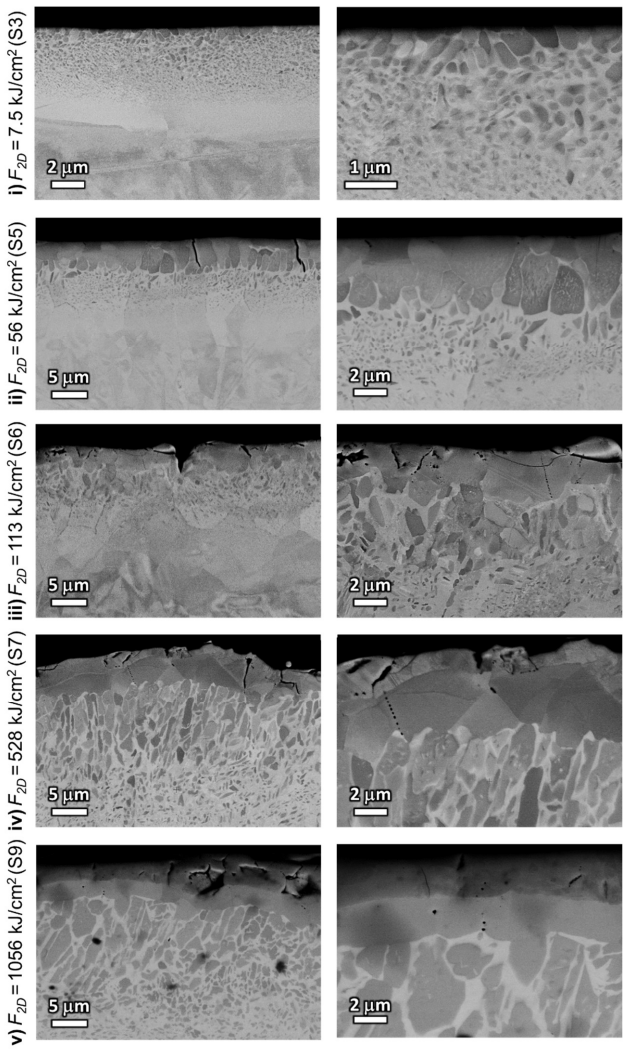
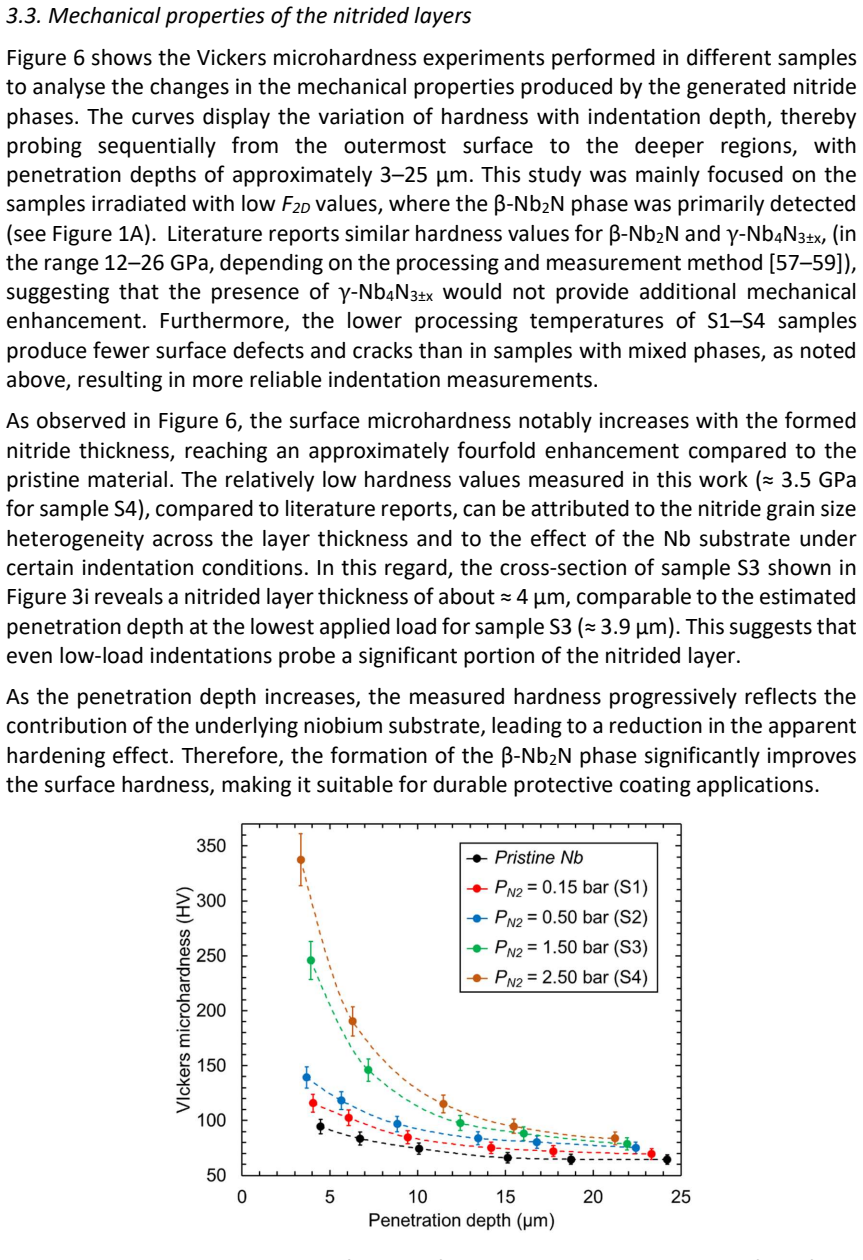
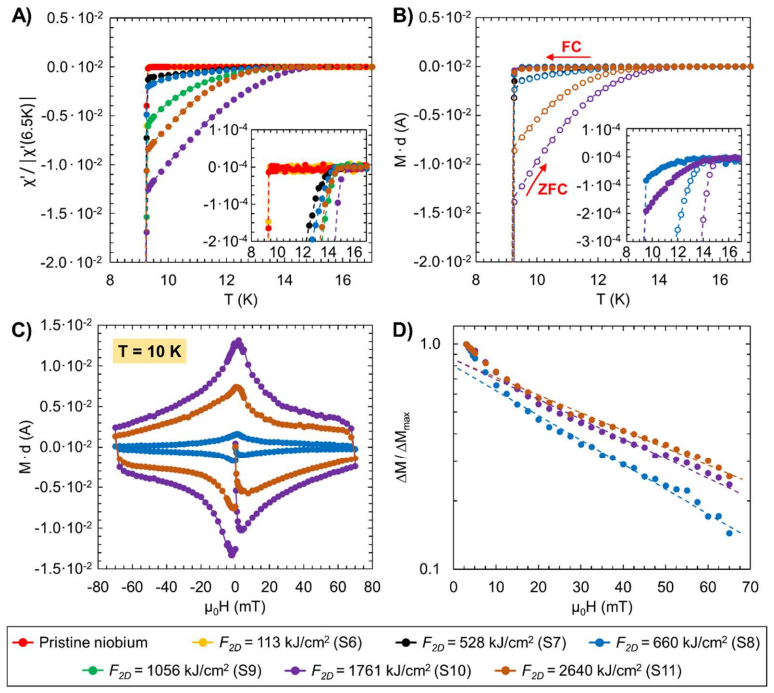
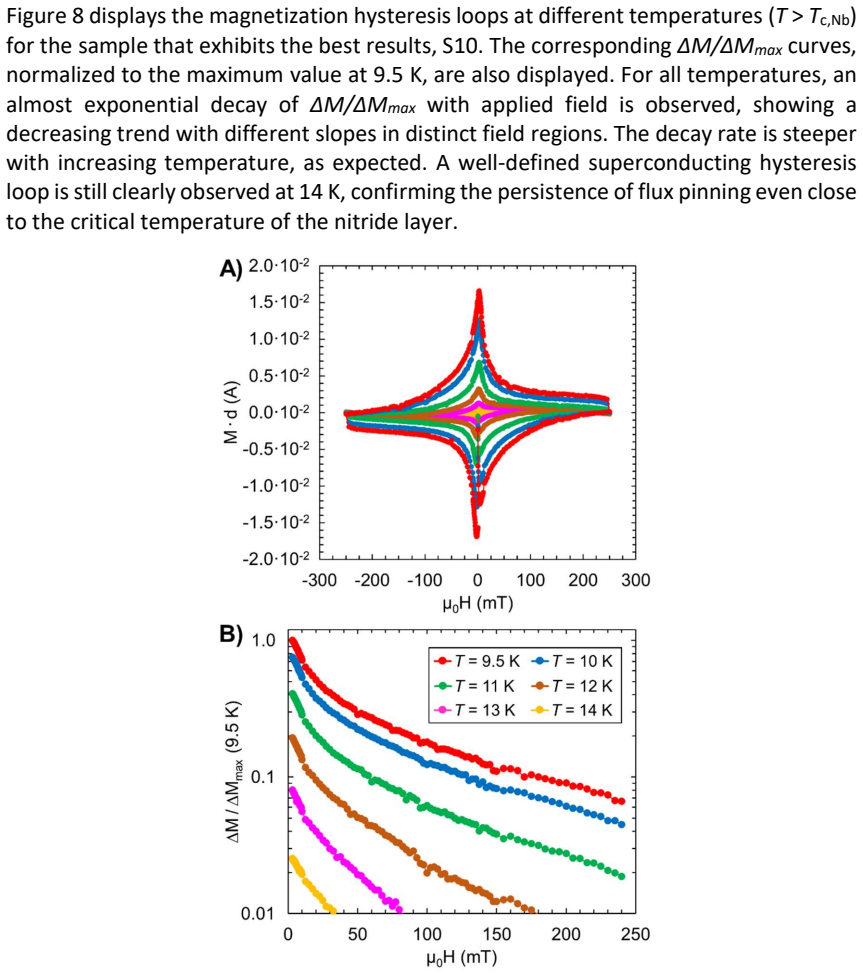
When the γ-phase becomes predominant, a significant increase in the superconducting critical temperature is observed, up to Tc ≈ 15 K, and magnetic irreversibility. For low F2D values (≈ 7.5 kJ/cm² at 1.50-2.50 bar), the formation of a uniform nitride layer composed of sub-micron-sized β-Nb2N grains results in a ca. fourfold enhancement in surface microhardness.
Load-bearing premise
The assumption that XRD patterns alone unambiguously identify the β-Nb2N and γ-Nb4N3±x phases and that the observed grain-size gradient is caused solely by thermal gradients and diffusion without contributions from plasma chemistry or rapid quenching effects.
Figures
read the original abstract
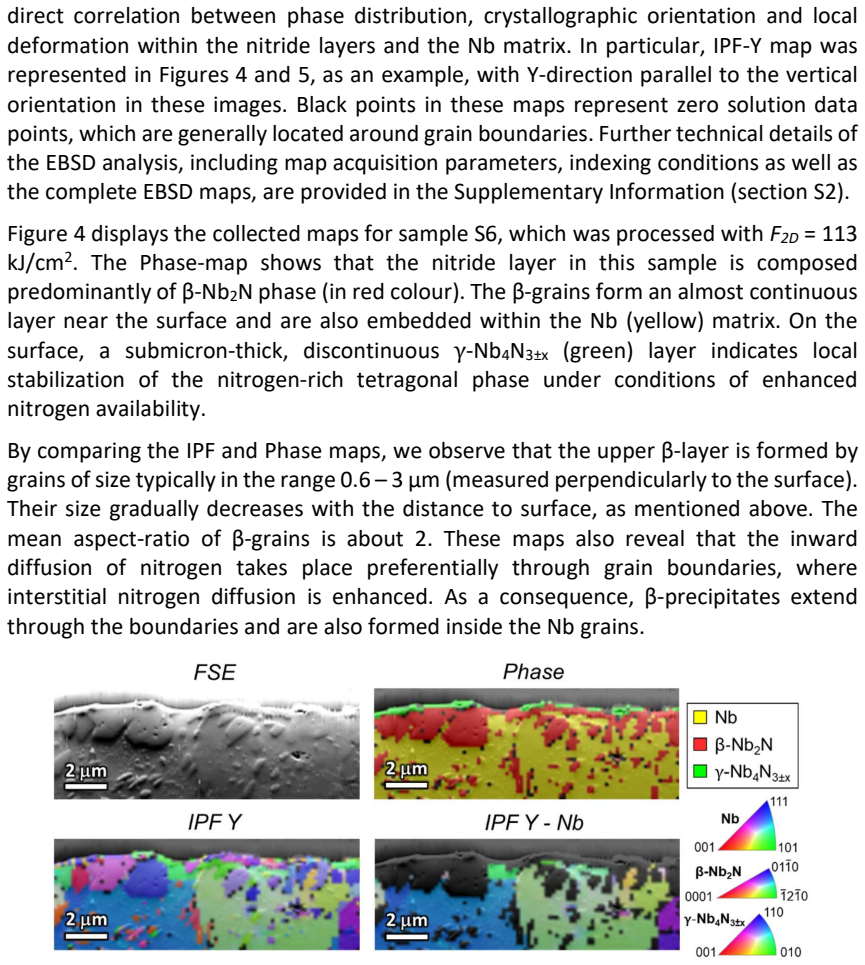
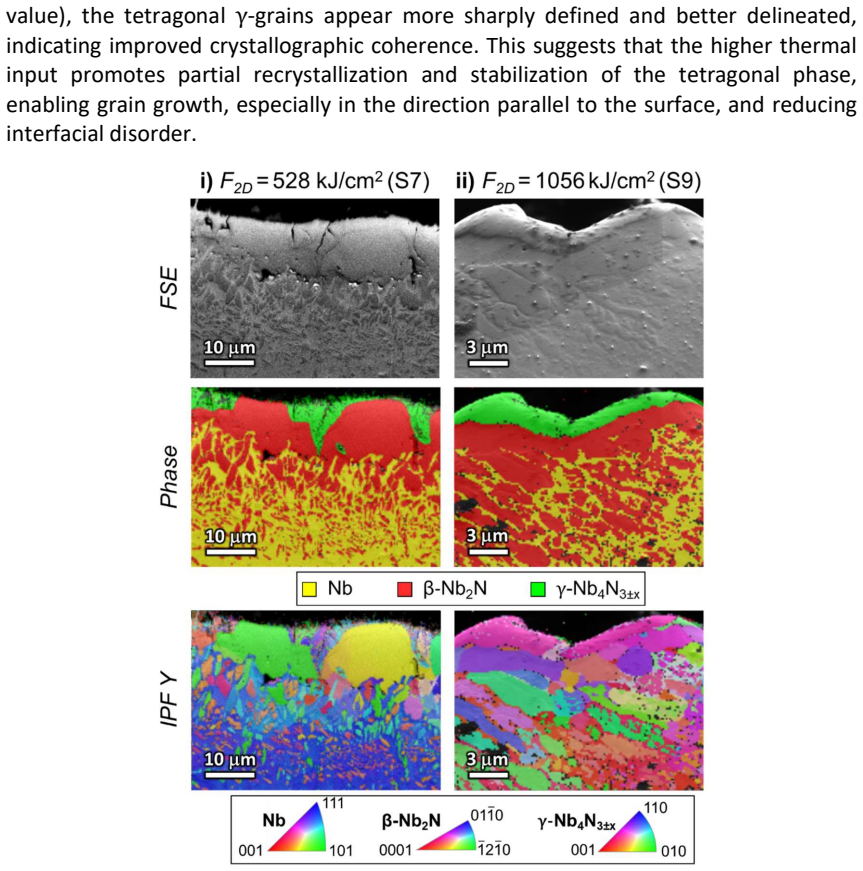
Laser nitriding represents a versatile approach for tailoring the surface properties of metals. Up to now, its effect on the superconducting response of niobium nitrides remains largely unexplored. In this work, the nitriding process of niobium by laser irradiation under a controlled nitrogen atmosphere up to 2.50 bar, using a nanosecond pulsed laser with wavelength of 1064 nm has been investigated. By independently tuning the nitrogen pressure, the two-dimensional accumulated fluence ($F_{2D}$) and the laser irradiance, a laser-processing map for the formation of either a combination of $\beta$-Nb$_2$N (hexagonal) and $\gamma$-Nb$_4$N$_{3\pm x}$ (tetragonal) phases or only the $\beta$-phase has been established. Systematic analysis by X-ray diffraction, scanning electron microscopy and electron backscatter diffraction revealed that the nitrogen-rich $\gamma$-phase forms in the near-surface layer through melting when $F_{2D}$ exceeds a certain value ($> 50 \,\mathrm{kJ/cm^2}$ at 2.50 bar). A $\beta$-layer is observed underneath, and further inside, there is a band of embedded $\beta$-grains in the Nb matrix. Their size gradually decreases with increasing distance to surface, suggesting thermal gradients and a diffusion formation mechanism. When the $\gamma$-phase becomes predominant, a significant increase in the superconducting critical temperature is observed, up to $T_c \approx 15\,\mathrm{K}$, and magnetic irreversibility. For low $F_{2D}$ values ($\approx 7.5 \,\mathrm{kJ/cm^2}$ at 1.50-2.50 bar), the formation of a uniform nitride layer composed of sub-micron-sized $\beta$-Nb$_2$N grains results in a ca. fourfold enhancement in surface microhardness. These findings provide fundamental insights into laser-induced nitriding of niobium to engineer mechanically robust and superconducting Nb-N layers.
Editorial analysis
A structured set of objections, weighed in public.
Referee Report
Summary. The manuscript reports an experimental investigation of laser-induced nitriding of niobium under controlled nitrogen pressures (up to 2.5 bar) using a 1064 nm nanosecond pulsed laser. By varying nitrogen pressure, two-dimensional accumulated fluence F_{2D}, and irradiance, the authors establish a processing map showing formation of β-Nb₂N (hexagonal) alone or in combination with γ-Nb₄N_{3±x} (tetragonal). XRD, SEM, and EBSD characterization indicate that the nitrogen-rich γ-phase forms in the near-surface layer via melting above ~50 kJ/cm² at 2.5 bar, with a β-layer beneath and embedded β-grains deeper in the Nb matrix whose size decreases with depth. When γ-phase predominates, Tc rises to ~15 K with magnetic irreversibility; at low F_{2D} (~7.5 kJ/cm²), a uniform sub-micron β-Nb₂N layer yields ~4× surface microhardness increase.
Significance. If the phase–property correlations are robustly established, the work offers a practical laser-processing route to create Nb-N surface layers combining enhanced superconductivity (Tc up to 15 K) and mechanical hardness, relevant for superconducting RF cavities, coatings, or hybrid devices. The multi-technique tracking of microstructure and the fluence/pressure map constitute useful empirical guidance.
major comments (3)
- [Results (XRD and superconductivity subsections)] Results section (XRD analysis and phase-evolution discussion): The assignment of γ-Nb₄N_{3±x} predominance above ~50 kJ/cm² rests on qualitative inspection of XRD peak positions and intensities without Rietveld refinement, quantitative phase fractions, or intensity-ratio calibration. In the Nb-N system, β and γ reflections can overlap or shift with stoichiometry; absent orthogonal confirmation (e.g., XPS N stoichiometry or TEM), the claim that γ-phase predominance directly produces the Tc increase to ~15 K and irreversibility remains unsupported.
- [Abstract and superconductivity characterization] Abstract and superconductivity results: No error bars are reported on the Tc values, and the extraction method (onset, midpoint, or zero-resistance criterion) is not specified. These omissions are load-bearing for the central claim of a “significant increase” to Tc ≈ 15 K when γ-phase becomes predominant.
- [Discussion] Discussion of microstructure: The grain-size gradient is attributed solely to thermal gradients and diffusion, yet no experimental test or argument excludes contributions from plasma chemistry or rapid-quenching kinetics. This weakens the mechanistic interpretation even if the phase–Tc correlation is addressed.
minor comments (2)
- [Methods / Results] The definition and units of F_{2D} are introduced only in the abstract; a clear definition with units should appear in the methods or first results paragraph.
- [Figure captions] Figure captions for SEM/EBSD images should explicitly state the fluence, pressure, and depth for each panel to allow direct correlation with the processing map.
Simulated Author's Rebuttal
We thank the referee for the constructive and detailed comments, which have helped us identify areas where the manuscript can be strengthened. We address each major comment below and outline the revisions we will make.
read point-by-point responses
-
Referee: Results section (XRD analysis and phase-evolution discussion): The assignment of γ-Nb₄N_{3±x} predominance above ~50 kJ/cm² rests on qualitative inspection of XRD peak positions and intensities without Rietveld refinement, quantitative phase fractions, or intensity-ratio calibration. In the Nb-N system, β and γ reflections can overlap or shift with stoichiometry; absent orthogonal confirmation (e.g., XPS N stoichiometry or TEM), the claim that γ-phase predominance directly produces the Tc increase to ~15 K and irreversibility remains unsupported.
Authors: We agree that Rietveld refinement would provide stronger quantitative support for the phase fractions. In the revised manuscript we will add Rietveld analysis of the XRD patterns to extract phase fractions as a function of fluence and pressure, confirming the transition to γ-Nb₄N_{3±x} predominance above ~50 kJ/cm² at 2.5 bar. We will also include intensity-ratio calibration where possible. While XPS and TEM were not performed in this study, the combination of XRD peak matching, SEM cross-sections showing the near-surface layer, and EBSD phase mapping already provides orthogonal microstructural evidence for the γ-phase location. The Tc increase to ~15 K is observed precisely when the processing map indicates γ predominance; we will rephrase the text to state that the correlation is supported by the fluence threshold rather than claiming direct causation from phase fraction alone. revision: yes
-
Referee: Abstract and superconductivity results: No error bars are reported on the Tc values, and the extraction method (onset, midpoint, or zero-resistance criterion) is not specified. These omissions are load-bearing for the central claim of a “significant increase” to Tc ≈ 15 K when γ-phase becomes predominant.
Authors: We accept this criticism. In the revised version we will specify that Tc is determined using the onset criterion (10% of the normal-state resistance drop) and will report error bars derived from repeated measurements on multiple samples. The abstract will be updated accordingly to reflect the revised presentation of the Tc data while retaining the observed increase to approximately 15 K under γ-dominant conditions. revision: yes
-
Referee: Discussion of microstructure: The grain-size gradient is attributed solely to thermal gradients and diffusion, yet no experimental test or argument excludes contributions from plasma chemistry or rapid-quenching kinetics. This weakens the mechanistic interpretation even if the phase–Tc correlation is addressed.
Authors: We will expand the discussion to acknowledge that plasma chemistry and rapid-quenching effects cannot be entirely ruled out with the present data. However, the observed monotonic decrease in β-grain size with depth correlates directly with the expected thermal gradient from the laser-melted surface, and the grain-size trend persists across different nitrogen pressures where plasma conditions vary. We will add a brief paragraph noting these alternative mechanisms as possible secondary contributions while maintaining that thermal diffusion remains the dominant explanation supported by the depth-dependent EBSD observations and fluence dependence. revision: partial
Circularity Check
No circularity: purely experimental observations without derived predictions or self-referential definitions
full rationale
This is a purely experimental materials-science study. The authors perform laser nitriding under controlled conditions, characterize phases and microstructures via XRD, SEM, and EBSD, and report direct measurements of Tc (up to ~15 K) and microhardness enhancement. No equations, models, fitted parameters, or 'predictions' are presented that reduce by construction to author-defined inputs. Phase identification and property correlations rest on standard empirical techniques and direct observation; the processing map is established from experimental outcomes rather than any self-referential derivation. No load-bearing self-citations or ansatzes appear in the provided text.
Axiom & Free-Parameter Ledger
axioms (2)
- domain assumption X-ray diffraction patterns can be used to unambiguously identify β-Nb2N (hexagonal) and γ-Nb4N3±x (tetragonal) phases
- domain assumption The observed decrease in β-grain size with depth is caused by thermal gradients and diffusion
Reference graph
Works this paper leans on
-
[1]
Laser Nitriding of Titanium and Its Alloys
Katayama, S., Matsunawa, A., Morimoto, A., Ishimoto, S., & Arata, Y. (1984). "Laser Nitriding of Titanium and Its Alloys." Proceedings of the 3rd International Congress on Applications of Lasers and Electro-Optics (ICALEO '83), Laser Institute of America (L.I.A.), Vol. 38, pp. 127–134
work page 1984
-
[2]
Prescott, G. R., & Cochran, W. C. (1984). "Aluminum nitriding by laser." U.S. Patent No. 4,451,302. Washington, DC: U.S. Patent and Trademark Office. Issued May 29, 1984
work page 1984
-
[3]
Process for surface hardening a piece of steel, and a piece of steel hardened by the process
Coulon, A. (1995). "Process for surface hardening a piece of steel, and a piece of steel hardened by the process." U.S. Patent No. 5,413,641. Washington, DC: U.S. Patent and Trademark Office. Issued May 9, 1995
work page 1995
-
[4]
Schaaf P. Laser nitriding of metals. Prog Mater Sci 2002; 47: 1–161
work page 2002
-
[5]
She D, Yue W, Fu Z, et al. Effects of nitriding temperature on microstructures and vacuum tribological properties of plasma-nitrided titanium. Surf Coatings Technol 2015; 264: 32–40
work page 2015
-
[6]
Laser nitriding of titanium surfaces for biomedical applications
Zeng C, Wen H, Hemmasian Ettefagh A, et al. Laser nitriding of titanium surfaces for biomedical applications. Surf Coatings Technol 2020; 385: 125397
work page 2020
-
[7]
Carpene E, Schaaf P, Han M, et al. Reactive surface processing by irradiation with excimer laser, Nd:YAG laser, free electron laser and Ti:sapphire laser in nitrogen atmosphere. Appl Surf Sci 2002; 186: 195–199
work page 2002
-
[8]
Laser nitriding of iron and aluminum
Carpene E, Schaaf P. Laser nitriding of iron and aluminum. Appl Surf Sci 2002; 186: 100–104
work page 2002
-
[9]
Laser nitridation on Ti-6.5Al-3.5Mo-1.5Zr-0.3Si titanium alloy
Zong X, Wang H, Li Z, et al. Laser nitridation on Ti-6.5Al-3.5Mo-1.5Zr-0.3Si titanium alloy. Surf Coatings Technol 2020; 386: 125425
work page 2020
-
[10]
Chan CW, Quinn J, Hussain I, et al. A promising laser nitriding method for the design of next generation orthopaedic implants: Cytotoxicity and antibacterial performance of titanium nitride (TiN) wear nano-particles, and enhanced wear properties of laser-nitrided Ti6Al4V surfaces. Surf Coatings Technol 2021; 405: 126714
work page 2021
-
[11]
Nishimoto A, Fukube T, Maruyama T. Microstructural, mechanical, and corrosion properties of plasma-nitrided CoCrFeMnNi high-entropy alloys. Surf Coatings Technol 2019; 376: 52–58
work page 2019
-
[12]
Laser nitriding of niobium for application to superconducting radio-frequency accelerator cavities
Singaravelu S, Klopf J, Krafft G, et al. Laser nitriding of niobium for application to superconducting radio-frequency accelerator cavities. J Vac Sci Technol B Microelectron Nanom Struct 2011; 29: 1803–1808
work page 2011
-
[13]
Nitridation of Nb surface by nanosecond and femtosecond laser pulses
Farha AH, Ozkendir OM, Koroglu U, et al. Nitridation of Nb surface by nanosecond and femtosecond laser pulses. J Alloys Compd 2015; 618: 685–693
work page 2015
-
[14]
“in-situ” XPS studies of laser induced surface cleaning and nitridation of Ti
Lahoz R, Espinós JP, de la Fuente GF, González-Elipe AR. “in-situ” XPS studies of laser induced surface cleaning and nitridation of Ti. Surf. Coat. Technol. 2008; 202: 1486.-1492
work page 2008
-
[15]
“in-situ” XPS 19 studies of laser-induced surface nitridation and oxidation of tantalum
Lahoz R, Espinós JP, Yubero F, González-Elipe AR, de la Fuente GF. “in-situ” XPS 19 studies of laser-induced surface nitridation and oxidation of tantalum. J. Mater. Res. 2015; 30: 2967-2976
work page 2015
-
[16]
Kobayashi A, Maeda T, Akiyama T, et al. Sputter Epitaxy of Transition Metal Nitrides: Advances in Superconductors, Semiconductors, and Ferroelectrics. Phys Status Solidi Appl Mater Sci 2025; 2400896: 1–10
work page 2025
-
[17]
Superconducting properties of high- purity niobium
Finnemore DK, Stromberg TF, Swenson CA. Superconducting properties of high- purity niobium. Phys Rev 1966; 149: 231–243
work page 1966
-
[18]
Transition temperatures and crystal structures of single- crystal and polycrystalline NbNx films
Oya GI, Onodera Y. Transition temperatures and crystal structures of single- crystal and polycrystalline NbNx films. J Appl Phys 1974; 45: 1389–1397
work page 1974
-
[19]
Substrate mediated nitridation of niobium into superconducting Nb2N thin films for phase slip study
Gajar B, Yadav S, Sawle D, et al. Substrate mediated nitridation of niobium into superconducting Nb2N thin films for phase slip study. Sci Rep 2019; 9: 1–11
work page 2019
-
[20]
Discovery of superconductivity in hard hexagonal ϵ- NbN
Zou Y, Qi X, Zhang C, et al. Discovery of superconductivity in hard hexagonal ϵ- NbN. Sci Rep 2016; 6: 1–9
work page 2016
-
[21]
Study of niobium nitrides for superconducting rf cavities
Fabbricatore P, Fernandes P, Gualco GC, et al. Study of niobium nitrides for superconducting rf cavities. J Appl Phys 1989; 66: 5944–5949
work page 1989
-
[22]
Preparation of NbN single crystals
Scheerer B. Preparation of NbN single crystals. J Cryst Growth 1980; 49: 61–66
work page 1980
-
[23]
Unexplored MBE growth mode reveals new properties of superconducting NbN
Wright J, Chang C, Waters D, et al. Unexplored MBE growth mode reveals new properties of superconducting NbN. Phys Rev Mater 2021; 5: 1–8
work page 2021
-
[24]
Superconducting transition temperatures of r
Keskar KS, Yamashita T, Onodera Y. Superconducting transition temperatures of r. F. sputtered NbN films. Jpn J Appl Phys 1971; 10: 370–374
work page 1971
-
[25]
Nanomechanical properties of NbN films prepared by pulsed laser deposition using nanoindendation
Mamun MA, Farha AH, Er AO, et al. Nanomechanical properties of NbN films prepared by pulsed laser deposition using nanoindendation. Appl Surf Sci 2012; 258: 4308–4313
work page 2012
-
[26]
Superconducting NbN thin films for use in superconducting radio frequency cavities
Leith S, Vogel M, Fan J, et al. Superconducting NbN thin films for use in superconducting radio frequency cavities. Supercond Sci Technol 2021; 34: 5006– 5017
work page 2021
-
[27]
Niobium and niobium-titanium nitrides for rf applications
Fabbricatore P, Gemme G, Musenich R, et al. Niobium and niobium-titanium nitrides for rf applications. IEEE Trans Appl Supercond 1993; 3: 1761–1764
work page 1993
-
[28]
Niobium Nitride Preparation for Superconducting Single-Photon Detectors
Luo P, Zhao Y. Niobium Nitride Preparation for Superconducting Single-Photon Detectors. Molecules 2023; 28: 6200–6219
work page 2023
-
[29]
Cucciniello N, Lee D, Feng HY, et al. Superconducting niobium nitride: A perspective from processing, microstructure, and superconducting property for single photon detectors. J Phys Condens Matter 2022; 34: 4003–4017
work page 2022
-
[30]
Niobium Nitride Nb4N5 as a New High-Performance Electrode Material for Supercapacitors
Cui H, Zhu G, Liu X, et al. Niobium Nitride Nb4N5 as a New High-Performance Electrode Material for Supercapacitors. Adv Sci 2015; 2: 1–12
work page 2015
-
[31]
Faucher M, Fournier T, Pannetier B, et al. Niobium and niobium nitride SQUIDs based on anodized nanobridges made with an atomic force microscope. Phys C Supercond its Appl 2002; 368: 211–217
work page 2002
-
[32]
NanoSQUIDs based on niobium nitride films
Russo R, Esposito E, Crescitelli A, et al. NanoSQUIDs based on niobium nitride films. Supercond Sci Technol 2017; 30: 4009–4014. 20
work page 2017
-
[33]
Wafer-level uniformity of atomic-layer- deposited niobium nitride thin films for quantum devices
Knehr E, Ziegler M, Linzen S, et al. Wafer-level uniformity of atomic-layer- deposited niobium nitride thin films for quantum devices. J Vac Sci Technol A Vacuum, Surfaces, Film 2021; 39: 2401–2407
work page 2021
-
[34]
Niobium zirconium nitride sputter-deposited protective coatings
Debessai M, Filip P, Aouadi SM. Niobium zirconium nitride sputter-deposited protective coatings. Appl Surf Sci 2004; 236: 63–70
work page 2004
-
[35]
Growth of niobium nitrides by nitrogen-niobium reaction at high temperature
Musenich R, Fabbricatore P, Gemme G, et al. Growth of niobium nitrides by nitrogen-niobium reaction at high temperature. J Alloys Compd 1994; 209: 319– 328
work page 1994
-
[36]
Formation of niobium nitride by rapid thermal processing
Angelkort C, Lewalter H, Warbichler P, et al. Formation of niobium nitride by rapid thermal processing. Spectrochim Acta - Part A Mol Biomol Spectrosc 2001; 57: 2077–2089
work page 2001
-
[37]
Synthesis of cubic niobium nitride by reactive diffusion under nitrogen pressure
Linde A V., Marin-Ayral RM, Granier D, et al. Synthesis of cubic niobium nitride by reactive diffusion under nitrogen pressure. Mater Res Bull 2009; 44: 1025–1030
work page 2009
-
[38]
Buscaglia V, Caracciolo F, Ferretti M, et al. Effect of pressure on the composition and superconducting Tc value of NbN prepared by combustion synthesis. J Alloys Compd 1998; 266: 201–206
work page 1998
- [39]
-
[40]
Multiphase reaction diffusion in metal-carbon and transition metal- nitrogen systems
Lengauer W. Multiphase reaction diffusion in metal-carbon and transition metal- nitrogen systems. J Alloys Compd 1995; 229: 80–92
work page 1995
-
[41]
High-temperature reactive phase formation in the Nb-N system
Joguet M, Lengauer W, Bohn M, et al. High-temperature reactive phase formation in the Nb-N system. J Alloys Compd 1998; 269: 233–237
work page 1998
-
[42]
Kaul AB, Sands TD, Van Duzer T. High-Tc superconducting NbN films with low particulate density grown at 25 °C using pulsed laser deposition. J Mater Res 2001; 16: 1223–1226
work page 2001
-
[43]
NbN superconducting thin films grown by pulsed laser ablation
Boffa V, Gambardella U, Marotta V, et al. NbN superconducting thin films grown by pulsed laser ablation. Appl Surf Sci 1996; 106: 361–364
work page 1996
-
[44]
Laser-fluence effects on NbNx thin films fabricated by pulsed laser deposition
Farha AH, Er AO, Ufuktepe Y, et al. Laser-fluence effects on NbNx thin films fabricated by pulsed laser deposition. Mater Chem Phys 2012; 132: 667–672
work page 2012
-
[45]
Superconducting niobium nitride films deposited by unbalanced magnetron sputtering
Olaya JJ, Huerta L, Rodil SE, et al. Superconducting niobium nitride films deposited by unbalanced magnetron sputtering. Thin Solid Films 2008; 516: 8768–8773
work page 2008
-
[46]
Niobium nitride thin films deposited by high temperature chemical vapor deposition
Mercier F, Coindeau S, Lay S, et al. Niobium nitride thin films deposited by high temperature chemical vapor deposition. Surf Coatings Technol 2014; 260: 126– 132
work page 2014
-
[47]
Tian L, Bottala-Gambetta I, Marchetto V, et al. Improved critical temperature of superconducting plasma-enhanced atomic layer deposition of niobium nitride thin films by thermal annealing. Thin Solid Films 2020; 709: 138232
work page 2020
-
[48]
On the kinetics of nitride and diffusion layer growth in niobium plasma nitriding
Kertscher R, Brunatto SF. On the kinetics of nitride and diffusion layer growth in niobium plasma nitriding. Surf Coatings Technol 2020; 401: 126220
work page 2020
-
[49]
Microstructure and transport properties of Bi-2212 prepared by CO2 laser line scanning
Lennikov V, Özkurt B, Angurel LA, et al. Microstructure and transport properties of Bi-2212 prepared by CO2 laser line scanning. J Supercond Nov Magn 2013; 26: 21 947–952
work page 2013
-
[50]
Frechilla A, Napari M, Strkalj N, et al. Spatially selective crystallization of ferroelectric Hf0.5Zr0.5O2 films induced by sub-nanosecond laser annealing. Appl Mater Today 2024; 36: 102033
work page 2024
-
[51]
Porta-Velilla L, Turan N, Cubero Á, et al. Highly Regular Hexagonally-Arranged Nanostructures on Ni-W Alloy Tapes upon Irradiation with Ultrashort UV Laser Pulses. Nanomaterials 2022; 12: 2380–2402
work page 2022
-
[52]
JCPDS-International Centre for Diffraction Data. 2000
work page 2000
-
[53]
Höche D, Schikora H, Zutz H, et al. Microstructure of TiN coatings synthesized by direct pulsed Nd:YAG laser nitriding of titanium: Development of grain size, microstrain, and grain orientation. Appl Phys A Mater Sci Process 2008; 91: 305– 314
work page 2008
-
[54]
Marattukalam JJ, Karlsson D, Pacheco V, et al. The effect of laser scanning strategies on texture, mechanical properties, and site-specific grain orientation in selective laser melted 316L SS. Mater Des 2020; 193: 108852
work page 2020
-
[55]
Growth rate effects on thin Bi2Sr2CaCu2O8+δ textured rods
Angurel LA, Dı́ez JC, Martı́nez E, et al. Growth rate effects on thin Bi2Sr2CaCu2O8+δ textured rods. Phys C Supercond 1998; 302: 39–50
work page 1998
-
[56]
Laser nitriding: Investigations on the model system TiN
Höche D, Schaaf P. Laser nitriding: Investigations on the model system TiN. A review. Heat Mass Transf und Stoffuebertragung 2011; 47: 519–540
work page 2011
-
[57]
Mamun MA Al, Farha AH, Ufuktepe Y, et al. Nanoindentation study of niobium nitride thin films on niobium fabricated by reactive pulsed laser deposition. Appl Surf Sci 2015; 330: 48–55
work page 2015
-
[58]
Ufuktepe Y, Farha AH, Kimura SI, et al. Structural, electronic, and mechanical properties of niobium nitride prepared by thermal diffusion in nitrogen. Mater Chem Phys 2013; 141: 393–400
work page 2013
-
[59]
Babu KR, Guo GY. Structure- and composition-tunable superconductivity, band topology, and elastic response of hard binary niobium nitrides Nb2N, Nb4N3 and Nb4N5. Phys Rev B 2023; 108: 1–12
work page 2023
-
[60]
A., Escobar-Rincón, D., Restrepo-Parra, E., & de la Cruz, W
Garzon-Fontecha, A., Castillo, H. A., Escobar-Rincón, D., Restrepo-Parra, E., & de la Cruz, W. (2019). Correlation Between Stoichiometry of NbxNy Coatings Produced by DC Magnetron Sputtering with Electrical Conductivity and the Hall Coefficient. Coatings 2019; 9: 196
work page 2019
-
[61]
Juang, J. Y., Barmak, K., Rudman, D. A., & van Dover, R. B. Enhancement of the critical current by grain size refinement in Ta-cosputtered NbN thin films. Journal of Applied Physics, 1989; 66: 3136–3143. Supporting information: Laser nitriding of bulk niobium: phase evolution and superconducting behaviour J. Frechilla1, A. Frechilla1, G.F. de la Fuente1, ...
work page 1989
-
[62]
Instituto de Nanociencia y Materiales de Aragón, INMA, CSIC-Universidad de Zaragoza, María de Luna, 3, 50018 Zaragoza, Spain 23 S1. XRD patterns In this supplementary section, the X-ray diffraction (XRD) patterns of the same samples presented in Figure 1 of the main text are shown over an extended angular range (30– 80°). The samples are named as in the m...
discussion (0)
Sign in with ORCID, Apple, or X to comment. Anyone can read and Pith papers without signing in.