Disambiguating electrical detection of magnetization dynamics in magnetic insulators
Pith reviewed 2026-05-10 07:58 UTC · model grok-4.3
The pith
Electrical voltage from magnetization dynamics in insulators cannot be uniquely linked to magnon chirality due to competing detection mechanisms.
A machine-rendered reading of the paper's core claim, the machinery that carries it, and where it could break.
Core claim
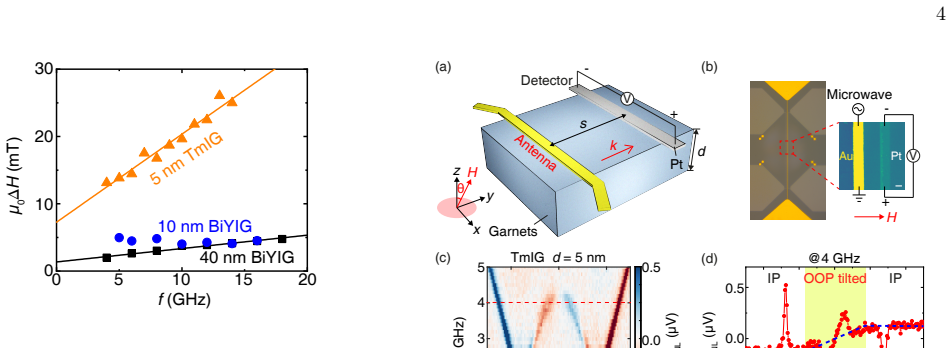
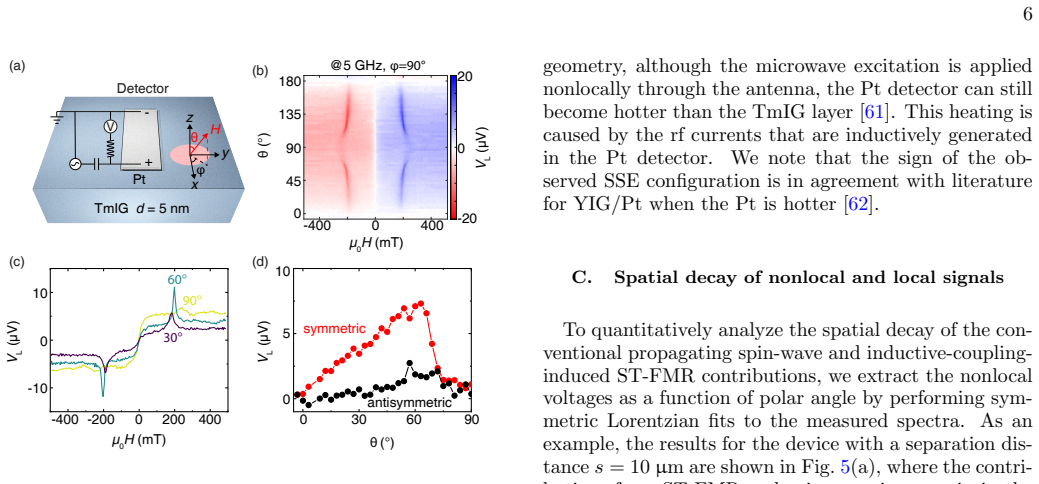
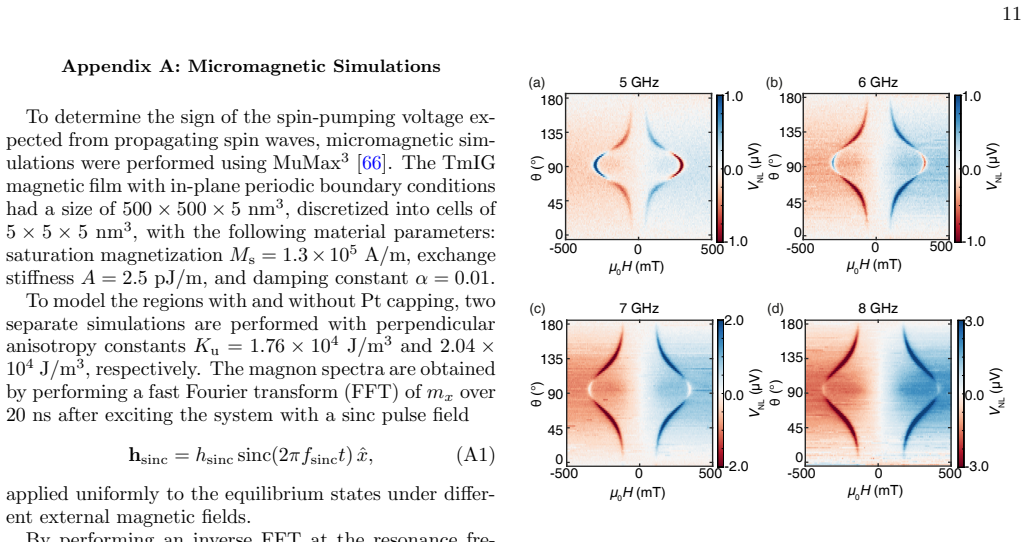
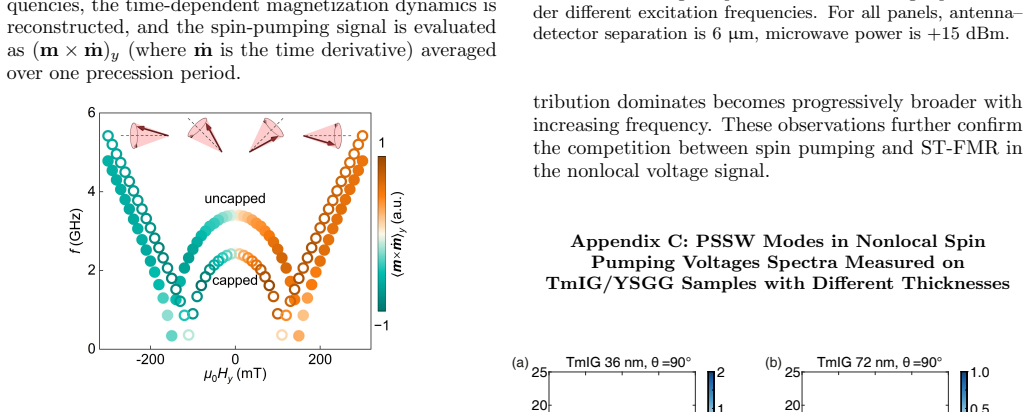
We disentangle a contribution due to spin pumping, induced by exponentially decaying propagating spin waves, and a weakly distance-dependent contribution from ST-FMR, remotely induced by inductive coupling. We show that both the spin wave excitation profile across the film thickness and magnetic damping largely determine which of the two contributions dominates. Hence, the sign of the electrical signal cannot be uniquely assigned to the chirality of the magnon modes.
What carries the argument
Competition between exponentially decaying propagating spin waves (spin pumping) and weakly distance-dependent inductive coupling (ST-FMR) in Pt-capped magnetic insulator films under microwave excitation.
If this is right
- The voltage generated by microwave excitation changes sign between out-of-plane and in-plane magnetic configurations.
- Spin-wave character, magnetic dissipation, field orientation, and device geometry together govern the sign and magnitude of the measured signals.
- Both local and nonlocal geometries can be used to separate the two contributions by varying the distance between excitation and detection.
- Higher damping favors the exponentially decaying spin-pumping contribution over the inductive ST-FMR contribution.
Where Pith is reading between the lines
- Experiments that infer magnon chirality from voltage sign should include systematic distance and orientation sweeps to confirm which mechanism dominates.
- Device design could deliberately tune geometry or damping to suppress the unwanted contribution and obtain cleaner electrical readout of a chosen effect.
- The same competition may appear in other microwave-excited spin-charge conversion setups, requiring analogous controls.
Load-bearing premise
The observed distance and field-orientation dependences arise solely from the competition between exponentially decaying propagating spin waves and weakly distance-dependent inductive coupling, without significant contributions from other rectification or thermoelectric effects.
What would settle it
Suppress inductive coupling (for example by increasing separation beyond the inductive range or by using non-inductive excitation) while keeping spin-wave propagation possible, then check whether the voltage sign still reverses with distance or field orientation as predicted.
Figures



read the original abstract
Electrical detection of magnetization dynamics in magnetic insulators underpins both fundamental studies of magnon transport and the development of low-loss magnonic devices. In heavy-metal/magnetic-insulator heterostructures, spin pumping and spin-torque ferromagnetic resonance (ST-FMR) are widely used for this purpose and are often treated separately in different measurement geometries. In practice, the competition between these two effects gives rise to electrical voltage signals of opposite signs, which can lead to ambiguous interpretations of the underlying physics. Here, we show how to disambiguate their respective contributions and provide a framework for interpreting experiments involving microwave excitation of magnetic insulators and detection of magnetization dynamics via spin-charge conversion in heavy metals. We systematically investigate spin pumping and ST-FMR in nonlocal and local devices using Pt-capped thin films of thulium and bismuth-yttrium iron garnets. We show how spin-wave character, magnetic dissipation, magnetic field orientation and device geometry govern the sign and magnitude of the resulting signals. In several cases, the voltage generated by microwave excitation changes sign between an out-of-plane or in-plane magnetic configuration. We disentangle a contribution due to spin pumping, induced by exponentially decaying propagating spin waves, and a weakly distance-dependent contribution from ST-FMR, remotely induced by inductive coupling. We show that both the spin wave excitation profile across the film thickness and magnetic damping largely determine which of the two contributions dominates. Hence, the sign of the electrical signal cannot be uniquely assigned to the chirality of the magnon modes.
Editorial analysis
A structured set of objections, weighed in public.
Referee Report
Summary. The paper claims that electrical voltage signals from microwave excitation of magnetization dynamics in Pt/TmIG and Pt/BiYIG heterostructures arise from competition between spin pumping (exponentially decaying with distance due to propagating spin waves) and ST-FMR (weakly distance-dependent via inductive coupling). Systematic measurements in local and nonlocal devices show that signal sign changes with magnetic field orientation (out-of-plane vs. in-plane), device geometry, spin-wave character, and damping; consequently, the sign cannot be uniquely assigned to magnon chirality. The authors provide a framework for disambiguation based on these factors.
Significance. If the separation of mechanisms holds, the result is significant for magnon transport studies and magnonic devices, as it resolves a common source of interpretive ambiguity in heavy-metal/magnetic-insulator heterostructures. The systematic variation across two garnet materials, multiple geometries, and field orientations supplies concrete guidance for experimental design. Credit is due for the explicit mapping of how excitation profile across film thickness and damping control dominance of each contribution.
major comments (1)
- [Abstract (disentangling procedure) and results sections describing distance/field sweeps] The central conclusion that signal sign cannot be uniquely assigned to magnon chirality depends on the premise that distance and orientation dependences arise solely from the spin-pumping vs. ST-FMR competition. The manuscript must demonstrate that other mechanisms (microwave rectification at interfaces, longitudinal/transverse thermoelectric voltages from local heating, or thickness-dependent Oersted torques) produce negligible contributions with comparable distance/orientation scaling; without such controls or estimates, the disambiguation remains vulnerable to alternative explanations.
minor comments (2)
- [Methods and device-geometry descriptions] Clarify the precise definition of 'nonlocal' vs. 'local' devices and the microwave excitation geometry in each case to allow readers to reproduce the inductive-coupling argument.
- [Figures showing distance dependence] Include quantitative error bars, raw data traces, and fitting parameters (e.g., decay lengths) for the voltage-vs-distance plots so that the claimed exponential vs. weak dependence can be independently assessed.
Simulated Author's Rebuttal
We thank the referee for the positive evaluation of our work and the constructive major comment. We address it directly below, providing both a substantive defense based on the existing data and a commitment to strengthen the manuscript with explicit estimates.
read point-by-point responses
-
Referee: [Abstract (disentangling procedure) and results sections describing distance/field sweeps] The central conclusion that signal sign cannot be uniquely assigned to magnon chirality depends on the premise that distance and orientation dependences arise solely from the spin-pumping vs. ST-FMR competition. The manuscript must demonstrate that other mechanisms (microwave rectification at interfaces, longitudinal/transverse thermoelectric voltages from local heating, or thickness-dependent Oersted torques) produce negligible contributions with comparable distance/orientation scaling; without such controls or estimates, the disambiguation remains vulnerable to alternative explanations.
Authors: We agree that explicit bounds on alternative mechanisms would further solidify the central claim. Our systematic measurements already provide strong discrimination: the observed exponential decay with distance matches propagating spin waves (spin pumping) while the weakly distance-dependent term matches inductive coupling (ST-FMR); both reverse sign with field orientation and depend on damping and spin-wave character in ways inconsistent with rectification, thermoelectric effects from local heating, or Oersted torques. Rectification at interfaces would lack the nonlocal exponential component and the specific damping dependence we report. Thermoelectric voltages are expected to be strictly local and would not produce the sign changes with out-of-plane versus in-plane fields or the geometry-dependent nonlocal signals. Thickness-dependent Oersted torques can be estimated from the applied microwave power, Pt conductivity, and garnet thickness; their contribution is at least an order of magnitude smaller than the measured voltages and does not reproduce the observed distance scaling or sign reversals. Nevertheless, to directly address the concern we will add a dedicated paragraph (with supporting estimates) in the revised manuscript and supplementary information quantifying the upper bounds on these alternatives and confirming their incompatibility with the data. This addition will be made without altering the main conclusions. revision: yes
Circularity Check
No circularity: experimental disentanglement of spin pumping vs. ST-FMR rests on direct measurements
full rationale
The manuscript is an experimental study that maps voltage sign changes across device geometries, distances, and field orientations in Pt/TmIG and Pt/BiYIG films. It attributes the observed behaviors to the competition between exponentially decaying propagating spin waves (spin pumping) and weakly distance-dependent inductive coupling (ST-FMR), using the measured distance and orientation dependences themselves as the separating observables. No equations, fitted parameters renamed as predictions, or self-referential derivations appear; the central claim that signal sign cannot be uniquely assigned to magnon chirality follows directly from the reported sign flips and their correlation with the two mechanisms. The analysis is therefore self-contained against external benchmarks of microwave excitation and spin-charge conversion, with no load-bearing step that reduces to its own inputs by construction.
Axiom & Free-Parameter Ledger
Reference graph
Works this paper leans on
-
[1]
Pirro, V
P. Pirro, V. I. Vasyuchka, A. A. Serga, and B. Hille- brands, Advances in coherent magnonics, Nat. Rev. Mater.6, 1114 (2021)
2021
-
[2]
A. V. Chumak, V. I. Vasyuchka, A. A. Serga, and B. Hillebrands, Magnon spintronics, Nat. Phys.11, 453 (2015)
2015
-
[3]
Demidov, S
V. Demidov, S. Urazhdin, G. De Loubens, O. Klein, V. Cros, A. Anane, and S. Demokritov, Magnetization oscillations and waves driven by pure spin currents, Phys. Rep.673, 1 (2017)
2017
-
[4]
A. A. Serga and A. V. Chumak, YIG magnonics, J. Phys. D: Appl. Phys.43, 264002 (2010)
2010
-
[5]
J. Han, R. Cheng, L. Liu, H. Ohno, and S. Fukami, Co- herent antiferromagnetic spintronics, Nat. Mater.22, 684 (2023)
2023
-
[6]
A. V. Chumak, A. A. Serga, and B. Hillebrands, Magnon transistor for all-magnon data processing, Nat. Commun. 5, 4700 (2014)
2014
-
[7]
Cornelissen, J
L. Cornelissen, J. Liu, R. Duine, J. B. Youssef, and B. Van Wees, Long-distance transport of magnon spin in- formation in a magnetic insulator at room temperature, Nat. Phys.11, 1022 (2015)
2015
-
[8]
Harder, Y
M. Harder, Y. Gui, and C.-M. Hu, Electrical detection of magnetization dynamics via spin rectification effects, Phys. Rep.661, 1 (2016)
2016
-
[9]
Sheng, A
L. Sheng, A. Duvakina, H. Wang, K. Yamamoto, R. Yuan, J. Wang, P. Chen, W. He, K. Yu, Y. Zhang, et al., Control of spin currents by magnon interference in a canted antiferromagnet, Nat. Phys.21, 740 (2025)
2025
- [10]
-
[11]
Rossi, D
Q. Rossi, D. Stoeffler, G. De Loubens, H. Merbouche, H. Majjad, Y. Henry, I. Ngouagnia, A. Solignac, and M. Bailleul, Magnetoresistive detection of spin waves, Sci. Adv.11, eadx4126 (2025)
2025
-
[12]
C. W. Sandweg, Y. Kajiwara, A. V. Chumak, A. A. Serga, V. I. Vasyuchka, M. B. Jungfleisch, E. Saitoh, and B. Hillebrands, Spin pumping by parametrically excited exchange magnons, Phys. Rev. Lett.106, 216601 (2011)
2011
-
[13]
Lebrun, A
R. Lebrun, A. Ross, S. Bender, A. Qaiumzadeh, L. Bal- drati, J. Cramer, A. Brataas, R. Duine, and M. Kl¨ aui, Tunable long-distance spin transport in a crystalline an- tiferromagnetic iron oxide, Nature561, 222 (2018)
2018
-
[14]
H. Wang, W. Legrand, R. Schlitz, and P. Gambardella, Current-controlled magnon–magnon coupling in an on- chip cavity resonator, Nano Lett.25, 9090 (2025)
2025
-
[15]
Schlitz, V
R. Schlitz, V. E. Demidov, M. Lammel, S. O. Demokri- tov, and P. Gambardella, Auto-oscillations and direc- tional magnon emission induced by spin current injection into large magnetic volumes, Nat. Commun.16, 8472 (2025)
2025
-
[16]
Azevedo, L
A. Azevedo, L. Vilela Le˜ ao, R. Rodriguez-Suarez, A. Oliveira, and S. Rezende, dc effect in ferromagnetic resonance: Evidence of the spin-pumping effect?, J. Appl. Phys.97, 10C715 (2005)
2005
-
[17]
Saitoh, M
E. Saitoh, M. Ueda, H. Miyajima, and G. Tatara, Con- version of spin current into charge current at room tem- perature: Inverse spin-Hall effect, Appl. Phys. Lett.88, 182509 (2006)
2006
-
[18]
Costache, M
M. Costache, M. Sladkov, S. Watts, C. Van Der Wal, and B. Van Wees, Electrical detection of spin pumping due to the precessing magnetization of a single ferromagnet, Phys. Rev. Lett.97, 216603 (2006)
2006
-
[19]
Tserkovnyak, A
Y. Tserkovnyak, A. Brataas, and G. E. Bauer, Spin pumping and magnetization dynamics in metallic mul- tilayers, Phys. Rev. B66, 224403 (2002)
2002
-
[20]
Yang and P
F. Yang and P. Chris Hammel, Fmr-driven spin pumping in Y3Fe5O12-based structures, J. Phys. D: Appl. Phys. 51, 253001 (2018)
2018
-
[21]
L. Liu, T. Moriyama, D. Ralph, and R. Buhrman, Spin- torque ferromagnetic resonance induced by the spin Hall effect, Phys. Rev. Lett.106, 036601 (2011)
2011
-
[22]
Chiba, G
T. Chiba, G. E. Bauer, and S. Takahashi, Current- induced spin-torque resonance of magnetic insulators, Phys. Rev. Appl.2, 034003 (2014)
2014
-
[23]
Kim, D.-K
S.-J. Kim, D.-K. Lee, S.-H. Oh, H. C. Koo, and K.- J. Lee, Theory of spin-torque ferrimagnetic resonance, Phys. Rev. B104, 024405 (2021)
2021
-
[24]
Takahashi, K
S. Takahashi, K. Harii, J. Ieda, W. Koshibae, S. Maekawa, and E. Saitoh, Observation of the spin See- beck effect, Nature455, 778 (2008)
2008
-
[25]
J. Xiao, J. Ieda, T. Ota, Y. Kajiwara, H. Umezawa, H. Kawai,et al., Spin Seebeck insulator, Nat. Mater.9, 894 (2010)
2010
-
[26]
Sinova and S
J. Sinova and S. O. Valenzuela, Spin Hall effects, Rev. Mod. Phys.87, 1213 (2015)
2015
-
[27]
J. Li, C. B. Wilson, R. Cheng, M. Lohmann, M. Kavand, W. Yuan, M. Aldosary, N. Agladze, P. Wei, M. S. Sher- win,et al., Spin current from sub-terahertz-generated an- tiferromagnetic magnons, Nature578, 70 (2020)
2020
-
[28]
H. Wang, C. Du, Y. Pu, R. Adur, and F. Yang, Scal- ing of spin hall angle in 3d, 4d, and 5d metals from Y3Fe5O12/metal spin pumping, Phys. Rev. Lett.112, 197201 (2014)
2014
-
[29]
C. Du, H. Wang, F. Yang, and P. C. Hammel, System- atic variation of spin-orbit coupling with d-orbital filling: Large inverse spin hall effect in 3 d transition metals, Phys. Rev. B90, 140407 (2014)
2014
-
[30]
Mosendz, J
O. Mosendz, J. Pearson, F. Fradin, G. Bauer, S. Bader, and A. Hoffmann, Quantifying spin hall angles from spin pumping: Experiments and theory, Phys. Rev. Lett.104, 046601 (2010)
2010
-
[31]
Mosendz, V
O. Mosendz, V. Vlaminck, J. Pearson, F. Fradin, G. Bauer, S. Bader, and A. Hoffmann, Detection and quantification of inverse spin hall effect from spin pump- ing in permalloy/normal metal bilayers, Phys. Rev. B82, 214403 (2010)
2010
-
[32]
Abr˜ ao, E
J. Abr˜ ao, E. Santos, J. Costa, J. Santos, J. Mendes, and A. Azevedo, Anomalous spin and orbital hall phenom- ena in antiferromagnetic systems, Phys. Rev. Lett.134, 026702 (2025)
2025
-
[33]
Wang, M.-G
H. Wang, M.-G. Kang, D. Petrosyan, S. Ding, R. Schlitz, L. J. Riddiford, W. Legrand, and P. Gambardella, Or- bital pumping in ferrimagnetic insulators, Phys. Rev. Lett.134, 126701 (2025)
2025
-
[34]
J. Wang, H. Wang, Z. Xu, A. L. Bassant, J. Hu, W. Song, C. Li, X. Meng, M. Zhao, S. Liu,et al., Observation and control of chiral spin frustration in BiYIG thin films, Phys. Rev. Lett.135, 066705 (2025). 14
2025
-
[35]
Y. Liu, Z. Xu, L. Liu, K. Zhang, Y. Meng, Y. Sun, P. Gao, H.-W. Zhao, Q. Niu, and J. Li, Switching magnon chi- rality in artificial ferrimagnet, Nat. Commun.13, 1264 (2022)
2022
-
[36]
Shiota, T
Y. Shiota, T. Taniguchi, D. Hayashi, H. Narita, S. Karube, R. Hisatomi, T. Moriyama, and T. Ono, Handedness manipulation of propagating antiferromag- netic magnons, Nat. Commun.15, 9750 (2024)
2024
-
[37]
Manchon, J
A. Manchon, J. ˇZelezn` y, I. M. Miron, T. Jungwirth, J. Sinova, A. Thiaville, K. Garello, and P. Gambardella, Current-induced spin-orbit torques in ferromagnetic and antiferromagnetic systems, Rev. Mod. Phys.91, 035004 (2019)
2019
-
[38]
Sklenar, W
J. Sklenar, W. Zhang, M. B. Jungfleisch, W. Jiang, H. Chang, J. E. Pearson, M. Wu, J. B. Ketterson, and A. Hoffmann, Driving and detecting ferromagnetic reso- nance in insulators with the spin hall effect, Phys. Rev. B92, 174406 (2015)
2015
-
[39]
M. B. Jungfleisch, J. Ding, W. Zhang, W. Jiang, J. E. Pearson, V. Novosad, and A. Hoffmann, Insulating nano- magnets driven by spin torque, Nano Lett.17, 8 (2017)
2017
-
[40]
A. R. Mellnik, J. Lee, A. Richardella, J. L. Grab, P. J. Mintun, M. H. Fischer, A. Vaezi, A. Manchon, E.-A. Kim, N. Samarth,et al., Spin-transfer torque generated by a topological insulator, Nature511, 449 (2014)
2014
-
[41]
Karimeddiny and D
S. Karimeddiny and D. C. Ralph, Resolving discrepancies in spin-torque ferromagnetic resonance measurements: Lineshape versus linewidth analyses, Phys. Rev. Appl. 15, 064017 (2021)
2021
-
[42]
G. E. Bauer, E. Saitoh, and B. J. Van Wees, Spin caloritronics, Nat. Mater.11, 391 (2012)
2012
-
[43]
Kikkawa, K
T. Kikkawa, K. Shen, B. Flebus, R. A. Duine, K.-i. Uchida, Z. Qiu, G. E. Bauer, and E. Saitoh, Magnon po- larons in the spin Seebeck effect, Phys. Rev. Lett.117, 207203 (2016)
2016
-
[44]
J. Xiao, G. E. Bauer, K.-c. Uchida, E. Saitoh, and S. Maekawa, Theory of magnon-driven spin Seebeck ef- fect, Phys. Rev. B81, 214418 (2010)
2010
-
[45]
Azevedo, L
A. Azevedo, L. Vilela-Le˜ ao, R. Rodr´ ıguez-Su´ arez, A. Lac- erda Santos, and S. Rezende, Spin pumping and anisotropic magnetoresistance voltages in magnetic bi- layers: Theory and experiment, Phys. Rev. B83, 144402 (2011)
2011
-
[46]
L. Bai, P. Hyde, Y. Gui, C.-M. Hu, V. Vlaminck, J. Pear- son, S. Bader, and A. Hoffmann, Universal method for separating spin pumping from spin rectification voltage of ferromagnetic resonance, Phys. Rev. Lett.111, 217602 (2013)
2013
-
[47]
Obstbaum, M
M. Obstbaum, M. H¨ artinger, H. Bauer, T. Meier, F. Swientek, C. Back, and G. Woltersdorf, Inverse spin hall effect in Ni81Fe19/normal-metal bilayers, Phys. Rev. B89, 060407 (2014)
2014
-
[48]
Okada, Y
A. Okada, Y. Takeuchi, K. Furuya, C. Zhang, H. Sato, S. Fukami, and H. Ohno, Spin-pumping-free determina- tion of spin-orbit torque efficiency from spin-torque ferro- magnetic resonance, Phys. Rev. Appl.12, 014040 (2019)
2019
-
[49]
Q. Liu, Y. Zhang, L. Sun, B. Miao, X. Wang, and H. Ding, Influence of the spin pumping induced inverse spin Hall effect on spin-torque ferromagnetic resonance measurements, Appl. Phys. Lett.118(2021)
2021
-
[50]
Keller, A
N. Keller, A. Bose, N. Soya, E. Hauth, F. Kammerbauer, R. Gupta, H. Hayashi, H. Kashiki, G. Jakob, S. Krish- nia,et al., Identification of orbital pumping from spin pumping and rectification effects, Nano Lett.25, 13462 (2025)
2025
-
[51]
M. Yactayo, M. Hehn, J.-C. Rojas-S´ anchez, and S. Petit- Watelot, Rf field characterization and rectification effects in spin pumping and spin-torque fmr for spin-orbitronics, arXiv preprint arXiv:2602.14429 (2026)
-
[52]
Sklenar, W
J. Sklenar, W. Zhang, M. B. Jungfleisch, H. Saglam, S. Grudichak, W. Jiang, J. E. Pearson, J. B. Ketterson, and A. Hoffmann, Unidirectional spin-torque driven mag- netization dynamics, Phys. Rev. B95, 224431 (2017)
2017
-
[53]
Azevedo, O
A. Azevedo, O. Alves Santos, G. Fonseca Guerra, R. Cunha, R. Rodr´ ıguez-Su´ arez, and S. Rezende, Com- peting spin pumping effects in magnetic hybrid struc- tures, Appl. Phys. Lett.104, 052402 (2014)
2014
-
[54]
L. Wang, L. Shen, H. Bai, H.-A. Zhou, K. Shen, and W. Jiang, Electrical excitation and detection of chiral magnons in a compensated ferrimagnetic insulator, Phys. Rev. Lett.133, 166705 (2024)
2024
-
[55]
H. Wang, W. Legrand, D. Petrosyan, M.-G. Kang, E. Karadˇ za, H. Matsumoto, R. Schlitz, M. Lam- mel, M. H. Aguirre, and P. Gambardella, Ultrathin bismuth-yttrium iron garnet films with tunable magnetic anisotropy, Phys. Rev. Mater.10, 034404 (2026)
2026
-
[56]
Legrand, Y
W. Legrand, Y. Kemna, S. Sch¨ aren, H. Wang, D. Pet- rosyan, L. Holder, R. Schlitz, M. H. Aguirre, M. Lam- mel, and P. Gambardella, Lattice-tunable substituted iron garnets for low-temperature magnonics, Adv. Funct. Mater.36, 2503644 (2026)
2026
-
[57]
Legrand, D
W. Legrand, D. Petrosyan, H. Wang, P. Helbingk, R. Schlitz, M. Lammel, J. Ben Youssef, and P. Gam- bardella, Implementation of field-differential phase- resolved microwave magnetic spectroscopy, Rev. Sci. In- strum96(2025)
2025
-
[58]
J. Wang, H. Wang, J. Chen, W. Legrand, P. Chen, L. Sheng, J. Xia, G. Lan, Y. Zhang, R. Yuan,et al., Broad-wave-vector spin pumping of flat-band magnons, Phys. Rev. Appl.21, 044024 (2024)
2024
-
[59]
A. J. Lee, A. S. Ahmed, B. A. McCullian, S. Guo, M. Zhu, S. Yu, P. M. Woodward, J. Hwang, P. C. Hammel, and F. Yang, Interfacial Rashba-effect-induced anisotropy in nonmagnetic-material–ferrimagnetic-insulator bilay- ers, Phys. Rev. Lett.124, 257202 (2020)
2020
-
[60]
B. H. Lee, T. Fakhrul, C. A. Ross, and G. S. Beach, Large anomalous frequency shift in perpendicular standing spin wave modes in BiYIG films induced by thin metallic over- layers, Phys. Rev. Lett.130, 126703 (2023)
2023
-
[61]
J. Shan, L. J. Cornelissen, N. Vlietstra, J. Ben Youssef, T. Kuschel, R. A. Duine, and B. J. Van Wees, Influence of yttrium iron garnet thickness and heater opacity on the nonlocal transport of electrically and thermally excited magnons, Phys. Rev. B94, 174437 (2016)
2016
-
[62]
Schreier, G
M. Schreier, G. E. Bauer, V. I. Vasyuchka, J. Flipse, K.-i. Uchida, J. Lotze, V. Lauer, A. V. Chumak, A. A. Serga, S. Daimon,et al., Sign of inverse spin hall voltages gen- erated by ferromagnetic resonance and temperature gra- dients in yttrium iron garnet platinum bilayers, J. Phys. D: Appl.48, 025001 (2015)
2015
-
[63]
Q. Wang, R. Verba, B. Heinz, M. Schneider, O. Wo- jewoda, K. Dav´ ıdkov´ a, K. Levchenko, C. Dubs, N. J. Mauser, M. Urb´ anek,et al., Deeply nonlinear excitation of self-normalized short spin waves, Sci. Adv.9, eadg4609 (2023)
2023
-
[64]
M. Aoki, E. Shigematsu, R. Ohshima, T. Shinjo, M. Shi- raishi, and Y. Ando, Anomalous sign inversion of spin- orbit torque in ferromagnetic/nonmagnetic bilayer sys- 15 tems due to self-induced spin-orbit torque, Phys. Rev. B 106, 174418 (2022)
2022
-
[65]
Datasets for: Disambiguating electrical detection of mag- netization dynamics in magnetic insulators,https:// doi.org/10.3929/ethz-c-000797505
-
[66]
Vansteenkiste, J
A. Vansteenkiste, J. Leliaert, M. Dvornik, M. Helsen, F. Garcia-Sanchez, and B. Van Waeyenberge, The design and verification of MuMax3, AIP Adv.4(2014)
2014
discussion (0)
Sign in with ORCID, Apple, or X to comment. Anyone can read and Pith papers without signing in.