Recognition: unknown
Quantum-Resistant Quantum Teleportation
Pith reviewed 2026-05-10 08:33 UTC · model grok-4.3
The pith
Post-quantum cryptography secures the classical correction channel in quantum teleportation, yet quantum memory coherence time caps practical secure distances at roughly 200 km.
A machine-rendered reading of the paper's core claim, the machinery that carries it, and where it could break.
Core claim
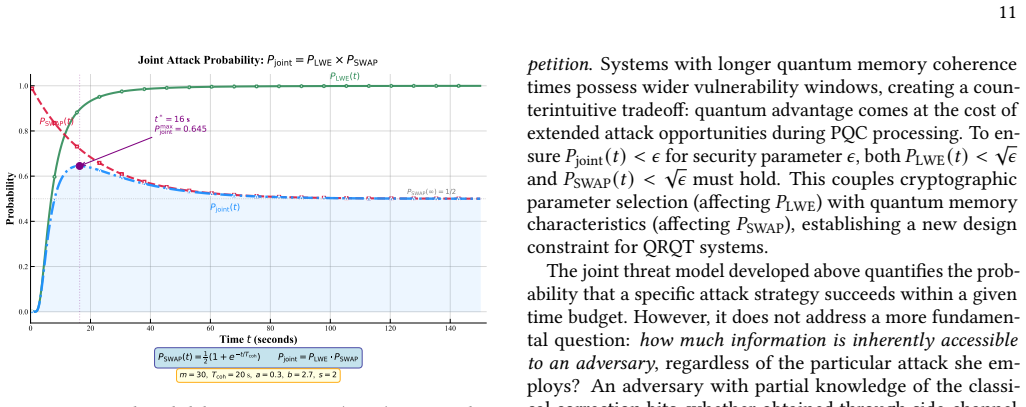
Quantum-resistant quantum teleportation is achieved by encrypting the classical correction bits with post-quantum schemes such as Kyber512 or FrodoKEM-1344; under a 1 ms coherence time and fiber-optic propagation the maximum secure distance lies between 191 km and 199 km, the joint attack probability follows a non-monotonic Bell-shaped profile arising from the opposing time scales of classical cryptanalysis and quantum decoherence, and closed-form Holevo quantities and fidelities are obtained for independent-exponential, sequential, burst, and correlated leakage models that also incorporate amplitude damping on the Bell pair.
What carries the argument
The finite coherence time of quantum memory, which simultaneously bounds propagation distance, tolerable post-quantum cryptographic overhead, and the adversary's usable attack interval.
If this is right
- Secure teleportation remains feasible only inside a bounded distance window set by memory lifetime.
- Attack success reaches a maximum at an intermediate time before decaying exponentially once decoherence dominates.
- Average extractable information can be bounded without performing measurements by using the Holevo quantity expressions.
- Leakage-resilient protocol designs can be guided by the closed-form fidelity formulas for each of the four leakage scenarios.
Where Pith is reading between the lines
- Longer-coherence quantum memories would directly extend both the reachable distance and the allowable computational overhead of the classical encryption.
- The same time-dependent tradeoff could be applied to other protocols that mix quantum states with classical control messages.
- Optimizing the timing of the classical correction step could be used to minimize the peak attack probability for a given memory lifetime.
Load-bearing premise
The chosen post-quantum schemes remain computationally secure for the full duration of the quantum memory coherence time and the four stochastic leakage models accurately represent real side-channel behavior on the classical correction bits.
What would settle it
An experiment that varies the delay between entanglement distribution and classical correction transmission, then measures whether the observed joint attack success rate rises and then falls in the predicted non-monotonic shape while teleportation fidelity matches the derived expressions.
Figures




read the original abstract
We propose a quantum-resistant quantum teleportation (QRQT) framework protected by post-quantum cryptography (PQC) to secure the classical correction channel, which is vulnerable to quantum adversaries. By applying PQC to the classical control bits, QRQT eliminates the classical attack surface of quantum teleportation. Our analysis reveals that quantum memory is a hidden bottleneck linking physical and computational security: its finite coherence time simultaneously limits communication distance, constrains tolerable PQC overhead, and restricts the adversary attack window. Under realistic parameters (1 ms coherence, fiber-optic propagation), the maximum secure teleportation distance ranges from 191 km (FrodoKEM-1344) to 199 km (Kyber512). We show that the joint classical-quantum attack probability exhibits a non-monotonic, Bell-shaped profile due to the opposing time dependencies of classical cryptanalysis and quantum decoherence, establishing a bounded optimal attack window beyond which adversarial success decays exponentially. We further analyze how leakage of classical correction bits affects teleportation security under four stochastic leakage models: independent exponential, sequential, burst, and correlated leakage, also accounting for amplitude damping on the shared Bell pair. For each scenario, we derive closed-form expressions for the average Holevo quantity and teleportation fidelity as functions of time, providing measurement-independent upper bounds on extractable information and guiding the design of leakage-resilient quantum communication protocols.
Editorial analysis
A structured set of objections, weighed in public.
Referee Report
Summary. The manuscript proposes a quantum-resistant quantum teleportation (QRQT) framework that applies post-quantum cryptography (PQC) to secure the classical correction channel against quantum adversaries. It identifies finite quantum memory coherence time as a bottleneck simultaneously limiting communication distance, tolerable PQC overhead, and adversary attack window. Under 1 ms coherence time and fiber-optic parameters, maximum secure distances are reported as 191 km (FrodoKEM-1344) to 199 km (Kyber512). Closed-form expressions are claimed for average Holevo quantity and teleportation fidelity under four stochastic leakage models plus amplitude damping, with the joint attack probability exhibiting a non-monotonic Bell-shaped profile due to opposing time dependencies.
Significance. If the derivations hold and the numerical results are robust, the work offers a useful conceptual link between physical-layer constraints (decoherence) and computational security (PQC) in quantum communication. The closed-form bounds on extractable information under leakage models could inform leakage-resilient protocol design, and the identification of an optimal attack window is a potentially actionable insight. The explicit parameter-driven distance estimates provide concrete benchmarks, though their generality remains to be established.
major comments (3)
- [Abstract and analysis section] Abstract and main analysis: The manuscript asserts closed-form expressions for the average Holevo quantity and teleportation fidelity as functions of time, yet supplies no derivations, intermediate steps, error analysis, or verification that the non-monotonic profile persists under realistic parameter variation. This is load-bearing for the central claims on bounded attack windows and the reported secure distances.
- [Numerical results section] Numerical results on secure distance: The maximum distances (191 km for FrodoKEM-1344, 199 km for Kyber512) are obtained directly from externally supplied inputs (1 ms coherence time, fiber propagation loss, PQC overhead) rather than derived or fitted internally from teleportation data; no sensitivity analysis or error propagation is shown, which directly affects the claimed robustness of the Bell-shaped profile.
- [Leakage models analysis] Leakage models: The four stochastic leakage models (independent exponential, sequential, burst, correlated) are invoked to bound security, but no justification, empirical grounding, or references are provided for their accuracy in modeling side-channel leakage on classical correction bits; this assumption is central to the Holevo and fidelity bounds.
minor comments (2)
- [Notation and models] The notation and parameter definitions for the leakage models would be clarified by a summary table listing their functional forms, rate parameters, and any assumptions about amplitude damping.
- [Figures] Figures depicting the Bell-shaped attack probability or fidelity versus time should explicitly list all numerical parameter values (coherence time, loss coefficients, PQC overhead) used to generate the plots.
Simulated Author's Rebuttal
We thank the referee for the constructive and detailed feedback on our manuscript. We address each major comment point by point below, providing clarifications and committing to revisions that enhance the rigor and transparency of the derivations, numerical analysis, and modeling assumptions.
read point-by-point responses
-
Referee: [Abstract and analysis section] Abstract and main analysis: The manuscript asserts closed-form expressions for the average Holevo quantity and teleportation fidelity as functions of time, yet supplies no derivations, intermediate steps, error analysis, or verification that the non-monotonic profile persists under realistic parameter variation. This is load-bearing for the central claims on bounded attack windows and the reported secure distances.
Authors: We acknowledge that the step-by-step derivations were not presented in the main text to preserve conciseness. In the revised manuscript we will add a dedicated appendix containing the complete derivations of the closed-form expressions for the average Holevo quantity and teleportation fidelity (including all intermediate algebraic steps, error bounds, and the explicit time-dependent forms). We will also include numerical checks confirming that the non-monotonic Bell-shaped profile of the joint attack probability remains stable across realistic ranges of coherence time and fiber loss. revision: yes
-
Referee: [Numerical results section] Numerical results on secure distance: The maximum distances (191 km for FrodoKEM-1344, 199 km for Kyber512) are obtained directly from externally supplied inputs (1 ms coherence time, fiber propagation loss, PQC overhead) rather than derived or fitted internally from teleportation data; no sensitivity analysis or error propagation is shown, which directly affects the claimed robustness of the Bell-shaped profile.
Authors: The quoted distances are computed from standard, literature-accepted fiber-optic loss coefficients and a representative 1 ms coherence time. To strengthen the robustness claim we will insert a new sensitivity-analysis subsection that systematically varies coherence time, propagation loss, and PQC overhead, together with first-order error-propagation estimates. This will explicitly demonstrate the stability of both the secure-distance bounds and the non-monotonic profile. revision: yes
-
Referee: [Leakage models analysis] Leakage models: The four stochastic leakage models (independent exponential, sequential, burst, correlated) are invoked to bound security, but no justification, empirical grounding, or references are provided for their accuracy in modeling side-channel leakage on classical correction bits; this assumption is central to the Holevo and fidelity bounds.
Authors: These four models are introduced as representative stochastic processes that bracket plausible side-channel leakage behaviors on classical control bits. In the revision we will add (i) citations to established side-channel leakage literature and (ii) a short justification paragraph explaining why the chosen processes are appropriate conservative bounds for the classical channel in QRQT. We will also note that direct empirical data for these exact models in quantum-teleportation settings are currently limited and flag this as an assumption requiring future experimental validation. revision: partial
Circularity Check
No circularity; derivations use external parameters and standard models
full rationale
The paper computes maximum secure teleportation distances and joint attack probabilities directly from externally supplied inputs (1 ms coherence time, fiber-optic loss rates, PQC scheme overheads) and standard quantum information expressions for Holevo quantity under amplitude damping plus four leakage models. The Bell-shaped profile arises mathematically from the product of an exponentially decaying quantum fidelity term and a time-dependent classical cryptanalysis success probability; this is not a fitted or self-defined relation but follows from the opposing functional forms. No parameters are obtained by fitting to teleportation data, no self-citations supply load-bearing uniqueness theorems or ansatzes, and the closed-form expressions are derived from established channel models without redefinition of outputs as inputs. The central claims therefore remain independent of the results they produce.
Axiom & Free-Parameter Ledger
free parameters (2)
- coherence time =
1 ms
- fiber propagation parameters
axioms (2)
- standard math Standard quantum teleportation protocol using Bell pairs and classical correction bits
- domain assumption Post-quantum cryptography schemes (Kyber, FrodoKEM) remain secure against quantum adversaries for the relevant time scales
Reference graph
Works this paper leans on
-
[1]
Dahlberg, M
A. Dahlberg, M. Skrzypczyk, T. Coopmans, L. Wubben, F. Rozpdek, M. Pompili, A. Stolk, P. Paweczak, R. Knegjens, J. de Oliveira Filho, R. Hanson, and S. Wehner, A link layer pro- tocol for quantum networks, inProceedings of the ACM Special Interest Group on Data Communication, SIGCOMM -?9 (ACM,
-
[2]
R. Valivarthi, S. I. Davis, C. Pea, S. Xie, N. Lauk, L. Narvez, J. P. Allmaras, A. D. Beyer, Y. Gim, M. Hussein, G. Iskander, H. L. Kim, B. Korzh, A. Mueller, M. Rominsky, M. Shaw, D. Tang, E. E. Wollman, C. Simon, P. Spentzouris, D. Oblak, N. Sinclair, and M. Spiropulu, Teleportation systems toward a quantum internet, PRX Quantum1, 10.1103/prxquantum.1.0...
-
[3]
C. H. Bennett, G. Brassard, C. Crpeau, R. Jozsa, A. Peres, and W. K. Wootters, Teleporting an unknown quantum state via dual classical and einstein-podolsky-rosen channels, Physical Review Letters70, 1895 (1993)
1993
-
[4]
H. J. Kimble, The quantum internet, Nature453, 1023 (2008)
2008
-
[5]
S. Wehner, D. Elkouss, and R. Hanson, Quantum internet: A vision for the road ahead, Science362, 10.1126/science.aam9288 (2018)
-
[6]
Sangouard, C
N. Sangouard, C. Simon, H. de Riedmatten, and N. Gisin, Quan- tum repeaters based on atomic ensembles and linear optics, Rev. Mod. Phys.83, 33 (2011)
2011
-
[7]
J. I. Cirac, A. K. Ekert, S. F. Huelga, and C. Macchiavello, Dis- tributed quantum computation over noisy channels, Phys. Rev. A59, 4249 (1999)
1999
-
[8]
Van Meter,Quantum Networking(Wiley, 2014)
R. Van Meter,Quantum Networking(Wiley, 2014)
2014
-
[9]
S. L. N. Hermans, M. Pompili, H. K. C. Beukers, S. Baier, J. Bor- regaard, and R. Hanson, Qubit teleportation between non- neighbouring nodes in a quantum network, Nature605, 663 (2022)
2022
-
[10]
S. Gangopadhyay, T. Wang, A. Mashatan, and S. Ghose, Con- trolled quantum teleportation in the presence of an adversary, Physical Review A106, 10.1103/physreva.106.052433 (2022)
-
[11]
S. Tserkis, N. Hosseinidehaj, N. Walk, and T. C. Ralph, Teleportation-based collective attacks in gaussian quantum key distribution, Physical Review Research2, 10.1103/physrevre- search.2.013208 (2020)
- [12]
-
[13]
N. K. Chandra, S. Guha, and K. P. Seshadreesan, Multiplexed bi- layered realization of fault-tolerant quantum computation over optically networked trapped-ion modules, IEEE Transactions on Quantum Engineering7, 1 (2026)
2026
-
[14]
M. A. Nielsen and I. L. Chuang,Quantum Computation and Quantum Information: 10th Anniversary Edition(Cambridge University Press, 2012)
2012
-
[15]
A. Parakh, Quantum teleportation with one classical bit, Scien- tific Reports12, 10.1038/s41598-022-06853-w (2022)
-
[16]
X.-S. Ma, T. Herbst, T. Scheidl, D. Wang, S. Kropatschek, W. Nay- lor, B. Wittmann, A. Mech, J. Kofler, E. Anisimova, V. Makarov, T. Jennewein, R. Ursin, and A. Zeilinger, Quantum teleportation over 143 kilometres using active feed-forward, Nature489, 269 (2012)
2012
-
[17]
R. Cane, W. Xie, and S. X. Ng, Turbo-oded secure and reliable quantum teleportation, IET Quantum Communication1, 16 (2020)
2020
-
[18]
Liu and R
Z. Liu and R. Zhou, Asymmetric cyclic controlled quantum teleportation in noisy environment, inProceedings of the 2024 21 3rd International Conference on Cryptography, Network Security and Communication Technology, CNSCT 2024 (ACM, 2024) pp. 504–?10
2024
-
[19]
Renner and R
R. Renner and R. Wolf, Quantum advantage in cryptography, AIAA Journal61, 1895 (2023)
2023
-
[20]
R. L. Rivest, A. Shamir, and L. Adleman, A method for obtain- ing digital signatures and public-key cryptosystems, Commun. ACM21, 120 (1978)
1978
-
[21]
National Institute of Standards and Technology,Digital signa- ture standard (DSS)(1994)
1994
-
[22]
P. W. Shor, Polynomial-time algorithms for prime factorization and discrete logarithms on a quantum computer, SIAM Review 41, 303 (1999)
1999
- [23]
-
[24]
M. N. Wegman and J. Carter, New hash functions and their use in authentication and set equality, Journal of Computer and System Sciences22, 265 (1981)
1981
-
[25]
C. H. Bennett and G. Brassard, Quantum cryptography: Public key distribution and coin tossing, Theoretical Computer Science 560, 7 (2014)
2014
-
[26]
Scarani, H
V. Scarani, H. Bechmann-Pasquinucci, N. J. Cerf, M. Duek, N. Lütkenhaus, and M. Peev, The security of practical quantum key distribution, Reviews of Modern Physics81, 1301 (2009)
2009
-
[27]
C. Portmann and R. Renner, Security in quantum cryptography, Reviews of Modern Physics94, 10.1103/revmodphys.94.025008 (2022)
-
[28]
R. Amiri, P. Wallden, A. Kent, and E. Andersson, Secure quan- tum signatures using insecure quantum channels, Physical Re- view A93, 10.1103/physreva.93.032325 (2016)
-
[29]
N. Aquina, B. Cimoli, S. Das, K. Hövelmanns, F. J. Weber, C. Okonkwo, S. Rommel, B. kori, I. Tafur Monroy, and S. Ver- schoor, A critical analysis of deployed use cases for quantum key distribution and comparison with post-quantum cryptography, EPJ Quantum Technology12, 10.1140/epjqt/s40507-025-00350-5 (2025)
-
[30]
Baseri, V
Y. Baseri, V. Chouhan, A. Ghorbani, and A. Chow, Evaluation framework for quantum security risk assessment: A compre- hensive strategy for quantum-safe transition, Computers & Security150, 104272 (2025)
2025
-
[31]
L. Chen, S. Jordan, Y.-K. Liu, D. Moody, R. Peralta, R. Perlner, and D. Smith-Tone,Report on Post-Quantum Cryptography(2016)
2016
-
[32]
J. Bos, L. Ducas, E. Kiltz, T. Lepoint, V. Lyubashevsky, J. M. Schanck, P. Schwabe, G. Seiler, and D. Stehle, Crystals - kyber: A cca-secure module-lattice-based kem, in2018 IEEE European Symposium on Security and Privacy (EuroS&P)(IEEE, 2018) pp. 353–?67
2018
-
[33]
Ducas, E
L. Ducas, E. Kiltz, T. Lepoint, V. Lyubashevsky, P. Schwabe, G. Seiler, and D. Stehl, Crystals-dilithium: A lattice-based dig- ital signature scheme, IACR Transactions on Cryptographic Hardware and Embedded Systems , 238 (2018)
2018
-
[34]
D. J. Bernstein, A. Hülsing, S. Kölbl, R. Niederhagen, J. Rijneveld, and P. Schwabe, The sphincs + signature framework, inPro- ceedings of the 2019 ACM SIGSAC Conference on Computer and Communications Security, CCS -?9 (ACM, 2019) pp. 2129–?146
2019
-
[35]
Moody, G
D. Moody, G. Alagic, D. C. Apon, D. A. Cooper, Q. H. Dang, J. M. Kelsey, Y.-K. Liu, C. A. Miller, R. C. Peralta, R. A. Perlner, A. Y. Robinson, D. C. Smith-Tone, and J. Alperin-Sheriff,Status report on the second round of the NIST post-quantum cryptography standardization process(2020)
2020
-
[36]
L.-J. Wang, K.-Y. Zhang, J.-Y. Wang, J. Cheng, Y.-H. Yang, S.- B. Tang, D. Yan, Y.-L. Tang, Z. Liu, Y. Yu, Q. Zhang, and J.-W. Pan, Experimental authentication of quantum key distribution with post-quantum cryptography, npj Quantum Information7, 10.1038/s41534-021-00400-7 (2021)
-
[37]
N. Bar-Gill, L. Pham, A. Jarmola, D. Budker, and R. Walsworth, Solid-state electronic spin coherence time approaching one second, Nature Communications4, 10.1038/ncomms2771 (2013)
-
[38]
Zhong, M
M. Zhong, M. P. Hedges, R. L. Ahlefeldt, J. G. Bartholomew, S. E. Beavan, S. M. Wittig, J. J. Longdell, and M. J. Sellars, Optically addressable nuclear spins in a solid with a six-hour coherence time, Nature517, 177 (2015)
2015
-
[39]
Heshami, D
K. Heshami, D. G. England, P. C. Humphreys, P. J. Bustard, V. M. Acosta, J. Nunn, and B. J. Sussman, Quantum memories: emerging applications and recent advances, Journal of Modern Optics63, 2005 (2016)
2005
-
[40]
Hucul, I
D. Hucul, I. V. Inlek, G. Vittorini, C. Crocker, S. Debnath, S. M. Clark, and C. Monroe, Modular entanglement of atomic qubits using photons and phonons, Nature Physics11, 37 (2014)
2014
-
[41]
M. Genovese, Proposal of an experimental scheme for realizing a translucent eavesdropping on a quantum cryptographic chan- nel, Physical Review A63, 10.1103/physreva.63.044303 (2001)
-
[42]
Lederman and U
M. Lederman and U. Pereg, Secure communication with unreli- able entanglement assistance, in2024 IEEE International Sympo- sium on Information Theory (ISIT)(IEEE, 2024) pp. 1017–?022
2024
-
[43]
Shaban and M
M. Shaban and M. Ismail, Secured quantum identity authen- tication protocol for quantum networks, in2024 IEEE 100th Vehicular Technology Conference (VTC2024-Fall)(IEEE, 2024) pp. 1–?
2024
-
[45]
S. Khatri, K. Sharma, and M. M. Wilde, Information-theoretic aspects of the generalized amplitude-damping channel, Physical Review A102, 10.1103/physreva.102.012401 (2020)
-
[46]
P. O. Boykin and V. Roychowdhury, Optimal encryption of quan- tum bits, Physical Review A67, 10.1103/physreva.67.042317 (2003)
-
[47]
Regev, On lattices, learning with errors, random linear codes, and cryptography, Journal of the ACM56, 1 (2009)
O. Regev, On lattices, learning with errors, random linear codes, and cryptography, Journal of the ACM56, 1 (2009)
2009
-
[48]
Chen and P
Y. Chen and P. Q. Nguyen, Bkz 2.0: Better lattice security esti- mates, inAdvances in Cryptology -?ASIACRYPT 2011(Springer Berlin Heidelberg, 2011) pp. 1–?0
2011
-
[49]
M. R. Albrecht, R. Player, and S. Scott, On the concrete hardness of learning with errors, Journal of Mathematical Cryptology9, 169 (2015)
2015
-
[50]
C. P. Schnorr and M. Euchner, Lattice basis reduction: Improved practical algorithms and solving subset sum problems, Mathe- matical Programming66, 181 (1994)
1994
-
[51]
Lindner and C
R. Lindner and C. Peikert, Better key sizes (and attacks) for lwe-based encryption, inTopics in Cryptology -?CT-RSA 2011 (Springer Berlin Heidelberg, 2011) pp. 319–?39
2011
-
[52]
org/lists/green500/2024/11/ (2024), accessed: 2025-08- 10
TOP500.org, Green500 list - november 2024,https://top500. org/lists/green500/2024/11/ (2024), accessed: 2025-08- 10
2024
-
[53]
P. G. Kwiat, K. Mattle, H. Weinfurter, A. Zeilinger, A. V. Sergienko, and Y. Shih, New high-intensity source of polarization-entangled photon pairs, Physical Review Letters 75, 4337 (1995)
1995
-
[54]
D. C. Burnham and D. L. Weinberg, Observation of simultane- ity in parametric production of optical photon pairs, Physical 22 Review Letters25, 84 (1970)
1970
-
[55]
M. P. Hedges, J. J. Longdell, Y. Li, and M. J. Sellars, Efficient quantum memory for light, Nature465, 1052 (2010)
2010
-
[56]
C. D. Bruzewicz, J. Chiaverini, R. McConnell, and J. M. Sage, Trapped-ion quantum computing: Progress and challenges, Ap- plied Physics Reviews6, 10.1063/1.5088164 (2019)
-
[57]
X. Liu, J. Hu, Z.-F. Li, X. Li, P.-Y. Li, P.-J. Liang, Z.-Q. Zhou, C.-F. Li, and G.-C. Guo, Heralded entanglement distribution between two absorptive quantum memories, Nature594, 41 (2021)
2021
-
[58]
Barnum, C
H. Barnum, C. Crepeau, D. Gottesman, A. Smith, and A. Tapp, Authentication of quantum messages, inThe 43rd Annual IEEE Symposium on Foundations of Computer Science, 2002. Proceed- ings., SFCS-02 (IEEE Comput. Soc, 2002) pp. 449–?58
2002
-
[59]
Yin, Y.-H
J. Yin, Y.-H. Li, S.-K. Liao, M. Yang, Y. Cao, L. Zhang, J.-G. Ren, W.-Q. Cai, W.-Y. Liu, S.-L. Li, R. Shu, Y.-M. Huang, L. Deng, L. Li, Q. Zhang, N.-L. Liu, Y.-A. Chen, C.-Y. Lu, X.-B. Wang, F. Xu, J.-Y. Wang, C.-Z. Peng, A. K. Ekert, and J.-W. Pan, Entanglement- based secure quantum cryptography over 1, 120 kilometres, Nature582, 501 (2020)
2020
-
[60]
Caleffi, Optimal routing for quantum networks, IEEE Access 5, 22299 (2017)
M. Caleffi, Optimal routing for quantum networks, IEEE Access 5, 22299 (2017)
2017
-
[61]
Pirandola, J
S. Pirandola, J. Eisert, C. Weedbrook, A. Furusawa, and S. L. Braunstein, Advances in quantum teleportation, Nature Pho- tonics9, 641 (2015)
2015
-
[62]
Holevo, The capacity of the quantum channel with general signal states, IEEE Transactions on Information Theory44, 269 (1998)
A. Holevo, The capacity of the quantum channel with general signal states, IEEE Transactions on Information Theory44, 269 (1998)
1998
-
[63]
M. M. Wilde,Quantum Information Theory(Cambridge Univer- sity Press, 2013)
2013
-
[64]
Horodecki, P
M. Horodecki, P. Horodecki, and R. Horodecki, General telepor- tation channel, singlet fraction, and quasidistillation, Physical Review A60, 1888 (1999)
1999
-
[65]
M. Curty, M. Lewenstein, and N. Lütkenhaus, Entanglement as a precondition for secure quantum key distribution, Physical Review Letters92, 10.1103/physrevlett.92.217903 (2004)
-
[66]
J. J. Pantoja, V. A. Bucheli, and R. Donaldson, Electromagnetic side-channel attack risk assessment on a practical quantum- key-distribution receiver based on multi-class classification, EPJ Quantum Technology11, 10.1140/epjqt/s40507-024-00290- 6 (2024)
-
[67]
Qi, C.-H
B. Qi, C.-H. F. Fung, H.-K. Lo, and F.-X. Ma, Time-shift attack in practical quantum cryptosystems, Quantum Information and Computation7, 73 (2007)
2007
-
[68]
N. Gisin, S. Fasel, B. Kraus, H. Zbinden, and G. Ribordy, Trojan- horse attacks on quantum-key-distribution systems, Physical Review A73, 10.1103/physreva.73.022320 (2006)
-
[69]
Brunner, D
N. Brunner, D. Cavalcanti, S. Pironio, V. Scarani, and S. Wehner, Bell nonlocality, Reviews of Modern Physics86, 419 (2014)
2014
-
[70]
H.-K. Lo, X. Ma, and K. Chen, Decoy state quantum key distribu- tion, Physical Review Letters94, 10.1103/physrevlett.94.230504 (2005)
-
[71]
Winitzki, A handy approximation for the error function and its inverse, A lecture note obtained through private communi- cation (2008)
S. Winitzki, A handy approximation for the error function and its inverse, A lecture note obtained through private communi- cation (2008)
2008
-
[72]
A. S. Holevo, Bounds for the quantity of information transmitted by a quantum communication channel, Problems of Information Transmission9, 177 (1973)
1973
-
[73]
Koeune and F.-X
F. Koeune and F.-X. Standaert, A tutorial on physical security and side-channel attacks, inFoundations of Security Analysis and Design III(Springer Berlin Heidelberg, 2005) pp. 78–?08
2005
-
[74]
M. Lucamarini, I. Choi, M.-. Ward, J.-. Dynes, Z.-. Yuan, and A.- . Shields, Practical security bounds against the trojan-horse attack in quantum key distribution, Physical Review X5, 10.1103/physrevx.5.031030 (2015)
-
[75]
Ghosh, S
S. Ghosh, S. Upadhyay, and A. Ash Saki, A primer on security of quantum computing hardware, Proceedings of the IEEE113, 640 (2025)
2025
-
[76]
Ruijters, D
E. Ruijters, D. Reijsbergen, P.-T. de Boer, and M. Stoelinga, Rare event simulation for dynamic fault trees, Reliability Engineering & System Safety186, 220 (2019)
2019
-
[77]
Z. Zeng, A. Barros, and D. Coit, Dependent failure behavior modeling for risk and reliability: A systematic and critical lit- erature review, Reliability Engineering & System Safety239, 109515 (2023)
2023
-
[78]
A. F. Karr, Stochastic processes (sheldon m. ross), SIAM Review 26, 448 (1984)
1984
-
[79]
Stochastic Models in Reliability and Maintenance(Springer Berlin Heidelberg, 2002)
2002
-
[81]
D.-G. Im, C.-H. Lee, Y. Kim, H. Nha, M. S. Kim, S.-W. Lee, and Y.-H. Kim, Optimal teleportation via noisy quantum channels without additional qubit resources, npj Quantum Information 7, 10.1038/s41534-021-00426-x (2021)
-
[82]
These symbols denote the same classical bits and are used interchangeably in some sections for notational convenience and clarity
Throughout this paper,𝑚 1 ≡𝑀 1 and𝑚 2 ≡𝑀 2. These symbols denote the same classical bits and are used interchangeably in some sections for notational convenience and clarity
discussion (0)
Sign in with ORCID, Apple, or X to comment. Anyone can read and Pith papers without signing in.