Environmental Control of Self-Aligning Chiral Bristlebots
Pith reviewed 2026-05-10 07:38 UTC · model grok-4.3
The pith
The stability of edge currents in self-aligning chiral bristlebot systems is determined by the alignment between particle chirality and the handedness of the edge current, allowing a nautilus-shaped obstacle to serve as a chirality-based ra
A machine-rendered reading of the paper's core claim, the machinery that carries it, and where it could break.
Core claim
In this system of self-aligning chiral bristlebots, the interaction between intrinsic particle chirality and the handedness of boundary currents governs the persistence of edge transport, while a specially designed nautilus obstacle enables geometric rectification of particle paths through double chirality sensitivity, and triangular assemblies of linked bots exhibit spontaneous transitions between translational and rotational collective states.
What carries the argument
The nautilus-shaped obstacle as a doubly chirality-sensitive ratchet, together with elastic couplings that produce self-aligning torque and chiral drift in the bristlebots.
Load-bearing premise
Custom housings and elastic couplings in the bristlebots generate a self-aligning torque and stable chiral drift that accurately follows a simple Langevin model without major unmodeled physical complications from the hardware.
What would settle it
Demonstrating stable edge currents in circular arenas despite a mismatch in chirality and current handedness, or showing that the nautilus obstacle rectifies transport independently of chirality.
Figures


read the original abstract
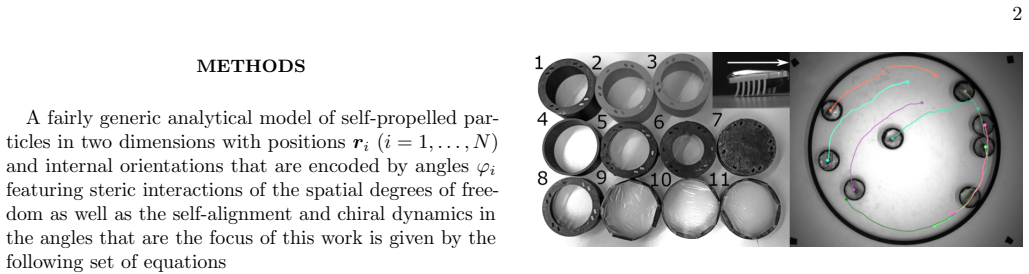
Active matter systems characterized by the interplay of chirality and self-alignment offer a rich landscape for the emergence of non-equilibrium collective behaviors and the development of autonomous materials. We present a versatile experimental platform for studying these dynamics using augmented commercial bristlebots, where custom-designed housings and elastic couplings induce a self-aligning torque and a stable chiral drift. By mapping experimental trajectories to a Langevin-type model, we characterize the single-particle dynamics. In circular geometries, we show that the stability of edge currents is governed by the interaction between intrinsic particle chirality and handedness of the edge current. Furthermore, we demonstrate that transport can be geometrically rectified using a nautilus-shaped obstacle, which acts as a doubly chirality-sensitive ratchet. Finally, we explore the collective dynamics of rigidly linked assemblies, observing spontaneous mode-switching between translational and rotational states in triangular active solids. Our results provide a robust framework for the passive control of active gases and illustrate how geometric constraints can be used to program complex transport properties in synthetic active systems.
Editorial analysis
A structured set of objections, weighed in public.
Referee Report
Summary. The manuscript presents an experimental platform using augmented commercial bristlebots with custom-designed housings and elastic couplings to induce self-aligning torques and stable chiral drifts. Single-particle trajectories are mapped to a Langevin-type model. In circular geometries, edge-current stability is shown to depend on the interaction between intrinsic particle chirality and the handedness of the edge current. Transport rectification is demonstrated via a nautilus-shaped obstacle acting as a doubly chirality-sensitive ratchet. Rigidly linked triangular assemblies exhibit spontaneous switching between translational and rotational collective modes.
Significance. If the experimental mappings and observations hold with quantitative support, the work supplies a versatile, low-cost platform for probing chirality-self-alignment interplay in active matter. The geometric rectification results and mode-switching observations provide concrete, falsifiable examples of passive environmental control over active transport and collective states, with potential relevance to designing programmable active materials and rectifying active gases.
major comments (2)
- The central claim that experimental trajectories are mapped to a Langevin-type model for characterizing single-particle dynamics lacks any reported quantitative validation (e.g., fitted parameter values with uncertainties, goodness-of-fit statistics, or overlaid data-model comparisons with error bars). This mapping underpins all subsequent claims about edge currents and rectification and must be shown explicitly.
- The description of the nautilus-shaped obstacle as a 'doubly chirality-sensitive ratchet' is load-bearing for the geometric-rectification result, yet no quantitative measures of rectification efficiency, reversal probability, or statistical significance across chirality combinations are provided in the reported results.
minor comments (2)
- Notation for the Langevin model parameters should be introduced with explicit definitions and units at first use to improve readability for readers outside the immediate subfield.
- Figure captions for trajectory plots and collective-mode examples would benefit from explicit statements of the number of independent realizations and any exclusion criteria applied to the data.
Simulated Author's Rebuttal
We thank the referee for their careful reading of the manuscript and for the constructive comments, which help clarify the presentation of our results. We address each major comment below and have revised the manuscript to incorporate the requested quantitative support.
read point-by-point responses
-
Referee: The central claim that experimental trajectories are mapped to a Langevin-type model for characterizing single-particle dynamics lacks any reported quantitative validation (e.g., fitted parameter values with uncertainties, goodness-of-fit statistics, or overlaid data-model comparisons with error bars). This mapping underpins all subsequent claims about edge currents and rectification and must be shown explicitly.
Authors: We agree that the mapping requires explicit quantitative validation to be fully convincing. In the revised manuscript we have added a dedicated subsection with the fitted Langevin parameters (including uncertainties), goodness-of-fit statistics (reduced chi-squared and R-squared values), and direct overlays of experimental trajectories against model predictions with error bars. These additions are placed immediately after the description of the single-particle model and are referenced in the subsequent sections on edge currents and rectification. revision: yes
-
Referee: The description of the nautilus-shaped obstacle as a 'doubly chirality-sensitive ratchet' is load-bearing for the geometric-rectification result, yet no quantitative measures of rectification efficiency, reversal probability, or statistical significance across chirality combinations are provided in the reported results.
Authors: We acknowledge that quantitative metrics for the ratchet performance were insufficiently detailed. The revised manuscript now includes explicit measures: rectification efficiency (net displacement ratio between favored and unfavored directions), reversal probabilities for each of the four chirality combinations, and statistical significance (p-values from t-tests on repeated trials). These quantities are reported in a new table and illustrated with bar plots, directly supporting the claim of doubly chirality-sensitive rectification. revision: yes
Circularity Check
No significant circularity
full rationale
The paper is an experimental study that constructs a custom bristlebot platform, maps observed trajectories to a Langevin-type model for characterization, and reports direct demonstrations of chirality-dependent edge currents, geometric rectification via a nautilus obstacle, and spontaneous mode-switching in linked assemblies. No equations, fitted parameters, or self-citations are presented in the provided text as load-bearing steps that reduce predictions or results to inputs by construction. The central claims rest on falsifiable experimental observations rather than internal redefinitions or renamed fits.
Axiom & Free-Parameter Ledger
Reference graph
Works this paper leans on
-
[1]
Ramaswamy, The mechanics and statistics of active matter, Annu
S. Ramaswamy, The mechanics and statistics of active matter, Annu. Rev. Cond. Mat. Phys.1, 323 (2010)
work page 2010
-
[2]
A. M. Menzel, Tuned, driven, and active soft matter, Physics reports554, 1 (2015)
work page 2015
-
[3]
M. Te Vrugt and R. Wittkowski, Metareview: a survey of active matter reviews, The European Physical Journal E 48, 12 (2025)
work page 2025
-
[4]
M. te Vrugt, B. Liebchen, and M. E. Cates, What ex- actly is ’active matter’? (2025), arXiv:2507.21621 [cond- mat.soft]
-
[5]
L. Ning, H. Zhu, J. Yang, Q. Zhang, P. Liu, R. Ni, and N. Zheng, Macroscopic, artificial active matter, Natl Sci Open3, 20240005 (2024)
work page 2024
-
[6]
Chat´ e, Dry aligning dilute active matter, Annu
H. Chat´ e, Dry aligning dilute active matter, Annu. Rev. Cond. Mat. Phys.11, 189 (2020)
work page 2020
-
[7]
J. Sawicki, R. Berner, S. A. M. Loos, M. Anvari, R. Bader, W. Barfuss, N. Botta, N. Brede, I. Franovi´ c, D. J. Gauthier, S. Goldt, A. Hajizadeh, P. H¨ ovel, O. Karin, P. Lorenz-Spreen, C. Miehl, J. M¨ olter, S. Olmi, E. Sch¨ oll, A. Seif, P. A. Tass, G. Volpe, S. Yanchuk, and J. Kurths, Perspectives on adaptive dynamical systems, Chaos: An Interdisciplin...
work page 2023
-
[8]
A. Doostmohammadi, M. G. Mazza, T. N. Shendruk, and H. Stark, Active and intelligent living matter: from funda- mentals to applications, Frontiers in Physics11, 1231716 (2023)
work page 2023
-
[9]
H. L¨ owen and B. Liebchen, Towards intelligent active particles, inArtificial Intelligence and Intelligent Mat- ter: Nanoscience, Soft Matter, Philosophy, edited by M. te Vrugt (Springer Nature Switzerland, Cham, 2026) pp. 257–271
work page 2026
-
[10]
P. Baconnier, O. Dauchot, V. D´ emery, G. D¨ uring, S. Henkes, C. Huepe, and A. Shee, Self-aligning polar active matter, Rev. Mod. Phys.97, 015007 (2025)
work page 2025
-
[11]
B. Liebchen and D. Levis, Chiral active matter, Euro- physics Letters139, 67001 (2022)
work page 2022
- [12]
-
[13]
Boltz H-H., B. Kohler, and T. Ihle, Kinetic theory of self- propelled particles with nematic alignment, Entropy26, 1054 (2024)
work page 2024
-
[14]
Boltz H-H. and T. Ihle, Spectral insights into active mat- ter: Exceptional points and the mathieu equation, En- tropy28, 10.3390/e28030284 (2026)
-
[15]
A. P. Antonov, L. Caprini, A. Ldov, C. Scholz, and H. L¨ owen, Inertial active matter with coulomb friction, Phys. Rev. Lett.133, 198301 (2024)
work page 2024
-
[16]
Wagner,Quantifying dynamics of chiral bristlebots in complex environments, B.Sc
T. Wagner,Quantifying dynamics of chiral bristlebots in complex environments, B.Sc. thesis, University of Greif- swald (2025)
work page 2025
- [17]
-
[18]
J. Wang, T. Xu, J. He, K. Chen, and W. Tian, Transition from isotropic to polar state of self-driven eccentric disks, Chinese Physics B32, 070501 (2023)
work page 2023
-
[19]
P. Baconnier, D. Shohat, C. H. L´ opez, C. Coulais, V. D´ emery, G. D¨ uring, and O. Dauchot, Selective and collective actuation in active solids, Nat. Phys.18, 1234 (2022)
work page 2022
-
[20]
J. P. Carrillo-Mora, A. Garc´ es, and D. Levis, Depinning and activated motion of chiral self-propelled particles, Phys. Rev. E112, 065417 (2025)
work page 2025
-
[21]
J. W. Eaton, D. Bateman, S. Hauberg, and R. Wehbring, GNU Octave version 8.4.0 manual: a high-level interactive language for numerical computations(2023)
work page 2023
-
[22]
Specifically, we make use of theimfindcirclesroutine of octave’s [21] image package
-
[23]
S. Ketzetzi, L. Caprini, V. Willems, L. Alvarez, H. L¨ owen, and L. Isa, Active colloidal molecules with dynamic con- figurational freedom, ACS nano19, 29430 (2025)
work page 2025
-
[24]
D. Grossman, I. Aranson, and E. Ben Jacob, Emergence of agent swarm migration and vortex formation through inelastic collisions, New Journal of Physics10, 023036 (2008)
work page 2008
-
[25]
A. M. Menzel and T. Ohta, Soft deformable self-propelled particles, Europhysics Letters99, 58001 (2012)
work page 2012
-
[26]
R. Großmann, I. S. Aranson, and F. Peruani, A particle- field approach bridges phase separation and collective motion in active matter, Nature communications11, 5365 (2020)
work page 2020
-
[27]
S. Das, M. Ciarchi, Z. Zhou, J. Yan, J. Zhang, and R. Alert, Flocking by turning away, PRX14, 031008 (2024)
work page 2024
-
[28]
See Video in the supplemental material
-
[29]
V. Ambegaokar and B. I. Halperin, Voltage due to thermal noise in the dc josephson effect, Phys. Rev. Lett.22, 1364 (1969)
work page 1969
-
[30]
R. L. Stratonovich,Topics in the theory of random noise, Vol. 2 (CRC Press, 1967)
work page 1967
-
[31]
S. van Teeffelen and H. L¨ owen, Dynamics of a brownian circle swimmer, Phys. Rev. E78, 020101 (2008)
work page 2008
- [32]
- [33]
-
[34]
B. Tian, W.-P. Sun, M. Li, R. Jiang, and M.-B. Hu, Flowrate behavior and clustering of self-driven robots in a channel*, Chinese Physics B27, 038902 (2018)
work page 2018
- [35]
-
[36]
T. Knippenberg, A. Jayaram, T. Speck, and C. Bechinger, Motility-induced clustering of active particles under soft confinement, Phys. Rev. Lett.133, 048301 (2024)
work page 2024
-
[37]
A. Barona Balda, A. Argun, A. Callegari, and G. Volpe, Playing with active matter, American Journal of Physics 92, 847 (2024)
work page 2024
-
[38]
A. Deblais, T. Barois, T. Guerin, P. H. Delville, R. Vau- daine, J. S. Lintuvuori, J. F. Boudet, J. C. Baret, and H. Kellay, Boundaries control collective dynamics of iner- tial self-propelled robots, Phys. Rev. Lett.120, 188002 (2018)
work page 2018
- [39]
- [40]
-
[41]
T. Barois, J.-F. Boudet, J. S. Lintuvuori, and H. Kellay, Sorting and extraction of self-propelled chiral particles by polarized wall currents, Phys. Rev. Lett.125, 238003 (2020)
work page 2020
-
[42]
X. Yang, C. Ren, K. Cheng, and H. P. Zhang, Robust boundary flow in chiral active fluid, Phys. Rev. E101, 022603 (2020)
work page 2020
-
[43]
L. Caprini, U. M. B. Marconi, B. Liebchen, and H. L¨ owen, Active thermodynamics of inertial chiral ac- tive gases: equation of state and edge currents (2025), arXiv:2509.05053 [cond-mat.soft]
-
[44]
G. hao Xu, T.-C. Li, and B. quan Ai, Sorting of chiral active particles by a spiral shaped obstacle, Physica A: Statistical Mechanics and its Applications608, 128247 (2022)
work page 2022
-
[45]
W. Li, L. Li, Q. Shi, M. Yang, and N. Zheng, Chiral sepa- ration of rotating robots through obstacle arrays, Powder Technology407, 117671 (2022)
work page 2022
-
[46]
C. W. Chan, D. Wu, K. Qiao, K. L. Fong, Z. Yang, Y. Han, and R. Zhang, Chiral active particles are sensitive re- porters to environmental geometry, Nature communica- tions15, 1406 (2024)
work page 2024
-
[47]
G. A. Patterson, P. I. Fierens, F. Sangiuliano Jimka, P. G. K¨ onig, A. Garcimart´ ın, I. Zuriguel, L. A. Pugnaloni, and D. R. Parisi, Clogging transition of vibration-driven vehi- cles passing through constrictions, Phys. Rev. Lett.119, 248301 (2017)
work page 2017
- [48]
-
[49]
C. O. Reichhardt and C. Reichhardt, Ratchet effects in ac- tive matter systems, Annual Review of Condensed Matter Physics8, 51 (2017)
work page 2017
-
[50]
J. S. Lee, J.-M. Park, J. D. Noh, and H. Park, Geometry- induced rectification for an active object, Phys. Rev. Res. 3, L042011 (2021)
work page 2021
-
[51]
C. Hern´ andez-L´ opez, P. Baconnier, C. Coulais, O. Dau- chot, and G. D¨ uring, Model of active solids: Rigid body motion and shape-changing mechanisms, Phys. Rev. Lett. 132, 238303 (2024)
work page 2024
- [52]
- [53]
-
[54]
Environmental Control of Self-Aligning Chiral Bristle- bots
T. Wagner, M. Himpel, T. Ihle, and Boltz, H-H., Dataset for “Environmental Control of Self-Aligning Chiral Bristle- bots”, 10.5281/zenodo.19566847 (2026). Supplemental Material for “Environmental Control of Self-Aligning Chiral Bristlebots” Timo Wagner, Michael Himpel, Thomas Ihle, and Horst-Holger Boltz ∗ Institute of Physics, University of Greifswald, F...
discussion (0)
Sign in with ORCID, Apple, or X to comment. Anyone can read and Pith papers without signing in.