Map-Dependent Quantum Characteristic Functions and CP-Divisibility in Non-Markovian Quantum Dynamics
Pith reviewed 2026-05-10 06:48 UTC · model grok-4.3
The pith
A Bochner-Choi positivity theorem shows that Gram matrices from normalized Choi operators are positive-type exactly when the quantum channel is completely positive.
A machine-rendered reading of the paper's core claim, the machinery that carries it, and where it could break.
Core claim
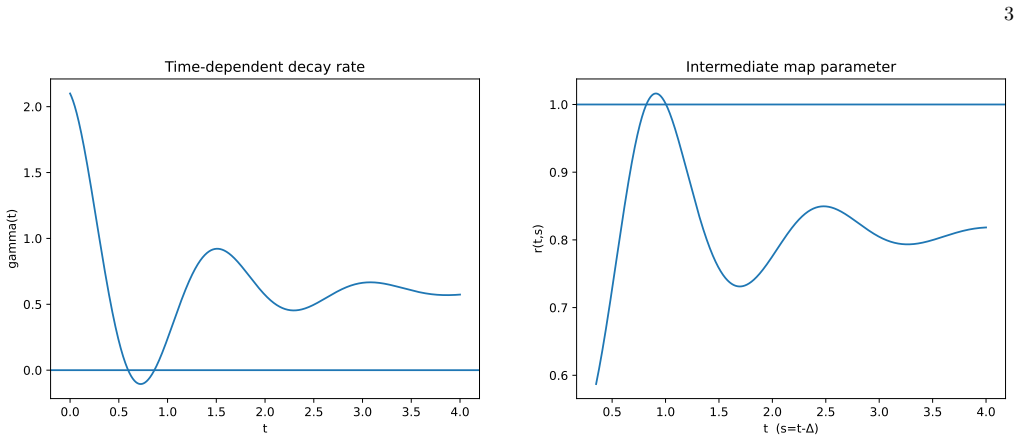
We introduce map-dependent quantum characteristic functions constructed from the normalized Choi operator of quantum dynamical maps. We prove a Bochner--Choi positivity theorem establishing that the positive-type condition of the associated Gram matrix is equivalent to complete positivity of the underlying quantum channel. Applying the construction to intermediate dynamical maps, we obtain a characterization of CP-divisibility in terms of positivity of two-time characteristic functions. Numerical examples for amplitude damping and pure dephasing models demonstrate that negativity of the Gram matrix coincides with the breakdown of CP-divisibility and the emergence of information backflow.
What carries the argument
Map-dependent quantum characteristic functions constructed from the normalized Choi operator of quantum dynamical maps, generating Gram matrices whose positive-type condition is equivalent to complete positivity of the channel.
If this is right
- Complete positivity of a quantum channel holds precisely when the associated Gram matrix satisfies the positive-type condition.
- CP-divisibility of a process holds precisely when the two-time characteristic functions remain positive.
- Negativity of the Gram matrix for an intermediate map signals the breakdown of CP-divisibility.
- This negativity coincides with the appearance of information backflow in standard models such as amplitude damping and pure dephasing.
Where Pith is reading between the lines
- The construction supplies a potential experimental signature for non-Markovianity by checking positivity at chosen intermediate times without full process tomography.
- The link to Bochner's classical theorem suggests possible extensions to classical stochastic processes or hybrid quantum-classical divisibility tests.
- The framework may support numerical searches for minimal CP-divisible approximations to given non-Markovian evolutions.
Load-bearing premise
The normalized Choi operator of an intermediate map remains well-defined and free of singularities even when the map is not completely positive.
What would settle it
A concrete quantum dynamical map for which the Gram matrix built from its normalized Choi operator fails the positive-type condition while the map is nevertheless completely positive, or vice versa.
Figures


read the original abstract
We introduce map-dependent quantum characteristic functions constructed from the normalized Choi operator of quantum dynamical maps. We prove a Bochner--Choi positivity theorem establishing that the positive-type condition of the associated Gram matrix is equivalent to complete positivity of the underlying quantum channel. Applying the construction to intermediate dynamical maps, we obtain a characterization of CP-divisibility in terms of positivity of two-time characteristic functions. Numerical examples for amplitude damping and pure dephasing models demonstrate that negativity of the Gram matrix coincides with the breakdown of CP-divisibility and the emergence of information backflow. The proposed framework provides a new bridge between characteristic-function methods in quantum statistics and structural properties of quantum dynamical maps.
Editorial analysis
A structured set of objections, weighed in public.
Referee Report
Summary. The manuscript introduces map-dependent quantum characteristic functions constructed from the normalized Choi operator of quantum dynamical maps. It proves a Bochner-Choi positivity theorem establishing equivalence between the positive-type condition on the associated Gram matrix and complete positivity of the underlying quantum channel. The construction is applied to intermediate dynamical maps to obtain a characterization of CP-divisibility in terms of positivity of two-time characteristic functions. Numerical examples for amplitude damping and pure dephasing models are presented to show that negativity of the Gram matrix coincides with breakdown of CP-divisibility and emergence of information backflow.
Significance. If the Bochner-Choi theorem holds rigorously for the relevant class of maps, the work establishes a useful connection between characteristic-function techniques from quantum statistics and the divisibility structure of quantum dynamical maps. This could provide a new diagnostic for non-Markovianity. The numerical illustrations on standard models are a positive feature, but the overall significance hinges on whether the normalization procedure is well-defined and the equivalence extends to non-CP intermediate maps without additional assumptions.
major comments (3)
- [§3] §3 (Bochner-Choi positivity theorem and definition of map-dependent QCF): The equivalence between the positive-type condition of the Gram matrix and complete positivity is stated for the normalized Choi operator. For intermediate maps Φ(t,s) that are not CP, the normalization step (division by the trace of the Choi operator) can encounter division by zero or yield non-positive or complex quantities when the un-normalized Choi operator has negative eigenvalues or non-positive trace. The proof does not explicitly demonstrate that the Gram matrix remains real and the equivalence continues to hold in this regime, which is load-bearing for the CP-divisibility claim.
- [§4] §4 (Characterization of CP-divisibility): The application to two-time characteristic functions for intermediate maps assumes the normalized construction is valid even when the maps are not CP by definition during non-Markovian intervals. No separate argument or regularization is provided to ensure the positive-type condition remains a faithful indicator of CP-divisibility when the underlying Choi operator is not positive semidefinite, risking that the claimed characterization depends on an unexamined extension of the theorem.
- [§5] §5 (Numerical examples for amplitude damping and pure dephasing): The reported coincidence between Gram-matrix negativity and the breakdown of CP-divisibility is shown for specific time intervals, but the manuscript provides no details on discretization step size, cutoff criteria, or sensitivity analysis. Without such checks it is unclear whether the observed agreement is robust or could be affected by post-hoc parameter choices.
minor comments (2)
- [Abstract] The abstract and introduction could more explicitly state the precise normalization convention used for the Choi operator to aid readers in assessing the scope of the theorem.
- [Notation] Notation for the two-time characteristic functions and the Gram matrix entries should be cross-checked for consistency between the theorem statement and the numerical section.
Simulated Author's Rebuttal
We thank the referee for the careful reading and constructive comments, which help clarify the scope of our results. We address each major comment below and will incorporate appropriate revisions.
read point-by-point responses
-
Referee: [§3] §3 (Bochner-Choi positivity theorem and definition of map-dependent QCF): The equivalence between the positive-type condition of the Gram matrix and complete positivity is stated for the normalized Choi operator. For intermediate maps Φ(t,s) that are not CP, the normalization step (division by the trace of the Choi operator) can encounter division by zero or yield non-positive or complex quantities when the un-normalized Choi operator has negative eigenvalues or non-positive trace. The proof does not explicitly demonstrate that the Gram matrix remains real and the equivalence continues to hold in this regime, which is load-bearing for the CP-divisibility claim.
Authors: We agree that the Bochner-Choi theorem is rigorously proven under the assumption that the map is CP, so that the normalized Choi operator is a valid density operator. For trace-preserving intermediate maps (standard in the dynamical-map setting), the trace of the Choi operator equals the Hilbert-space dimension and is therefore strictly positive, precluding division by zero. The resulting normalized operator is Hermitian with unit trace even when it possesses negative eigenvalues. The associated Gram matrix is constructed from the (real) matrix elements of this Hermitian operator and remains real-valued. While the full equivalence holds only for CP maps, the contrapositive implies that negativity of the Gram matrix is a reliable indicator of non-CP. We will add an explicit remark in §3 clarifying the domain of the theorem and noting that the construction extends formally to Hermitian operators for the purpose of detecting CP breakdown. revision: partial
-
Referee: [§4] §4 (Characterization of CP-divisibility): The application to two-time characteristic functions for intermediate maps assumes the normalized construction is valid even when the maps are not CP by definition during non-Markovian intervals. No separate argument or regularization is provided to ensure the positive-type condition remains a faithful indicator of CP-divisibility when the underlying Choi operator is not positive semidefinite, risking that the claimed characterization depends on an unexamined extension of the theorem.
Authors: The characterization of CP-divisibility is based on the observation that an intermediate map is CP if and only if the associated two-time Gram matrix is positive semidefinite. When the map fails to be CP, the Gram matrix can (and does) become indefinite; this negativity is used as a diagnostic of non-divisibility. Because the underlying Choi operator is always Hermitian for Hermiticity-preserving maps, the characteristic-function construction and the Gram matrix remain well-defined without additional regularization. We will insert a short dedicated paragraph in §4 that explicitly invokes the contrapositive of the Bochner-Choi theorem to justify the indicator for non-CP intervals, thereby removing any ambiguity about the extension. revision: partial
-
Referee: [§5] §5 (Numerical examples for amplitude damping and pure dephasing): The reported coincidence between Gram-matrix negativity and the breakdown of CP-divisibility is shown for specific time intervals, but the manuscript provides no details on discretization step size, cutoff criteria, or sensitivity analysis. Without such checks it is unclear whether the observed agreement is robust or could be affected by post-hoc parameter choices.
Authors: We thank the referee for highlighting this omission. In the revised manuscript we will add a new subsection (or appendix) that specifies the time-discretization step size employed in the numerical integration, the numerical threshold used to declare an eigenvalue negative, and the results of a sensitivity analysis performed by varying the step size by factors of two and altering the negativity cutoff. These additions will confirm that the reported coincidence is robust and not an artifact of particular parameter choices. revision: yes
Circularity Check
No significant circularity; central result is an independent equivalence theorem
full rationale
The paper introduces map-dependent quantum characteristic functions from the normalized Choi operator and proves a Bochner-Choi positivity theorem equating the Gram matrix positive-type condition to complete positivity of the channel. This equivalence is derived as a mathematical statement rather than by redefinition or fitting. Application to intermediate maps yields a characterization of CP-divisibility via two-time characteristic functions, following directly from the theorem without reducing to self-referential inputs, fitted parameters renamed as predictions, or load-bearing self-citations. Numerical examples illustrate the result but do not constitute statistical forcing. The derivation chain is self-contained against external benchmarks, with the normalization step treated as an explicit modeling choice rather than a hidden tautology.
Axiom & Free-Parameter Ledger
axioms (2)
- domain assumption The Choi operator of a quantum dynamical map is well-defined and can be normalized to produce a valid characteristic function.
- standard math Standard properties of completely positive maps and their divisibility hold in the finite-dimensional setting used for the examples.
invented entities (1)
-
map-dependent quantum characteristic function
no independent evidence
Reference graph
Works this paper leans on
-
[1]
H.-P. Breuer, E.-M. Laine, and J. Piilo, Phys. Rev. Lett. 103, 210401 (2009)
work page 2009
- [2]
-
[3]
M. M. Wolf, J. Eisert, T. S. Cubitt, and J. I. Cirac, Phys. Rev. Lett.101, 150402 (2008)
work page 2008
-
[4]
Emori, Quantum statistical functions (2026), arXiv:2602.05821 [quant-ph]
H. Emori, Quantum statistical functions (2026), arXiv:2602.05821 [quant-ph]
-
[5]
Choi, Linear Algebra and Its Applications10, 285 (1975)
M.-D. Choi, Linear Algebra and Its Applications10, 285 (1975)
work page 1975
-
[6]
K. Nakagawa, Structural theory of information backflow in non-markovian relaxation: Tc/tcl formalism and minimal phase diagrams (2026), arXiv:2602.09054 [quant-ph]
work page internal anchor Pith review arXiv 2026
-
[7]
Nakagawa, Information Geometry 10.1007/s41884-026- 5 00195-6 (2026)
K. Nakagawa, Information Geometry 10.1007/s41884-026- 5 00195-6 (2026)
-
[8]
K. Nakagawa, Phase diagrams of information backflow: Unifying entanglement revivals and entropy overshoots in minimal non-markovian models (2026), arXiv:2601.18822 [quant-ph]
-
[9]
K. Nakagawa, Thermo-field entanglement description of markovian two-state relaxation (2026), arXiv:2601.12435 [quant-ph]
work page internal anchor Pith review arXiv 2026
discussion (0)
Sign in with ORCID, Apple, or X to comment. Anyone can read and Pith papers without signing in.