Approximate Hamiltonian Simulation Algorithm for Efficient Fluid Quantum Simulations
Pith reviewed 2026-05-10 05:38 UTC · model grok-4.3
The pith
Approximate truncations cut Hamiltonian circuit depth for quantum fluid simulations from quadratic to linear while retaining macroscopic flow features.
A machine-rendered reading of the paper's core claim, the machinery that carries it, and where it could break.
Core claim
The proposed approximate operator optimization scheme reduces the depth of analog circuits from O(n²) to O(n log n) or even O(n) by eliminating O(n²) redundant two-qubit entangling gates. Numerical experiments on simulating two-dimensional unsteady divergent flow show that despite theoretical errors from truncation, the macroscopic temporal evolution characteristics are preserved in a 10-qubit simulation with high correlation coefficients of r=0.933, r=0.941, and r=0.977 for density, X-momentum, and Y-momentum distributions respectively. The study also shows that truncation thresholds can be tuned to balance algorithmic error against hardware noise accumulation at higher qubit counts.
What carries the argument
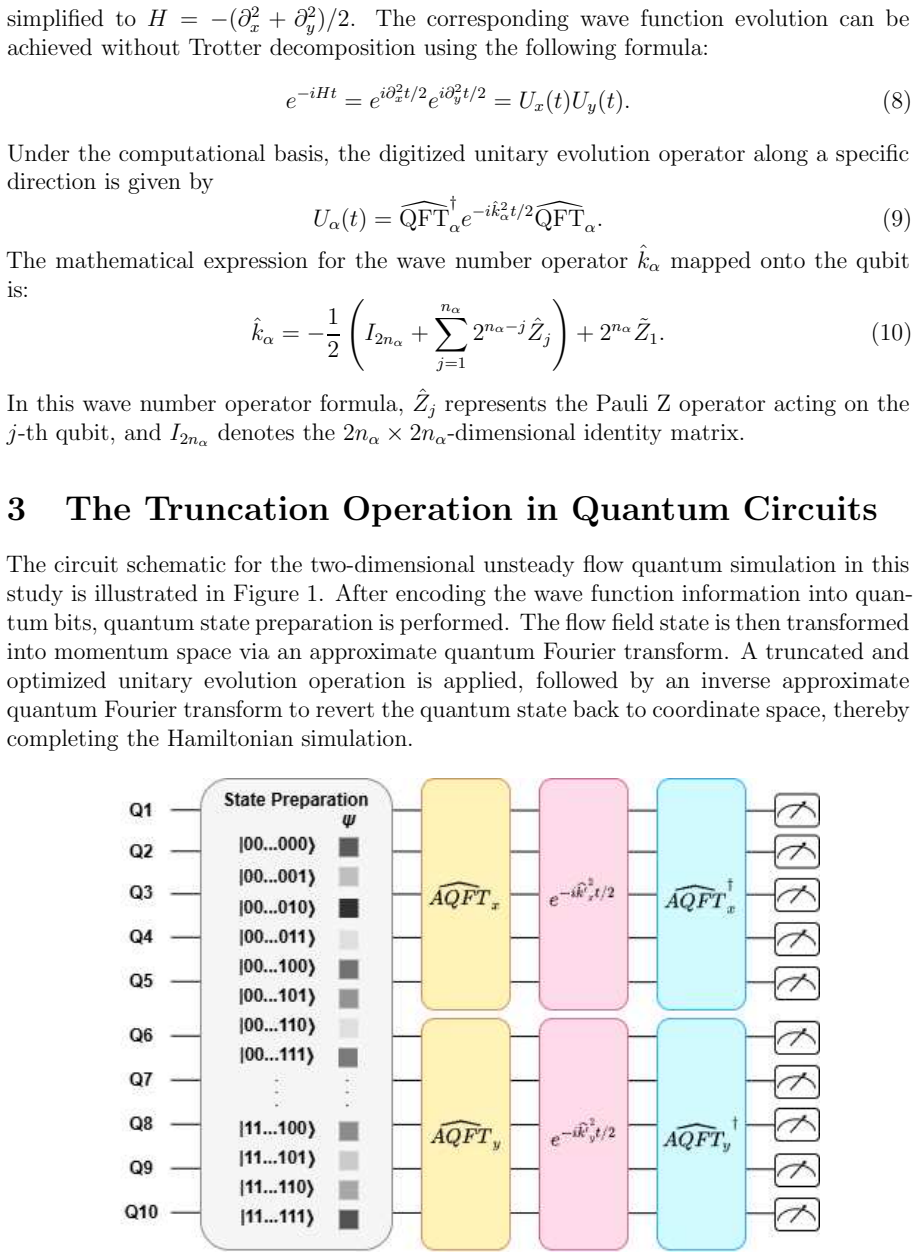
Approximate quantum Fourier transform (AQFT) and momentum operator truncation that removes high-frequency qubit couplings to reduce entangling gates.
If this is right
- Circuit depth for the Hamiltonian evolution scales as O(n) or O(n log n) rather than O(n²).
- High correlation with classical fluid evolution holds in 10-qubit tests of 2D unsteady divergent flow.
- Truncation thresholds can be chosen to keep cumulative hardware error from reaching 100 percent at the 20-30 qubit scale.
- The approach supplies a concrete engineering route for simulating complex fluid systems on near-term quantum devices.
Where Pith is reading between the lines
- Similar truncation could be tested on other quantum simulations that rely on Fourier or momentum operators to reduce gate counts without changing large-scale observables.
- If thresholds are tuned per problem size, the method may allow useful fluid modeling on devices with 20-30 noisy qubits before full error correction arrives.
- Direct comparison of the approximated circuits against exact classical fluid solvers at increasing qubit numbers would quantify how far the macroscopic agreement extends.
Load-bearing premise
Truncating high-frequency qubit coupling terms does not alter the macroscopic fluid behavior enough to invalidate the simulation even as qubit count grows.
What would settle it
Running the 10-qubit or larger simulation on actual quantum hardware and finding that the density or momentum correlation coefficients fall below 0.8 or that visible fluid features deviate from the untruncated reference would falsify the preservation claim.
Figures


read the original abstract
This work aims to address the bottleneck issues of hardware resource limitation and decoherence error in the Hamiltonian simulation of quantum fluids, which are caused by the standard quantum Fourier transform and the evolution of momentum operators, resulting in excessively deep circuits and excessive two-qubit gates. We propose an approximate operator optimization scheme aimed at reducing the circuit depth in Hamiltonian evolution. The proposed scheme successfully reduces the depth of analog circuits from $O(n^2)$ to $O(nlogn)$ or even $O(n)$ by eliminating $O(n^2)$ redundant two-qubit entangling gates. In this work, the numerical experiments are implemented on a supercomputing-oriented quantum simulator, simulating two-dimensional unsteady divergent flow. Experimental results demonstrate that although the truncation of high-frequency qubit coupling terms introduces deterministic theoretical errors, scaling at $O(n)$ for AQFT and $O(n^2)$ for momentum truncation, the optimized simulations successfully preserve the inherent macroscopic temporal evolution characteristics of the fluid in a 10-qubit simulation, achieving high correlation coefficients of $r$=0.933, $r$=0.941, and $r$=0.977 for density, X-momentum, and Y-momentum distributions respectively. Furthermore, we also analyzed the relationship between the algorithm truncation error and the hardware cumulative noise when the qubit number is extended to a higher level. This study proves that rationally adjusting truncation thresholds can establish an equilibrium point, preventing the hardware cumulative error from rapidly approaching 100% at the 20-30 qubit scale, providing a feasible engineering pathway for simulating complex fluid systems on real quantum devices in the future.
Editorial analysis
A structured set of objections, weighed in public.
Referee Report
Summary. The manuscript introduces an approximate Hamiltonian simulation scheme for quantum fluids that truncates high-frequency qubit coupling terms in the approximate quantum Fourier transform (AQFT) and momentum operators, reducing circuit depth from O(n²) to O(n log n) or O(n). Numerical experiments on a classical emulator of a 10-qubit circuit for two-dimensional unsteady divergent flow report correlation coefficients of r=0.933 (density), r=0.941 (X-momentum), and r=0.977 (Y-momentum) between the truncated and reference evolutions, and analyze the tradeoff between truncation error and hardware noise at higher qubit counts.
Significance. If the truncation is shown to preserve the underlying conservation laws and PDE dynamics, the method could offer a practical route to larger-scale fluid simulations on near-term hardware by balancing deterministic approximation error against decoherence, extending the feasible qubit range before cumulative noise reaches 100%.
major comments (3)
- [Abstract] Abstract (numerical experiments paragraph): the reported snapshot correlations (r=0.933/0.941/0.977) do not establish that the truncated unitary preserves the integrated invariants of the fluid Hamiltonian, such as total density (continuity equation) and total momentum. Because the O(n) AQFT and O(n²) momentum truncations are deterministic and grow with qubit number, high point-wise distribution correlations at selected times do not guarantee long-time conservation of these macroscopic quantities.
- [Abstract] Abstract (final paragraph): the analysis of truncation error versus hardware cumulative noise at the 20-30 qubit scale is described only qualitatively; no explicit error bounds, scaling formulas, or quantitative determination of the 'equilibrium point' are provided, leaving the engineering pathway claim unsupported by data.
- [Numerical experiments] Numerical experiments: no baseline comparisons to standard (untruncated) Hamiltonian simulation, other approximation schemes, or classical fluid solvers are reported, and the correlation coefficients lack error bars or statistical significance tests, making it impossible to assess whether the observed agreement exceeds what would be expected from the truncation alone.
minor comments (1)
- [Abstract] The abstract states that the scheme 'eliminates O(n²) redundant two-qubit entangling gates' but does not specify the precise truncation threshold or the resulting gate count scaling in the results section.
Simulated Author's Rebuttal
We thank the referee for the constructive and detailed comments on our manuscript. We address each major comment point by point below, indicating the revisions we will make to strengthen the presentation of our results.
read point-by-point responses
-
Referee: [Abstract] Abstract (numerical experiments paragraph): the reported snapshot correlations (r=0.933/0.941/0.977) do not establish that the truncated unitary preserves the integrated invariants of the fluid Hamiltonian, such as total density (continuity equation) and total momentum. Because the O(n) AQFT and O(n²) momentum truncations are deterministic and grow with qubit number, high point-wise distribution correlations at selected times do not guarantee long-time conservation of these macroscopic quantities.
Authors: We agree that high point-wise correlations in the field distributions at selected times do not by themselves rigorously establish long-time preservation of integrated invariants such as total density and total momentum. Our 10-qubit experiments compare the full spatial distributions at multiple time steps, and the reported correlations indicate that the macroscopic evolution remains close to the reference. To directly address the concern, the revised manuscript will include explicit time-series plots of the spatially integrated total density and total momentum for both the truncated and reference evolutions, thereby demonstrating the degree of conservation over the simulated interval. revision: yes
-
Referee: [Abstract] Abstract (final paragraph): the analysis of truncation error versus hardware cumulative noise at the 20-30 qubit scale is described only qualitatively; no explicit error bounds, scaling formulas, or quantitative determination of the 'equilibrium point' are provided, leaving the engineering pathway claim unsupported by data.
Authors: The current version discusses the tradeoff qualitatively, noting the O(n) scaling of AQFT truncation error and O(n²) scaling of momentum-operator truncation together with the growth of cumulative hardware noise. We acknowledge that explicit bounds and a quantitative location of the equilibrium point are not supplied. In the revision we will add explicit scaling expressions for both error sources and provide a quantitative estimate of the equilibrium qubit count (around 20–30) obtained by extrapolating the observed 10-qubit truncation errors against a standard noise model. revision: partial
-
Referee: [Numerical experiments] Numerical experiments: no baseline comparisons to standard (untruncated) Hamiltonian simulation, other approximation schemes, or classical fluid solvers are reported, and the correlation coefficients lack error bars or statistical significance tests, making it impossible to assess whether the observed agreement exceeds what would be expected from the truncation alone.
Authors: The reference evolution against which the correlations are computed is precisely the standard untruncated Hamiltonian simulation executed on the same simulator; we will make this explicit in the revised numerical-experiments section. Direct comparisons with other quantum approximation schemes and with classical fluid solvers lie outside the primary scope of the work, which focuses on circuit-depth reduction; a brief clarifying sentence will be added. For the correlation coefficients we will include error bars obtained from repeated simulations with varied random seeds and will report the results of basic statistical significance tests to quantify the reliability of the observed agreement. revision: partial
Circularity Check
No circularity in approximate Hamiltonian truncation or numerical validation
full rationale
The paper introduces an ansatz-based truncation of high-frequency terms in the AQFT and momentum operators to shorten the circuit, then validates the approximation by direct classical emulation of the resulting quantum circuit on a 10-qubit 2D fluid problem. The reported correlation coefficients are computed outputs of that emulation, not quantities fitted to the same data or derived by re-labeling the truncation itself. No equation is shown to equal its own input by construction, no uniqueness theorem is imported from self-citation, and no conservation law is asserted without the accompanying numerical check. The derivation chain therefore remains self-contained and non-circular.
Axiom & Free-Parameter Ledger
Reference graph
Works this paper leans on
-
[1]
P. Moin and K. Mahesh. Direct numerical simulation: a tool in turbu lence research. Annu. Rev. Fluid Mech. , 30:539, 1998
work page 1998
-
[2]
T. Ishihara, T. Gotoh, and Y. Kaneda. Study of high-reynolds n umber isotropic turbulence by direct numerical simulation. Annu. Rev. Fluid Mech. , 41:165, 2009
work page 2009
-
[3]
A. J. Daley et al. Practical quantum advantage in quantum simulat ion. Nature, 607:667, 2022
work page 2022
- [4]
-
[5]
M. Hibat-Allah, M. Mauri, J. Carrasquilla, and A. Perdomo-Ortiz. A framework for demonstrating practical quantum advantage: comparing quantu m against classical generative models. Commun. Phys. , 7:68, 2024. 16
work page 2024
-
[6]
R. Demirdjian, D. Gunlycke, C. A. Reynolds, J. D. Doyle, and S. Ta fur. Varia- tional quantum solutions to the advection-diffusion equation for ap plications in fluid dynamics. Quantum Inf. Process. , 21:322, 2022
work page 2022
-
[7]
N. Gourianov et al. A quantum-inspired approach to exploit turbu lence structures. Nat. Comput. Sci. , 2:30, 2022
work page 2022
- [8]
- [9]
-
[10]
S. S. Bharadwaj and K. R. Sreenivasan. Hybrid quantum algorit hms for flow prob- lems. Proc. Natl Acad. Sci. USA. , 120:e2311014120, 2023
work page 2023
-
[11]
B. Liu, L. Zhu, Z. Yang, and G. He. Quantum implementation of nu merical methods for convection-diffusion equations: toward computational fluid dy namics. Commun. Comput. Phys. , 33:425, 2023
work page 2023
-
[12]
R. Au-Yeung, A. J. Williams, V. M. Kendon, and S. J. Lind. Quantu m algorithm for smoothed particle hydrodynamics. Comput. Phys. Commun. , 294:108909, 2024
work page 2024
- [13]
-
[14]
J. Zylberman, G. Di Molfetta, M. Brachet, N. F. Loureiro, and F. Debbasch. Quan- tum simulations of hydrodynamics via the madelung transformation. Phys. Rev. A , 106:032408, 2022
work page 2022
-
[17]
L. Salasnich, S. Succi, and A. Tiribocchi. Quantum wave represe ntation of dissipative fluids. Int. J. Mod. Phys. C. , 35:2450100, 2024
work page 2024
-
[18]
L. Wright et al. Noisy intermediate-scale quantum simulation of th e one-dimensional wave equation, 2024. Preprint at https://arxiv.org/abs/2402.19247
-
[19]
C. Sanavio, R. Scatamacchia, C. de Falco, and S. Succi. Three c arleman routes to the quantum simulation of classical fluids. Phys. Fluids , 36:057143, 2024
work page 2024
-
[20]
M. Griebel, T. Dornseifer, and T. Neunhoeffer. Numerical simulation in fluid dy- namics: a practical introduction . Society for Industrial and Applied Mathematics, Philadelphia, 1998
work page 1998
-
[21]
R. Steijl and G. N. Barakos. Parallel evaluation of quantum algo rithms for compu- tational fluid dynamics. Comput. Fluids , 173:22, 2018
work page 2018
-
[22]
F. Gaitan. Finding flows of a navier-stokes fluid through quantu m computing. npj Quantum Inform. , 6:61, 2020. 17
work page 2020
-
[23]
I. Joseph. Koopman-von neumann approach to quantum simula tion of nonlinear classical dynamics. Phys. Rev. Res. , 2:043102, 2020
work page 2020
-
[24]
Z.-Y. Chen et al. Quantum approach to accelerate finite volume m ethod on steady computational fluid dynamics problems. Quantum Inf. Process. , 21:137, 2022
work page 2022
-
[25]
W. Itani and S. Succi. Analysis of carleman linearization of lattice boltzmann. Fluids, 7:24, 2022
work page 2022
- [26]
-
[27]
Z. Meng and Y. Yang. Quantum computing of fluid dynamics using t he hydrody- namic schr¨ odinger equation.Phys. Rev. Res. , 5:033182, 2023
work page 2023
- [28]
- [29]
-
[30]
Z. Meng and Y. Yang. Quantum spin representation for the nav ier-stokes equation. Physical Review Research, 6:043130, 2024
work page 2024
-
[31]
Z. Meng and Y. Yang. Lagrangian dynamics and regularity of the spin euler equation. J. Fluid Mech. , 985:A34, 2024
work page 2024
-
[32]
Z. Meng et al. Simulating unsteady flows on a superconducting qu antum processor. Commun. Phys. , 7:349, 2024
work page 2024
- [33]
-
[34]
N. Jain, J. Landman, N. Mathur, and I. Kerenidis. Quantum fou rier networks for solving parametric pdes. Quantum Sci. Technol. , 9:ad42ce, 2024
work page 2024
-
[35]
G. Agliardi and E. Prati. Quantum data encoding as a distinct abs traction layer in the design of quantum circuits. Quantum Sci. Technol. , 10:ada6f8, 2025
work page 2025
- [36]
-
[37]
Y. Wang, Q. Li, S.-M. Fei, and V. Vedral. Practical blind quantum c omputation with parity quantum computing framework. Quantum Sci. Technol. , 11:025033, 2026
work page 2026
- [38]
-
[39]
J. Smith et al. Gate teleportation-assisted routing for quantu m algorithms. Quantum Sci. Technol., 10:035004, 2025
work page 2025
-
[40]
S. Efthymiou et al. Qibo: a framework for quantum simulation with hardware acceleration. Quantum Sci. Technol. , 7:015018, 2022. 18
work page 2022
discussion (0)
Sign in with ORCID, Apple, or X to comment. Anyone can read and Pith papers without signing in.