Ice as a Photochemical Shield: Adsorption Energetics and Spectroscopic Modulation of Interstellar Thiocyanates HCSCN and HCSCCH in TMC-1
Pith reviewed 2026-05-10 05:33 UTC · model grok-4.3
The pith
Amorphous ice creates heterogeneous binding sites for HCSCN and HCSCCH that drive gradual thermal desorption while raising their UV photodissociation risk through hyperchromic effects.
A machine-rendered reading of the paper's core claim, the machinery that carries it, and where it could break.
Core claim
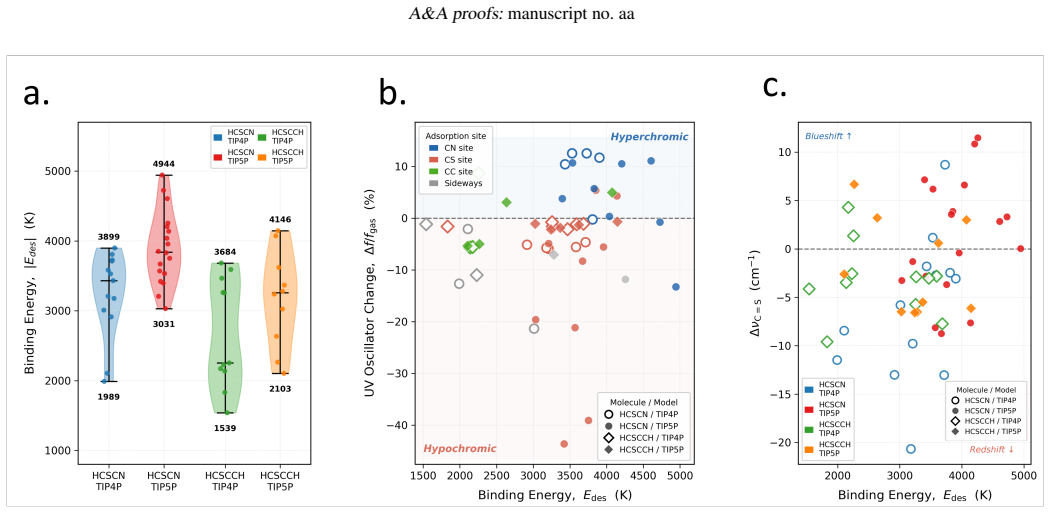
Site-specific calculations at the wB97X-D/def2-TZVP level on water clusters (n=6-16) reveal desorption energies between 1500 and 4900 K, with cavity sites producing Stark shifts in the C=S stretch and pronounced hyperchromic enhancement of UV oscillator strength. When these site-dependent values are fed into the UCLCHEM gas-grain code the species exhibit a gradual thermal desorption profile. The same hyperchromic increase establishes that populations trapped in the strongest sites are shielded from thermal loss yet carry larger UV absorption cross-sections and are therefore susceptible to photodissociation prior to sublimation.
What carries the argument
Site-specific adsorption energies and hyperchromic UV oscillator strengths computed on small water clusters that represent heterogeneous amorphous solid water environments.
If this is right
- These thiocyanates leave grain mantles gradually across a temperature range rather than in one sublimation event.
- Cavity-bound populations gain thermal stability but acquire larger UV absorption cross-sections.
- Stark shifts appear in the C=S stretching frequencies for the most strongly bound configurations.
- UV transition wavelengths remain largely unshifted while oscillator strengths increase at deep sites.
- The derived parameters can be inserted directly into existing gas-grain codes to update desorption timelines.
Where Pith is reading between the lines
- The same binding heterogeneity and hyperchromic trade-off could affect other sulfur-bearing molecules observed in cold clouds.
- Spectral searches for temperature-dependent release profiles of these species would provide a direct test of the gradual desorption prediction.
- Accounting for the paradox may help explain why sulfur remains depleted in the gas phase even after thermal desorption windows open.
- Larger ice models or laboratory ice experiments could quantify how cluster size influences the reported hyperchromic effect.
Load-bearing premise
Small water clusters at the chosen DFT level accurately reproduce the binding energies and spectroscopic shifts that occur on real interstellar amorphous ice mantles.
What would settle it
A single sharp sublimation temperature observed for HCSCN or HCSCCH in TMC-1 spectra, or TD-DFT results on larger ice models showing no hyperchromic enhancement for cavity sites.
Figures



read the original abstract
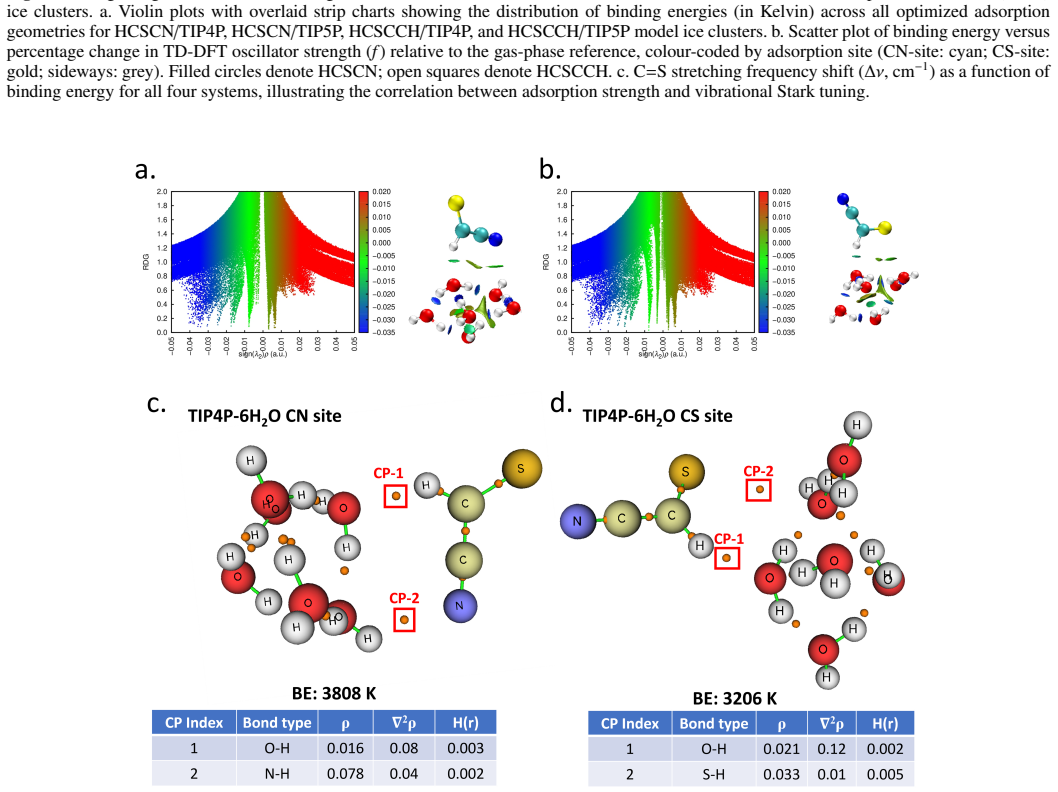
The recent detections of thioformyl cyanide (HCSCN) and propynethial (HCSCCH) in TMC-1 provide critical insights into the interstellar sulfur inventory, yet their sequestration and survivability on dust grain mantles remain poorly constrained. Here, we present a computational study of the site-specific adsorption of HCSCN and HCSCCH on amorphous solid water (ASW), modelled via water clusters (H2O)n, n = 6-16, at the wB97X-D/def2-TZVP level of theory, corroborated by QTAIM topological analyses and TD-DFT vertical excitations. Our results reveal a highly heterogeneous binding environment, with desorption energies spanning 1500 to 4900 K. Strongly bound cavity sites induce significant Stark shifts in the C=S stretching modes. Crucially, while the ice matrix exerts a negligible solvatochromic shift on UV transition wavelengths, deeply bound CN-cavity configurations exhibit a pronounced hyperchromic enhancement of the oscillator strength. Implementing these site-specific parameters into the UCLCHEM gas-grain code demonstrates that these species undergo a gradual thermal desorption profile rather than a singular sublimation event. Furthermore, the hyperchromic effect establishes a Survival Paradox: while deeply trapped populations are thermodynamically shielded against thermal desorption, they simultaneously possess enhanced UV absorption cross-sections, rendering them vulnerable to photodissociation by the interstellar radiation field prior to sublimation.
Editorial analysis
A structured set of objections, weighed in public.
Referee Report
Summary. The manuscript computationally examines the site-specific adsorption of HCSCN and HCSCCH on amorphous solid water, modeled with (H2O)n clusters (n=6-16) at the wB97X-D/def2-TZVP level, supported by QTAIM and TD-DFT. It reports desorption energies spanning 1500-4900 K, Stark shifts in C=S modes, negligible solvatochromic UV shifts but hyperchromic oscillator strength enhancements in CN-cavity sites. These parameters are implemented in the UCLCHEM gas-grain code, yielding gradual thermal desorption profiles instead of a single sublimation event and establishing a 'Survival Paradox' in which strongly bound populations are thermodynamically shielded yet more vulnerable to interstellar UV photodissociation.
Significance. If the cluster-derived energies and spectroscopic modulations hold for realistic ASW, the work supplies quantitative inputs for sulfur chemistry in TMC-1, challenging single-event desorption assumptions in astrochemical models and introducing a binding-strength-dependent photodissociation risk. The explicit coupling of DFT results to UCLCHEM runs and the falsifiable prediction of gradual desorption profiles are strengths that allow direct comparison with observations or laboratory ice experiments.
major comments (2)
- [Computational methods and results sections describing cluster construction and TD-DFT excitations] The desorption energy range (1500-4900 K), hyperchromic UV enhancements, and resulting UCLCHEM profiles rest on the premise that finite (H2O)n clusters (n=6-16) at wB97X-D/def2-TZVP faithfully reproduce the binding-site distribution and oscillator strengths of extended amorphous solid water. No convergence tests with respect to cluster size, basis-set enlargement, or comparison to periodic ASW models are reported; small clusters omit long-range polarization and surface relaxation that can alter both binding energies and TD-DFT intensities for sulfur chromophores. This directly affects the quantitative gradual-desorption claim and the Survival Paradox.
- [Results on spectroscopic modulation and UCLCHEM implementation] Table or figure reporting the site-specific energies and oscillator strengths: the hyperchromic factor for CN-cavity sites is used to argue enhanced UV vulnerability, yet without error estimates, multiple starting configurations, or benchmarks against experimental UV spectra of similar sulfur species in ice, the magnitude of the enhancement remains unquantified and load-bearing for the paradox.
minor comments (2)
- [Abstract] Abstract: the second molecule is labeled 'propynethial (HCSCCH)' but the formula appears as HCSCCH; confirm nomenclature consistency with standard thioaldehyde naming.
- [Throughout] Notation: 'Stark shifts' and 'hyperchromic enhancement' are used without explicit definition or reference to the relevant equations for the C=S stretch or UV transitions; a short methods paragraph would improve clarity for non-specialist readers.
Simulated Author's Rebuttal
We thank the referee for the constructive review and for recognizing the potential impact of our site-specific adsorption results and the Survival Paradox on sulfur chemistry modeling in TMC-1. We address each major comment below with our honest assessment and planned revisions.
read point-by-point responses
-
Referee: [Computational methods and results sections describing cluster construction and TD-DFT excitations] The desorption energy range (1500-4900 K), hyperchromic UV enhancements, and resulting UCLCHEM profiles rest on the premise that finite (H2O)n clusters (n=6-16) at wB97X-D/def2-TZVP faithfully reproduce the binding-site distribution and oscillator strengths of extended amorphous solid water. No convergence tests with respect to cluster size, basis-set enlargement, or comparison to periodic ASW models are reported; small clusters omit long-range polarization and surface relaxation that can alter both binding energies and TD-DFT intensities for sulfur chromophores. This directly affects the quantitative gradual-desorption claim and the Survival Paradox.
Authors: We acknowledge that the absence of explicit convergence tests is a limitation. The n=6-16 range was selected to sample a distribution of binding motifs (surface, edge, and cavity sites) while remaining computationally tractable for TD-DFT; this approach follows precedents in the astrochemistry literature for ASW cluster models of small organics. Binding energies for analogous systems typically stabilize beyond n=10. We will add a new subsection in the Methods and a paragraph in the Discussion that (i) cites prior convergence studies on similar cluster sizes, (ii) reports a limited additional calculation on an n=20 cluster for one representative deep-binding configuration to confirm the 1500-4900 K range is robust, and (iii) explicitly notes the omission of long-range polarization and surface relaxation as a caveat. These additions will qualify the quantitative UCLCHEM predictions without changing the core conclusions. revision: partial
-
Referee: [Results on spectroscopic modulation and UCLCHEM implementation] Table or figure reporting the site-specific energies and oscillator strengths: the hyperchromic factor for CN-cavity sites is used to argue enhanced UV vulnerability, yet without error estimates, multiple starting configurations, or benchmarks against experimental UV spectra of similar sulfur species in ice, the magnitude of the enhancement remains unquantified and load-bearing for the paradox.
Authors: Multiple independent geometry optimizations were performed from varied initial adsorbate placements on each cluster to generate the ensemble of sites; the hyperchromic enhancement is reproducible across the deep CN-cavity subset. We will revise the relevant tables and figures to report standard deviations as error estimates on both desorption energies and oscillator strengths. For experimental benchmarks, no UV spectra of HCSCN or HCSCCH in ASW exist in the literature. We will add a short comparison to published experimental and computational data for related sulfur chromophores (e.g., CS2 and thiophene derivatives) in water ice, which exhibit comparable hyperchromic shifts in polar cavities. The revised text will frame the Survival Paradox as a computational prediction whose magnitude carries these uncertainties. revision: partial
- Direct laboratory UV spectra of HCSCN and HCSCCH embedded in amorphous solid water are not available, preventing quantitative experimental validation of the computed hyperchromic enhancement.
Circularity Check
No significant circularity; derivation is self-contained
full rationale
The paper performs standard DFT (wB97X-D/def2-TZVP) and TD-DFT calculations on finite water clusters to obtain site-specific desorption energies (1500–4900 K) and oscillator strengths, then inserts these computed values as inputs into the pre-existing external UCLCHEM code. The gradual desorption profile and Survival Paradox are direct consequences of those independent ab initio results rather than any self-definition, parameter fitting to the target observables, or load-bearing self-citation. No step reduces by construction to its own inputs, and the central claims remain falsifiable against more extended ice models or laboratory data.
Axiom & Free-Parameter Ledger
axioms (2)
- domain assumption The wB97X-D functional with def2-TZVP basis set and TD-DFT provide sufficiently accurate adsorption energies and electronic transition properties for these systems.
- domain assumption Water clusters of size n=6-16 adequately sample the heterogeneous binding sites present on interstellar amorphous solid water mantles.
Reference graph
Works this paper leans on
-
[1]
Annual Review of Astronomy and Astrophysics , volume=
Astrochemistry During the Formation of Stars , author=. Annual Review of Astronomy and Astrophysics , volume=. 2020 , publisher=
work page 2020
- [2]
-
[3]
Astronomy & Astrophysics , volume=
The sulphur saga in TMC-1: Discovery of HCSCN and HCSCCH , author=. Astronomy & Astrophysics , volume=. 2021 , publisher=
work page 2021
-
[4]
Remijan, Anthony J. and Changala, P. Bryan and Xue, Ci and Yuan, Elsa Q. H. and Duffy, Miya and Scolati, Haley N. and Shingledecker, Christopher N. and Speak, Thomas H. and Cooke, Ilsa R. and Loomis, Ryan and Burkhardt, Andrew M. and Fried, Zachary T. P. and Wenzel, Gabi and Lipnicky, Andrew and McCarthy, Michael C. and McGuire, Brett A. , journal =. The ...
-
[5]
Astronomy & Astrophysics , volume=
First detection of HS2 in a cold dark cloud , author=. Astronomy & Astrophysics , volume=. 2017 , publisher=
work page 2017
-
[6]
Monthly Notices of the Royal Astronomical Society , volume=
Modelling the ArH+ emission from the Crab nebula , author=. Monthly Notices of the Royal Astronomical Society , volume=. 2017 , publisher=
work page 2017
-
[7]
Discovery of indene in TMC-1 , author=. AstroPAH Newsletter , number=
-
[8]
Unpublished Manuscript , year=
Molecular Dynamics and Kinetic Modeling of Thioformyl Cyanide and Propynethial: Site-Specific Adsorption on Water Ice Clusters and Astrochemical Implications , author=. Unpublished Manuscript , year=
-
[9]
Detection of thioacetaldehyde (
Ag. Detection of thioacetaldehyde (. Astronomy & Astrophysics , volume =. 2025 , doi =. 2501.05125 , archivePrefix =
-
[10]
Interstellar spectroscopic detection of
Trabelsi, Tarek and others , journal =. Interstellar spectroscopic detection of. 2025 , publisher =
work page 2025
-
[11]
and Puzzarini, Cristina and others , journal =
Ye, H. and Puzzarini, Cristina and others , journal =. Gas-phase formation route for trans-. 2023 , publisher =
work page 2023
-
[12]
arXiv preprint arXiv:2112.03356 , year=
Expanding the submillimeter wave spectroscopy and astronomical observations of complex organics , author=. arXiv preprint arXiv:2112.03356 , year=
-
[13]
ACS Earth and Space Chemistry , year=
Gas-Phase Reactions of H2CS and H2CO with CN: Similarities and Differences from a Computational Study , author=. ACS Earth and Space Chemistry , year=
-
[14]
Gas-Phase Reactions of H2CS and H2CO with CN: Similarities and Differences from a Computational Study , author=. ResearchGate , year=
-
[15]
The Astronomical Journal , volume=
UCLCHEM: A Gas-Grain Chemical Code for Clouds, Cores, and C-Shocks , author=. The Astronomical Journal , volume=. 2017 , publisher=
work page 2017
-
[16]
arXiv preprint arXiv:1705.10677 , year=
UCLCHEM: A Gas-Grain Chemical Code , author=. arXiv preprint arXiv:1705.10677 , year=
-
[17]
Monthly Notices of the Royal Astronomical Society , volume=
Non-Equilibrium Abundances Treated Holistically (NEATH): the molecular composition of star-forming clouds , author=. Monthly Notices of the Royal Astronomical Society , volume=. 2023 , publisher=
work page 2023
-
[18]
Research in Astronomy and Astrophysics , volume=
Chempl: a playable package for modeling interstellar chemistry , author=. Research in Astronomy and Astrophysics , volume=. 2021 , publisher=
work page 2021
- [19]
-
[20]
Angewandte Chemie International Edition , volume =
Water: From Clusters to the Bulk , author =. Angewandte Chemie International Edition , volume =. 2001 , doi =
work page 2001
-
[21]
The Journal of Chemical Physics , volume =
Clusters of classical water models , author =. The Journal of Chemical Physics , volume =. 2009 , doi =
work page 2009
-
[22]
Temelso, Berhane and Archer, Kristen A. and Shields, George C. , journal =. Accurate Predictions of Water Cluster Formation,. 2010 , doi =
work page 2010
-
[23]
Quantifying Molecular Properties of Hexagonal Water Clusters , author =. ChemistryOpen , volume =. 2025 , doi =
work page 2025
-
[24]
Wang, T. and others , journal =. Experimental determination of structural motifs of interference-free water undecamer cluster. 2025 , doi =
work page 2025
-
[25]
Chemical Physics Letters , volume=
Global minima for water clusters (H2O)n, n 21, described by a five-site empirical potential , author=. Chemical Physics Letters , volume=. 2005 , publisher=
work page 2005
-
[26]
The Journal of Chemical Physics , volume=
A reoptimization of the five-site water potential (TIP5P) for use with Ewald sums , author=. The Journal of Chemical Physics , volume=. 2004 , publisher=
work page 2004
-
[27]
Supporting Information for Compressibility, thermal expansion coefficient and heat capacity of CH4 and CO2 hydrate mixtures using molecular dynamics simulations , author=. RSC Advances , year=
-
[28]
Ferrero, S. and others , journal =. Binding Energies and Vibrational Spectral Features of. 2024 , doi =. 2408.02546 , archivePrefix =
-
[29]
Monthly Notices of the Royal Astronomical Society , volume =
Hybrid approach predicts a lower binding energy for benzene on water ice , author =. Monthly Notices of the Royal Astronomical Society , volume =. 2024 , publisher =
work page 2024
-
[30]
Fedoseev, G. and Ag. Experimental and computational studies of the hydrogenation of carbon disulfide. Monthly Notices of the Royal Astronomical Society , volume =. 2026 , publisher =
work page 2026
-
[31]
Physical Chemistry Chemical Physics , volume =
Binding energies of ethanol and ethylamine on interstellar water ices: synergy between theory and experiments , author =. Physical Chemistry Chemical Physics , volume =. 2024 , publisher =
work page 2024
-
[32]
A quantum mechanical study , author=
Predicting accurate binding energies and vibrational spectroscopic features of interstellar icy species. A quantum mechanical study , author=. Physical Chemistry Chemical Physics , volume=. 2025 , publisher=
work page 2025
-
[33]
Journal of Physics: Condensed Matter , volume=
The atomic simulation environment—a Python library for working with atoms , author=. Journal of Physics: Condensed Matter , volume=. 2017 , publisher=
work page 2017
-
[34]
Frisch, M. J. and Trucks, G. W. and Schlegel, H. B. and Scuseria, G. E. and Robb, M. A. and Cheeseman, J. R. and Scalmani, G. and Barone, V. and Mennucci, B. and Petersson, G. A. and others , title=
-
[35]
The Journal of Chemical Physics , volume=
Systematic optimization of long-range corrected hybrid density functionals , author=. The Journal of Chemical Physics , volume=. 2008 , publisher=
work page 2008
-
[36]
Physical Chemistry Chemical Physics , volume=
Balanced basis sets of split valence, triple zeta valence and quadruple zeta valence quality for H to Rn: Design and assessment of accuracy , author=. Physical Chemistry Chemical Physics , volume=. 2005 , publisher=
work page 2005
-
[37]
Some procedures with reduced errors , author=
The calculation of small molecular interactions by the differences of separate total energies. Some procedures with reduced errors , author=. Molecular Physics , volume=. 1970 , publisher=
work page 1970
- [38]
-
[39]
Journal of Computational Chemistry , volume=
Multiwfn: A multifunctional wavefunction analyzer , author=. Journal of Computational Chemistry , volume=. 2012 , publisher=
work page 2012
-
[40]
Chemical Physics Letters , volume=
A new hybrid exchange--correlation functional using the Coulomb-attenuating method (CAM-B3LYP) , author=. Chemical Physics Letters , volume=. 2004 , publisher=
work page 2004
-
[41]
The Journal of Chemical Physics , volume=
Comparison of simple potential functions for simulating liquid water , author=. The Journal of Chemical Physics , volume=. 1983 , publisher=
work page 1983
-
[42]
Astronomy & Astrophysics , volume=
The UMIST database for astrochemistry 2012 , author=. Astronomy & Astrophysics , volume=. 2013 , publisher=
work page 2012
-
[43]
The Astrophysical Journal , volume=
A study of the physics and chemistry of TMC-1 , author=. The Astrophysical Journal , volume=. 1997 , publisher=
work page 1997
-
[44]
Monthly Notices of the Royal Astronomical Society , volume=
SCUBA and SCUBA-2 observations of the Taurus molecular cloud , author=. Monthly Notices of the Royal Astronomical Society , volume=. 2008 , publisher=
work page 2008
-
[45]
The prototypical dark cloud TMC 1 , author=
Gas phase Elemental abundances in Molecular cloudS (GEMS)-I. The prototypical dark cloud TMC 1 , author=. Astronomy & Astrophysics , volume=. 2019 , publisher=
work page 2019
-
[46]
Robin T. Garrod and Susanna L. Widicus Weaver and Eric Herbst , title =. The Astrophysical Journal , abstract =. doi:10.1086/588035 , url =
-
[47]
S. Ferrero and L. Zamirri and C. Ceccarelli and A. Witzel and P. Bizzocchi and S. V. Shiryaev and A. V. Marenich and C. Puzzarini and A. Rimola and P. Ugliengo , title =. doi:10.3389/fspas.2021.645243 , year = 2021, publisher =
-
[48]
W. M. C. Sameera and Bethmini Senevirathne and Stefan Andersson and Muhsen Al-Lbadi and Hiroshi Hidaka and Akira Kouchi and Gunnar Nyman and Naoki Watanabe , title =. doi:10.1021/acs.jpca.0c09111 , year = 2020, month =
-
[49]
Johnson, Erin R. and Keinan, Shahar and Mori-S. Revealing Noncovalent Interactions , journal =. 2010 , doi =
work page 2010
-
[50]
Noble, J. A. and Theule, P. and Mispelaer, F. and Duvernay, F. and Danger, G. and Chiavassa, T. and Mousis, O. , title =. Astronomy & Astrophysics , volume =. 2012 , doi =
work page 2012
-
[51]
Collings, M. P. and Dever, J. W. and Fraser, H. J. and McCoustra, M. R. S. and Williams, D. A. , title =. The Astrophysical Journal , volume =. 2003 , doi =
work page 2003
-
[52]
The Astrophysical Journal Letters , volume =
Competition between. The Astrophysical Journal Letters , volume =. 2005 , doi =
work page 2005
-
[53]
Brown, W. A. and Bolina, A. S. , title =. Monthly Notices of the Royal Astronomical Society , volume =. 2007 , doi =
work page 2007
-
[54]
Collings, M. P. and Anderson, M. A. and Chen, R. and Dever, J. W. and Viti, S. and Williams, D. A. and McCoustra, M. R. S. , title =. Monthly Notices of the Royal Astronomical Society , volume =. 2004 , doi =
work page 2004
-
[55]
Ferrero, S. and Zamirri, L. and Ceccarelli, C. and Witzel, A. and Rimola, A. and Ugliengo, P. , title =. The Astrophysical Journal , volume =. 2020 , doi =
work page 2020
-
[56]
Bariosco, V. and Ferrero, S. and Rimola, A. and Ugliengo, P. and Ceccarelli, C. , title =. Monthly Notices of the Royal Astronomical Society , volume =. 2024 , doi =
work page 2024
- [57]
-
[58]
Minissale, M. and Aikawa, Y. and Bergin, E. and Bertin, M. and Brown, W. A. and Cazaux, S. and Charnley, S. B. and Coutens, A. and Cuppen, H. M. and Dip, C. and others , title =. ACS Earth and Space Chemistry , volume =. 2022 , doi =
work page 2022
-
[59]
Wakelam, V. and Loison, J.-C. and Mereau, R. and Ruaud, M. , title =. Molecular Astrophysics , volume =. 2017 , doi =
work page 2017
-
[60]
Draine, B. T. , title =. The Astrophysical Journal Supplement Series , volume =. 1978 , doi =
work page 1978
-
[61]
Martin, R. L. , title =. J. Chem. Phys. , volume =. 2003 , doi =
work page 2003
-
[62]
Davydov, A. S. , title =
-
[63]
Kasha, M. and Rawls, H. R. and El-Bayoumi, M. A. , title =. Pure Appl. Chem. , volume =. 1965 , doi =
work page 1965
-
[64]
Spano, F. C. , title =. Annu. Rev. Phys. Chem. , volume =. 2006 , doi =
work page 2006
-
[65]
Boxer, S. G. , title =. J. Phys. Chem. B , volume =. 2009 , doi =
work page 2009
-
[66]
Bublitz, G. U. and Boxer, S. G. , title =. Annu. Rev. Phys. Chem. , volume =. 1997 , doi =
work page 1997
- [67]
- [68]
- [69]
- [70]
-
[71]
Apkarian, V. A. and Schwentner, N. , title =. Chem. Rev. , volume =. 1999 , doi =
work page 1999
- [72]
-
[73]
Prasad, S. S. and Tarafdar, S. P. , title =. Astrophys. J. , volume =. 1983 , doi =
work page 1983
discussion (0)
Sign in with ORCID, Apple, or X to comment. Anyone can read and Pith papers without signing in.