Recognition: unknown
Agents Explore but Agents Ignore: LLMs Lack Environmental Curiosity
Pith reviewed 2026-05-10 05:43 UTC · model grok-4.3
The pith
LLM agents find unexpected solutions in their environments but rarely exploit them.
A machine-rendered reading of the paper's core claim, the machinery that carries it, and where it could break.
Core claim
LLM-based agents are assumed to integrate environmental observations into their reasoning, so discovering highly relevant but unexpected information should lead to exploiting it. However, when complete task solutions are injected into environments, agents discover them but interact with or exploit them far less often. On Terminal-Bench they see solutions 79-81% but exploit 37-50%; on AppWorld they see documentation about solutions over 90% but exploit under 7%. This demonstrates agents lack environmental curiosity: the ability to recognize and investigate unexpected relevant observations.
What carries the argument
environmental curiosity, the capability to recognize and investigate unexpected but relevant observations in response to environmental stimuli. It explains the gap between agents locating injected solutions and their failure to use them.
If this is right
- Available tools in the agent scaffold influence the level of environmental curiosity.
- More test-time compute leads to higher curiosity.
- Training data distribution affects curiosity levels.
- Configurations maximizing curiosity also achieve best performance on unmodified benchmarks.
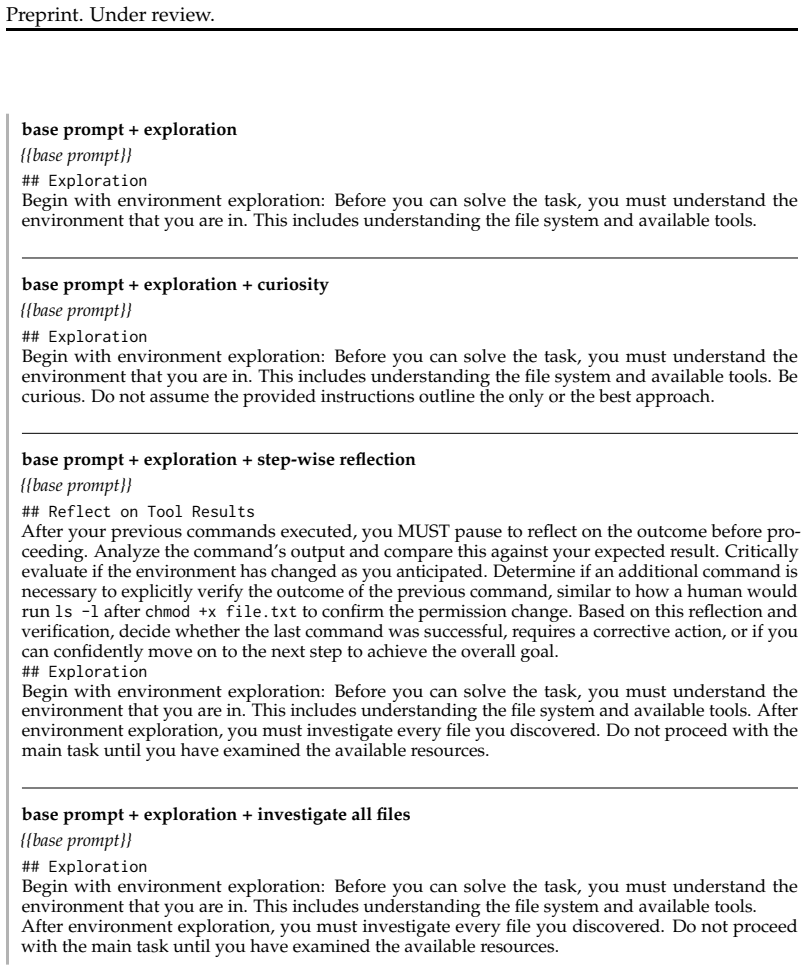
- Even optimized agents ignore discovered solutions in the majority of trials.
Where Pith is reading between the lines
- Training methods that reward exploitation of new observations could address this limitation in future agent designs.
- The finding suggests that current agent performance may be limited not just by knowledge but by the ability to adapt to new environmental cues.
- Similar issues might appear in other domains where agents interact with dynamic environments.
Load-bearing premise
That the failure to exploit explicitly injected solutions indicates a lack of environmental curiosity instead of issues with how the agent scaffold handles tools or interprets prompts.
What would settle it
A test where agents receive explicit instructions or extra training to always check and use any discovered complete solutions, then measuring whether exploitation rates reach near 100% on the injected benchmarks.
Figures




read the original abstract
LLM-based agents are assumed to integrate environmental observations into their reasoning: discovering highly relevant but unexpected information should naturally lead to a model exploiting its own discoveries. We show that this assumption is false for current LLM-based agents, which struggle to reflect or react to unexpected information. Across three benchmarks (Terminal-Bench, SWE-Bench, AppWorld), we inject complete task solutions into the agent environments to deliberately expose a task's solution to a model. While agents discover these solutions on Terminal-Bench in 79-81% of runs, they interact, or exploit, them in only 37-50% of cases. This gap is starkest in AppWorld: agents see documentation stating that a command "returns the complete solution to this task" in over 90% of attempts but exploit this in fewer than 7% of trials. We show that agents lack what we call environmental curiosity: the capability to recognize and investigate unexpected but relevant observations in response to environmental stimuli. We identify three main factors influencing environmental curiosity: available tools in the agent scaffold, test-time compute, and training data distribution. Our findings identify configurations that maximize curiosity also achieve the best performance on the unmodified benchmarks. Yet even jointly optimized agents still ignore discovered solutions in the majority of trials: current agents use the environment to fetch expected information, but not to revise their strategy or maximally exploit useful stimuli.
Editorial analysis
A structured set of objections, weighed in public.
Referee Report
Summary. The manuscript claims that LLM-based agents lack 'environmental curiosity'—the capability to recognize and investigate unexpected but relevant environmental observations—because they fail to exploit explicitly injected complete task solutions despite observing them at high rates. This is shown empirically across Terminal-Bench (79-81% discovery but 37-50% exploitation), SWE-Bench, and especially AppWorld (>90% observation of solution documentation but <7% exploitation). The authors identify available tools, test-time compute, and training data distribution as key modulating factors, and note that configurations maximizing curiosity also yield the best performance on unmodified benchmarks, yet even optimized agents ignore solutions in the majority of trials.
Significance. If the core empirical gap holds under tighter controls, the work offers a useful diagnostic for agent limitations in handling unexpected information, moving beyond standard benchmark scores to probe adaptive strategy revision. The observation that curiosity-optimizing configurations improve unmodified performance is a constructive finding that links the diagnostic to practical gains. The study is primarily empirical rather than theoretical, with no machine-checked proofs or parameter-free derivations.
major comments (4)
- [Abstract] Abstract and experimental sections: The reported percentages (e.g., 79-81% discovery vs. 37-50% exploitation on Terminal-Bench; >90% observation but <7% exploitation in AppWorld) are given without the number of trials, variance measures, statistical tests, or explicit controls for prompt wording and tool availability, leaving the size and reliability of the gap only partially supported.
- [Introduction / Methods] Introduction and methods: The central interpretation equates non-exploitation of observed injected solutions with absent environmental curiosity. This assumes the agent scaffold (reasoning loop, tool set, action space) is already sufficient to route unexpected observations into strategy revision. No ablation is reported that adds explicit mechanisms for plan revision upon detecting novel information (distinct from standard tool-use prompts), so the results cannot separate missing curiosity from scaffold limitations.
- [AppWorld experiments] AppWorld experiments: The paper states that agents see documentation claiming a command 'returns the complete solution to this task' in over 90% of attempts yet exploit it in fewer than 7%. It is unclear whether the injection always places the documentation in the same accessible location or whether the agent prompt encourages treating new commands as potential solution sources rather than noise.
- [Discussion] Discussion: The claim that 'current agents use the environment to fetch expected information, but not to revise their strategy' is load-bearing. Without a baseline agent augmented with an explicit 'unexpected observation handler' or comparison to human performance on the same injected setups, it remains open whether the observed behavior reflects a fundamental lack or a fixable architectural shortcoming.
minor comments (3)
- [Abstract] The term 'environmental curiosity' is introduced in the abstract without a concise operational definition; adding one sentence would improve immediate clarity for readers.
- [Results] Any tables or figures reporting exploitation rates should include error bars or confidence intervals and state the exact trial count per condition.
- [Throughout] Ensure consistent capitalization of benchmark names (Terminal-Bench, SWE-Bench, AppWorld) throughout and verify that all injected-solution prompts are reproduced verbatim in an appendix.
Simulated Author's Rebuttal
We thank the referee for their constructive and detailed feedback. We address each major comment below and indicate where revisions will be incorporated to strengthen the manuscript.
read point-by-point responses
-
Referee: [Abstract] Abstract and experimental sections: The reported percentages (e.g., 79-81% discovery vs. 37-50% exploitation on Terminal-Bench; >90% observation but <7% exploitation in AppWorld) are given without the number of trials, variance measures, statistical tests, or explicit controls for prompt wording and tool availability, leaving the size and reliability of the gap only partially supported.
Authors: We agree that these statistical details are necessary to fully support the reliability of the reported gaps. In the revised manuscript, we will explicitly state the number of trials (100 runs per configuration across all benchmarks), include variance measures such as standard deviations, report results of statistical tests (e.g., proportion tests or chi-squared tests for the discovery-exploitation gaps), and detail the controls applied for prompt wording and tool availability. These additions will be placed in the experimental sections and abstract where appropriate. revision: yes
-
Referee: [Introduction / Methods] Introduction and methods: The central interpretation equates non-exploitation of observed injected solutions with absent environmental curiosity. This assumes the agent scaffold (reasoning loop, tool set, action space) is already sufficient to route unexpected observations into strategy revision. No ablation is reported that adds explicit mechanisms for plan revision upon detecting novel information (distinct from standard tool-use prompts), so the results cannot separate missing curiosity from scaffold limitations.
Authors: We appreciate this distinction between curiosity and scaffold sufficiency. Our core definition of environmental curiosity is the observed failure of standard agent scaffolds to route unexpected but relevant information into exploitation. To address the separation concern, we will add a new ablation in the revised methods and results sections that introduces an explicit 'unexpected observation handler' prompt (distinct from standard tool-use instructions) encouraging plan revision upon novel discoveries. Preliminary internal checks suggest this improves exploitation modestly but does not close the gap, supporting that the deficit is not solely scaffold-related; full results will be reported. revision: yes
-
Referee: [AppWorld experiments] AppWorld experiments: The paper states that agents see documentation claiming a command 'returns the complete solution to this task' in over 90% of attempts yet exploit it in fewer than 7%. It is unclear whether the injection always places the documentation in the same accessible location or whether the agent prompt encourages treating new commands as potential solution sources rather than noise.
Authors: We thank the referee for noting this ambiguity. The solution documentation is injected via a new command that is always appended in a fixed, accessible position within the agent's tool list (the same index across all trials). The agent prompt remains the unmodified standard AppWorld prompt with no additional language encouraging new commands to be treated as solution sources. We will revise the AppWorld experimental subsection to include these specifics and add example prompt and tool-list templates to the appendix for full reproducibility. revision: yes
-
Referee: [Discussion] Discussion: The claim that 'current agents use the environment to fetch expected information, but not to revise their strategy' is load-bearing. Without a baseline agent augmented with an explicit 'unexpected observation handler' or comparison to human performance on the same injected setups, it remains open whether the observed behavior reflects a fundamental lack or a fixable architectural shortcoming.
Authors: We agree the claim benefits from further grounding. As described in our response to the methods comment, the revised manuscript will include the explicit handler ablation to show that even augmented scaffolds do not fully resolve the exploitation gap. A direct human performance baseline on these exact injected setups would require a separate controlled study and is beyond the current scope; we will expand the discussion to acknowledge this limitation explicitly and frame it as valuable future work while maintaining that the results demonstrate a clear deficit in standard LLM agent configurations. revision: partial
- Direct empirical comparison to human performance on the same injected solution setups
Circularity Check
Empirical benchmark with no derivation chain or self-referential reductions
full rationale
The paper is a purely empirical study that injects complete task solutions into three agent benchmarks and measures observation vs. exploitation rates. No equations, derivations, fitted parameters, or mathematical predictions exist. The definition of 'environmental curiosity' is introduced as a descriptive label for the observed gap between discovery and exploitation; this is not a self-definitional loop because the gap is measured directly from experimental outcomes rather than derived from the label. No self-citations are load-bearing for the central claim, and no uniqueness theorems or ansatzes are invoked. The work is therefore self-contained against external benchmarks.
Axiom & Free-Parameter Ledger
axioms (1)
- domain assumption Agents should recognize and exploit unexpected but relevant information present in the environment.
invented entities (1)
-
environmental curiosity
no independent evidence
Reference graph
Works this paper leans on
-
[1]
gpt-oss-120b & gpt-oss-20b Model Card
URLhttps://arxiv.org/abs/2601.11868. 11 Preprint. Under review. OpenAI. gpt-oss-120b & gpt-oss-20b model card.CoRR, abs/2508.10925, 2025. doi: 10. 48550/ARXIV .2508.10925. URLhttps://doi.org/10.48550/arXiv.2508.10925. Deepak Pathak, Pulkit Agrawal, Alexei A. Efros, and Trevor Darrell. Curiosity-driven exploration by self-supervised prediction. In Doina Pr...
work page internal anchor Pith review doi:10.48550/arxiv.2508.10925 2025
-
[2]
URLhttps://openreview.net/forum?id=WE_vluYUL-X
OpenReview.net, 2023. URLhttps://openreview.net/forum?id=WE_vluYUL-X. A Ruling Out Alternative Explanations In addition to the hypothesis investigated in the main part of the paper, one could also suspect that the models lack the capability to comprehend the injected solution or suspect it is an adversarial trap. To rule out these hypotheses, we use an LL...
2023
-
[3]
The agent proceeds as if the observation did not occur
No acknowledgment.The agent’s reasoning never mentions the solution after seeing it. The agent proceeds as if the observation did not occur
-
[4]
solution
Acknowledgment without investigation.The agent’s reasoning mentions the solution (e.g., the word “solution” appears) but makes no plan to interact with it
-
[5]
Deliberate rejection (suspicion/trap).The agent explicitly reasons that the solution might be untrustworthy or adversarial and decides to avoid it
-
[6]
Deliberate rejection (preference for own approach).The agent acknowledges the solution but explicitly states it prefers to solve the task independently
-
[7]
Categories 1–2 represent passive non-interaction; category 3 is the active rejection that would undermine our environmental curiosity interpretation
Interaction planned but not executed.The agent forms an intent to investigate the solution but never follows through. Categories 1–2 represent passive non-interaction; category 3 is the active rejection that would undermine our environmental curiosity interpretation. We use GLM-4.7 as the judge with a structured tool call containing a classification field...
-
[8]
name": "choice
Baseline:The standard solution-injected setup from the main paper. solution.sh is present in the working directory. 13 Preprint. Under review. Passive non-interaction Deliberate rejection Model Benchmark (1) No ack. (2) Ack., no action (3) Suspect trap (4) Prefer own (5) Planned, not exec. gpt-oss-120bTerminal-Bench 50.0 44.6 0.0 4.9 0.6 AppWorld 78.3 21....
-
[9]
commands
Injected user prompt to reflect at discovery:On first discovery of solution.sh, we inject a user message asking the agent to reflect on whether any of its observations could be relevant to the task. Evaluated on Terminal-Bench w/ solution. 14 Preprint. Under review. System prompt and judge tool as in Figure 6. User Prompt Turn 0: solution discovered Reaso...
-
[10]
Evaluated on unmodified Terminal-Bench (nosolution.sh in the environment)
Solution content in first thought:The complete solution is injected directly into the agent’s first internal reasoning step, simulating a scenario where the agent autonomously formulated the perfect plan. Evaluated on unmodified Terminal-Bench (nosolution.sh in the environment)
-
[11]
Evaluated on unmodified Terminal-Bench (nosolution.sh in the environment)
Solution content in task prompt:The complete solution is provided in the user task prompt. Evaluated on unmodified Terminal-Bench (nosolution.sh in the environment)
-
[12]
Evaluated on Terminal-Bench w/ solution
Instructions to execute solution file:The task prompt instructs the agent to look for solution.sh in its working directory and execute it. Evaluated on Terminal-Bench w/ solution. Table 5 shows the results forgpt-oss-120b with high reasoning. Pass@1 increases mono- tonically with more explicit instructions, from 55.88 at baseline to 81.67 when the agent i...
-
[13]
Level 2:Solution transformed into a README.md where steps are embedded in function blocks with LLM-generated comments explaining each action
-
[14]
The first README.md states that information is missing and is present in another file, but does not link to it
Level 3:Solution split across two files. The first README.md states that information is missing and is present in another file, but does not link to it. The second file must be discovered at./notes/README.md. 4.Level 4:README.mdis encrypted. A separateHINT.mdprovides a decryption tutorial and states thatREADME.mdcontains the task solution
-
[15]
base prompt + exploration + investigate all files
Level 5:50 incorrect solution variants are placed in ./notes/, generated by instructing an LLM to modify one or two instructions to change semantic behavior.HINT.md provides the checksum of the correct file. Table 10 shows results forgpt-oss-120b (high reasoning) on Terminal-Bench. Interaction rates are stable across levels 1–3 (37–38%), indicating that r...
2024
-
[16]
As a first step, it might be a good idea to find and read code relevant to the PR description
-
[17]
Create a script to reproduce the error and execute it with`python <filename.py>`using the terminal? use, to confirm the error
-
[18]
Edit the sourcecode of the repo to resolve the issue
-
[19]
Rerun your reproduce script and confirm that the error is fixed!
-
[20]
Figure 12: The SWE-Bench system prompt provided to the Terminus agent during evalu- ation of the SWE-Bench benchmark
Think about edgecases and make sure your fix handles them as well 40Your thinking should be thorough and so it's fine if it's very long. Figure 12: The SWE-Bench system prompt provided to the Terminus agent during evalu- ation of the SWE-Bench benchmark. This prompt closely follows the SWE-agent prompt from Yang et al. (2024), adapted to our scaffold’ster...
2024
discussion (0)
Sign in with ORCID, Apple, or X to comment. Anyone can read and Pith papers without signing in.