Recognition: unknown
Voronoi-guided Bilateral 2D Gaussian Splatting for Arbitrary-Scale Hyperspectral Image Super-Resolution
Pith reviewed 2026-05-10 05:40 UTC · model grok-4.3
The pith
Voronoi-guided bilateral 2D Gaussian splatting reconstructs hyperspectral images at arbitrary scales from one model.
A machine-rendered reading of the paper's core claim, the machinery that carries it, and where it could break.
Core claim
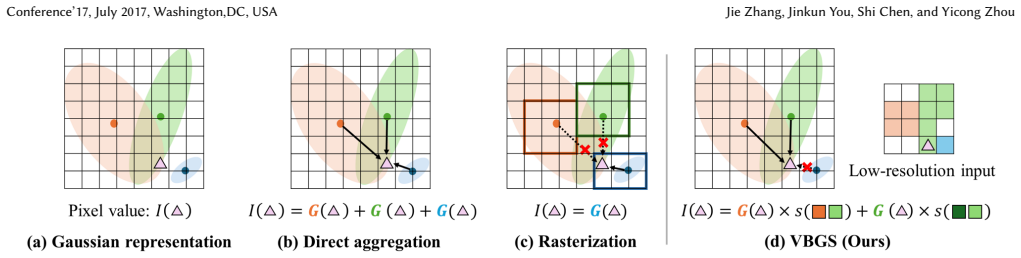
After predicting a set of 2D Gaussian functions from the input, the method associates each target pixel with relevant Gaussians via Voronoi-guided selection and reconstructs the pixel by weighted aggregation that incorporates both geometric relevance and consistency with low-resolution reference features; a Spectral Detail Enhancement module is then applied to refine spectral bands, producing high-resolution hyperspectral output at any desired scale without per-scale model changes.
What carries the argument
Voronoi-Guided Bilateral 2D Gaussian Splatting, which uses Voronoi cells to select which Gaussians contribute to each pixel and applies reference-aware bilateral weighting to aggregate them for spatial reconstruction.
If this is right
- A single trained model supports reconstruction at any continuous scale factor without retraining or architectural changes.
- Voronoi selection combined with bilateral weighting provides adaptive spatial detail while the separate module maintains spectral consistency.
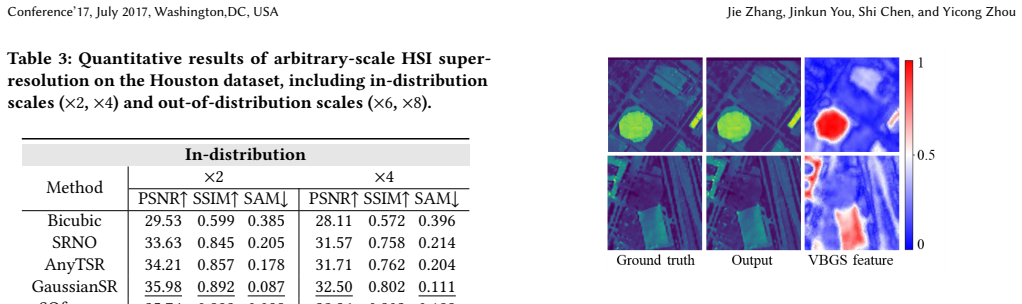
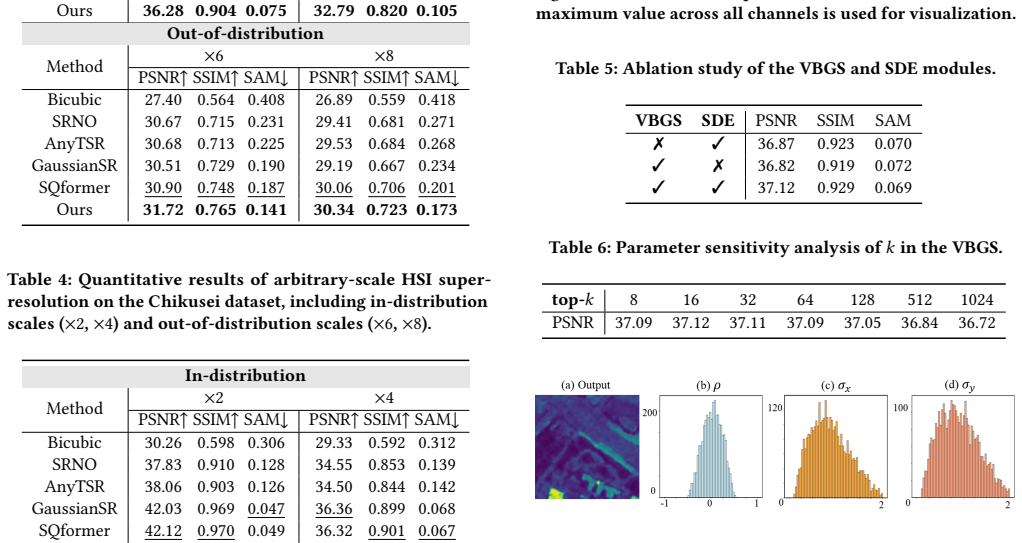
- The framework outperforms prior state-of-the-art methods on standard benchmark datasets for arbitrary-scale hyperspectral super-resolution.
- The continuous Gaussian representation eliminates the need for discrete scale-specific networks.
Where Pith is reading between the lines
- This representation could simplify deployment in remote-sensing systems that must generate outputs at multiple resolutions from the same sensor data.
- The explicit Voronoi partitioning may offer a geometric alternative to learned attention mechanisms in other continuous image synthesis tasks.
- Extending the bilateral weighting to incorporate temporal consistency could support hyperspectral video super-resolution at variable frame rates.
- The method's parameter-free scale handling suggests it might transfer to related problems such as arbitrary-scale multispectral or medical image enhancement.
Load-bearing premise
That Voronoi-guided selection of Gaussians together with reference-aware bilateral weighting will deliver adaptive spatial reconstruction at arbitrary scales while preserving spectral fidelity without requiring any scale-specific modifications to the model.
What would settle it
Apply the trained GaussianHSI model to a held-out hyperspectral image at an extreme unseen scale factor such as 64x and compare the output against ground-truth high-resolution data; if spatial sharpness degrades or spectral signatures deviate significantly from the reference, the arbitrary-scale claim fails.
Figures


read the original abstract
Most existing hyperspectral image super-resolution methods require modifications for different scales, limiting their flexibility in arbitrary-scale reconstruction. 2D Gaussian splatting provides a continuous representation that is compatible with arbitrary-scale super-resolution. Existing methods often rely on rasterization strategies, which may limit flexible spatial modeling. Extending them to hyperspectral image super-resolution remains challenging, as the task requires adaptive spatial reconstruction while preserving spectral fidelity. This paper proposes GaussianHSI, a Gaussian-Splatting-based framework for arbitrary-scale hyperspectral image super-resolution. We develop a Voronoi-Guided Bilateral 2D Gaussian Splatting for spatial reconstruction. After predicting a set of Gaussian functions to represent the input, it associates each target pixel with relevant Gaussian functions through Voronoi-guided selection. The target pixel is then reconstructed by aggregating the selected Gaussian functions with reference-aware bilateral weighting, which considers both geometric relevance and consistency with low-resolution features. We further introduce a Spectral Detail Enhancement module to improve spectral reconstruction. Extensive experiments on benchmark datasets demonstrate the effectiveness of GaussianHSI over state-of-the-art methods for arbitrary-scale hyperspectral image super-resolution.
Editorial analysis
A structured set of objections, weighed in public.
Referee Report
Summary. The paper proposes GaussianHSI, a Gaussian-splatting framework for arbitrary-scale hyperspectral image super-resolution. It predicts a fixed set of 2D Gaussians from the low-resolution input, associates target pixels via Voronoi-guided selection, aggregates them using reference-aware bilateral weighting (geometric relevance plus LR-feature consistency), and adds a Spectral Detail Enhancement module for spectral fidelity. The abstract claims this yields continuous, scale-agnostic reconstruction without per-scale modifications and outperforms SOTA on benchmarks.
Significance. If the continuity and fidelity claims hold, the work would offer a genuinely flexible continuous representation for HSI SR that avoids retraining or architectural changes across scales, which is practically valuable for remote-sensing pipelines. Extending 2D Gaussian splatting with Voronoi partitioning and bilateral reference weighting is a plausible direction, but its advantage over existing continuous or implicit representations remains to be demonstrated quantitatively.
major comments (2)
- [Method (Voronoi-Guided Bilateral 2D Gaussian Splatting)] Method section describing Voronoi-Guided Bilateral 2D Gaussian Splatting: the construction fixes Gaussian parameters (means, covariances, opacities) at the input scale and uses discrete Voronoi assignment followed by bilateral aggregation. No derivation or analysis is supplied showing that the reconstructed value at an arbitrary continuous coordinate (e.g., scale factor 2.37) remains a smooth, faithful interpolation of the underlying field when the scale lies far from the training distribution. This directly underpins the central “arbitrary-scale without per-scale modifications” claim.
- [Experiments] Experimental section: while the abstract states “extensive experiments on benchmark datasets,” no quantitative tables, ablation studies, or error analysis for non-integer scales are referenced in the provided description. Without these, it is impossible to verify whether performance degrades precisely in the regime the skeptic highlights.
minor comments (1)
- [Abstract / Method overview] The abstract and method overview would benefit from an explicit statement of the mathematical formulation (e.g., the exact form of the bilateral weight and the Voronoi selection rule) rather than high-level prose.
Simulated Author's Rebuttal
Thank you for the opportunity to respond to the referee's report. We appreciate the insightful comments and will revise the manuscript to provide additional theoretical analysis and experimental details as requested.
read point-by-point responses
-
Referee: [Method (Voronoi-Guided Bilateral 2D Gaussian Splatting)] Method section describing Voronoi-Guided Bilateral 2D Gaussian Splatting: the construction fixes Gaussian parameters (means, covariances, opacities) at the input scale and uses discrete Voronoi assignment followed by bilateral aggregation. No derivation or analysis is supplied showing that the reconstructed value at an arbitrary continuous coordinate (e.g., scale factor 2.37) remains a smooth, faithful interpolation of the underlying field when the scale lies far from the training distribution. This directly underpins the central “arbitrary-scale without per-scale modifications” claim.
Authors: We acknowledge the referee's observation that the current manuscript does not provide a formal derivation or analysis demonstrating the smoothness and fidelity of the reconstruction at arbitrary continuous coordinates. The framework is built upon continuous 2D Gaussian functions, with Voronoi-guided selection and bilateral weighting defined to operate directly on continuous target coordinates without requiring scale-specific modifications. Nevertheless, to rigorously support the arbitrary-scale claim, we will add a dedicated analysis in the revised Method section. This will include a mathematical characterization of the reconstruction as a continuous function of the query position and empirical evaluation for non-integer scales distant from the training set, such as 2.37. revision: yes
-
Referee: [Experiments] Experimental section: while the abstract states “extensive experiments on benchmark datasets,” no quantitative tables, ablation studies, or error analysis for non-integer scales are referenced in the provided description. Without these, it is impossible to verify whether performance degrades precisely in the regime the skeptic highlights.
Authors: The manuscript does contain quantitative evaluations on benchmark datasets for arbitrary scales. However, we agree that the presentation could be improved to explicitly include and highlight results for non-integer scales. In the revision, we will expand the Experiments section with dedicated tables, additional ablation studies, and error analysis specifically for non-integer scale factors. This will provide clear evidence regarding performance consistency or degradation in those regimes. revision: yes
Circularity Check
No circularity: framework introduces independent components without reduction to inputs
full rationale
The abstract and description present GaussianHSI as a composite construction: a network predicts a set of 2D Gaussians from the LR hyperspectral input; Voronoi partitioning then selects relevant Gaussians per target coordinate; reference-aware bilateral weights (geometric + LR-feature consistency) aggregate them; a separate Spectral Detail Enhancement module refines the spectrum. None of these steps are shown to be equivalent to the input by definition, nor are any core quantities obtained by fitting a parameter to a subset and relabeling the fit as a prediction. No self-citations, uniqueness theorems, or ansatzes imported from prior author work are invoked in the provided text to justify the central choices. The arbitrary-scale claim therefore rests on the explicit algorithmic steps rather than on any self-referential closure.
Axiom & Free-Parameter Ledger
Reference graph
Works this paper leans on
-
[1]
Franz Aurenhammer. 1991. Voronoi diagrams—a survey of a fundamental geo- metric data structure.ACM computing surveys (CSUR)23, 3 (1991), 345–405
1991
-
[2]
Du Chen, Liyi Chen, Zhengqiang Zhang, and Lei Zhang. 2025. Generalized and efficient 2d gaussian splatting for arbitrary-scale super-resolution. InProceedings of the IEEE/CVF International Conference on Computer Vision. 26435–26445
2025
-
[3]
Shi Chen, Lefei Zhang, and Liangpei Zhang. 2023. MSDformer: Multiscale de- formable transformer for hyperspectral image super-resolution.IEEE Transactions on Geoscience and Remote Sensing61 (2023), 1–14
2023
- [4]
-
[5]
Roy De Maesschalck, Delphine Jouan-Rimbaud, and Désiré L Massart. 2000. The mahalanobis distance.Chemometrics and intelligent laboratory systems50, 1 (2000), 1–18
2000
-
[6]
Paolo Gamba. 2004. A collection of data for urban area characterization. In IGARSS 2004. 2004 IEEE International Geoscience and Remote Sensing Symposium, Vol. 1. IEEE
2004
-
[7]
Albert Gu and Tri Dao. 2024. Mamba: Linear-time sequence modeling with selective state spaces. InFirst conference on language modeling
2024
-
[8]
Quangui He, Jiahui Qu, Wenqian Dong, Song Xiao, and Qinghao Gao. 2025. Cycle-Consistent Mamba-Based Registration-Fusion Joint Network for Unreg- istered Hyperspectral Image Super-Resolution. InProceedings of the 33rd ACM International Conference on Multimedia. 1724–1733
2025
-
[9]
Jintong Hu, Bin Xia, Bin Chen, Wenming Yang, and Lei Zhang. 2025. Gaussiansr: High fidelity 2d gaussian splatting for arbitrary-scale image super-resolution. In Proceedings of the AAAI Conference on Artificial Intelligence, Vol. 39. 3554–3562
2025
-
[10]
Yang Hu, Jingui Ma, Yucheng Yang, Jie Liang, Jinbo Yan, Jiahao Wu, Jiayu Yang, Yang Deng, and Ronggang Wang. 2025. Excavating the Most Critical Gaussians: Sparse Selection and Structural Optimization for Efficient 3DGS Compression. In Proceedings of the 33rd ACM International Conference on Multimedia. 6967–6976
2025
-
[11]
Shuguo Jiang, Nanying Li, Meng Xu, Shuyu Zhang, and Sen Jia. 2024. SQ- former: Spectral-query transformer for hyperspectral image arbitrary-scale super- resolution.IEEE Transactions on Geoscience and Remote Sensing62 (2024), 1–15
2024
-
[12]
Bernhard Kerbl, Georgios Kopanas, Thomas Leimkühler, George Drettakis, et al
-
[13]
Graph.42, 4 (2023), 139–1
3d gaussian splatting for real-time radiance field rendering.ACM Trans. Graph.42, 4 (2023), 139–1
2023
-
[14]
Muhammad Jaleed Khan, Hamid Saeed Khan, Adeel Yousaf, Khurram Khurshid, and Asad Abbas. 2018. Modern trends in hyperspectral image analysis: A review. Ieee Access6 (2018), 14118–14129
2018
-
[15]
Diederik P Kingma and Jimmy Ba. 2014. Adam: A method for stochastic opti- mization.arXiv preprint arXiv:1412.6980(2014)
work page internal anchor Pith review Pith/arXiv arXiv 2014
-
[16]
Jiaojiao Li, Yuzhe Liu, Rui Song, Wei Liu, Yunsong Li, and Qian Du. 2024. Hyper- MLP: Superpixel prior and feature aggregated perceptron networks for hyper- spectral and LiDAR hybrid classification.IEEE Transactions on Geoscience and Remote Sensing62 (2024), 1–14
2024
- [17]
-
[18]
Qiang Li, Qi Wang, and Xuelong Li. 2020. Mixed 2D/3D convolutional network for hyperspectral image super-resolution.Remote sensing12, 10 (2020), 1660
2020
-
[19]
Bee Lim, Sanghyun Son, Heewon Kim, Seungjun Nah, and Kyoung Mu Lee
-
[20]
In Proceedings of the IEEE conference on computer vision and pattern recognition workshops
Enhanced deep residual networks for single image super-resolution. In Proceedings of the IEEE conference on computer vision and pattern recognition workshops. 136–144
-
[21]
Xuyao Liu, Jiahui Qu, and Wenqian Dong. 2025. Breaking the Spatial-Temporal Consistency Constraint: Towards Reference-Based Hyperspectral Image Super- Resolution. InProceedings of the 33rd ACM International Conference on Multimedia. 2094–2103
2025
-
[22]
Ze Liu, Yutong Lin, Yue Cao, Han Hu, Yixuan Wei, Zheng Zhang, Stephen Lin, and Baining Guo. 2021. Swin transformer: Hierarchical vision transformer us- ing shifted windows. InProceedings of the IEEE/CVF international conference on computer vision. 10012–10022
2021
-
[23]
Usman Muhammad and Jorma Laaksonen. 2025. Hybrid Deep Learning for Hy- perspectral Single Image Super-Resolution.IEEE Geoscience and Remote Sensing Letters(2025)
2025
-
[24]
Li Pang, Xiangyu Rui, Long Cui, Hongzhong Wang, Deyu Meng, and Xiangyong Cao. 2024. Hir-diff: Unsupervised hyperspectral image restoration via improved diffusion models. InProceedings of the IEEE/CVF conference on computer vision and pattern recognition. 3005–3014
2024
- [25]
-
[26]
Antonio Plaza, Jon Atli Benediktsson, Joseph W Boardman, Jason Brazile, Lorenzo Bruzzone, Gustavo Camps-Valls, Jocelyn Chanussot, Mathieu Fauvel, Paolo Gamba, Anthony Gualtieri, et al. 2009. Recent advances in techniques for hyper- spectral image processing.Remote sensing of environment113 (2009), S110–S122
2009
-
[27]
Mary B Stuart, Andrew JS McGonigle, and Jon R Willmott. 2019. Hyperspectral imaging in environmental monitoring: A review of recent developments and technological advances in compact field deployable systems.Sensors19, 14 (2019), 3071
2019
-
[28]
Yuanchao Su, Lianru Gao, Antonio Plaza, Xu Sun, Mengying Jiang, and Guang Yang. 2025. SRViT: Self-supervised relation-aware vision transformer for hyper- spectral unmixing.IEEE Transactions on Neural Networks and Learning Systems (2025)
2025
-
[29]
Waldo R Tobler. 1970. A computer movie simulating urban growth in the Detroit region.Economic geography46, sup1 (1970), 234–240
1970
-
[30]
Xinya Wang, Qian Hu, Yingsong Cheng, and Jiayi Ma. 2023. Hyperspectral image super-resolution meets deep learning: A survey and perspective.IEEE/CAA Journal of Automatica Sinica10, 8 (2023), 1668–1691
2023
-
[31]
Xinya Wang, Qian Hu, Junjun Jiang, and Jiayi Ma. 2022. A group-based embedding learning and integration network for hyperspectral image super-resolution.IEEE Transactions on Geoscience and Remote Sensing60 (2022), 1–16
2022
-
[32]
Min Wei and Xuesong Zhang. 2023. Super-resolution neural operator. InPro- ceedings of the IEEE/CVF Conference on Computer Vision and Pattern Recognition. 18247–18256
2023
-
[33]
Zhehui Wu, Yong Chen, Naoto Yokoya, and Wei He. 2025. MP-HSIR: A multi- prompt framework for universal hyperspectral image restoration. InProceedings of the IEEE/CVF International Conference on Computer Vision. 13009–13020
2025
-
[34]
Xiaofei Yang, Sihuan Li, Weijia Cao, Dong Tang, Yifang Ban, and Yicong Zhou
-
[35]
RWKVSR: Receptance Weighted Key-Value Network for Hyperspectral Image Super-Resolution.IEEE Transactions on Circuits and Systems for Video Technology(2025)
2025
-
[36]
Naoto Yokoya and Akira Iwasaki. 2016. Airborne hyperspectral data over Chiku- sei.Space Appl. Lab., Univ. Tokyo, Tokyo, Japan, Tech. Rep. SAL-2016-05-275 (2016), 5
2016
-
[37]
Zhaojie Zeng, Yuesong Wang, Tao Guan, Chao Yang, and Lili Ju. 2025. Instant GaussianImage: A generalizable and self-adaptive image representation via 2D Gaussian splatting. InProceedings of the IEEE/CVF International Conference on Computer Vision. 27896–27905
2025
-
[38]
Mingjin Zhang, Chi Zhang, Qiming Zhang, Jie Guo, Xinbo Gao, and Jing Zhang
-
[39]
InProceedings of the IEEE/CVF International Conference on Computer Vision
ESSAformer: Efficient transformer for hyperspectral image super-resolution. InProceedings of the IEEE/CVF International Conference on Computer Vision. 23073– 23084
-
[40]
Xinjie Zhang, Xingtong Ge, Tongda Xu, Dailan He, Yan Wang, Hongwei Qin, Guo Lu, Jing Geng, and Jun Zhang. 2024. Gaussianimage: 1000 fps image repre- sentation and compression by 2d gaussian splatting. InEuropean Conference on Computer Vision. Springer, 327–345
2024
-
[41]
Yongshan Zhang, Zixuan Zhang, Xinxin Wang, Lefei Zhang, and Zhihua Cai
-
[42]
InProceedings of the AAAI Conference on Artificial Intelligence, Vol
Anchor-Guided Discriminative Subspace Alignment and Clustering for Cross-Scene Hyperspectral Imagery. InProceedings of the AAAI Conference on Artificial Intelligence, Vol. 40. 12961–12969
discussion (0)
Sign in with ORCID, Apple, or X to comment. Anyone can read and Pith papers without signing in.