Recognition: unknown
Modeling Multiple Support Strategies within a Single Turn for Emotional Support Conversations
Pith reviewed 2026-05-10 04:33 UTC · model grok-4.3
The pith
Emotional support conversations improve when a single turn can use multiple strategies instead of one.
A machine-rendered reading of the paper's core claim, the machinery that carries it, and where it could break.
Core claim
By treating emotional support conversation as multi-strategy utterance generation, in which each turn may hold several strategy-response pairs, and by implementing All-in-One and One-by-One decoding further guided by reinforcement-learning cognitive reasoning, the resulting models produce utterances and dialogues that score higher on supportive quality and success measures than single-strategy baselines on the ESConv dataset.
What carries the argument
Multi-strategy utterance generation using All-in-One and One-by-One decoding procedures that are augmented with reinforcement-learning cognitive reasoning for strategy selection and response composition.
If this is right
- Utterances containing several strategies at once can be generated reliably with the All-in-One and One-by-One procedures.
- Reinforcement learning for cognitive reasoning improves both strategy choice and response quality in this setting.
- The multi-strategy approach raises scores on both per-turn and full-dialogue evaluation metrics.
- Allowing multiple strategies per turn is feasible without harming coherence or relevance.
Where Pith is reading between the lines
- The same multi-strategy framing could be tested in other goal-oriented dialogues such as persuasion or counseling.
- Real-world deployment would let researchers check whether users actually prefer mixed-strategy turns over single-strategy ones.
- The methods might shorten average response length while preserving coverage of needed support actions.
Load-bearing premise
The ESConv dataset and the chosen utterance-level and dialogue-level metrics accurately measure real-world supportive quality and that observed gains are not caused by unstated differences in training or decoding.
What would settle it
A human-subject study in which participants experiencing distress converse with single-strategy versus multi-strategy models and rate the conversations for empathy, helpfulness, and overall support.
Figures






read the original abstract
Emotional Support Conversation (ESC) aims to assist individuals experiencing distress by generating empathetic and supportive dialogue. While prior work typically assumes that each supporter turn corresponds to a single strategy, real-world supportive communication often involves multiple strategies within a single utterance. In this paper, we revisit the ESC task by formulating it as multi-strategy utterance generation, where each utterance may contain one or more strategy-response pairs. We propose two generation methods: All-in-One, which predicts all strategy-response pairs in a single decoding step, and One-by-One, which iteratively generates strategy-response pairs until completion. Both methods are further enhanced with cognitive reasoning guided by reinforcement learning to improve strategy selection and response composition. We evaluate our models on the ESConv dataset under both utterance-level and dialogue-level settings. Experimental results show that our methods effectively model multi-strategy utterances and lead to improved supportive quality and dialogue success. To our knowledge, this work provides the first systematic empirical evidence that allowing multiple support strategies within a single utterance is both feasible and beneficial for emotional support conversations. All code and data will be publicly available at https://github.com/aliyun/qwen-dianjin.
Editorial analysis
A structured set of objections, weighed in public.
Referee Report
Summary. The paper reformulates Emotional Support Conversations (ESC) as multi-strategy utterance generation, where each supporter turn can contain one or more strategy-response pairs. It introduces two decoding procedures—All-in-One (single-step prediction of all pairs) and One-by-One (iterative generation)—both augmented with reinforcement learning for cognitive reasoning in strategy selection and response composition. Experiments on the ESConv dataset under utterance-level and dialogue-level settings report improved supportive quality and dialogue success, positioning the work as the first systematic empirical evidence that multi-strategy modeling within single utterances is feasible and beneficial.
Significance. If the empirical gains are robustly attributable to the multi-strategy formulation, the work advances ESC modeling toward greater realism by capturing how supportive communication often interleaves multiple strategies in one turn. The planned public release of code and data supports reproducibility and follow-on research. Significance is tempered by the need to confirm that improvements exceed what RL augmentation alone would provide on single-strategy baselines.
major comments (2)
- [Experiments] The central claim—that gains arise from explicitly modeling multiple strategy-response pairs within one utterance—requires an ablation that applies equivalent RL cognitive reasoning to single-strategy baselines. The manuscript describes RL enhancement only for the proposed All-in-One and One-by-One methods; without this control, attribution to the multi-strategy change versus the RL training signal remains insecure (see Experiments section and the reported comparisons to prior single-strategy work).
- [Evaluation and Results] The abstract and evaluation description state that models 'lead to improved supportive quality and dialogue success' on ESConv but supply no numerical results, baseline scores, statistical significance tests, or ablation tables. This prevents verification of the magnitude and reliability of the claimed benefits under both utterance- and dialogue-level protocols.
Simulated Author's Rebuttal
We thank the referee for the thoughtful and constructive feedback. We address each major comment below and describe the revisions we will make to strengthen the manuscript.
read point-by-point responses
-
Referee: [Experiments] The central claim—that gains arise from explicitly modeling multiple strategy-response pairs within one utterance—requires an ablation that applies equivalent RL cognitive reasoning to single-strategy baselines. The manuscript describes RL enhancement only for the proposed All-in-One and One-by-One methods; without this control, attribution to the multi-strategy change versus the RL training signal remains insecure (see Experiments section and the reported comparisons to prior single-strategy work).
Authors: We agree that the current experimental design leaves open the possibility that observed gains are partly attributable to the RL component rather than the multi-strategy formulation itself. To isolate the contribution of modeling multiple strategies per utterance, we will add a new ablation in the revised Experiments section that applies the identical RL cognitive-reasoning procedure to strong single-strategy baselines. This will allow direct comparison between RL-enhanced single-strategy models and our multi-strategy All-in-One and One-by-One variants under both utterance- and dialogue-level protocols. revision: yes
-
Referee: [Evaluation and Results] The abstract and evaluation description state that models 'lead to improved supportive quality and dialogue success' on ESConv but supply no numerical results, baseline scores, statistical significance tests, or ablation tables. This prevents verification of the magnitude and reliability of the claimed benefits under both utterance- and dialogue-level protocols.
Authors: We acknowledge that the current manuscript version presents only qualitative statements of improvement without accompanying numerical tables, baseline scores, or significance tests. In the revised version we will expand the Evaluation and Results section to include full numerical results for all models and settings, complete baseline comparisons, statistical significance tests, and the new ablation tables mentioned above. These additions will enable readers to assess the magnitude and reliability of the reported gains. revision: yes
Circularity Check
No significant circularity in empirical task reformulation and evaluation
full rationale
The paper reformulates the ESC task as multi-strategy utterance generation, introduces All-in-One and One-by-One decoding procedures, augments them with RL-guided cognitive reasoning, and reports experimental gains on the external ESConv dataset under utterance- and dialogue-level metrics. No equations, parameters, or claims reduce by construction to fitted inputs, self-definitions, or load-bearing self-citations; the central evidence consists of comparative results against prior single-strategy baselines rather than tautological renaming or imported uniqueness theorems.
Axiom & Free-Parameter Ledger
Reference graph
Works this paper leans on
-
[1]
DeepSeek-R1: Incentivizing Reasoning Capability in LLMs via Reinforcement Learning
Improving multi-turn emotional support dia- logue generation with lookahead strategy planning. InProceedings of EMNLP, pages 3014–3026. Yang Deng, Wenxuan Zhang, Wai Lam, See-Kiong Ng, and Tat-Seng Chua. 2024. Plug-and-play policy planner for large language model powered dialogue agents. InProceedings of ICLR. Google. 2024. Gemini 2.5 flash. Daya Guo, Dej...
work page internal anchor Pith review Pith/arXiv arXiv 2024
-
[2]
strategy
algorithm for 7 epochs on the same hardware setup, with a batch size of 1024, a rollout size of 16, and a learning rate of 1e-6. The KL-penalty coefficient is fixed at 0.01. Additionally, the data distillation, self-play eval- uation, and other processes involving advanced model API calls incurred an approximate total cost of 800 USD. C Performance of Ins...
2025
-
[4]
Context":
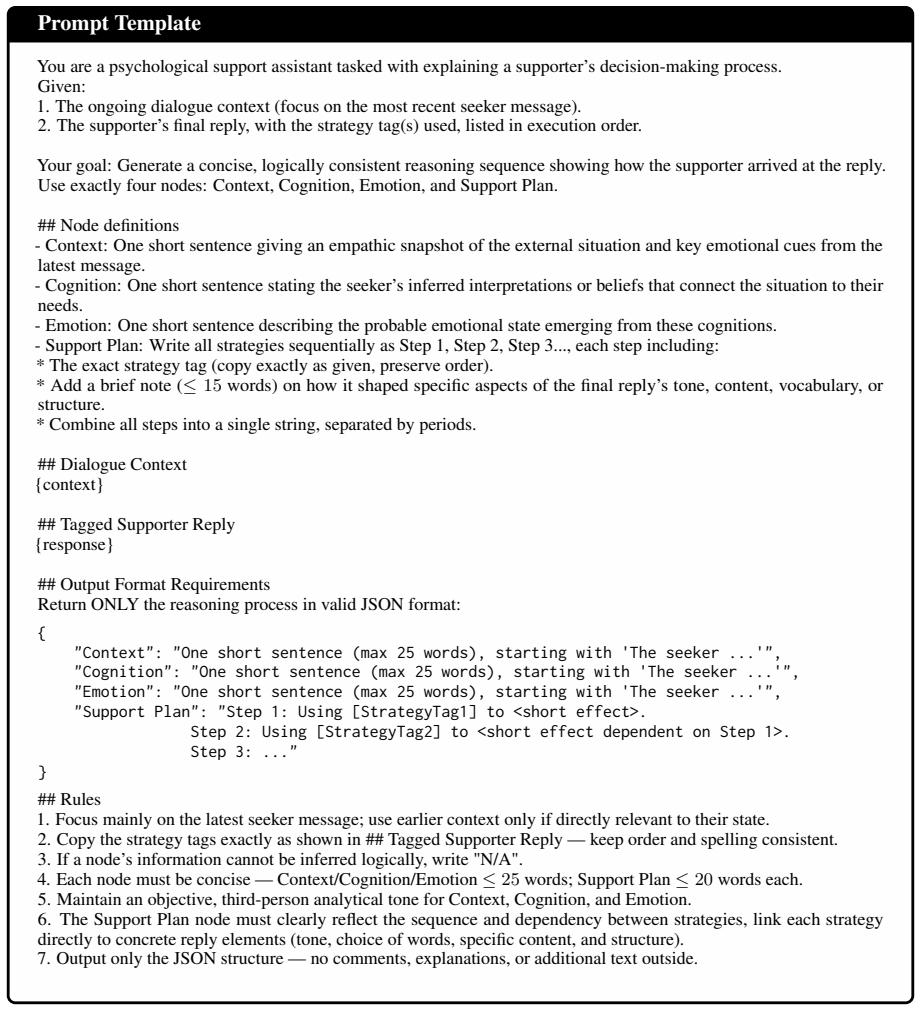
The supporter’s final reply, with the strategy tag(s) used, listed in execution order. Your goal: Generate a concise, logically consistent reasoning sequence showing how the supporter arrived at the reply. Use exactly four nodes: Context, Cognition, Emotion, and Support Plan. ## Node definitions - Context: One short sentence giving an empathic snapshot of...
-
[6]
Copy the strategy tags exactly as shown in ## Tagged Supporter Reply — keep order and spelling consistent
-
[8]
Each node must be concise — Context/Cognition/Emotion≤25words; Support Plan≤20words each
-
[10]
The Support Plan node must clearly reflect the sequence and dependency between strategies, link each strategy directly to concrete reply elements (tone, choice of words, specific content, and structure)
-
[11]
strategy
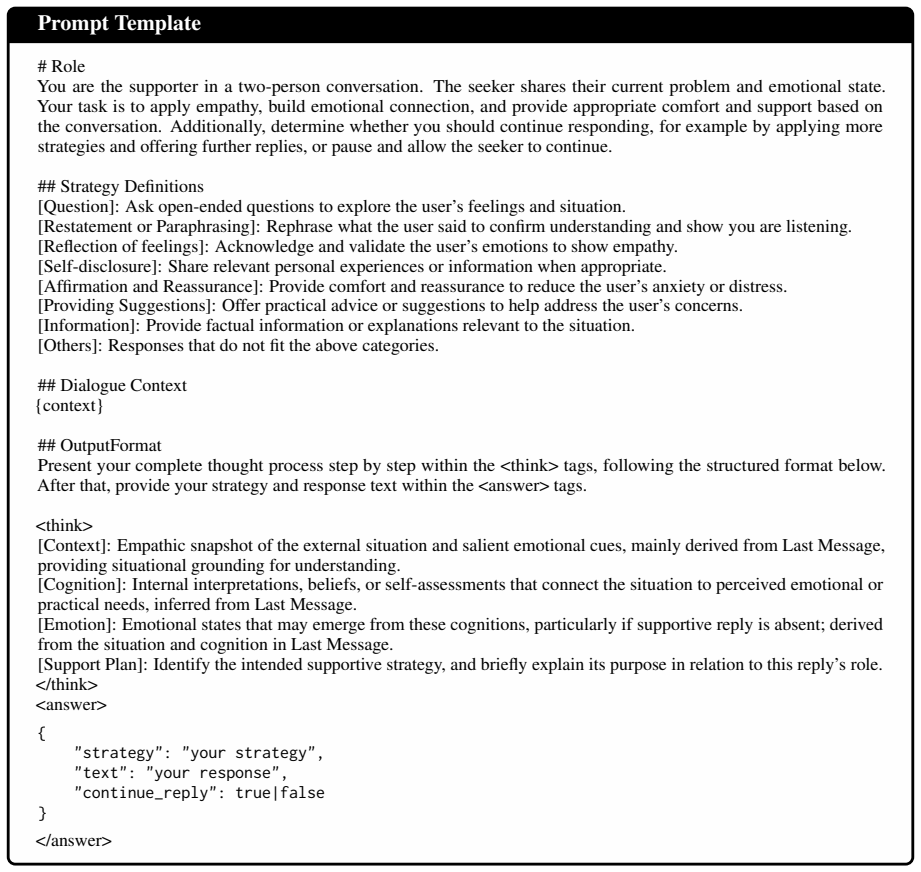
Output only the JSON structure — no comments, explanations, or additional text outside. Figure 8: Prompt used for the All-in-One method, which distills cognitive reasoning. Prompt Template # Role You are the supporter in a two-person conversation. The seeker shares their current problem and emotional state. Your task is to apply empathy, build emotional c...
-
[12]
The ongoing dialogue context (focus on the most recent seeker message)
-
[13]
Context":
The supporter’s final reply, with the strategy tag used. Your goal: Generate a concise, logically consistent reasoning sequence showing how the supporter arrived at the reply. Use exactly four nodes: Context, Cognition, Emotion, and Support Plan. ## Node definitions - Context: One short sentence giving an empathic snapshot of the external situation and ke...
-
[14]
Focus mainly on the latest seeker message; use earlier context only if directly relevant to their state
-
[15]
Copy the strategy tag exactly as shown in ## Tagged Supporter Reply — keep spelling consistent
-
[16]
If a node’s information cannot be inferred logically, write "N/A"
-
[17]
Each node must be concise — Context/Cognition/Emotion≤25words; Support Plan≤25words
-
[18]
Maintain an objective, third-person analytical tone for Context, Cognition, and Emotion
-
[19]
The Support Plan node should link the strategy directly to concrete reply elements (tone, choice of words, specific content, and structure)
-
[20]
Figure 11: Prompt used for the One-by-One method, which distills cognitive reasoning
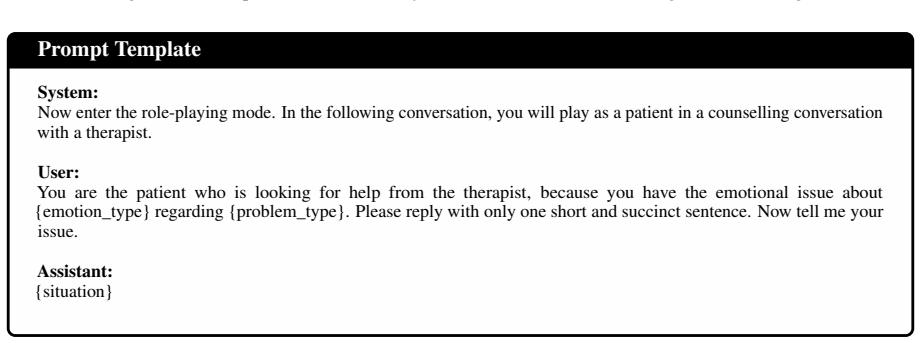
Output only the JSON structure — no comments, explanations, or additional text outside. Figure 11: Prompt used for the One-by-One method, which distills cognitive reasoning. Prompt Template System: Now enter the role-playing mode. In the following conversation, you will play as a patient in a counselling conversation with a therapist. User: You are the pa...
-
[21]
Thanks. Please stop the conversation now
If at any point you feel you’ve received enough support or are feeling overwhelmed or exhausted, you may end the conversation by saying, “Thanks. Please stop the conversation now.”
-
[22]
<Dialogue History>: {dialogue_history} Figure 15: Prompt used for seeker simulation
Avoid sharing too many personal information or speak more than 3 sentences upfront or in a single message. <Dialogue History>: {dialogue_history} Figure 15: Prompt used for seeker simulation. Guideline of Human Evaluation # Evaluation Objectives The objective of this evaluation is to evaluate the emotional support performance of three Supporters in entire...
-
[23]
Carefully read the conversations to fully understand the Seeker’s emotional state and support needs
-
[24]
Identification,
Read the three conversations and assess and rank them based on the dimensions of “Identification,” “Comforting,” “Suggestion,” and “Overall.”
-
[25]
Figure 16: Guideline of human evaluation
Complete the ranking table, assigning a rank from 1 to 3 for each conversation, where 1 is the best and 3 is the worst. Figure 16: Guideline of human evaluation
discussion (0)
Sign in with ORCID, Apple, or X to comment. Anyone can read and Pith papers without signing in.