Beyond Reproduction: A Paired-Task Framework for Assessing LLM Comprehension and Creativity in Literary Translation
Pith reviewed 2026-05-10 04:43 UTC · model grok-4.3
The pith
Strong comprehension in LLMs does not produce human-level creativity in literary translation
A machine-rendered reading of the paper's core claim, the machinery that carries it, and where it could break.
Core claim
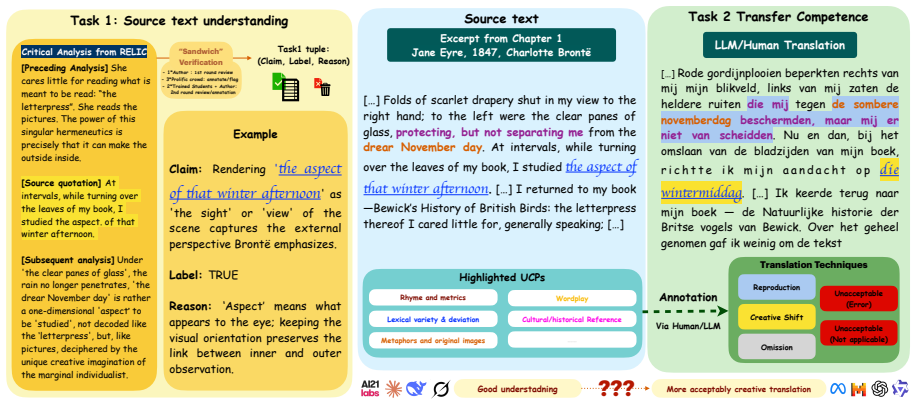
The paper claims that LLMs can comprehend literary source texts effectively yet consistently fail to translate them with human-like creativity, defaulting instead to literal or inappropriate renderings. This is shown using a framework that pairs a comprehension task with a creativity evaluation based on annotated Units of Creative Potential such as metaphors and wordplay, applied across multiple models and prompts.
What carries the argument
A paired-task framework that first assesses source-text comprehension and then measures translational creativity through Units of Creative Potential identified in the source material.
Load-bearing premise
That the selected Units of Creative Potential and expert annotations provide a reliable and complete way to measure translational creativity in line with professional judgment.
What would settle it
Observing a model that consistently produces translations rated as more creative than human ones by experts on the same literary excerpts, or one that correctly and creatively handles all identified Units of Creative Potential.
Figures


read the original abstract
Large language models (LLMs) are increasingly used for creative tasks such as literary translation. Yet translational creativity remains underexplored and is rarely evaluated at scale, while source-text comprehension is typically studied in isolation, despite the fact that, in professional translation, comprehension and creativity are tightly intertwined. We address these gaps with a paired-task framework applied to literary excerpts from 11 books. Task 1 assesses source-text comprehension, and Task 2 evaluates translational creativity through Units of Creative Potential (UCPs), such as metaphors and wordplay. Using a scalable evaluation setup that combines expert human annotations with UCP-based automatic scoring, we benchmark 23 models and four creativity-oriented prompts. Our findings show that strong comprehension does not translate into human-level creativity: models often produce literal or contextually inappropriate renderings, with particularly large gaps for the more distant English-Chinese language pair. Creativity-oriented prompts yield only modest gains, and only one model, Mistral-Large, comes close to human-level creativity (0.167 vs. 0.246). Across all model-prompt combinations, only three exceed a creativity score of 0.1, while the rest remain at or near zero.
Editorial analysis
A structured set of objections, weighed in public.
Referee Report
Summary. The paper introduces a paired-task framework for evaluating LLMs on literary translation tasks, separating source-text comprehension (Task 1) from translational creativity assessed via Units of Creative Potential (UCPs) such as metaphors and wordplay (Task 2). Applied to excerpts from 11 books, it benchmarks 23 models plus four creativity-oriented prompts against human baselines, concluding that strong comprehension does not yield human-level creativity, with models frequently producing literal or inappropriate renderings (especially for English-Chinese), creativity prompts offering only modest gains, and only Mistral-Large approaching human scores (0.167 vs. 0.246), while most model-prompt pairs score at or near zero.
Significance. If the UCP-based measure proves robust, the work offers a useful disentangled evaluation paradigm for creative generation tasks where comprehension and creativity are intertwined in professional practice. The scale of the benchmark (23 models) and the explicit human comparison provide concrete evidence of current LLM limitations in literary translation beyond reproduction, which could guide future prompt engineering and model development.
major comments (2)
- [§3 and §4] §3 (Paired-Task Framework) and §4 (UCP Annotation Protocol): The central claim that models exhibit a comprehension-creativity disconnect rests on UCPs serving as a valid, comprehensive proxy for translational creativity. However, the manuscript provides no inter-annotator agreement statistics, no correlation analysis with professional translator judgments, and no external validation of the UCP inventory against established translation quality frameworks; without these, the reported gaps (particularly the English-Chinese disparity) risk being artifacts of annotation subjectivity or incomplete coverage of culturally specific creative elements.
- [§5] §5 (Results and Model Rankings): The quantitative finding that only three model-prompt combinations exceed a creativity score of 0.1, with Mistral-Large at 0.167 versus human 0.246, is load-bearing for the headline conclusion. Yet the automatic UCP scoring procedure and its agreement with the expert annotations are not detailed with sufficient precision (e.g., exact matching rules, weighting of UCP types, or error analysis), making it impossible to determine whether the low scores reflect genuine creative deficits or measurement limitations.
minor comments (2)
- [Results tables] Table 2 or equivalent results table: report standard errors or confidence intervals alongside the mean creativity scores to allow readers to assess the stability of the model-human gaps.
- [§2] §2 (Related Work): the discussion of prior LLM translation benchmarks could more explicitly contrast the paired-task design with existing holistic quality metrics such as BLEU or human MQM to clarify the novelty.
Simulated Author's Rebuttal
We thank the referee for the insightful comments on the validity of our paired-task framework and the UCP-based evaluation. We address the major comments point by point below, indicating the changes we will implement in the revised manuscript.
read point-by-point responses
-
Referee: [§3 and §4] §3 (Paired-Task Framework) and §4 (UCP Annotation Protocol): The central claim that models exhibit a comprehension-creativity disconnect rests on UCPs serving as a valid, comprehensive proxy for translational creativity. However, the manuscript provides no inter-annotator agreement statistics, no correlation analysis with professional translator judgments, and no external validation of the UCP inventory against established translation quality frameworks; without these, the reported gaps (particularly the English-Chinese disparity) risk being artifacts of annotation subjectivity or incomplete coverage of culturally specific creative elements.
Authors: We recognize that additional evidence for the robustness of the UCP measure would strengthen our conclusions. The UCP inventory draws from well-established categories in literary translation theory, including those identified in prior work on creative translation. To address the lack of reported inter-annotator agreement, we will include these statistics in the revised manuscript, calculated across the annotations of the expert annotators for both source comprehension and creativity tasks. We will also provide a more detailed discussion of how UCP scores correlate with the professional human translations used as baselines and align with established frameworks such as functionalist approaches to translation quality. A full-scale external validation against independent professional judgments is not feasible within the current study but represents an important direction for future research. We maintain that the consistent patterns observed across 23 models and the clear gap with human performance support the comprehension-creativity disconnect, particularly as the annotation protocol was applied uniformly. revision: partial
-
Referee: [§5] §5 (Results and Model Rankings): The quantitative finding that only three model-prompt combinations exceed a creativity score of 0.1, with Mistral-Large at 0.167 versus human 0.246, is load-bearing for the headline conclusion. Yet the automatic UCP scoring procedure and its agreement with the expert annotations are not detailed with sufficient precision (e.g., exact matching rules, weighting of UCP types, or error analysis), making it impossible to determine whether the low scores reflect genuine creative deficits or measurement limitations.
Authors: We agree that the automatic scoring procedure requires more detailed exposition to ensure transparency and allow verification of the results. In the revised manuscript, we will elaborate on the UCP scoring algorithm in §5, specifying the exact rules for matching UCPs (including handling of synonyms and paraphrases via semantic similarity thresholds), the weighting applied to different UCP categories, and a comprehensive error analysis that reports the agreement between automatic scores and expert manual annotations on a held-out sample. This will include precision, recall, and F1 metrics for UCP detection. We believe this will demonstrate that the low creativity scores accurately reflect the models' output characteristics rather than flaws in the measurement process. revision: yes
Circularity Check
No circularity: empirical benchmarking with external human baselines
full rationale
The paper presents an empirical paired-task evaluation framework for LLMs on literary translation. Task 1 measures source-text comprehension and Task 2 scores translational creativity via Units of Creative Potential (UCPs) identified in source texts, followed by expert human annotations and automatic UCP-based scoring. Reported creativity scores (e.g., 0.167 for Mistral-Large vs. human 0.246) are direct outputs of this annotation pipeline applied to model generations, not quantities derived from fitted parameters or self-referential equations within the paper. No self-definitional loops, fitted-input predictions, or load-bearing self-citations appear in the derivation of the central claims. The framework is self-contained against external human baselines and does not reduce its findings to inputs by construction.
Axiom & Free-Parameter Ledger
axioms (1)
- domain assumption Units of Creative Potential such as metaphors and wordplay constitute measurable and representative aspects of translational creativity
invented entities (1)
-
Units of Creative Potential (UCPs)
no independent evidence
Reference graph
Works this paper leans on
-
[1]
William Orwig, Emma R Edenbaum, Joshua D Greene, and Daniel L Schacter
How does narrow ai impact human creativity? Creativity Research Journal, pages 1–11. William Orwig, Emma R Edenbaum, Joshua D Greene, and Daniel L Schacter. 2024. The language of cre- ativity: Evidence from humans and large language models.The Journal of creative behavior, 58(1):128– 136. Max Peeperkorn, Tom Kouwenhoven, Dan Brown, and Anna Jordanous. 202...
work page 2024
-
[2]
(perhaps) beyond human translation: Harness- ing multi-agent collaboration for translating ultra- long literary texts.Transactions of the Association for Computational Linguistics, 13:901–922. Ran Zhang and Steffen Eger. 2026. Llm-based multi-agent poetry generation in non-cooperative environments.Journal of Language Modelling, 13(2):261–318. Ran Zhang, W...
work page 2026
-
[3]
Assessing and understanding creativity in large language models.Machine Intelligence Research, 22(3):417–436. A Dataset construction A.1 Task 1 details A.1.1 Translation difficulty Tables 3 and 4 contain the prompt with the defini- tion of translation difficulties, i.e., Units of Creative Shift (UCPs). A.1.2 Task 1 annotation guideline OverviewYou will ev...
-
[4]
Metaphors and original images: A metaphor is a figure of speech in which a word or phrase is applied to an object or action to which it is not literally applicable, but helps explain an idea or make a comparison. E.g., Time is a thief
-
[5]
Comparisons/simile: A figure of speech in- volving an explicit comparison of one thing with another thing of a different kind used to make a description more empathic or vivid (often using words like “like”, “-like”, “as”, and “-looking”. E.g. Her smile was as bright as the sun
-
[6]
E.g., He had a photographic memory but never developed it
Wordplay: Wordplay refers to the clever and humorous use of words in a way that exploits their multiple meanings, sounds, or structures. E.g., He had a photographic memory but never developed it. E.g., I scream for ice cream
-
[7]
E.g., Achilles heel, French Revolution
Cultural and historical references: References to culture-specific items or historical events, fig- ures, or practices. E.g., Achilles heel, French Revolution
-
[8]
E.g., piece of cake, bite the bullet, break the ice
Idiomatic phrases: An idiom is a phrase or expression that largely or exclusively carries a figurative or non-literal meaning. E.g., piece of cake, bite the bullet, break the ice
-
[9]
Rhyme and metrics: Use of rhyme and rhyth- mic patterns E.g. It was the best of times, it was the worst of times, it was the age of wisdom, it was the age of foolishness, it was the epoch of belief, it was the epoch of incredulity, it was the season of light, it was the season of darkness, it was the spring of hope, it was the winter of de- spair. (Charle...
-
[10]
E.g., a well-to-do girl of about thirteen (Sarah Waters - Night Watch)
Lexical variety & lexical deviation: The use of a wide range of vocabulary, including infrequent words, or departure from conventional meanings and uses of words. E.g., a well-to-do girl of about thirteen (Sarah Waters - Night Watch). E.g., A great sport ... old Evie! (Agatha Christie - The Mysterious Affair at Styles)
-
[11]
Proper names: Names of people, places, and organizations. E.g., Albus Dumbledore (Harry Potter - J.K. Rowling), Oompa-Loompas (Roald Dahl - Charlie and the Chocolate Factory). Table 3: Translation difficulty (1) 13 Now read the following text and determine whether it contains any translation problems or not. text Please return the answer in the following ...
work page 1925
-
[12]
Label: Translation Technique (choose exactly ONE) - Creative Shift (CS): translations that deviate from a literal rendering of the source text to cre- ate a more impactful, natural, or culturally ap- propriate translation in the target language in a meaningful or stylistically motivated way. Please make sure the deviation of meaning or image is rooted in ...
-
[13]
Level_of_creativity ∈ [low, medium, high]: How surprising, inventive, or non-routine the translation choice feels within the given literary context. - low→routine, literal, unsurprising - medium → some interpretive or stylistic choice - high→clearly inventive, or unexpected
-
[14]
Level_of_acceptability ∈ [low, medium, high]: Overall translation quality and appropriateness in context: - low→clearly unacceptable as a translation - medium → understandable but flawed, awk- ward, or unstable - high → logical, fluent, appropriate, and accept- able for literary use based on the source text. Make sure the word choice is conventional for t...
-
[15]
Level of deviation∈[low, medium, high]: - low→meaning & imagery preserved - medium → meaning & imagery partially pre- served - high → strongly reimagined meaning or image, with added information !! Please double-check to ensure the deviation adheres to the source context. Be cautious in cases of medium or high deviation, as this usu- ally indicates change...
discussion (0)
Sign in with ORCID, Apple, or X to comment. Anyone can read and Pith papers without signing in.