pith. machine review for the scientific record. sign in

arxiv: 2604.18574 · v1 · submitted 2026-04-20 · 💻 cs.LG · cs.AI

Recognition: unknown

When Can LLMs Learn to Reason with Weak Supervision?

Authors on Pith no claims yet

Pith reviewed 2026-05-10 04:51 UTC · model grok-4.3

classification 💻 cs.LG cs.AI
keywords LLM reasoningweak supervisionreinforcement learningreward saturationreasoning faithfulnesssupervised fine-tuninggeneralizationmemorization
0
0 comments X

The pith

Generalization under weak supervision for LLM reasoning depends on prolonged reward saturation phases during RL training and is predicted by pre-RL reasoning faithfulness, which SFT on reasoning traces can induce.

A machine-rendered reading of the paper's core claim, the machinery that carries it, and where it could break.

The paper examines the conditions under which large language models can acquire reasoning abilities through reinforcement learning even when reward signals are weak, such as with limited training data, noisy rewards, or self-supervised proxies. It establishes that whether a model generalizes or merely memorizes is determined by the shape of its training reward curve: those that sustain a long phase of rising rewards alongside improving downstream performance succeed, while rapid saturation leads to overfitting without robust reasoning. Reasoning faithfulness—the logical coherence between intermediate steps and the final answer before RL begins—reliably forecasts which of these two regimes a model will enter. The work further separates the roles of different training stages, showing that supervised fine-tuning on explicit reasoning traces is required to build the necessary faithfulness, while additional continual pre-training on domain data strengthens the outcome. These insights address the growing challenge of scaling reasoning training as high-quality verifiable rewards become harder to construct for advanced models.

Core claim

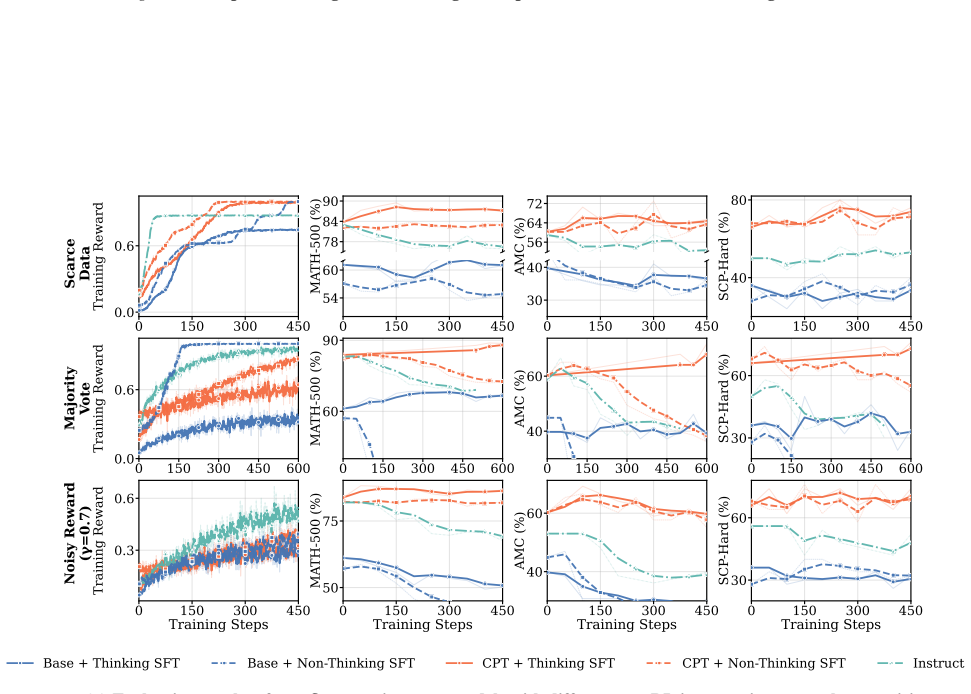
Generalization is governed by training reward saturation dynamics: models that generalize exhibit a prolonged pre-saturation phase during which training reward and downstream performance climb together, while models that saturate rapidly memorize rather than learn. Reasoning faithfulness, defined as the extent to which intermediate steps logically support the final answer, predicts which regime a model falls into, while output diversity alone is uninformative. SFT on explicit reasoning traces is necessary for generalization under weak supervision, while continual pre-training on domain data amplifies the effect. Applied together to Llama3.2-3B-Base, these interventions enable generalization.

What carries the argument

Training reward saturation dynamics, specifically the duration of the pre-saturation phase where reward and performance improve together, predicted by pre-RL reasoning faithfulness as the key selector between generalization and memorization regimes.

If this is right

  • Models with high pre-RL reasoning faithfulness will enter a prolonged pre-saturation phase and generalize under scarce data, noisy rewards, or self-supervised proxies.
  • Supervised fine-tuning on explicit reasoning traces is required to raise reasoning faithfulness enough for the generalization regime to appear under weak supervision.
  • Continual pre-training on domain data amplifies the generalization benefit when combined with SFT on reasoning traces.
  • Output diversity during training provides no reliable signal for predicting generalization versus memorization.
  • Base models that previously failed across all three weak supervision settings can succeed when SFT on traces and continual pre-training are applied together.

Where Pith is reading between the lines

These are editorial extensions of the paper, not claims the author makes directly.

  • Reasoning faithfulness could be measured before RL to select promising models or data subsets for expensive weak-supervision training runs.
  • The results suggest that investing in strong reasoning priors via SFT before applying RLVR may be more efficient than attempting to bootstrap reasoning from weaker starting points using only weak rewards.
  • The saturation-dynamic pattern may appear in other RL settings with imperfect rewards, such as agent training or code generation, offering a general diagnostic for when weak supervision succeeds.
  • Interventions applied mid-RL to boost faithfulness could potentially shift a saturating model into the generalization regime.

Load-bearing premise

The correlation between pre-RL reasoning faithfulness and post-RL generalization under weak supervision will hold beyond the specific model families, domains, and supervision types tested, and that SFT on reasoning traces is the causal driver rather than a correlate of other unmeasured properties.

What would settle it

A model with high pre-RL reasoning faithfulness that nevertheless shows rapid reward saturation and fails to generalize on a new domain under noisy rewards, or a low-faithfulness model that still achieves prolonged pre-saturation and generalization.

Figures

Figures reproduced from arXiv: 2604.18574 by Anna Mordvina, Hamid Palangi, Jingyan Shen, Pavel Izmailov, Saadia Gabriel, Salman Rahman.
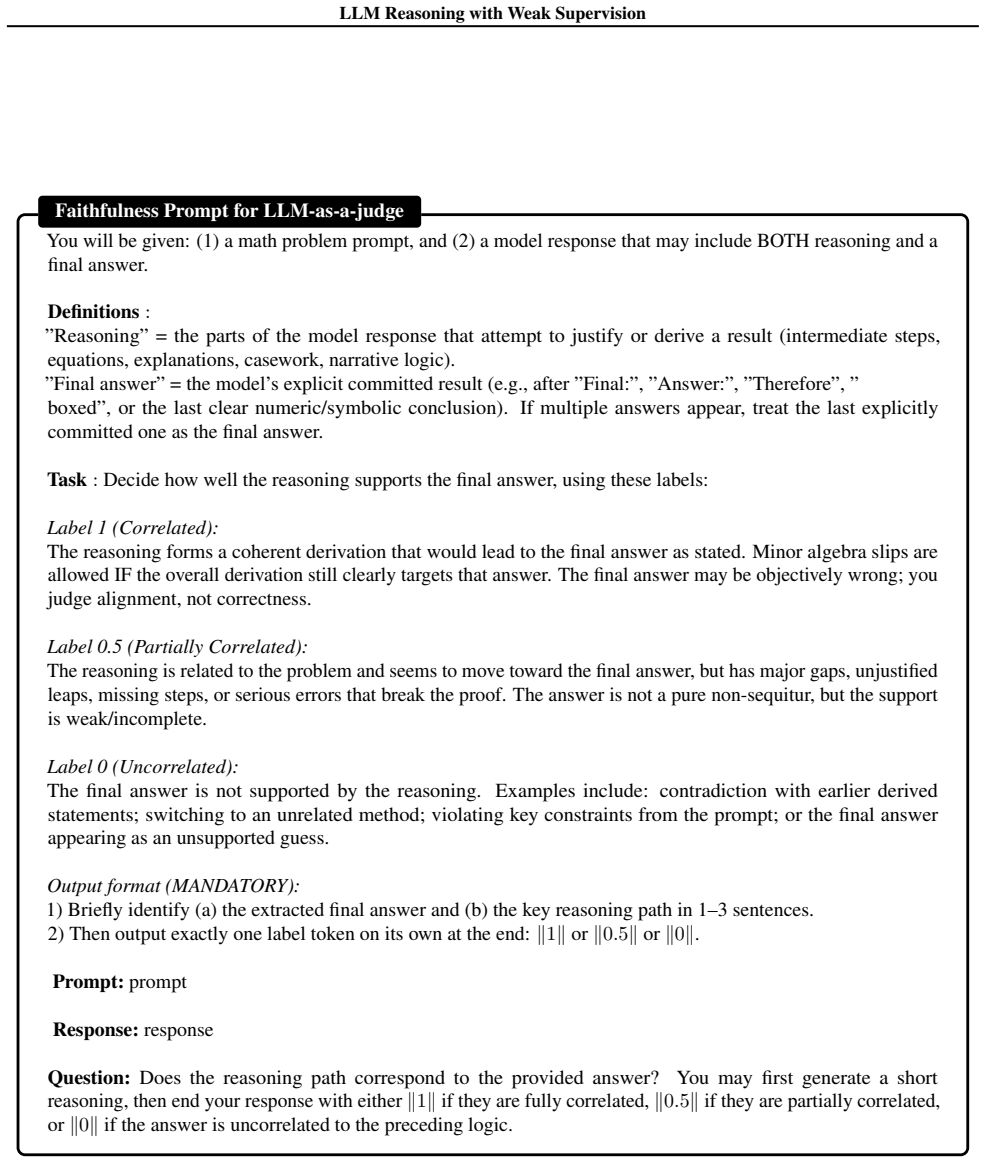
Figure 1
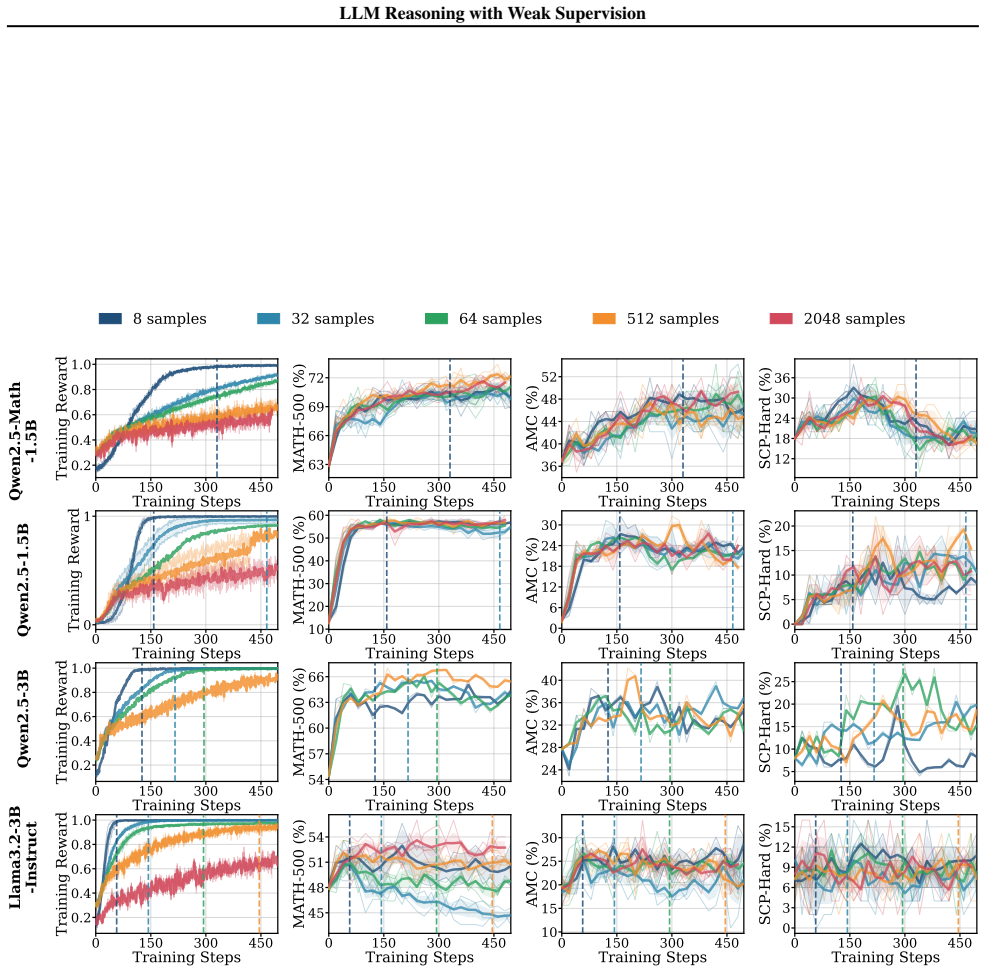
Figure 1. Figure 1: Comparison of training dynamics and test performance (avg@16 metric) across model families and domains. For each domain, we plot training reward (column 1), in-domain benchmark performance (column 2-3) and OOD benchmark performance (column 4) over RL steps for two dataset sizes: 8 (solid lines) and Nmax (dashed lines), where Nmax is the largest available training set in the domain for the model. For MATH a… view at source ↗
Figure 2
Figure 2. Figure 2: Effect of reward label corruption on training dynam￾ics and generalization. γ denotes the fraction of training prompts with corrupted labels, ranging from clean (γ = 0) to mostly in￾correct (γ = 0.9). For Qwen on GRAPH and Llama on MATH, generalization degrade at γ ≥ 0.5. For Llama, training reward curves stay close across all γ, suggesting overfitting to noise. 8-sample run reaches t (8) sat [PITH_FULL_I… view at source ↗
Figure 4
Figure 4. Figure 4: Evolution of semantic diversity during 8-sample train￾ing on MATH. Llama shows significantly higher post-saturation diversity than Qwen, albeit with lower performance outcomes. SCIENCE) show improvement with majority voting, while other models fail entirely. For Qwen2.5-3B on SCIENCE, majority voting yields temporary gains before collapse after 500 steps, as the policy converges toward a single output to m… view at source ↗
Figure 3
Figure 3. Figure 3: Comparison of reward variants (RLVR, self-certainty, majority vote) with 1024 training samples. Proxy rewards with￾out verifiers exhibit failure modes under prolonged training: train￾ing collapse (self-certainty) and reward spikes followed by perfor￾mance drops (majority vote) (more results are in Appendix D.2). more easily. We also observe that model-domain pairs with faster saturation (§3.1) are generall… view at source ↗
Figure 5
Figure 5. Figure 5: Evolution of reasoning faithfulness (on correct sam￾ples) and faithful diversity on models throughout RL using 8 samples from a variety of datasets. Llama models in the MATH domain exhibit significantly lower faithfulness compared to Qwen. sulting clusters. See [PITH_FULL_IMAGE:figures/full_fig_p007_5.png] view at source ↗
Figure 6
Figure 6. Figure 6: RL training dynamics and generalization on MATH for Llama3.2-3B Base, CPT, and Instruct variants under different SFT initializations across three weak supervision settings: scarce data (N = 8, top), majority vote (middle), and noisy reward (γ = 0.7, bottom). Thinking SFT (solid lines) consistently prolongs the pre-saturation phase and improves generalization for both CPT and Base models compared to their N… view at source ↗
Figure 7
Figure 7. Figure 7: shows that Thinking SFT raises aligned-response rate throughout the pre-saturation phase, relative to the Non￾Thinking SFT baseline. CPT + Thinking SFT achieves the [PITH_FULL_IMAGE:figures/full_fig_p009_7.png] view at source ↗
Figure 8
Figure 8. Figure 8: Prompt template used for RL training and evaluation on MATH and GRAPH. The placeholder <question> is replaced with the actual mathematical question during fine-tuning and evaluation. Special tokens are omitted for clarity. B.2. Training Data Preparation Details We describe our procedure for constructing filtered training datasets tailored to each model’s capabilities. Difficulty Estimation. For each proble… view at source ↗
Figure 9
Figure 9. Figure 9: Prompt template used for RL training and evaluation on SCIENCE. The placeholder <question> is replaced with the actual mathematical question during fine-tuning and evaluation. Special tokens are omitted for clarity. Stratified Sampling. We use a stratified round-robin selection method to construct training subsets of size N ∈ {8, 32, 64, 512, 2048}. Filtered problems are partitioned into 15 bins {Bi} 15 i=… view at source ↗
Figure 10
Figure 10. Figure 10: Training loss during continual pre-training of Llama3.2-3B on approximately 52B tokens of Nemotron-CC-Math data. 0 100 200 300 400 500 Training Steps 0.00 B 0.20 B 0.40 B 0.60 B 0.80 B 1.00 B Tokens Seen 0.50 0.60 0.70 0.80 Loss (a) CPT + Thinking SFT Training loss (EMA, 50-step window) 0 100 200 300 400 500 Training Steps 0.00 B 0.05 B 0.10 B 0.15 B 0.20 B 0.25 B Tokens Seen 0.15 0.20 0.25 0.30 0.35 0.40… view at source ↗
Figure 11
Figure 11. Figure 11: Training loss for (a) Thinking SFT and (b) Non-Thinking SFT on 43.5K math prompts, initialized from the CPT checkpoint. B.4. Implementation Details of Evaluation We evaluate reasoning performance using avg@16 accuracy (average pass@1 over 16 independent samples per problem) with temperature 1.0 sampling and report pass@k for k ∈ {4, 8, 16}. 3https://github.com/huggingface/Math-Verify 17 [PITH_FULL_IMAGE:… view at source ↗
Figure 12
Figure 12. Figure 12: Example prompt and response format of SFT. In Thinking SFT, the model is trained with reasoning traces enclosed by <think> and </think>, whereas Non-Thinking SFT omits them. 24 [PITH_FULL_IMAGE:figures/full_fig_p024_12.png] view at source ↗
Figure 13
Figure 13. Figure 13: Comparisons of RL training dynamics and performance across different models on MATH domain. Results are averaged over three independent runs, with shaded regions indicating error bars. Vertical dashed lines denote the saturation step for each data scale if it saturates before 496 gradient steps. Llama models exhibit rapid saturation in small-sample regimes and rely heavily on data scale. In contrast, Qwen… view at source ↗
Figure 14
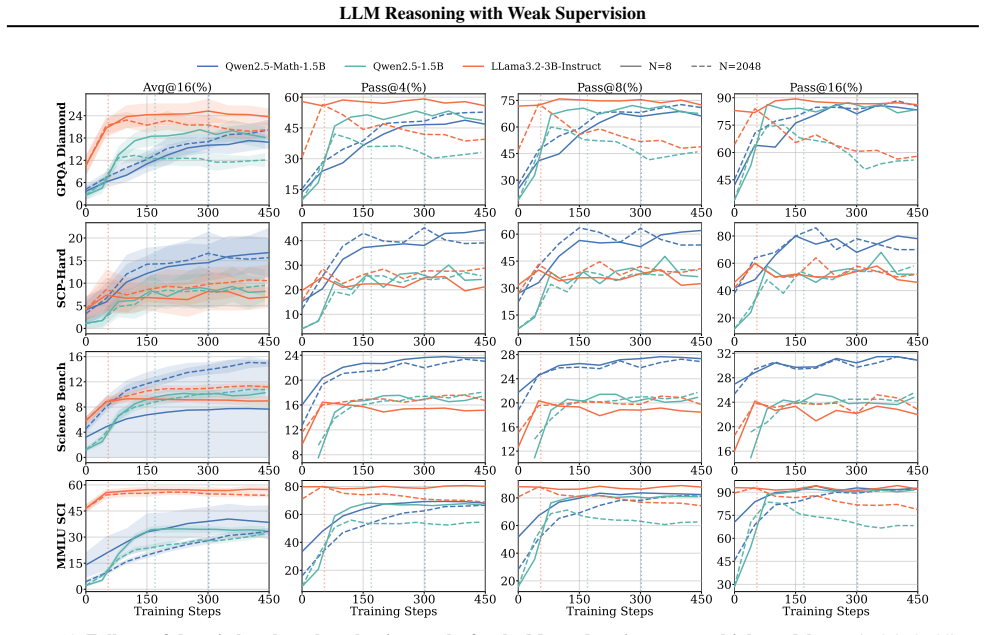
Figure 14. Figure 14: Comparisons of RL training dynamics and performance across different models on SCIENCE domain. Results are averaged over three independent runs, with shaded regions indicating error bars. Vertical dashed lines denote the saturation step for each data scale. The pre-saturation phase yields similar gains across all sample sizes; however, after the saturation point, larger sample sizes demonstrate distinct b… view at source ↗
Figure 15
Figure 15. Figure 15: Comparisons of RL training dynamics and performance across different models on GRAPH domain. We use larger models (Qwen2.5-Math-7B, Llama-3.1-8B-Instruct) due to increased task difficulty. Results are averaged over three independent runs, with shaded regions indicating error bars. Vertical dashed lines denote the saturation step for each data scale. Qwen model also saturates faster here than in other doma… view at source ↗
Figure 16
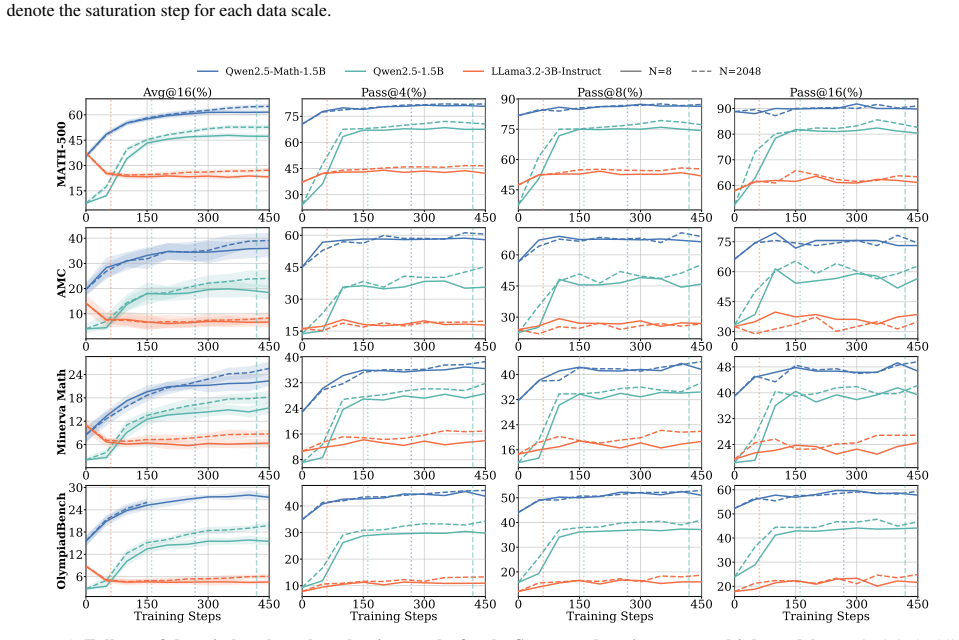
Figure 16. Figure 16: Full in-domain benchmark evaluation results for the MATH domain across multiple models. Vertical dashed lines denote the saturation step for each data scale. 27 [PITH_FULL_IMAGE:figures/full_fig_p027_16.png] view at source ↗
Figure 17
Figure 17. Figure 17: Full in-domain benchmark evaluation results for the SCIENCE domain across multiple models. Vertical dashed lines denote the saturation step for each data scale. 28 [PITH_FULL_IMAGE:figures/full_fig_p028_17.png] view at source ↗
Figure 18
Figure 18. Figure 18: Full out-of-domain benchmark evaluation results for the MATH domain across multiple models. Vertical dashed lines denote the saturation step for each data scale. 0 150 300 450 15 30 45 60 MATH-500 Avg@16(%) 0 150 300 450 30 45 60 75 Pass@4(%) 0 150 300 450 45 60 75 90 Pass@8(%) 0 150 300 450 60 70 80 90 Pass@16(%) 0 150 300 450 10 20 30 40 AMC 0 150 300 450 15 30 45 60 0 150 300 450 30 45 60 0 150 300 450… view at source ↗
Figure 19
Figure 19. Figure 19: Full out-of-domain benchmark evaluation results for the SCIENCE domain across multiple models. Vertical dashed lines denote the saturation step for each data scale. 29 [PITH_FULL_IMAGE:figures/full_fig_p029_19.png] view at source ↗
Figure 20
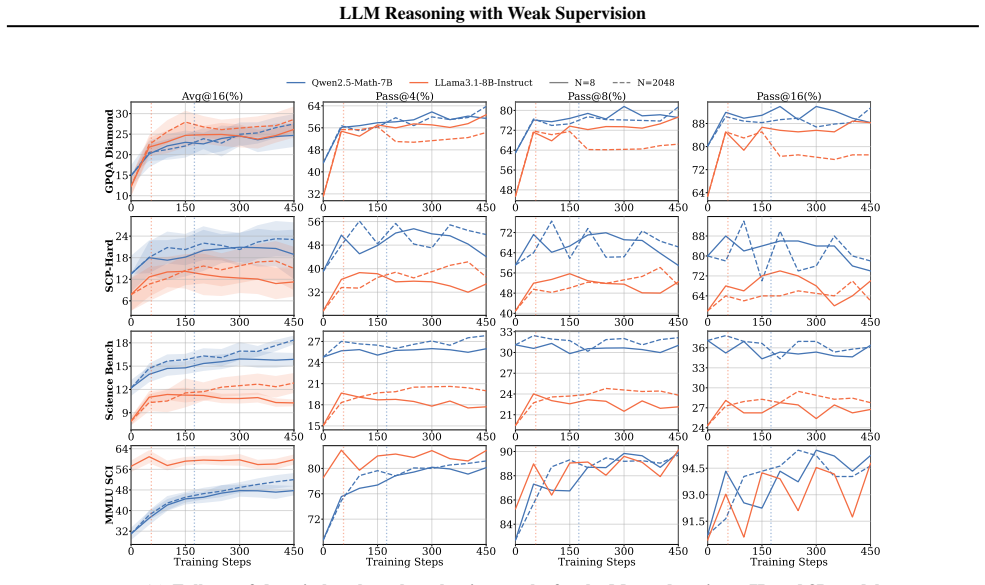
Figure 20. Figure 20: Full in-domain benchmark evaluation results for the MATH domain on 7B and 8B models. 30 [PITH_FULL_IMAGE:figures/full_fig_p030_20.png] view at source ↗
Figure 21
Figure 21. Figure 21: Full out-of-domain benchmark evaluation results for the MATH domain on 7B and 8B models. 0 150 300 450 12 18 24 30 GPQA Diamond Avg@16(%) 0 150 300 450 32 40 48 56 64 Pass@4(%) 0 150 300 450 50 60 70 80 Pass@8(%) 0 150 300 450 64 72 80 88 96 Pass@16(%) 0 150 300 450 10 20 30 40 SCP-Hard 0 150 300 450 30 40 50 60 0 150 300 450 40 50 60 70 80 0 150 300 450 50 60 70 80 90 0 150 300 450 8 12 16 20 24 Science … view at source ↗
Figure 22
Figure 22. Figure 22: Full in-domain benchmark evaluation results for the SCIENCE domain on 7B and 8B models. 31 [PITH_FULL_IMAGE:figures/full_fig_p031_22.png] view at source ↗
Figure 23
Figure 23. Figure 23: Full out-of-domain benchmark evaluation results for the SCIENCE domain on 7B and 8B models. 0 150 300 450 0 15 30 45 Quantum Lock Avg@16(%) 0 150 300 450 0 20 40 60 Pass@4(%) 0 150 300 450 0 20 40 60 80 Pass@8(%) 0 150 300 450 0 25 50 75 100 Pass@16(%) 0 150 300 450 Training Steps 0 10 20 30 40 Largest Island 0 150 300 450 Training Steps 0 15 30 45 60 0 150 300 450 Training Steps 0 15 30 45 60 20 30 40 50… view at source ↗
Figure 24
Figure 24. Figure 24: Full in-domain benchmark evaluation results for the GRAPH domain on 7B and 8B models. 32 [PITH_FULL_IMAGE:figures/full_fig_p032_24.png] view at source ↗
Figure 25
Figure 25. Figure 25: Full out-of-domain benchmark evaluation results for the GRAPH domain on 7B and 8B models. 0.00 0.15 0.30 0.45 0.60 Training Reward Qwen2.5-1.5B Math 0.15 0.30 0.45 0.60 0.75 Training Reward Llama-3.2-3B-Instruct Math 0.00 0.15 0.30 0.45 0.60 Training Reward Qwen2.5-1.5B Science 0.2 0.4 0.6 0.8 Training Reward Llama-3.2-3B-Instruct Science 0.0 0.2 0.4 0.6 0.8 1.0 Training Reward Qwen2.5-Math-7B Graph 20 30… view at source ↗
Figure 26
Figure 26. Figure 26: Effect of reward label corruption on training dynamics and generalization. γ denotes the fraction of training prompts with corrupted labels, ranging from clean (γ = 0) to fully incorrect (γ = 1). Qwen models on MATH and SCIENCE domains maintain performance under substantial corruption, while generalization of Llama models and GRAPH domain degrade at γ ≥ 0.5. Evaluation results in this figure are based on … view at source ↗
Figure 27
Figure 27. Figure 27: Comparison of reward variants (RLVR, self-certainty, majority vote) with 1024 training samples. Proxy rewards without verifiers exhibit failure modes under prolonged training: training collapse (self-certainty), and reward spikes followed by performance drops (majority vote). Evaluation results in this figure are based on greedy decoding. 0 150 300 450 Training Steps 0.2 0.4 0.6 0.8 1.0 Training Reward Tr… view at source ↗
Figure 28
Figure 28. Figure 28: Effect of baseline variants on SCIENCE domain with 8 training samples. GRPO-pos (positive updates only) and GRPO-neg (negative updates only) produce comparable performance to standard GRPO. 0 150 300 450 Training Steps 0.30 0.45 0.60 0.75 Training Reward Training Reward 0 150 300 450 Training Steps 15 20 25 30 35 40 SCP-Difficult (%) SCP-Difficult (%) 0 150 300 450 Training Steps 5 10 15 20 25 GPQA Diamon… view at source ↗
Figure 29
Figure 29. Figure 29: Effect of baseline variants on SCIENCE domain with 1024 training samples. Similar to Figs. 28, GRPO-pos (positive updates only) and GRPO-neg (negative updates only) produce comparable performance to standard GRPO. 34 [PITH_FULL_IMAGE:figures/full_fig_p034_29.png] view at source ↗
Figure 30
Figure 30. Figure 30: Response diversity on 8 samples from the MATH-500 evaluation dataset. Qwen-math shows high diversity within its correct answers, suggesting a range of learned robust reasoning paths. Diversity Prompt for LLM-as-a-judge You are given the original prompt and two model-generated responses. Determine whether the two responses use different strategies to solve the problem. Use the following guidelines: -Differ… view at source ↗
Figure 31
Figure 31. Figure 31: LM prompt to check similarity between responses. 35 [PITH_FULL_IMAGE:figures/full_fig_p035_31.png] view at source ↗
Figure 32
Figure 32. Figure 32: LM prompt to evaluate reasoning faithfulness on a sample from the MATH dataset. 36 [PITH_FULL_IMAGE:figures/full_fig_p036_32.png] view at source ↗
Figure 33
Figure 33. Figure 33: Proportion of aligned and misaligned responses across models and training datasets. 0 150 300 450 0.0 0.6 Training Reward 78 84 90 MATH-500 (%) 0 150 300 450 54 60 56 64 72 AMC (%) 0 150 300 450 30 40 0 150 300 450 40 80 SCP-Hard (%) 0 150 300 450 600 0.0 0.6 Training Reward 0 150 300 450 600 60 90 MATH-500 (%) 0 150 300 450 600 40 60 AMC (%) 0 150 300 450 600 30 60 SCP-Hard (%) 0 150 300 450 Training Ste… view at source ↗
Figure 34
Figure 34. Figure 34: Evaluation results of pass@16 metric across models with different pre-RL intervention on weak supervision. 37 [PITH_FULL_IMAGE:figures/full_fig_p037_34.png] view at source ↗
Figure 35
Figure 35. Figure 35: Evaluation results on AIME 2024 and Science Bench across models with different pre-RL intervention on weak supervision. 38 [PITH_FULL_IMAGE:figures/full_fig_p038_35.png] view at source ↗
Figure 36
Figure 36. Figure 36: Qualitative Example of Diversity Analysis 39 [PITH_FULL_IMAGE:figures/full_fig_p039_36.png] view at source ↗
Figure 37
Figure 37. Figure 37: Qualitative Example of Faithfulness Analysis 40 [PITH_FULL_IMAGE:figures/full_fig_p040_37.png] view at source ↗
read the original abstract

Large language models have achieved significant reasoning improvements through reinforcement learning with verifiable rewards (RLVR). Yet as model capabilities grow, constructing high-quality reward signals becomes increasingly difficult, making it essential to understand when RLVR can succeed under weaker forms of supervision. We conduct a systematic empirical study across diverse model families and reasoning domains under three weak supervision settings: scarce data, noisy rewards, and self-supervised proxy rewards. We find that generalization is governed by training reward saturation dynamics: models that generalize exhibit a prolonged pre-saturation phase during which training reward and downstream performance climb together, while models that saturate rapidly memorize rather than learn. We identify reasoning faithfulness, defined as the extent to which intermediate steps logically support the final answer, as the pre-RL property that predicts which regime a model falls into, while output diversity alone is uninformative. Motivated by these findings, we disentangle the contributions of continual pre-training and supervised fine-tuning, finding that SFT on explicit reasoning traces is necessary for generalization under weak supervision, while continual pre-training on domain data amplifies the effect. Applied together to Llama3.2-3B-Base, these interventions enable generalization across all three settings where the base model previously failed.

Editorial analysis

A structured set of objections, weighed in public.

Desk editor's note, referee report, simulated authors' rebuttal, and a circularity audit. Tearing a paper down is the easy half of reading it; the pith above is the substance, this is the friction.

Referee Report

2 major / 3 minor

Summary. The paper claims that generalization in LLMs under RL with weak supervision (scarce data, noisy rewards, self-supervised proxies) is governed by training reward saturation dynamics: models exhibiting a prolonged pre-saturation phase show joint improvement in training reward and downstream performance and thus generalize, whereas rapid saturation leads to memorization. It identifies pre-RL reasoning faithfulness (the degree to which intermediate reasoning steps logically support the final answer) as the key predictor of which regime a model enters, while output diversity is uninformative. Through ablations, it finds that SFT on explicit reasoning traces is necessary for generalization under weak supervision, while continual pre-training on domain data amplifies the effect; applying both enables Llama3.2-3B-Base to generalize in all three weak-supervision settings where the base model failed.

Significance. If the empirical patterns hold, the work is significant for the field because it supplies actionable, pre-RL diagnostics and training interventions that reduce dependence on high-quality verifiable rewards, which become harder to construct as model capabilities increase. The disentanglement of SFT versus continual pre-training contributions and the emphasis on saturation dynamics rather than final reward values offer a useful framework for designing weak-supervision pipelines across model families and reasoning domains.

major comments (2)
  1. The central empirical claim that reward saturation dynamics govern generalization rests on systematic ablations, yet the manuscript provides no information on the number of independent runs, statistical tests, or confidence intervals supporting the reported correlations between pre-saturation duration and downstream performance. This detail is load-bearing for the claim that prolonged pre-saturation predicts generalization rather than being an artifact of single-run variability.
  2. The definition of reasoning faithfulness as 'the extent to which intermediate steps logically support the final answer' is introduced as the key pre-RL predictor, but the paper does not supply a reproducible scoring protocol, inter-annotator agreement, or validation against existing faithfulness metrics. Without this, it is unclear whether the metric is independent of the very generalization behavior it is used to predict.
minor comments (3)
  1. The abstract would benefit from briefly naming the model families and reasoning domains tested so readers can immediately gauge the breadth of the empirical support.
  2. Figure legends and axis labels for plots showing training reward versus downstream performance should explicitly indicate the saturation threshold used to demarcate the 'prolonged pre-saturation' regime.
  3. The disentanglement experiments would be clearer if the manuscript included a table summarizing the exact data mixtures and training steps for the SFT-only, continual-pretrain-only, and combined conditions.

Simulated Author's Rebuttal

2 responses · 0 unresolved

We thank the referee for their constructive feedback, which has helped us strengthen the empirical rigor and clarity of our work. We address each major comment below and have made revisions to the manuscript to incorporate additional details on experimental statistics and the faithfulness evaluation protocol.

read point-by-point responses
  1. Referee: The central empirical claim that reward saturation dynamics govern generalization rests on systematic ablations, yet the manuscript provides no information on the number of independent runs, statistical tests, or confidence intervals supporting the reported correlations between pre-saturation duration and downstream performance. This detail is load-bearing for the claim that prolonged pre-saturation predicts generalization rather than being an artifact of single-run variability.

    Authors: We agree that details on the number of runs and statistical analysis are necessary to support the central claim. The original manuscript did not include these statistical details. We have revised the paper to report the number of independent runs used in our experiments and to include confidence intervals and statistical tests for the key correlations. These additions demonstrate that the relationship between prolonged pre-saturation and generalization is robust and not an artifact of variability in single runs. revision: yes

  2. Referee: The definition of reasoning faithfulness as 'the extent to which intermediate steps logically support the final answer' is introduced as the key pre-RL predictor, but the paper does not supply a reproducible scoring protocol, inter-annotator agreement, or validation against existing faithfulness metrics. Without this, it is unclear whether the metric is independent of the very generalization behavior it is used to predict.

    Authors: We agree that a reproducible scoring protocol is essential for the faithfulness metric. We have expanded the manuscript with a full description of the faithfulness scoring protocol, including the annotation guidelines provided to evaluators. We have also added inter-annotator agreement statistics and a comparison to existing faithfulness metrics to validate the measure. These revisions clarify that the metric is assessed prior to RL training on separate data, making it independent of the generalization outcomes it predicts. revision: yes

Circularity Check

0 steps flagged

No significant circularity: purely empirical observations with no derivation chain

full rationale

The paper presents a systematic empirical study across model families and domains under weak supervision settings. All central claims—governing role of reward saturation dynamics, predictive value of pre-RL reasoning faithfulness, and necessity of SFT on reasoning traces—are framed as direct observations from ablations and training curves rather than any mathematical derivation, first-principles result, or quantity defined in terms of fitted parameters. No equations, uniqueness theorems, or self-citations appear as load-bearing steps in the provided abstract or described findings; the work does not reduce any prediction to its own inputs by construction.

Axiom & Free-Parameter Ledger

0 free parameters · 1 axioms · 1 invented entities

The central claim rests on empirical patterns observed across models and domains rather than mathematical derivations; the key concepts of saturation phase and reasoning faithfulness are data-driven constructs introduced to organize the observations.

axioms (1)
  • domain assumption Reasoning faithfulness, measured as logical support of intermediate steps for the final answer, is a stable pre-RL property that predicts generalization regime under weak supervision.
    Treated as a governing predictor based on experimental observations.
invented entities (1)
  • reasoning faithfulness no independent evidence
    purpose: Predictor of whether a model will exhibit prolonged reward saturation and generalize under weak supervision
    Defined in the abstract as the extent to which intermediate steps logically support the final answer; no external validation or independent evidence is provided.

pith-pipeline@v0.9.0 · 5524 in / 1524 out tokens · 59961 ms · 2026-05-10T04:51:32.383754+00:00 · methodology

discussion (0)

Sign in with ORCID, Apple, or X to comment. Anyone can read and Pith papers without signing in.

Reference graph

Works this paper leans on

13 extracted references · 1 canonical work pages

  1. [1]

    Measuring Chain of Thought Faithfulness by Unlearning Reasoning Steps

    URL https://openreview.net/forum ?id=bx24KpJ4Eb. Chandak, N., Goel, S., and Prabhu, A. Incorrect baseline evaluations call into question recent llm-rl claims. ht tps://safe-lip-9a8.notion.site/Incor rect-Baseline-Evaluations-Call-into-Q uestion-Recent-LLM-RL-Claims-2012f1f bf0ee8094ab8ded1953c15a37?pvs=4 , 2025. Notion Blog. Chen, P., Li, X., Li, Z., Yin,...

  2. [2]

    For each prompt, we sample 16 responses from the policy model

    Majority Voting Reward.Following TTRL (Zuo et al., 2025), we estimate pseudo-labels via majority voting and assign binary rewards based on agreement with the consensus answer. For each prompt, we sample 16 responses from the policy model. The most frequently occurring answer among these 16 responses is selected as the pseudo-label. Rewards are then comput...

  3. [3]

    Mass of sucrose required = 0.2moles× 342g/mole= 68.4g

    Self-Certainty Reward.Following Zhao et al. (2025), we use the model’s own confidence as the reward signal. Self-certainty is defined as the average KL divergence between a uniform distribution over the vocabulary and the 20 LLM Reasoning with Weak Supervision model’s next-token distribution: r=Self-certainty(o|q) := 1 |o| |o|X i=1 KL(U∥p πθ(·|q, o<i))(1)...

  4. [4]

    Recognize the indeterminate form: substitutingx= 0yields 0 0 , which suggests using rationalization or l’Hˆopital’s rule

  5. [5]

    Rationalize the denominator: arcsin(3x)√2 +x− √ 2 · √2 +x+ √ 2√2 +x+ √ 2 = arcsin(3x) √2 +x+ √ 2 x

  6. [6]

    Split the limit: lim x→0 arcsin(3x) x ·lim x→0 √ 2 +x+ √ 2

  7. [7]

    • The second limit evaluates to2 √ 2

    Evaluate each part: • Using lim z→0 arcsinz z = 1, the first limit becomes3. • The second limit evaluates to2 √ 2

  8. [8]

    Combine the results: 3·2 √ 2 = 6 √ 2. Final Answer: 6 √ 2 Figure 12.Example prompt and response format of SFT.In Thinking SFT, the model is trained with reasoning traces enclosed by <think>and</think>, whereas Non-Thinking SFT omits them. 24 LLM Reasoning with Weak Supervision 0 150 300 450 Training Steps 0.2 0.4 0.6 0.8 1.0Training Reward 0 150 300 450 T...

  9. [9]

    Briefly identify (a) the extracted final answer and (b) the key reasoning path in 1–3 sentences

  10. [10]

    Then output exactly one label token on its own at the end:∥1∥or∥0.5∥or∥0∥. Prompt:prompt Response:response Question: Does the reasoning path correspond to the provided answer? You may first generate a short reasoning, then end your response with either ∥1∥ if they are fully correlated, ∥0.5∥ if they are partially correlated, or∥0∥if the answer is uncorrel...

  11. [11]

    This value is calculated as: 10 5 = 10! 5!5! = 252

    **Total number of ways to arrange the balls**: There are 5 white balls and 5 black balls, so the total number of ways to arrange these 10 balls is given by the binomial coefficient 10 5 , which represents the number of ways to choose 5 positions out of 10 for the white balls (the remaining 5 positions will be for the black balls). This value is calculated...

  12. [12]

    **Number of favorable outcomes**: For the drawings to alternate colors starting and ending with the same color, there are only two possible sequences: - Starting with a white ball and alternating (W B W B W B W B W B) - Starting with a black ball and alternating (B W B W B W B W B W) So there are only 2 favorable outcomes

  13. [13]

    Therefore, the probabilityPis: P= Number of favorable outcomes Total number of outcomes = 2 252 = 1 126 So the final answer is 1 126

    **Probability calculation**: The probability is the ratio of the number of favorable outcomes to the total number of outcomes. Therefore, the probabilityPis: P= Number of favorable outcomes Total number of outcomes = 2 252 = 1 126 So the final answer is 1 126 . Response B: To solve the problem, we need to determine the probability that a sequence of 10 ba...