Logarithmic Entanglement and Emergent Dipole Symmetry from a Strongly Coupled Light-Matter Quantum Circuit
Pith reviewed 2026-05-10 03:20 UTC · model grok-4.3
The pith
Strong light-matter coupling in a solvable quantum circuit produces logarithmic entanglement scaling with system size via an emergent dipole symmetry.
A machine-rendered reading of the paper's core claim, the machinery that carries it, and where it could break.
Core claim
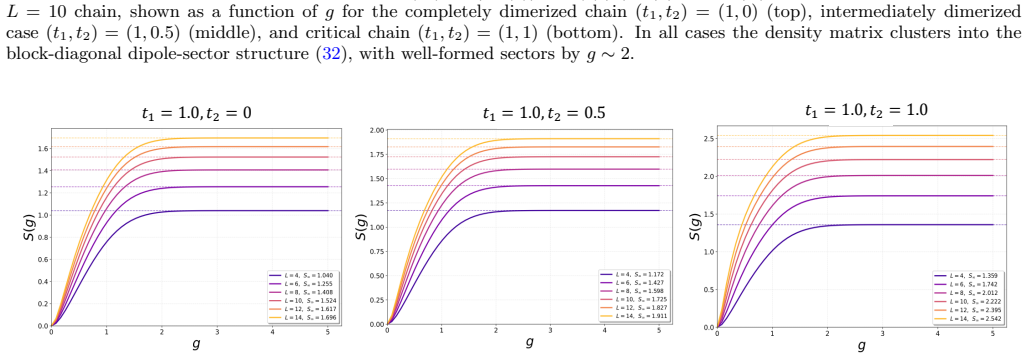
At strong coupling the reduced density matrix becomes exactly block-diagonal in sectors of fixed many-body dipole, reflecting an emergent dipole symmetry imposed by the photon. Both the light-matter entanglement entropy and the spatial entanglement entropy of the photon-dressed state then equal the Shannon entropy over the dipole-sector weights and scale as S_infinity approximately alpha over two times log L. This scaling holds uniformly across the entire phase diagram of the half-filled Su-Schrieffer-Heeger model because the photon resolves fluctuations of a single collective dipole coordinate P that grow proportionally to L to the alpha over two.
What carries the argument
The light-matter quantum circuit obtained by reinterpreting the Power-Zienau-Woolley transformation, which couples the photonic position quadrature X to the many-body dipole P and supplies an exact reduced density matrix valid at every coupling strength.
If this is right
- Both light-matter and spatial entanglement entropies scale logarithmically with system size at strong coupling.
- The density matrix becomes block-diagonal in dipole sectors at ultrastrong coupling, enforcing an emergent dipole symmetry.
- The logarithmic scaling is robust and holds for every phase of the half-filled Su-Schrieffer-Heeger chain.
- The logarithm arises because the photon distinguishes a single collective dipole coordinate whose fluctuations grow as L to the alpha over two.
Where Pith is reading between the lines
- The same collective-coordinate mechanism could be used to tune entanglement scaling in other one-dimensional chains by adjusting cavity parameters.
- If a similar photon-resolved collective operator exists in two-dimensional materials, the framework may predict analogous logarithmic entanglement there.
- Circuit-QED experiments that vary both chain length and coupling strength could directly map the crossover from Lindbladian to block-diagonal regimes.
Load-bearing premise
Reinterpreting the Power-Zienau-Woolley transformation as a light-matter quantum circuit that couples the photonic position quadrature to the many-body dipole produces an exactly solvable model whose reduced density matrix remains valid at all coupling strengths.
What would settle it
Measure or compute the entanglement entropy as a function of chain length L at fixed strong coupling strength and check whether the scaling is logarithmic with prefactor alpha over two and independent of the Su-Schrieffer-Heeger phase.
Figures




read the original abstract
Hybrid systems where a quantum material strongly couples to a nonlocal cavity photon mode have emerged as a new frontier for controlling and probing quantum correlations, yet the structure and scaling of light-matter entanglement produced by the nonlocal coupling remains poorly understood. We address this problem through an exactly solvable framework based on reinterpreting the Power--Zienau--Woolley (PZW) transformation as a \textit{light-matter quantum circuit} that couples the photonic position quadrature $X \sim a + a^\dagger$ to the many-body dipole $\mathcal{P}$ of a one-dimensional quantum chain. We derive a closed-form expression for the reduced density matrix valid at all coupling strengths, in which off-diagonal elements between matter states of unequal dipole are suppressed by a Gaussian factor encoding the full weak-to-ultrastrong coupling crossover. At weak coupling, the reduced density matrix takes a Lindbladian form with $\mathcal{P}$ as the jump operator, and the entanglement entropy is controlled by the dipole variance. At ultrastrong coupling, the density matrix becomes exactly block-diagonal in dipole sectors, reflecting an \textit{emergent dipole symmetry} dynamically imposed by the photon field, with entanglement entropy given exactly by the Shannon entropy of the dipole-sector weight distribution. Applying this framework to a half-filled Su--Schrieffer--Heeger chain, we show that, at strong coupling, both the light-matter entanglement and the spatial entanglement of the photon-dressed matter state scale logarithmically with system size, $S_\infty \sim \frac{\alpha}{2}\log L$, robust across the SSH phase diagram. The logarithm originates from the photon resolving a single collective coordinate $\mathcal{P}$ whose fluctuations grow as $L^{\alpha/2}$, a distinct mechanism from the logarithmic entanglement of critical one-dimensional systems.
Editorial analysis
A structured set of objections, weighed in public.
Referee Report
Summary. The manuscript reinterprets the Power-Zienau-Woolley transformation as a light-matter quantum circuit coupling the photonic position quadrature X to the collective dipole P of a 1D chain. It derives a closed-form reduced density matrix valid at all couplings, with a Gaussian suppression of off-diagonal elements between unequal-P states that interpolates from a Lindbladian form at weak coupling to exact block-diagonality in dipole sectors at ultrastrong coupling (emergent dipole symmetry). Applied to the half-filled SSH chain, both light-matter entanglement and spatial entanglement of the photon-dressed state are shown to scale as S_∞ ∼ (α/2) log L at strong coupling, with the logarithm arising from photon resolution of a single collective coordinate whose fluctuations grow as L^{α/2}.
Significance. If the central claims hold, the work supplies an exactly solvable, parameter-free framework for light-matter entanglement that yields a distinct logarithmic mechanism tied to collective dipole fluctuations rather than criticality. The closed-form reduced density matrix and its explicit weak-to-ultrastrong crossover constitute a clear technical advance for hybrid quantum systems.
major comments (1)
- [SSH application / spatial entanglement results] In the SSH application (abstract and results section on spatial entanglement of the photon-dressed state): the claim that spatial entanglement entropy inherits the full (α/2) log L scaling from the Shannon entropy of the P distribution rests on the assumption that a spatial bipartition fully resolves global dipole sectors. Because P is a nonlocal sum over the entire chain, reduced density operators belonging to different P eigenvalues generally have overlapping support on one half; the von Neumann entropy of their mixture is therefore strictly smaller than the Shannon entropy plus average intra-sector entropy. This point is load-bearing for the spatial-entanglement claim and requires explicit verification or a quantitative bound.
Simulated Author's Rebuttal
We thank the referee for their careful reading of the manuscript and for identifying this important subtlety in the spatial entanglement analysis. We address the comment directly below and will revise the manuscript to incorporate a quantitative clarification.
read point-by-point responses
-
Referee: In the SSH application (abstract and results section on spatial entanglement of the photon-dressed state): the claim that spatial entanglement entropy inherits the full (α/2) log L scaling from the Shannon entropy of the P distribution rests on the assumption that a spatial bipartition fully resolves global dipole sectors. Because P is a nonlocal sum over the entire chain, reduced density operators belonging to different P eigenvalues generally have overlapping support on one half; the von Neumann entropy of their mixture is therefore strictly smaller than the Shannon entropy plus average intra-sector entropy. This point is load-bearing for the spatial-entanglement claim and requires explicit verification or a quantitative bound.
Authors: We agree that the non-locality of the collective dipole operator P implies that the reduced density matrices on a spatial half for different P sectors generally overlap, so that the von Neumann entropy of the mixture is strictly less than the Shannon entropy of the P distribution plus the weighted intra-sector entropies. This is a valid technical observation. At ultrastrong coupling the full state is block-diagonal in P, and the leading (α/2) log L term originates from the growing variance of P (∼ L^α). While the overlap reduces the entropy relative to the naive sum, the correction is controlled by local dipole fluctuations, which remain O(1) per site and do not grow with L. Consequently the difference is sub-leading and the asymptotic scaling S_∞ ∼ (α/2) log L is preserved. We will add to the revised manuscript an explicit bound on the overlap (or a direct numerical extraction of the correction term) together with a clarification in the abstract and results section that the logarithmic scaling is the leading behavior, not an exact equality to the Shannon entropy. Our existing finite-size data already confirm the log L growth, consistent with this analysis. revision: yes
Circularity Check
Derivation self-contained from standard PZW transformation with no load-bearing self-references or fitted predictions
full rationale
The paper begins from the standard Power-Zienau-Woolley transformation, reinterpreted as a light-matter quantum circuit coupling photonic quadrature X to many-body dipole P. It derives a closed-form reduced density matrix (valid at all couplings) whose block-diagonal structure at strong coupling directly yields the Shannon entropy of the P-distribution. The logarithmic scaling S_∞ ∼ (α/2) log L follows analytically from the stated dipole fluctuations ∼ L^{α/2} in the SSH model. No parameters are fitted then renamed as predictions, no self-citations are invoked to justify uniqueness or ansatz, and the spatial-entanglement claim is presented as following from the same reduced-density-matrix construction rather than by redefinition. The chain is independent of its own outputs.
Axiom & Free-Parameter Ledger
axioms (2)
- domain assumption The Power-Zienau-Woolley transformation can be reinterpreted as a light-matter quantum circuit coupling photonic position quadrature X to the many-body dipole P
- standard math Standard quantum mechanics and the dipole approximation apply to the hybrid system
Reference graph
Works this paper leans on
-
[1]
C. H. Bennett, G. Brassard, C. Cr´ epeau, R. Jozsa, A. Peres, and W. K. Wootters, Physical review letters 70, 1895 (1993). 12
work page 1993
-
[2]
D. Bouwmeester, J.-W. Pan, K. Mattle, M. Eibl, H. We- infurter, and A. Zeilinger, Nature390, 575 (1997)
work page 1997
-
[3]
S. Pirandola, J. Eisert, C. Weedbrook, A. Furusawa, and S. L. Braunstein, Nature photonics9, 641 (2015)
work page 2015
-
[4]
X.-M. Hu, Y. Guo, B.-H. Liu, C.-F. Li, and G.-C. Guo, Nature Reviews Physics5, 339 (2023)
work page 2023
- [5]
- [6]
- [7]
- [8]
-
[9]
I. Affleck, T. Kennedy, E. H. Lieb, and H. Tasaki, Com- munications in Mathematical Physics115, 477 (1988)
work page 1988
-
[10]
F. Pollmann, A. M. Turner, E. Berg, and M. Oshikawa, Phys. Rev. B81, 064439 (2010)
work page 2010
- [11]
-
[12]
A. M. Turner, F. Pollmann, and E. Berg, Phys. Rev. B 83, 075102 (2011)
work page 2011
- [13]
- [14]
-
[15]
L. H. Santos, Phys. Rev. B91, 155150 (2015)
work page 2015
-
[16]
L. H. Santos, J. Cano, M. Mulligan, and T. L. Hughes, Phys. Rev. B98, 075131 (2018)
work page 2018
- [17]
-
[18]
P. Calabrese and J. Cardy, Journal of statistical mechan- ics: theory and experiment2004, P06002 (2004)
work page 2004
- [19]
- [20]
- [21]
- [22]
-
[23]
J. H. Bardarson, F. Pollmann, and J. E. Moore, Physical review letters109, 017202 (2012)
work page 2012
- [24]
- [25]
- [26]
-
[27]
M. B. Hastings, J. Stat. Mech. , P08024 (2007)
work page 2007
-
[28]
F. J. Garcia-Vidal, C. Ciuti, and T. W. Ebbesen, Science373, eabd0336 (2021), https://www.science.org/doi/pdf/10.1126/science.abd0336
-
[29]
H. H¨ ubener, U. De Giovannini, C. Sch¨ afer, J. Andberger, M. Ruggenthaler, J. Faist, and A. Rubio, Nat. Mater. 20, 438 (2021)
work page 2021
-
[30]
A. Frisk Kockum, A. Miranowicz, S. De Liberato, S. Savasta, and F. Nori, Nature Reviews Physics1, 19 (2019)
work page 2019
-
[31]
P. Forn-D´ ıaz, L. Lamata, E. Rico, J. Kono, and E. Solano, Rev. Mod. Phys.91, 025005 (2019)
work page 2019
-
[32]
F. Schlawin, A. Cavalleri, and D. Jaksch, Phys. Rev. Lett.122, 133602 (2019)
work page 2019
-
[33]
A. A. Allocca, Z. M. Raines, J. B. Curtis, and V. M. Galitski, Physical Review B99, 020504 (2019)
work page 2019
- [34]
- [35]
-
[36]
G. Jarc, S. Y. Mathengattil, A. Montanaro, F. Giusti, E. M. Rigoni, R. Sergo, F. Fassioli, S. Winnerl, S. Dal Zilio, D. Mihailovic,et al., Nature622, 487 (2023)
work page 2023
-
[37]
Fluctuation engineering in cavity quantum materials
H. M. Bretscher, L. Graziotto, M. H. Michael, A. Mon- tanaro, I.-T. Lu, A. Grankin, J. W. McIver, J. Faist, D. Fausti, M. Eckstein, M. Ruggenthaler, A. Rubio, D. Basov, M. Hafezi, M. Claassen, D. M. Kennes, and M. A. Sentef, “Fluctuation engineering in cavity quantum materials,” (2026), arXiv:2604.08666 [cond-mat.mes- hall]
work page internal anchor Pith review Pith/arXiv arXiv 2026
-
[38]
D. Shaffer, M. Claassen, A. Srivastava, and L. H. Santos, Physical Review B109, 155160 (2024)
work page 2024
- [39]
-
[40]
Z. Bacciconi, G. M. Andolina, and C. Mora, Phys. Rev. B109, 165434 (2024)
work page 2024
- [41]
-
[42]
Z. Bacciconi, H. B. Xavier, I. Carusotto, T. Chanda, and M. Dalmonte, Phys. Rev. X15, 021027 (2025)
work page 2025
- [43]
-
[44]
E. A. Power and S. Zienau, Philosophical Transactions of the Royal Society of London. Series A, Mathematical and Physical Sciences251, 427 (1959)
work page 1959
-
[45]
R. G. Woolley, Proceedings of the Royal Society of Lon- don. A. Mathematical and Physical Sciences321, 557 (1971)
work page 1971
- [46]
- [47]
-
[48]
H.-P. Breuer and F. Petruccione,The theory of open quantum systems(OUP Oxford, 2002)
work page 2002
-
[49]
P. Sala, T. Rakovszky, R. Verresen, M. Knap, and F. Pollmann, Phys. Rev. X10, 011047 (2020)
work page 2020
-
[50]
V. Khemani, M. Hermele, and R. Nandkishore, Phys. Rev. B101, 174204 (2020)
work page 2020
-
[51]
S. Moudgalya, B. A. Bernevig, and N. Regnault, Rep. Prog. Phys.85, 086501 (2022)
work page 2022
-
[52]
F. Appugliese, J. Enkner, G. L. Paravicini-Bagliani, M. Beck, C. Reichl, W. Wegscheider, G. Scalari, C. Ciuti, and J. Faist, Science375, 1030 (2022), https://www.science.org/doi/pdf/10.1126/science.abl5818
-
[53]
T. Neupert, L. Santos, C. Chamon, and C. Mudry, Phys. Rev. Lett.106, 236804 (2011)
work page 2011
-
[54]
K. Sun, Z. Gu, H. Katsura, and S. Das Sarma, Phys. Rev. Lett.106, 236803 (2011)
work page 2011
-
[55]
D. N. Sheng, Z.-C. Gu, K. Sun, and L. Sheng, Nature Communications2, 389 EP (2011)
work page 2011
- [56]
- [57]
-
[58]
T. Cao, L. Fu, L. Ju, D. Xiao, and X. Xu, Annual Review of Condensed Matter Physics17(2025)
work page 2025
- [59]
- [60]
-
[61]
Y. Li, X. Chen, and M. P. A. Fisher, Phys. Rev. B98, 205136 (2018)
work page 2018
- [62]
-
[63]
A. Chan, A. De Luca, and J. T. Chalker, Phys. Rev. B 99, 224307 (2019)
work page 2019
discussion (0)
Sign in with ORCID, Apple, or X to comment. Anyone can read and Pith papers without signing in.