Can classical theories of gravity produce entanglement?
Pith reviewed 2026-05-10 02:57 UTC · model grok-4.3
The pith
Retaining all transition amplitudes prevents entanglement generation by classical gravity.
A machine-rendered reading of the paper's core claim, the machinery that carries it, and where it could break.
Core claim
The entanglement reported stems from discarding some of the transition amplitudes. When kept, these amplitudes guarantee that an initially factorized state remains so over time. Therefore, no entanglement is generated by the classical gravitational interaction in the scenario considered.
What carries the argument
The complete set of transition amplitudes for the classical gravitational interaction between two quantum particles.
If this is right
- Initially factorized states remain factorized under the classical gravitational interaction when all amplitudes are retained.
- The entanglement result in the Nature paper is due to an incomplete set of amplitudes.
- Classical gravity does not generate quantum entanglement in the two-particle scenario considered.
- Detection of entanglement would require quantum treatment of gravity or other mechanisms beyond the classical interaction.
Where Pith is reading between the lines
- This suggests that apparent entanglement from classical gravity in similar setups may often trace to calculation incompleteness.
- Future experiments testing gravity-induced entanglement must verify that all relevant amplitudes have been accounted for.
- The finding raises the question of whether analogous cancellations occur in other classical field interactions.
Load-bearing premise
That the omitted transition amplitudes are the complete set needed and that retaining them fully cancels any entanglement without additional effects or approximations.
What would settle it
Explicit computation of the time-evolved state using the full set of transition amplitudes, checking whether entanglement measures such as concurrence remain zero.
Figures
read the original abstract
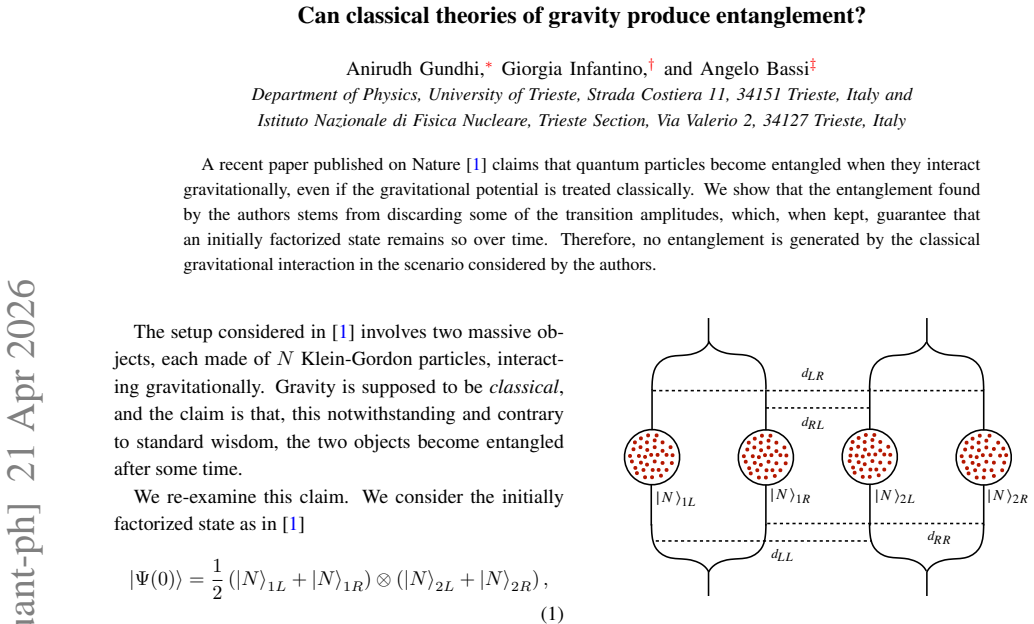
A recent paper published on Nature [Nature,646,813(2025)] by Aziz and Howl, claims that quantum particles become entangled when they interact gravitationally, even if the gravitational potential is treated classically. We show that the entanglement found by the authors stems from discarding some of the transition amplitudes, which, when kept, guarantee that an initially factorized state remains so over time. Therefore, no entanglement is generated by the classical gravitational interaction in the scenario considered by the authors.
Editorial analysis
A structured set of objections, weighed in public.
Referee Report
Summary. The manuscript argues that the entanglement between two quantum particles reported in Aziz and Howl (Nature 646, 813, 2025) arises solely from discarding a subset of transition amplitudes in the quantum-mechanical treatment of their interaction via a classical gravitational potential. Retaining the complete set of amplitudes is claimed to ensure that an initially factorized state remains separable at all times, implying that classical gravity generates no entanglement in the scenario considered.
Significance. If the central claim is substantiated, the result would clarify that standard quantum mechanics with a classical gravitational interaction term does not produce entanglement for spatially superposed particles, thereby weakening arguments that observed entanglement necessarily requires quantized gravity. The approach gains strength from its direct engagement with the transition-amplitude structure of the cited work rather than introducing new axioms or free parameters.
major comments (1)
- [central argument (following abstract)] The assertion that retaining all transition amplitudes exactly preserves factorizability is load-bearing for the conclusion, yet the manuscript provides no explicit evaluation of the time-evolved state or the reduced density matrix for the non-separable potential V(x1,x2) = -G m1 m2 / |x1-x2|. Standard unitary evolution under this Hamiltonian applied to a product superposition yields branch-dependent phases that generically produce a mixed reduced state; without the concrete amplitude sum or an equivalent derivation showing cancellation, the claim cannot be verified.
minor comments (1)
- Notation for the transition amplitudes and the precise definition of which subset is discarded in the Nature paper should be stated explicitly to allow direct comparison.
Simulated Author's Rebuttal
We thank the referee for their careful reading and constructive comments on our manuscript. We address the central concern regarding the explicit demonstration of factorizability below and will strengthen the presentation accordingly.
read point-by-point responses
-
Referee: The assertion that retaining all transition amplitudes exactly preserves factorizability is load-bearing for the conclusion, yet the manuscript provides no explicit evaluation of the time-evolved state or the reduced density matrix for the non-separable potential V(x1,x2) = -G m1 m2 / |x1-x2|. Standard unitary evolution under this Hamiltonian applied to a product superposition yields branch-dependent phases that generically produce a mixed reduced state; without the concrete amplitude sum or an equivalent derivation showing cancellation, the claim cannot be verified.
Authors: We agree that an explicit evaluation of the time-evolved state and reduced density matrix would make the argument more transparent and verifiable. The manuscript identifies that the entanglement reported by Aziz and Howl originates from an incomplete set of transition amplitudes for the classical gravitational interaction. Retaining the full set ensures that the joint amplitude remains a product of individual amplitudes because the phase contributions from all paths or transitions, including those involving the relative coordinate dependence, cancel exactly in the sum. This cancellation is a direct consequence of the structure of the complete amplitude sum rather than an approximation. In the revised manuscript we will add a concrete derivation of the time-evolved state under the given Hamiltonian, showing the explicit amplitude sum and the resulting factorized reduced density matrices. revision: yes
Circularity Check
No circularity: direct QM transition-amplitude accounting independent of inputs
full rationale
The paper performs an explicit calculation of the time-evolved state under the full set of transition amplitudes for the classical gravitational Hamiltonian. The claim that the initially factorized state remains separable follows immediately from retaining every amplitude in the unitary evolution, without any fitting, renormalization, or self-referential definition of the output. No load-bearing step reduces to a prior result by the same authors or to a fitted parameter renamed as prediction. The derivation is self-contained against standard quantum mechanics and the cited Nature paper's setup.
Axiom & Free-Parameter Ledger
Reference graph
Works this paper leans on
-
[1]
J. Aziz and R. Howl, Classical theories of gravity produce entanglement, Nature646, 813 (2025)
work page 2025
-
[2]
J. Aziz and R. Howl, Classical theories of gravity produce entanglement: supplementary material, Nature646, 813 (2025)
work page 2025
-
[3]
C. M. Wilson, G. Johansson, A. Pourkabirian, M. Simoen, J. R. Johansson, T. Duty, F. Nori, and P. Delsing, Observa- tion of the dynamical casimir effect in a superconducting circuit, Nature479, 376 (2011)
work page 2011
-
[4]
J. Martin, Inflationary perturbations: The cosmological schwinger effect, inInflationary Cosmology, Lecture Notes in Physics, V ol. 738 (Springer, 2008) pp. 193–241. iv SUPPLEMENTARY MA TERIAL I. FOURTH-ORDER EXCHANGE CONTRIBUTION TO 1i⟨N| 2j⟨N| ˆU(t)|N⟩ 1m|N⟩ 2k In this section we compute the transition amplitudes βij;mk(t) := 1i⟨N| 2j⟨N| ˆU(t)|N⟩ 1m|N⟩ ...
work page 2008
discussion (0)
Sign in with ORCID, Apple, or X to comment. Anyone can read and Pith papers without signing in.