Recognition: unknown
Precision Kinematic Sunyaev--Zel'dovich Measurements Across Halo Mass and Redshift with DESI DR2 and ACT DR6: Part II. Bright Galaxy Survey and Emission-Line Galaxies
Pith reviewed 2026-05-10 01:19 UTC · model grok-4.3
The pith
DESI DR2 and ACT DR6 yield the first high-significance spectroscopic kSZ detections of circumgalactic gas for bright galaxies and emission-line galaxies.
A machine-rendered reading of the paper's core claim, the machinery that carries it, and where it could break.
Core claim
By combining reconstructed line-of-sight velocities from DESI DR2 galaxies with high-resolution ACT DR6 temperature maps, the kinetic Sunyaev-Zel'dovich signal is detected at high significance for both BGS and ELG tracers. Splitting the samples into stellar-mass bins reveals how the kSZ amplitude scales with galaxy properties. Joint analysis with CMB lensing maps shows low gas fractions around the virial radius for BGS galaxies, consistent with AGN feedback, and relatively high gas fractions for ELGs, suggesting weaker feedback at their mass scale. Generalized Navarro-Frenk-White fits to the harmonic-space profiles provide a compact parametrization of the gas distribution.
What carries the argument
Spectroscopic stacked kinetic Sunyaev-Zel'dovich effect, which isolates the Doppler shift in CMB temperature caused by moving ionized gas using precise galaxy velocities.
If this is right
- BGS galaxies exhibit low gas fractions near the virial radius relative to standard expectations, pointing to AGN activity as the cause.
- Higher-mass halos retain a larger fraction of their baryons, consistent with more efficient feedback in lower-mass systems.
- ELG host halos show relatively high gas fractions, indicating weaker feedback from AGN and supernova activity at that mass scale.
- Generalized Navarro-Frenk-White parametrizations of the gas profiles enable direct forward modeling in large-scale structure analyses.
Where Pith is reading between the lines
- The mass-dependent gas fractions could be compared directly to hydrodynamic simulations to test whether current feedback prescriptions reproduce the observed depletion trends.
- Extending the same velocity-stacking approach to higher-redshift tracers in future surveys would map the redshift evolution of baryon retention inside halos.
- Joint kSZ and lensing constraints on gas content provide an independent route to calibrate the galaxy-halo connection without relying solely on abundance matching.
Load-bearing premise
The analysis assumes that line-of-sight velocities reconstructed from DESI galaxy spectra are sufficiently accurate and unbiased for stacking, and that ACT temperature maps isolate the kSZ signal without significant residual contamination from other astrophysical or instrumental effects.
What would settle it
The stacked kSZ signal vanishing when measured galaxy velocities are replaced by random draws from the same distribution, or when the stack is repeated on maps known to contain no kSZ contribution, would indicate that the detection is not physical.
Figures


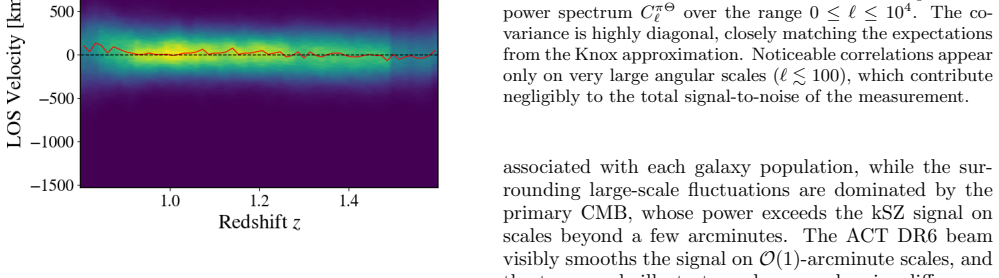


read the original abstract
We present the first high-significance spectroscopic stacked kinetic Sunyaev-Zel'dovich (kSZ) measurements of circumgalactic gas profiles for both Bright Galaxy Survey (BGS) and Emission Line Galaxy (ELG) tracers, combining DESI Data Release 2 with ACT Data Release 6. Using reconstructed line-of-sight velocities from the DESI galaxies and high-resolution ACT temperature maps, we detect the kSZ signal at high significance, reaching signal-to-noise ratios of up to $\sim$9 for BGS and $\sim$7.5 for ELGs in optimal stellar-mass selections. Together with the LRG measurements presented in Paper I, these constitute the most significant kSZ detections from any spectroscopic survey to date. We perform the analysis in both real and harmonic space, obtaining consistent results. By splitting both tracers into stellar-mass bins, we study the scaling of the kSZ amplitude with galaxy properties. Combining the kSZ measurements with ACT Data Release 6 (DR6) CMB lensing maps enables a joint calibration of the galaxy-halo connection and the gas fractions of host halos. For the BGS galaxies, we observe low gas fractions around the virial radius relative to standard expectations, likely attributable to active galactic nuclei (AGN) activity. We find some evidence for higher-mass halos retaining a larger fraction of their baryons, consistent with more efficient feedback in lower-mass systems. For the ELG sample, dominated by blue, star-forming galaxies, we provide the first detection of the gas distribution in ELG host halos. The ELGs appear to exhibit relatively high gas fractions, which points to the possibility of weaker feedback (due to e.g. low AGN and supernova feedback activity) at their mass scale. Finally, we present generalized Navarro-Frenk-White (GNFW) fits to the harmonic-space measurements, providing a compact parametrization of gas profiles for forward modeling in large-scale structure analyses.
Editorial analysis
A structured set of objections, weighed in public.
Referee Report
Summary. The paper reports the first high-significance spectroscopic stacked kSZ measurements of circumgalactic gas for DESI DR2 BGS and ELG tracers using ACT DR6 maps. It achieves SNR up to ~9 (BGS) and ~7.5 (ELG) in optimal stellar-mass bins, presents consistent results in real and harmonic space, examines scaling with galaxy properties, performs joint calibration with CMB lensing, infers gas fractions (low for BGS, higher for ELGs), and provides GNFW fits to the profiles.
Significance. If the central assumptions hold, this work delivers the most significant spectroscopic kSZ detections to date from any survey, extending Paper I (LRGs) to new tracers and providing the first ELG host-halo gas constraints. The real/harmonic consistency, mass-binned scaling, lensing joint analysis, and GNFW parametrization are strengths that enable direct use in forward modeling of large-scale structure and feedback studies.
major comments (2)
- [§4.2] §4.2 (velocity reconstruction and stacking): The reported SNR values of ~9 (BGS) and ~7.5 (ELG) are obtained by weighting ACT maps with reconstructed line-of-sight velocities v_los. No mock-based recovery fraction, cross-correlation coefficient r = <v_rec v_true>/σ_v, or bias quantification is presented for the DESI BGS/ELG samples (including potential ELG outflow effects). This directly scales the stacked amplitude and is load-bearing for the detection claims.
- [§5.1] §5.1 and §6 (systematic tests and null tests): While map-cleaning null tests are mentioned, the manuscript lacks explicit tests for residual contamination in the velocity-weighted stacks (e.g., from tSZ leakage, instrumental noise, or redshift-dependent selection) that could mimic or dilute the reported high-SNR signals. These tests are needed to support the central detection significance.
minor comments (2)
- [Abstract] The abstract and §1 should explicitly define 'optimal stellar-mass selections' and the precise binning used for the quoted peak SNR values.
- [§5.3] Figure captions and §5.3 could clarify how the GNFW parameters are jointly constrained with the lensing data versus kSZ-only fits.
Simulated Author's Rebuttal
We thank the referee for their careful review and for highlighting the potential impact of this work. We address each major comment below with point-by-point responses and have revised the manuscript to incorporate additional supporting material.
read point-by-point responses
-
Referee: [§4.2] §4.2 (velocity reconstruction and stacking): The reported SNR values of ~9 (BGS) and ~7.5 (ELG) are obtained by weighting ACT maps with reconstructed line-of-sight velocities v_los. No mock-based recovery fraction, cross-correlation coefficient r = <v_rec v_true>/σ_v, or bias quantification is presented for the DESI BGS/ELG samples (including potential ELG outflow effects). This directly scales the stacked amplitude and is load-bearing for the detection claims.
Authors: The velocity reconstruction employs the same DESI pipeline validated in Paper I (LRGs) and companion DESI analyses, where mock catalogs yielded recovery fractions >0.8 with minimal bias. For BGS and ELG tracers we will add an explicit subsection (and appendix) summarizing sample-specific mock tests, including cross-correlation coefficients and bias estimates. For ELGs we will additionally compare to hydrodynamical simulations to quantify any outflow-induced velocity bias. These additions directly buttress the reported SNRs. revision: yes
-
Referee: [§5.1] §5.1 and §6 (systematic tests and null tests): While map-cleaning null tests are mentioned, the manuscript lacks explicit tests for residual contamination in the velocity-weighted stacks (e.g., from tSZ leakage, instrumental noise, or redshift-dependent selection) that could mimic or dilute the reported high-SNR signals. These tests are needed to support the central detection significance.
Authors: We already present map-cleaning nulls and random-velocity-sign-flip tests that return null signals. In the revision we will expand §§5.1 and 6 with three new explicit tests: (i) cross-correlation of the velocity-weighted stacks against ACT tSZ maps to bound leakage, (ii) end-to-end noise-only simulations of the weighted estimator, and (iii) redshift-binned splits to verify absence of selection-induced systematics. These will be shown alongside the primary results. revision: yes
Circularity Check
No significant circularity; detections are direct data products
full rationale
The paper reports stacked kSZ detections obtained by weighting ACT temperature maps with reconstructed DESI line-of-sight velocities. The reported S/N values (~9 for BGS, ~7.5 for ELG) follow directly from the stacked maps and covariance estimation on the data; no equation reduces these amplitudes to a prior fit or self-citation. GNFW profiles are fitted after the fact to the measured profiles and are not used to generate the detection statistic. The reference to Paper I supplies complementary LRG results but is not invoked to justify the BGS/ELG detections or their significance. The analysis chain is therefore self-contained against external benchmarks (ACT maps and DESI spectra) and does not exhibit any of the enumerated circularity patterns.
Axiom & Free-Parameter Ledger
free parameters (1)
- GNFW profile parameters
axioms (2)
- domain assumption Line-of-sight velocities from DESI spectra are accurate enough for kSZ stacking
- domain assumption ACT DR6 maps contain the kSZ signal with controllable systematics
Reference graph
Works this paper leans on
-
[1]
Pseudo-C ℓ correction withNaMaster Survey masks, beam convolution, and pixelization cou- ple harmonic modes and bias the direct pseudo-C ℓ esti- mators. We use the publicNaMasterpackage [64] to com- pute the mode-coupling (workspace) for the particular pair of masks (momentum map mask and ACT temper- ature mask), decouple the pseudo-spectra, and produce u...
-
[2]
Harmonic-space covariance For the harmonic-space analysis we use the analytic Gaussian covariance computed byNaMaster. In band- power space (bins labelled bybwith width ∆ℓ) the (approximate) Gaussian diagonal variance for the cross- spectrum is Var C ˆπΘ ℓb = 1 (2ℓb + 1)∆ℓ fsky h C ˆπˆπ ℓb CΘΘ ℓb + C πΘ ℓb 2i , (13) withC ππ ℓb the measured momentum auto-...
-
[3]
Harmonic estimators of the optical depth On small scales, and assuming statistical isotropy of the velocity field, the momentum-temperature cross- spectrum can be related to the optical-depth-galaxy cross-spectrum by a velocity factor [65, 66]. Denoting byC τ g ℓ the angular cross-power spectrum between the projected optical-depth fieldτ( ˆn) and the gala...
-
[4]
Limber approximation In the Limber approximation, the angular cross- spectrum between the projected optical-depth (or elec- tron column) and galaxies is C τ g ℓ = Z ∞ 0 dχ χ2 Wτ(χ)W g(χ)P eg k= ℓ+ 1/2 χ , z(χ) , (15) whereP eg(k, z) is the electron-galaxy cross-power spec- trum, with the radial kernels Wτ(χ) =σ T a−2(χ) ¯ne(χ),(16) Wg(χ) = dp dχ ,(17) 11 ...
-
[5]
Z dM dn dM (M, z)b(M, z) ˜ue(k|M, z) # ×
Halo model for the electron-galaxy cross-power spectrum We model the 3D electron-galaxy cross-spectrum Peg(k, z) with a halo-model decomposition into one-halo and two-halo components: P 1h eg (k, z) = Z dM dn dM (M, z) ˜ue(k|M, z) ˜ug(k|M, z), (18) P 2h eg (k, z) = "Z dM dn dM (M, z)b(M, z) ˜ue(k|M, z) # × "Z dM dn dM (M, z)b(M, z) ˜ug(k|M, z) # PL(k, z)....
2008
-
[6]
implementation of the high-mass quenched (HMQ) model based on Refs. [73–75], for which the centrals HOD is given by: ¯nELG cent (M) = 2Aϕ(M)Φ(γM) + 1 2Q h 1 + erf log10 Mh−log10 Mcut 0.01 i ,(22) where ϕ(x) =N(log 10 Mcut, σM),(23) Φ(x) = R x −∞ ϕ(t)dt= 1 2 h 1 + erf x√ 2 i ,(24) A=p max −1/Q.(25) For the ELG satellites, we adopt the same form as the BGS ...
-
[7]
This is done to reduce degeneracies between the parameters, some of which are poorly constrained
GNFW model for the gas density We model the 3D ionized gas density with a generalized Navarro–Frenk-White (GNFW) profile: ρGNFW(r) =ρ 0 r xc r200c !γ" 1 + r xc r200c !α#−(β+γ)/α , (26) ρgas,free(r) =f b ρcr(z)ρ GNFW(r).(27) We adopt fixedγ=−0.5 andx c = 0.7 and free the parameters{ρ 0, α, β}in the fits. This is done to reduce degeneracies between the para...
-
[8]
(14), to the model 12 predictions from the halo model described above
Likelihood and priors For each stellar-mass selection, we compare the mea- sured bandpowers in harmonic space,C πΘ ℓ , after con- verting to an equivalentC τ g ℓ via Eq. (14), to the model 12 predictions from the halo model described above. We adopt a Gaussian likelihood for the vector of observed bandpowersd: lnL(d|θ) =− 1 2 d−m(θ) T C−1 d−m(θ) ,(28) whe...
-
[9]
template
Sampling Posterior sampling is performed with the nested- sampling packagedynesty[76] to estimate the posterior distributions and Bayesian evidence. For each fit we run dynestywithnlive=500 using dynamic nested sampling until convergence. From the posterior samples, we com- pute marginalized parameter constraints (shown in App. D), and the model bandpower...
2000
-
[10]
This procedure preserves the overall sky mask but erases any true correlation with the velocity field
Random angular offsets In the first test, we add, to every galaxy in the cata- log, a random angular offset drawn uniformly from the interval [0,20] arcmin in both right ascension and dec- lination. This procedure preserves the overall sky mask but erases any true correlation with the velocity field. We then recomputeC gτ ℓ for each of our five samples: E...
-
[11]
Velocity-shuffling test In the second test, we randomly permute the velocities of the galaxy catalog while keeping the positions fixed. This process destroys the true velocity-density relation while leaving the angular selection function unchanged. For each shuffled catalog, we again measureC gτ ℓ . Because a single shuffling introduces substantial real- ...
-
[12]
Fukugitaet al., ApJ601, L127 (2004)
M. Fukugitaet al., ApJ601, L127 (2004)
2004
-
[13]
Cen and J
R. Cen and J. P. Ostriker, ApJ650, 560 (2006)
2006
-
[14]
N. E. Chisariet al., The Open Journal of Astrophysics 2, 4 (2019)
2019
-
[15]
Semboloniet al., Mon
E. Semboloniet al., Mon. Not. Roy. Astron. Soc.417, 2020 (2011)
2020
-
[16]
Schneideret al., J
A. Schneideret al., J. Cosmology Astropart. Phys.2019, 020 (2019)
2019
-
[17]
Amon and G
A. Amon and G. Efstathiou, MNRAS516, 5355 (2022)
2022
-
[18]
Birkinshaw, Phys
M. Birkinshaw, Phys. Rep.310, 97 (1999)
1999
-
[19]
Mroczkowskiet al., Space Sci
T. Mroczkowskiet al., Space Sci. Rev.215, 17 (2019)
2019
-
[20]
Handet al., Phys
N. Handet al., Phys. Rev. Lett.109, 041101 (2012)
2012
-
[21]
Soergelet al., MNRAS461, 3172 (2016)
B. Soergelet al., MNRAS461, 3172 (2016)
2016
-
[22]
De Bernardiset al., J
F. De Bernardiset al., J. Cosmology Astropart. Phys.2017, 008 (2017)
2017
-
[23]
Calafutet al., Phys
V. Calafutet al., Phys. Rev. D104, 043502 (2021)
2021
-
[24]
O. Dore, J. F. Hennawi, and D. N. Spergel, Astrophys. J.606, 46 (2004)
2004
-
[25]
J. C. Hillet al., Phys. Rev. Lett.117, 051301 (2016)
2016
-
[26]
Ferraroet al., Phys
S. Ferraroet al., Phys. Rev. D94, 123526 (2016)
2016
-
[27]
S. Ho, S. Dedeo, and D. Spergel, (2009)
2009
-
[28]
Harscouetet al., (2025)
L. Harscouetet al., (2025)
2025
-
[29]
Schaanet al., Phys
E. Schaanet al., Phys. Rev. D93, 082002 (2016)
2016
-
[31]
Hadzhiyskaet al., Phys
B. Hadzhiyskaet al., Phys. Rev. D112, 083509 (2025)
2025
-
[32]
Ried Guachallaet al., Phys
B. Ried Guachallaet al., Phys. Rev. D112, 103512 (2025)
2025
-
[33]
Mallaby-Kayet al., Phys
M. Mallaby-Kayet al., Phys. Rev. D108, 023516 (2023)
2023
-
[34]
Lucie-Smithet al., Phys
L. Lucie-Smithet al., Phys. Rev. D112, 063541 (2025)
2025
-
[35]
Miller, S
K. Miller, S. More, and B. Jain, (2025)
2025
-
[36]
Hahnet al., Astron
C. Hahnet al., Astron. J.165, 253 (2023)
2023
-
[37]
Raichooret al., Astron
A. Raichooret al., Astron. J.165, 126 (2023)
2023
-
[38]
F. J. Quet al., Precision Kinematic Sunyaev–Zel’dovich Measurements Across Halo Mass and Redshift with DESI DR2 and ACT DR6: Part I. Luminous Red Galaxies, 2026
2026
-
[39]
Zhouet al., AJ165, 58 (2023)
R. Zhouet al., AJ165, 58 (2023)
2023
-
[40]
Hadzhiyska, S
B. Hadzhiyska, S. Ferraro, and R. Zhou, Phys. Rev. D 111, 023534 (2025)
2025
-
[41]
Hadzhiyskaet al., Phys
B. Hadzhiyskaet al., Phys. Rev. D112, 123507 (2025)
2025
-
[43]
Sunseriet al., (2025)
J. Sunseriet al., (2025)
2025
-
[44]
I. G. McCarthyet al., MNRAS540, 143 (2025)
2025
-
[45]
Bigwoodet al., MNRAS534, 655 (2024)
L. Bigwoodet al., MNRAS534, 655 (2024)
2024
-
[46]
Siegelet al., (2025)
J. Siegelet al., (2025)
2025
-
[47]
Bigwoodet al., (2025)
L. Bigwoodet al., (2025)
2025
-
[48]
DESI Collaborationet al., AJ164, 207 (2022)
2022
-
[49]
T. N. Milleret al., AJ168, 95 (2024)
2024
-
[50]
Poppettet al., AJ168, 245 (2024)
C. Poppettet al., AJ168, 245 (2024)
2024
-
[51]
DESI Collaborationet al., arXiv e-prints arXiv:1611.00037 (2016)
work page Pith review arXiv 2016
-
[52]
Guyet al., AJ165, 144 (2023)
J. Guyet al., AJ165, 144 (2023)
2023
-
[53]
E. F. Schlaflyet al., AJ166, 259 (2023)
2023
-
[54]
DESI Collaborationet al., arXiv e-prints arXiv:2503.14745 (2025)
work page internal anchor Pith review arXiv 2025
- [55]
-
[56]
DESI Collaborationet al., in preparation (2026). 27 Sample log 10 ρ0 α βlog 10 Ak2h χ2 null χ2 bf SNR ELG (all) 6.23±0.58 0.214±0.026 3.96±0.72−0.74±0.20 56.71 0.64 7.49 ELG (logM ⋆ >9.0) 6.24±0.60 0.214±0.026 3.98±0.72−0.73±0.21 53.23 0.73 7.25 ELG (logM ⋆ >9.5) 6.32±0.62 0.213±0.027 4.05±0.80−0.77±0.19 46.56 6.91 6.30 BGS (all) 5.81±0.58 0.210±0.026 3.7...
2026
-
[57]
Zouet al., PASP129, 064101 (2017)
H. Zouet al., PASP129, 064101 (2017)
2017
-
[58]
Deyet al., AJ157, 168 (2019)
A. Deyet al., AJ157, 168 (2019)
2019
-
[59]
A. D. Myerset al., AJ165, 50 (2023)
2023
-
[60]
Raichooret al., AJ165, 126 (2023)
A. Raichooret al., AJ165, 126 (2023)
2023
-
[61]
Siudeket al., A&A691, A308 (2024)
M. Siudeket al., A&A691, A308 (2024)
2024
-
[62]
Siudeket al., A&A700, A209 (2025)
M. Siudeket al., A&A700, A209 (2025)
2025
-
[63]
E. L. Wrightet al., AJ140, 1868 (2010)
2010
-
[64]
Coultonet al., Phys
W. Coultonet al., Phys. Rev. D109, 063530 (2024)
2024
- [65]
-
[66]
M. S. Madhavacherilet al., Astrophys. J.962, 113 (2024)
2024
-
[67]
F. J. Quet al., Astrophys. J.962, 112 (2024)
2024
-
[68]
MacCrannet al., Astrophys
N. MacCrannet al., Astrophys. J.966, 138 (2024)
2024
-
[69]
G. S. Farrenet al., Astrophys. J.966, 157 (2024)
2024
-
[70]
Sailer, E
N. Sailer, E. Schaan, and S. Ferraro, Phys. Rev. D102, 063517 (2020)
2020
-
[71]
Quet al., in preparation (unpublished)
F. Quet al., in preparation (unpublished)
-
[72]
Ried Guachalla, E
B. Ried Guachalla, E. Schaan, B. Hadzhiyska, and S. Ferraro, Phys. Rev. D109, 103533 (2024)
2024
-
[73]
Abdul Karimet al., Phys
M. Abdul Karimet al., Phys. Rev. D112, 083515 (2025)
2025
-
[74]
Hadzhiyska, S
B. Hadzhiyska, S. Ferraro, B. R. Guachalla, and E. Schaan, Phys. Rev. D109, 103534 (2024)
2024
-
[75]
Alonso, J
D. Alonso, J. Sanchez, and A. Slosar, Monthly Notices of the Royal Astronomical Society484, 4127–4151 (2019)
2019
-
[76]
Ma and J
C.-P. Ma and J. N. Fry, Phys. Rev. Lett.88, 211301 (2002)
2002
-
[77]
J. P. Ostriker and E. T. Vishniac, ApJ306, L51 (1986)
1986
-
[78]
Bollietet al., J
B. Bollietet al., J. Cosmology Astropart. Phys.2023, 039 (2023)
2023
-
[79]
Bollietet al., arXiv e-prints arXiv:2310.18482 (2023)
B. Bollietet al., arXiv e-prints arXiv:2310.18482 (2023)
-
[80]
Bollietet al., (2025)
B. Bollietet al., (2025)
2025
-
[81]
Zhenget al., Astrophys
Z. Zhenget al., Astrophys. J.633, 791 (2005)
2005
-
[82]
J. L. Tinkeret al., Astrophys. J.688, 709 (2008)
2008
discussion (0)
Sign in with ORCID, Apple, or X to comment. Anyone can read and Pith papers without signing in.