Second-order topology in two-dimensional azulenoid kekulene carbon lattices
Pith reviewed 2026-05-10 00:32 UTC · model grok-4.3
The pith
Two-dimensional azulenoid-kekulene carbon lattices realize a higher-order topological phase with fractionally charged corner states.
A machine-rendered reading of the paper's core claim, the machinery that carries it, and where it could break.
Core claim
In the organic lattices AKC-[3,3] and AKC-[6,0], C6 symmetry produces a nontrivial higher-order topology quantified by the invariant {[M(I)2],[K(3)2]} = {0,2} and a corner charge Q_corner = e/3; the same charge quantization and associated corner-localized states persist in the derived structure PAK-[6,0].
What carries the argument
C6 rotational symmetry that enforces the higher-order bulk invariant and the resulting fractional corner charge of e/3.
If this is right
- Finite nanoflakes of these lattices exhibit exotic corner-localized electronic states.
- The higher-order phase remains intact after the structural modification that produces PAK-[6,0].
- Azulenoid-kekulene carbon allotropes constitute a platform where crystalline symmetry directly controls higher-order boundary responses.
Where Pith is reading between the lines
- Similar symmetry-driven corner states might appear in other carbon allotropes engineered to possess six-fold rotational symmetry.
- The fractional charge could be probed in transport or scanning-probe experiments on synthesized flakes without requiring external magnetic fields.
Load-bearing premise
First-principles calculations capture the topological invariants, band structure, and fractional corner charge without large errors from exchange-correlation approximations or finite-size effects.
What would settle it
An experimental measurement on a nanoflakes sample that finds corner charge exactly equal to e/3 (or exactly zero) would confirm or refute the predicted quantization.
Figures


read the original abstract
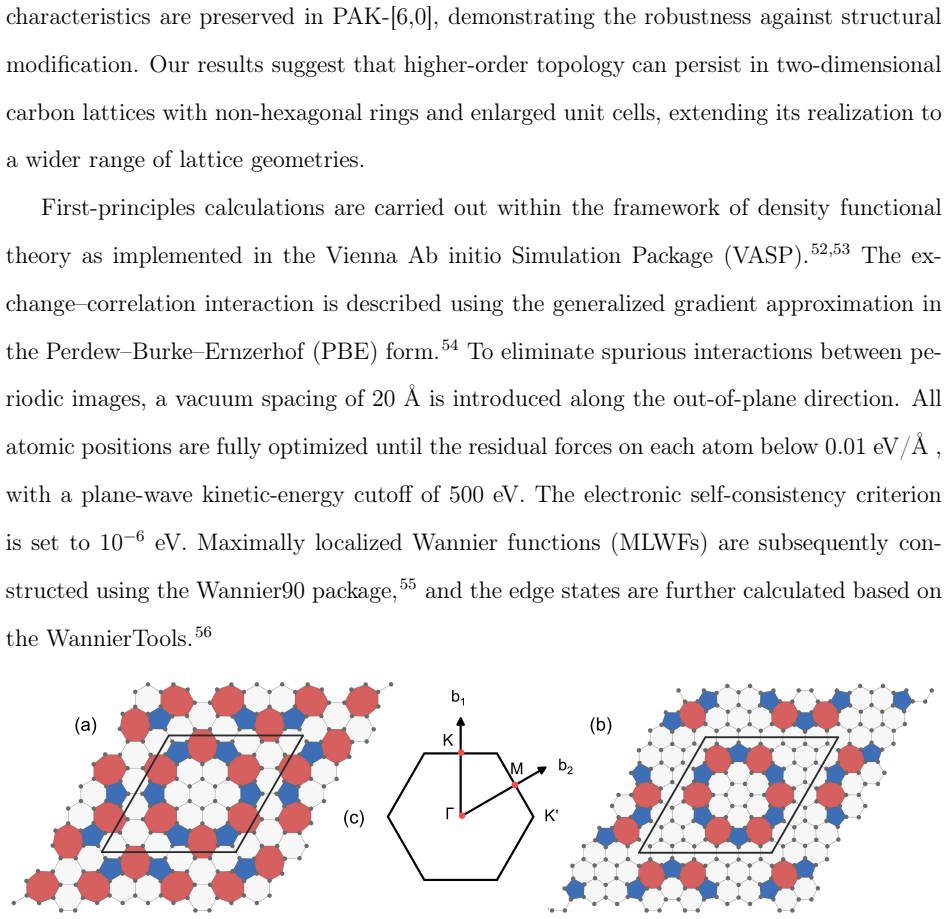
The discovery of higher-order topological insulator (HOTI) has established a new paradigm for understanding symmetry-constrained boundary electronic states. Here, based on first-principles calculations, we demonstrate the emergence of HOTI phase in organic lattices of two-dimensional azulenoid-kekulene-type carbon allotropes, namely AKC-[3,3] and AKC-[6,0]. Enabled by the $C_6$ rotational symmetry, the nontrivial bulk topology is confirmed through the topological invariant and fractionally quantized corner charge, giving $\{[M^{(I)}_{2}],[K^{(3)}_{2}]\}$ = $\{0,2\}$ and $Q_{\mathrm{corner}} = e/3$, respectively, accompanied by the emergence of exotic corner states in nanoflakes. Notably, the structural modifications are explored, revealing that in the derived structure PAK-[6,0], whose corner-localized states are preserved, highlighting the robustness of the higher-order topological phase. These findings highlight azulenoid-kekulene-based carbon allotropes as a promising platform to explore the interplay between structural design, crystalline symmetry, and higher-order topological boundary responses in two dimensional carbon systems.
Editorial analysis
A structured set of objections, weighed in public.
Referee Report
Summary. The manuscript claims to demonstrate a higher-order topological insulator (HOTI) phase in two-dimensional azulenoid-kekulene carbon allotropes AKC-[3,3] and AKC-[6,0] via first-principles calculations. Enabled by C6 rotational symmetry, the nontrivial topology is diagnosed by the invariant {[M(I)2],[K(3)2]} = {0,2} and fractionally quantized corner charge Q_corner = e/3, with associated corner states appearing in nanoflakes; a derived structure PAK-[6,0] is presented to illustrate robustness of the phase.
Significance. If the first-principles results hold under scrutiny, the work would identify a new family of purely carbon-based 2D lattices hosting C6-protected higher-order topology, offering a chemically tunable platform for studying fractional corner charges and boundary states without requiring heavy elements or strong spin-orbit coupling.
major comments (2)
- [Computational Methods / Results] The manuscript provides no details on the first-principles methodology (exchange-correlation functional, plane-wave cutoff, k-mesh density, or convergence criteria) nor any tests of sensitivity of the high-symmetry-point eigenvalues at M and K. This directly affects the reliability of the reported invariant {[M(I)2],[K(3)2]} = {0,2} (abstract and § Results).
- [Nanoflake calculations] No analysis of finite-size effects, edge termination, or structural relaxation is given for the nanoflakes used to extract Q_corner = e/3. Polarization leakage or relaxation-induced shifts could move the integrated corner charge away from exact quantization even when the bulk invariant is formally correct (abstract and nanoflakes discussion).
minor comments (1)
- [Abstract] The final sentence of the abstract is grammatically incomplete ('revealing that in the derived structure PAK-[6,0], whose corner-localized states are preserved, highlighting the robustness...'), reducing clarity.
Simulated Author's Rebuttal
We thank the referee for the positive evaluation of our work's significance and for the constructive comments that have helped us strengthen the manuscript. We address each major comment below and have revised the manuscript to incorporate the requested information and analyses.
read point-by-point responses
-
Referee: [Computational Methods / Results] The manuscript provides no details on the first-principles methodology (exchange-correlation functional, plane-wave cutoff, k-mesh density, or convergence criteria) nor any tests of sensitivity of the high-symmetry-point eigenvalues at M and K. This directly affects the reliability of the reported invariant {[M(I)2],[K(3)2]} = {0,2} (abstract and § Results).
Authors: We agree that the original manuscript did not provide sufficient methodological details. In the revised version, we have added a dedicated Computational Methods section that specifies the exchange-correlation functional employed, the plane-wave energy cutoff, the k-point mesh density used for Brillouin zone sampling, and the convergence criteria for self-consistent calculations. We have also included explicit sensitivity tests in which the k-mesh density and cutoff energy were systematically varied; these tests confirm that the eigenvalues at the M and K points (and therefore the topological invariant {[M^{(I)}_{2}],[K^{(3)}_{2}]} = {0,2}) remain unchanged within the numerical precision of the calculations. These additions directly address the concern regarding the reliability of the reported invariant. revision: yes
-
Referee: [Nanoflake calculations] No analysis of finite-size effects, edge termination, or structural relaxation is given for the nanoflakes used to extract Q_corner = e/3. Polarization leakage or relaxation-induced shifts could move the integrated corner charge away from exact quantization even when the bulk invariant is formally correct (abstract and nanoflakes discussion).
Authors: We thank the referee for raising this important point about the robustness of the corner-charge quantization. In the revised manuscript we have expanded the nanoflakes section to include a systematic study of finite-size effects by considering nanoflakes of increasing lateral dimensions. We have also examined different edge terminations (including hydrogen passivation) and performed full structural relaxations of the nanoflakes. The additional data show that the integrated corner charge converges to e/3 and remains quantized to within numerical accuracy even after relaxation, with no evidence of polarization leakage that would violate the quantization expected from the bulk invariant. These results reinforce the protection of the corner states by the higher-order topology. revision: yes
Circularity Check
No circularity: standard topological invariants computed from first-principles inputs
full rationale
The derivation computes the C6-protected invariant {[M(I)2],[K(3)2]}={0,2} and corner charge Q_corner=e/3 directly from DFT band eigenvalues at high-symmetry points and integrated charge in finite nanoflakes. These are independent diagnostic outputs, not quantities fitted to the target result or defined in terms of themselves. No self-citation chain, ansatz smuggling, or renaming of known results is load-bearing; the structural models and symmetry arguments are external to the final invariants. The paper remains self-contained against external benchmarks.
Axiom & Free-Parameter Ledger
axioms (2)
- domain assumption First-principles electronic-structure methods accurately predict topological invariants and fractional corner charges in 2D carbon systems
- domain assumption The C6 rotational symmetry is preserved in the relaxed structures
Reference graph
Works this paper leans on
-
[1]
Westervelt, R. M. Graphene Nanoelectronics. Science 2008, 320, 324--325
2008
-
[2]
A review of electrode materials for electrochemical supercapacitors
Wang, G.; Zhang, L.; Zhang, J. A review of electrode materials for electrochemical supercapacitors. Chem. Soc. Rev. 2012, 41, 797--828
2012
-
[3]
De Volder, M. F. L.; Tawfick, S. H.; Baughman, R. H.; Hart, A. J. Carbon Nanotubes: Present and Future Commercial Applications. Science 2013, 339, 535--539
2013
-
[4]
Graphdiyne: synthesis, properties, and applications
Gao, X.; Liu, H.; Wang, D.; Zhang, J. Graphdiyne: synthesis, properties, and applications. Chem. Soc. Rev. 2019, 48, 908--936
2019
-
[5]
W.; Krejčí, O.; Dimosthenous, S.; Kachel, S
Fan, Q.; Yan, L.; Tripp, M. W.; Krejčí, O.; Dimosthenous, S.; Kachel, S. R.; Chen, M.; Foster, A. S.; Koert, U.; Liljeroth, P.; Gottfried, J. M. Biphenylene network: A nonbenzenoid carbon allotrope. Science 2021, 372, 852--856
2021
-
[6]
G.; Abdelkareem, M
Olabi, A. G.; Abdelkareem, M. A.; Wilberforce, T.; Sayed, E. T. Application of graphene in energy storage device – A review. Renew. Sustain. Energy Rev. 2021, 135, 110026
2021
-
[7]
L.; Mele, E
Kane, C. L.; Mele, E. J. Quantum Spin Hall Effect in Graphene . Phys. Rev. Lett. 2005, 95, 226801
2005
-
[8]
H.; Guinea, F.; Peres, N
Castro Neto, A. H.; Guinea, F.; Peres, N. M. R.; Novoselov, K. S.; Geim, A. K. The electronic properties of graphene. Rev. Mod. Phys. 2009, 81, 109--162
2009
-
[9]
Geim, A. K. Graphene: Status and Prospects. Science 2009, 324, 1530--1534
2009
-
[10]
s d ^ 2 Graphene: Kagome Band in a Hexagonal Lattice
Zhou, M.; Liu, Z.; Ming, W.; Wang, Z.; Liu, F. s d ^ 2 Graphene: Kagome Band in a Hexagonal Lattice. Phys. Rev. Lett. 2014, 113, 236802
2014
-
[11]
Kinetics of Graphene and 2D Materials Growth
Dong, J.; Zhang, L.; Ding, F. Kinetics of Graphene and 2D Materials Growth. Adv. Mater. 2019, 31, 1801583
2019
-
[12]
Yankowitz, M.; Ma, Q.; Jarillo-Herrero, P.; LeRoy, B. J. van der Waals heterostructures combining graphene and hexagonal boron nitride. Nat. Rev. Phys. 2019, 1, 112--125
2019
-
[13]
H.; Yun, S
Choi, S. H.; Yun, S. J.; Won, Y. S.; Oh, C. S.; Kim, S. M.; Kim, K. K.; Lee, Y. H. Large-scale synthesis of graphene and other 2D materials towards industrialization. Nat. Commun. 2022, 13, 1484
2022
-
[14]
Wang, Z.; Zhou, X.-F.; Zhang, X.; Zhu, Q.; Dong, H.; Zhao, M.; Oganov, A. R. Phagraphene: A Low-Energy Graphene Allotrope Composed of 5–6–7 Carbon Rings with Distorted Dirac Cones. Nano Lett. 2015, 15, 6182--6186
2015
-
[15]
C.-Y.; Sun, Q.; Eimre, K.; Di Giovannantonio, M.; Urgel, J
Hou, I. C.-Y.; Sun, Q.; Eimre, K.; Di Giovannantonio, M.; Urgel, J. I.; Ruffieux, P.; Narita, A.; Fasel, R.; Müllen, K. On-Surface Synthesis of Unsaturated Carbon Nanostructures with Regularly Fused Pentagon–Heptagon Pairs. J. Am. Chem. Soc. 2020, 142, 10291--10296
2020
-
[16]
Nature of Intrinsic Defects in Carbon Materials for Electrochemical Dechlorination of 1,2-Dichloroethane to Ethylene
Gan, G.; Fan, S.; Li, X.; Wang, J.; Bai, C.; Guo, X.; Tade, M.; Liu, S. Nature of Intrinsic Defects in Carbon Materials for Electrochemical Dechlorination of 1,2-Dichloroethane to Ethylene. ACS Catal. 2021, 11, 14284--14292
2021
-
[17]
Synthesis of Defective Nanographenes Containing Joined Pentagons and Heptagons
Fei, Y.; Liu, J. Synthesis of Defective Nanographenes Containing Joined Pentagons and Heptagons. Adv. Sci. 2022, 9, 2201000
2022
-
[18]
Li, L.; Kong, X.; Peeters, F. M. New nanoporous graphyne monolayer as nodal line semimetal: Double Dirac points with an ultrahigh Fermi velocity. Carbon 2019, 141, 712--718
2019
-
[19]
M.; Sanyal, B
Chen, X.; Bouhon, A.; Li, L.; Peeters, F. M.; Sanyal, B. PAI-graphene: A new topological semimetallic two-dimensional carbon allotrope with highly tunable anisotropic Dirac cones. Carbon 2020, 170, 477--486
2020
-
[20]
O.; Gusynin, V
Oriekhov, D. O.; Gusynin, V. P.; Loktev, V. M. Orbital susceptibility of T-graphene: Interplay of high-order van Hove singularities and Dirac cones. Phys. Rev. B 2021, 103, 195104
2021
-
[21]
Two-Dimensional Carbon Allotropes and Nanoribbons based on 2,6-Polyazulene Chains: Stacking Stabilities and Electronic Properties
Li, J.; Li, S.; Ouyang, T.; Zhang, C.; Tang, C.; He, C.; Zhong, J. Two-Dimensional Carbon Allotropes and Nanoribbons based on 2,6-Polyazulene Chains: Stacking Stabilities and Electronic Properties. J. Phys. Chem. Lett. 2021, 12, 732--738
2021
-
[22]
Isolated zero-energy flat bands and intrinsic magnetism in carbon monolayers
He, C.; Li, S.; Zhang, Y.; Fu, Z.; Li, J.; Zhong, J. Isolated zero-energy flat bands and intrinsic magnetism in carbon monolayers. Phys. Rev. B 2025, 111, L081404
2025
-
[23]
Zhang, Z.; Pham, H. D. M.; Perepichka, D. F.; Khaliullin, R. Z. Prediction of highly stable 2D carbon allotropes based on azulenoid kekulene. Nat. Commun. 2024, 15, 1953
2024
-
[24]
M.; Vergniory, M
Schindler, F.; Cook, A. M.; Vergniory, M. G.; Wang, Z.; Parkin, S. S.; Bernevig, B. A.; Neupert, T. Higher-order topological insulators. Sci. Adv. 2018, 4, eaat0346
2018
-
[25]
First-principles calculations for topological quantum materials
Xiao, J.; Yan, B. First-principles calculations for topological quantum materials. Nat. Rev. Phys. 2021, 3, 283--297
2021
-
[26]
Higher-order band topology
Xie, B.; Wang, H.-X.; Zhang, X.; Zhan, P.; Jiang, J.-H.; Lu, M.; Chen, Y. Higher-order band topology. Nat. Rev. Phys. 2021, 3, 520--532
2021
-
[27]
A.; Bernevig, B
Benalcazar, W. A.; Bernevig, B. A.; Hughes, T. L. Quantized electric multipole insulators. Science 2017, 357, 61--66
2017
-
[28]
(d - 2)-dimensional edge states of rotation symmetry protected topological states
Song, Z.; Fang, Z.; Fang, C. (d - 2)-dimensional edge states of rotation symmetry protected topological states. Phys. Rev. Lett. 2017, 119, 246402
2017
-
[29]
Topological switch between second-order topological insulators and topological crystalline insulators
Ezawa, M. Topological switch between second-order topological insulators and topological crystalline insulators. Phys. Rev. Lett. 2018, 121, 116801
2018
-
[30]
Engineering Corner States from Two-Dimensional Topological Insulators
Ren, Y.; Qiao, Z.; Niu, Q. Engineering Corner States from Two-Dimensional Topological Insulators. Phys. Rev. Lett. 2020, 124, 166804
2020
-
[31]
W.; Li, T.; Benalcazar, W
Peterson, C. W.; Li, T.; Benalcazar, W. A.; Hughes, T. L.; Bahl, G. A fractional corner anomaly reveals higher-order topology. Science 2020, 368, 1114--1118
2020
-
[32]
Zeng, J.; Liu, H.; Jiang, H.; Sun, Q.-F.; Xie, X. C. Multiorbital model reveals a second-order topological insulator in 1H transition metal dichalcogenides. Phys. Rev. B 2021, 104, L161108
2021
-
[33]
Second-order topological insulator state in hexagonal lattices and its abundant material candidates
Qian, S.; Liu, C.-C.; Yao, Y. Second-order topological insulator state in hexagonal lattices and its abundant material candidates. Phys. Rev. B 2021, 104, 245427
2021
-
[34]
Topology on a new facet of bismuth
Hsu, C.-H.; Zhou, X.; Chang, T.-R.; Ma, Q.; Gedik, N.; Bansil, A.; Xu, S.-Y.; Lin, H.; Fu, L. Topology on a new facet of bismuth. Proc. Natl. Acad. Sci. U. S. A. 2019, 116, 13255--13259
2019
-
[35]
Topological Axion States in the Magnetic Insulator MnBi _ 2 Te _ 4 with the Quantized Magnetoelectric Effect
Zhang, D.; Shi, M.; Zhu, T.; Xing, D.; Zhang, H.; Wang, J. Topological Axion States in the Magnetic Insulator MnBi _ 2 Te _ 4 with the Quantized Magnetoelectric Effect. Phys. Rev. Lett. 2019, 122, 206401
2019
-
[36]
Higher-Order Topological Odd-Parity Superconductors
Yan, Z. Higher-Order Topological Odd-Parity Superconductors. Phys. Rev. Lett. 2019, 123, 177001
2019
-
[37]
Time-periodic corner states from Floquet higher-order topology
Zhu, W.; Xue, H.; Gong, J.; Chong, Y.; Zhang, B. Time-periodic corner states from Floquet higher-order topology. Nat. Commun. 2022, 13, 11
2022
-
[38]
Fragile topological band in the checkerboard antiferromagnetic monolayer FeSe
Luo, A.; Song, Z.; Xu, G. Fragile topological band in the checkerboard antiferromagnetic monolayer FeSe. NPJ Comput. Mater. 2022, 8, 26
2022
-
[39]
O.; Zhang, Y.; Kartashov, Y
Zhong, H.; Kompanets, V. O.; Zhang, Y.; Kartashov, Y. V.; Cao, M.; Li, Y.; Zhuravitskii, S. A.; Skryabin, N. N.; Dyakonov, I. V.; Kalinkin, A. A.; Kulik, S. P.; Chekalin, S. V.; Zadkov, V. N. Observation of nonlinear fractal higher order topological insulator. Light Sci. Appl. 2024, 13, 264
2024
-
[40]
Wang, Z. et al. Realization of a three-dimensional photonic higher-order topological insulator. Nat. Commun. 2025, 16, 3122
2025
-
[41]
Ferroelectrics Drive Topological Magnon Transitions and Valley Transport
Bai, Y.; Yuan, B.; Chen, Z.; Dai, Y.; Huang, B.; Wang, X.; Niu, C. Ferroelectrics Drive Topological Magnon Transitions and Valley Transport. Phys. Rev. Lett. 2026, 136, 046602
2026
-
[42]
Two-Dimensional Quadrupole Topological Insulator in -Graphyne
Liu, B.; Zhao, G.; Liu, Z.; Wang, Z. Two-Dimensional Quadrupole Topological Insulator in -Graphyne. Nano Lett. 2019, 19, 6492--6497
2019
-
[43]
Two-dimensional higher-order topology in monolayer graphdiyne
Lee, E.; Kim, R.; Ahn, J.; Yang, B.-J. Two-dimensional higher-order topology in monolayer graphdiyne. npj Quantum Mater. 2020, 5, 1--7
2020
-
[44]
Two-dimensional Stiefel-Whitney insulators in liganded Xenes
Pan, M.; Li, D.; Fan, J.; Huang, H. Two-dimensional Stiefel-Whitney insulators in liganded Xenes. NPJ Comput. Mater. 2022, 8, 1
2022
-
[45]
Organic Higher-Order Topological Insulators: Heterotriangulene-Based Covalent Organic Frameworks
Ni, X.; Huang, H.; Brédas, J.-L. Organic Higher-Order Topological Insulators: Heterotriangulene-Based Covalent Organic Frameworks. J. Am. Chem. Soc. 2022, 144, 22778--22786
2022
-
[46]
Intrinsic Second-Order Topological Insulator in Two-Dimensional Covalent Organic Frameworks
Hu, T.; Zhang, T.; Mu, H.; Wang, Z. Intrinsic Second-Order Topological Insulator in Two-Dimensional Covalent Organic Frameworks. J. Phys. Chem. Lett. 2022, 13, 10905--10911
2022
-
[47]
Metal-organic framework as high-order topological insulator with protected corner modes
He, T.; Zhang, X.; Li, Y.; Jin, L.; Liu, Y.; Liu, G.; Yuan, H. Metal-organic framework as high-order topological insulator with protected corner modes. Mater. Today Nano 2023, 24, 100389
2023
-
[48]
Hu, T.; Zhong, W.; Zhang, T.; Wang, W.; Wang, Z. F. Identifying topological corner states in two-dimensional metal-organic frameworks. Nat. Commun. 2023, 14, 7092
2023
-
[49]
Higher-Order Topology of the Axion Insulator EuIn _2 As _2
Xu, Y.; Song, Z.; Wang, Z.; Weng, H.; Dai, X. Higher-Order Topology of the Axion Insulator EuIn _2 As _2 . Phys. Rev. Lett. 2019, 122, 256402
2019
-
[50]
J.; Taniguchi, T.; Watanabe, K.; Kim, J.; Fong, K
Choi, Y.-B.; Xie, Y.; Chen, C.-Z.; Park, J.; Song, S.-B.; Yoon, J.; Kim, B. J.; Taniguchi, T.; Watanabe, K.; Kim, J.; Fong, K. C.; Ali, M. N.; Law, K. T.; Lee, G.-H. Evidence of higher-order topology in multilayer WTe _ 2 from Josephson coupling through anisotropic hinge states. Nat. Mater. 2020, 19, 974--979
2020
-
[51]
Chen, C.; Song, Z.; Zhao, J.-Z.; Chen, Z.; Yu, Z.-M.; Sheng, X.-L.; Yang, S. A. Universal Approach to Magnetic Second-Order Topological Insulator. Phys. Rev. Lett. 2020, 125, 056402
2020
-
[52]
Ab initio molecular dynamics for liquid metals
Kresse, G.; Hafner, J. Ab initio molecular dynamics for liquid metals. Phys. Rev. B 1993, 47, 558--561
1993
-
[53]
Efficient iterative schemes for ab initio total-energy calculations using a plane-wave basis set
Kresse, G.; Furthmüller, J. Efficient iterative schemes for ab initio total-energy calculations using a plane-wave basis set. Phys. Rev. B 1996, 54, 11169
1996
-
[54]
P.; Burke, K.; Ernzerhof, M
Perdew, J. P.; Burke, K.; Ernzerhof, M. Generalized gradient approximation made simple. Phys. Rev. Lett. 1996, 77, 3865
1996
-
[55]
Pizzi, G. et al. Wannier90 as a community code: new features and applications. J. Phys.: Condens. Matter. 2020, 32, 165902
2020
-
[56]
Wu, Q.; Zhang, S.; Song, H.-F.; Troyer, M.; Soluyanov, A. A. WannierTools : An open-source software package for novel topological materials. Comput. Phys. Commun. 2018, 224, 405 -- 416
2018
-
[57]
A.; Iraola, M.; Bouhon, A.; Tsirkin, S
Schindler, F.; Brzezi n \' n ska, M.; Benalcazar, W. A.; Iraola, M.; Bouhon, A.; Tsirkin, S. S.; Vergniory, M. G.; Neupert, T. Fractional corner charges in spin-orbit coupled crystals. Phys. Rev. Res. 2019, 1, 033074
2019
-
[58]
A.; Li, T.; Hughes, T
Benalcazar, W. A.; Li, T.; Hughes, T. L. Quantization of fractional corner charge in C _n -symmetric higher-order topological crystalline insulators. Phys. Rev. B 2019, 99, 245151
2019
-
[59]
A.; Hughes, T
Li, T.; Zhu, P.; Benalcazar, W. A.; Hughes, T. L. Fractional disclination charge in two-dimensional C _ n -symmetric topological crystalline insulators. Phys. Rev. B 2020, 101, 115115 mcitethebibliography document
2020
discussion (0)
Sign in with ORCID, Apple, or X to comment. Anyone can read and Pith papers without signing in.