Including nanoparticle shape into macrospin models
Pith reviewed 2026-05-10 00:22 UTC · model grok-4.3
The pith
An extended Stoner-Wohlfarth model with shape anisotropy reproduces micromagnetic hysteresis of magnetite nanoparticles from 10 to 60 nm depending on elongation.
A machine-rendered reading of the paper's core claim, the machinery that carries it, and where it could break.
Core claim
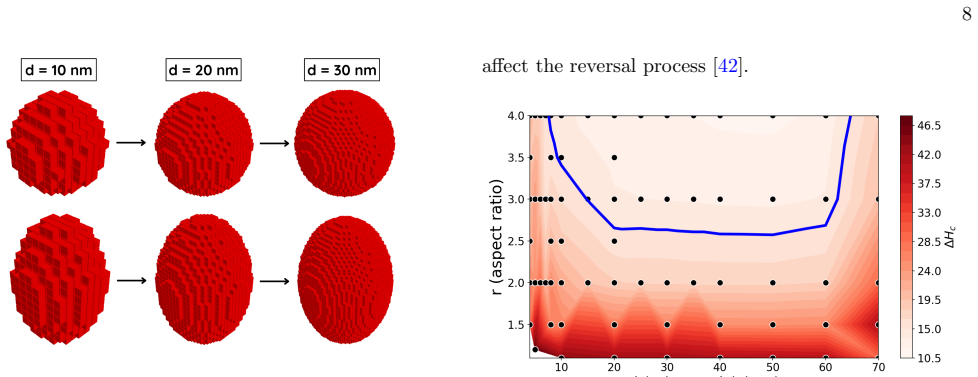
By direct comparison of angular-dependent hysteresis loops, the authors find that the macrospin description holds for magnetite nanoparticles approximately in the range 10-60 nm for axial ratios r>1.5, and 20-60 nm for 1.0<r<1.5, when an effective uniaxial anisotropy from the shape is added to the cubic magnetocrystalline anisotropy in the Stoner-Wohlfarth model.
What carries the argument
The extended Stoner-Wohlfarth model incorporating both intrinsic cubic magnetocrystalline anisotropy and an effective uniaxial contribution from particle elongation, validated against micromagnetic simulations on superellipsoidal particle geometries.
If this is right
- The macrospin approximation is valid for elongated magnetite nanoparticles (r>1.5) in the 10-60 nm size range.
- For less elongated particles (1.0<r<1.5), the approximation holds from 20 nm to 60 nm.
- Particle morphology can be directly linked to effective macrospin parameters via the elongation ratio.
- The generalized Stoner-Wohlfarth model is suitable for describing the magnetic response of realistically shaped magnetic nanoparticles.
Where Pith is reading between the lines
- If the limits hold, device designers could use the simple model to quickly screen shapes for optimal performance in hyperthermia or magnetic recording.
- Similar comparisons could be performed for other soft magnetic materials to establish material-specific validity ranges.
- Dynamic magnetization processes like switching times might also be approximable with the same effective anisotropy term.
Load-bearing premise
Non-uniform magnetization states inside the nanoparticle can be adequately represented by adding a single effective uniaxial anisotropy term to the cubic magnetocrystalline anisotropy, without causing large errors in the angular dependence of the hysteresis loops.
What would settle it
Micromagnetic simulations of a 30 nm magnetite particle with axial ratio 2.0 producing an angular hysteresis loop that differs markedly in shape or coercivity from the extended Stoner-Wohlfarth prediction would falsify the claim of validity in that size range.
Figures




read the original abstract
We investigate the feasibility of the macrospin approximation to account for the actual shape of soft magnetic nanoparticles (MNPs) with realistic geometries. Specifically focusing on magnetite, we use the superellipsoidal parametrisation to account for a variety of shapes, with a continuous interpolation from spherical to cubic morphologies, as well as different elongations. Our procedure consists of the direct comparison between angular-dependent hysteresis loops obtained by full micromagnetic simulations, with those produced by an extended Stoner-Wohlfarth (SW) model that incorporates both the intrinsic cubic magnetocrystalline anisotropy, and an effective uniaxial contribution arising from the particle elongation. The limits of validity of the macrospin description are approximately 10-60 nm for axial ratios r>1.5, and 20-60 nm for 1.0<r<1.5. These results establish a direct connection between nanoparticle morphology and effective macrospin parameters, demonstrating the suitability of the generalized SW model for describing the magnetic response of realistically shaped MNPs.
Editorial analysis
A structured set of objections, weighed in public.
Referee Report
Summary. The paper examines the macrospin approximation for magnetite nanoparticles with superellipsoidal shapes (continuous interpolation from spheres to cubes with varying elongations). It performs direct numerical comparisons of angular-dependent hysteresis loops between full micromagnetic simulations and an extended Stoner-Wohlfarth model that augments the intrinsic cubic magnetocrystalline anisotropy with a single effective uniaxial term arising from particle elongation. The central result is a set of approximate validity windows for the macrospin description: 10-60 nm for axial ratios r>1.5 and 20-60 nm for 1.0<r<1.5.
Significance. If the reported numerical agreement holds under scrutiny, the work supplies concrete, morphology-linked size ranges within which a simple macrospin model remains usable for realistically shaped soft MNPs. This is useful for applications that require rapid evaluation of hysteresis (e.g., hyperthermia or magnetic recording) while still grounding the effective parameters in micromagnetic reality. The direct simulation-to-model comparison is a methodological strength.
major comments (3)
- [Abstract / Results] Abstract and results: the validity limits (10-60 nm and 20-60 nm) are stated without an explicit quantitative acceptance criterion (maximum relative error in coercivity, remanence, or loop area, or a statistical measure of loop agreement). Without this threshold it is impossible to judge how robust the quoted windows are or how they would shift under a different tolerance.
- [Methods / Results] Methods / Results: the effective uniaxial anisotropy constant is introduced as arising from elongation, yet it is not stated whether this constant is computed from first-principles demagnetization factors for the superellipsoid or obtained by fitting the micromagnetic loops. If the latter, the comparison is partly tautological and the predictive power of the extended SW model is reduced.
- [Results] Results: for superellipsoids the demagnetizing field is spatially non-uniform; the paper must demonstrate that any residual angular dependence beyond a pure sin²θ uniaxial term remains negligible inside the quoted size windows. Showing only selected hysteresis loops (rather than full angular error maps or higher-order Fourier components) leaves open the possibility that non-uniaxial contributions grow near the upper size limit.
minor comments (2)
- [Methods] The superellipsoidal parametrization (continuous shape interpolation) should be given explicitly, including the range of the shape exponent and how axial ratio r is defined.
- [Results] Error bars or uncertainty quantification on the micromagnetic loops (arising from mesh discretization or thermal effects) are not mentioned; their absence makes it difficult to assess whether the reported agreement lies within numerical noise.
Simulated Author's Rebuttal
We thank the referee for the constructive and positive review. The comments highlight important points on quantitative rigor, parameter determination, and validation of the uniaxial approximation. We address each below and have revised the manuscript accordingly to strengthen these aspects.
read point-by-point responses
-
Referee: [Abstract / Results] Abstract and results: the validity limits (10-60 nm and 20-60 nm) are stated without an explicit quantitative acceptance criterion (maximum relative error in coercivity, remanence, or loop area, or a statistical measure of loop agreement). Without this threshold it is impossible to judge how robust the quoted windows are or how they would shift under a different tolerance.
Authors: We agree that an explicit quantitative criterion is necessary for transparency and reproducibility. In the revised manuscript we have added a clear definition in the Methods and Results sections: the macrospin model is deemed valid when the maximum relative error in coercivity remains below 10% and in remanence below 5% over the full angular range, with loop-area error also kept under 8%. The quoted size windows (10-60 nm for r>1.5 and 20-60 nm for 1.0<r<1.5) are the ranges where these thresholds are satisfied for at least 80% of sampled angles and shapes. The abstract has been updated to reference this criterion. revision: yes
-
Referee: [Methods / Results] Methods / Results: the effective uniaxial anisotropy constant is introduced as arising from elongation, yet it is not stated whether this constant is computed from first-principles demagnetization factors for the superellipsoid or obtained by fitting the micromagnetic loops. If the latter, the comparison is partly tautological and the predictive power of the extended SW model is reduced.
Authors: The effective uniaxial term is obtained from first-principles demagnetization factors calculated for each superellipsoidal geometry. We use the standard expression K_u = (1/2) μ₀ M_s² (N_⊥ − N_∥), where the demagnetizing factors N are evaluated numerically from the superellipsoid parameters (shape exponents and axial ratios) via established integration methods; no fitting to micromagnetic hysteresis data is performed. We have now made this procedure explicit in the revised Methods section, including the relevant formulas and references, to remove any ambiguity and confirm the independent, predictive character of the extended Stoner-Wohlfarth model. revision: yes
-
Referee: [Results] Results: for superellipsoids the demagnetizing field is spatially non-uniform; the paper must demonstrate that any residual angular dependence beyond a pure sin²θ uniaxial term remains negligible inside the quoted size windows. Showing only selected hysteresis loops (rather than full angular error maps or higher-order Fourier components) leaves open the possibility that non-uniaxial contributions grow near the upper size limit.
Authors: We accept that additional quantitative validation is required. In the revised manuscript we have added supplementary figures that present full angular error maps (difference in coercivity and remanence versus field angle) for all particle sizes and elongations inside the validity windows. We have also included a Fourier analysis of the angular dependence of the switching field, showing that the sin²θ term accounts for >95% of the variation while higher-order components (sin⁴θ and above) contribute less than 5% throughout the 10-60 nm range. These additions confirm that non-uniaxial contributions remain negligible within the reported windows. revision: yes
Circularity Check
No circularity: validity limits obtained from direct numerical comparison to independent micromagnetic simulations
full rationale
The paper determines the macrospin validity windows (10-60 nm for r>1.5; 20-60 nm for 1<r<1.5) by comparing angular-dependent hysteresis loops from full micromagnetic simulations against those of an extended Stoner-Wohlfarth model that adds one effective uniaxial shape term to the cubic magnetocrystalline anisotropy. This comparison is external to the model itself; the effective uniaxial term is introduced as an ansatz motivated by elongation but is not fitted to the target hysteresis data and then re-used as a 'prediction.' No self-citations are invoked to justify uniqueness or to close the derivation loop, and the central claim remains falsifiable against the independent micromagnetic benchmark. The derivation chain is therefore self-contained and does not reduce to its inputs by construction.
Axiom & Free-Parameter Ledger
free parameters (1)
- effective uniaxial anisotropy constant from elongation
axioms (2)
- domain assumption Magnetization remains sufficiently uniform that the macrospin approximation holds inside the stated size windows
- standard math Cubic magnetocrystalline anisotropy of magnetite can be treated as an additive constant independent of shape-induced terms
Reference graph
Works this paper leans on
-
[1]
soidal geometry, including elongation effects
with the permission of American Chemical Society. soidal geometry, including elongation effects. The article is organized as follows. Sections II and III briefly describe the physical and computational frame- works employed. In Section IV A, we analyze in de- tail the influence of particle shape and elongation on the magnetic behavior of magnetite nanopar...
-
[2]
+K u sin2 θ −µ 0MsHcos(θ H −θ),(3) whereK c andK u are the cubic and uniaxial shape anisotropy constants, respectively;α i (i= 1,2,3) are the direction cosines of the magnetization relative to the crystallographic axes;θandθ H are the angles that the easy axes forms with magnetization and applied field di- rections, respectively. The uniaxial shape anisot...
-
[3]
The results are shown in Fig
Comparison of angular dependence As a representative case, we focus on particles with V 1/3 = 40 nm andr=1.1, well below the critical thresh- old, and compare the resulting magnetic parameters (Hc, Mr, and hysteresis loop area) obtained from micromag- netic simulations to those obtained from theK c +K u model. The results are shown in Fig. 6. The results ...
-
[4]
particles, reaffirming that particle shape does not play a critical role in the magnetic behavior within the quasi-uniform regime. Although we only show the case r= 1.1 here, the casesr= 1.0 andr= 1.2 exhibit the same good correspondence between micromagnetic simulations and the macrospin model, as will be shown more generally in the following subsection
-
[5]
Comparison of orientation-averaged hysteresis loops To perform a more meaningful comparison, we now compare the averaged hysteresis loops obtained from mi- cromagnetic simulations with those predicted by the ef- fectiveK c +K u macrospin model. These averaged loops provide a more representative basis for comparison, as they reflect the expected magnetic b...
-
[6]
Generalization: Phase Diagram Up to this point, our analysis has been limited to a narrow range of particle sizes and axial ratios, leaving open the question of whether the correspondence between micromagnetic simulations and the effective macrospin description persists across the full parameter space. The aim of this section is therefore to assess the va...
-
[7]
Micromagnetics We construct the same type of phase diagram in- troduced in Sec
Uniaxial SW model vs. Micromagnetics We construct the same type of phase diagram in- troduced in Sec. IV B 3, but taking now the uniax- ial SW model as the theoretical reference. The re- sulting deviations are summarized in Fig. 10. For all sizes and axial ratios considered, the deviations with re- spect to the SW model exceed 10%. This result under- scor...
-
[8]
Cubic SW vs. Micromagnetics After demonstrating the limited capability of theK u- only SW model to describe the behavior of superellip- soidal MNPs, we now compare the micromagnetic re- sults with the predictions of a purely cubic SW model, in which the nanoparticle is treated as a single-domain macrospin subject exclusively to cubic magnetocrys- talline ...
2022
-
[9]
E. C. Stoner and E. P. Wohlfarth, Philosophical Trans- actions of the Royal Society of London. Series A, Math- ematical and Physical Sciences240, 599 (1948)
1948
-
[10]
Tannous and J
C. Tannous and J. Gieraltowski, European journal of physics29, 475 (2008)
2008
-
[11]
Tannous and J
C. Tannous and J. Gieraltowski, Physica B403, 3563 (2008)
2008
-
[12]
Doyle, IEEE Trans
B. Doyle, IEEE Trans. Magn.45, 7 (2009)
2009
-
[13]
Pfeiffer, Phys
H. Pfeiffer, Phys. Stat. Sol. (a)118, 295 (1990)
1990
-
[14]
R. W. Chantrell, N. Walmsley, J. Gore, and M. Maylin, Phys. Rev. B63, 024410 (2000)
2000
-
[15]
S. Ruta, R. Chantrell, and O. Hovorka, Sci. Rep.5, 9090 (2015)
2015
-
[16]
Garc´ ıa-Otero, M
J. Garc´ ıa-Otero, M. Porto, J. Rivas, and A. Bunde, J. Magn. Magn. Mater.203, 268 (1999)
1999
-
[17]
Garc´ ıa-Otero, M
J. Garc´ ıa-Otero, M. Porto, J. Rivas, and A. Bunde, J. Appl. Phys.85, 2287 (1999)
1999
-
[18]
Wernsdorfer, C
W. Wernsdorfer, C. Thirion, N. Demoncy, H. Pascard, and D. Mailly, J. Magn. Magn, Mater.242, 132 (2002)
2002
-
[19]
Peterson and Y
S. Peterson and Y. Idzerda, AIP Adv.11, 085111 (2021)
2021
-
[20]
D. Cimpoesu, L. Stoleriu, and A. Stancu, J. Appl. Phys. 114, 10.1063/1.4839895 (2013)
-
[21]
A. Winter, H. Pascher, H. Krenn, X. Liu, and J. Furdyna, J. Appl. Phys.108, 10.1063/1.3466771 (2010)
-
[22]
S. Yan, Z. Sun, and Y. B. Bazaliy, Phys. Rev. B88, 054408 (2013)
2013
-
[23]
Amanoloaei, A
G. Amanoloaei, A. Stancu, and L. Stoleriu, IEEE Magn. Lett.12, 1 (2021)
2021
-
[24]
D. Lee, J. Park, D. Han, S. Ippei, T. Yukiko, S. Noh, J. Lee, J. Kwon, H. Lee, and S. Kim, Phys. Rev. Applied 21, 024027 (2024)
2024
-
[25]
W. T. Coffey, Y. P. Kalmykov, and S. V. Titov,Thermal Fluctuations and Relaxation Processes in Nanomagnets (World Scientific, 2020)
2020
-
[26]
Garanin and H
D. Garanin and H. Kachkachi, Phys. Rev. Lett.90, 065504 (2003)
2003
-
[27]
Kachkachi, J
H. Kachkachi, J. Magn. Magn. Mater.316, 248 (2007)
2007
-
[28]
Gandia, L
D. Gandia, L. Gandarias, L. Marcano, I. Orue, D. Gil- Cart´ on, J. Alonso, A. Garc´ ıa-Arribas, A. Muela, and M. L. Fdez-Gubieda, Nanoscale12, 16081 (2020)
2020
-
[29]
Russier, Journal of Magnetism and Magnetic Materi- als409, 50 (2016)
V. Russier, Journal of Magnetism and Magnetic Materi- als409, 50 (2016)
2016
-
[30]
Conde-Leboran, D
I. Conde-Leboran, D. Baldomir, C. Martinez-Boubeta, O. Chubykalo-Fesenko, M. del Puerto Morales, G. Salas, D. Cabrera, J. Camarero, F. J. Teran, and D. Serantes, J. Phys. Chem. C119, 15698 (2015)
2015
-
[31]
Niculaes, A
D. Niculaes, A. Lak, G. C. Anyfantis, S. Marras, O. Laslett, S. K. Avugadda, M. Cassani, D. Serantes, O. Hovorka, R. Chantrell,et al., ACS nano11, 12121 (2017)
2017
-
[32]
N. Usov, J. Appl. Phys.107, doi.org/10.1063/1.3445879 (2010)
-
[33]
G. Vallejo-Fernandez and K. O’grady, Appl. Phys. Lett. 103, https://doi.org/10.1063/1.4824649 (2013)
-
[34]
Salazar-Alvarez, J
G. Salazar-Alvarez, J. Qin, V. Sepelak, I. Bergmann, M. Vasilakaki, K. Trohidou, J. Ardisson, W. Macedo, M. Mikhaylova, M. Muhammed,et al., JACS130, 13234 (2008)
2008
-
[35]
J. M. Paez-Mu˜ noz, F. G´ amez, Y. Fern´ andez-Afonso, R. Gallardo, M. P. Leal, L. Guti´ errez, J. M. de la Fuente, C. Caro, and M. L. Garc´ ıa-Mart´ ın, Journal of Materials Chemistry B11, 11110 (2023)
2023
-
[36]
A. G. Roca, L. Guti´ errez, H. Gavil´ an, M. E. F. Brollo, S. Veintemillas-Verdaguer, and M. del Puerto Morales, Advanced drug delivery reviews138, 68 (2019)
2019
-
[37]
E. Navarro, Y. Luengo, S. Veintemillas, P. Morales, F. J. Palomares, U. Urdiroz, F. Cebollada, and J. M. Gonz´ alez, AIP Advances9, 10.1063/1.5130164 (2019)
-
[38]
Gavil´ an, G
H. Gavil´ an, G. M. Rizzo, N. Silvestri, B. T. Mai, and T. Pellegrino, Nature Protocols18, 783 (2023)
2023
-
[39]
G. Mandriota, S. K. Avugadda, E. Sadeghi, N. Sil- vestri, R. Marotta, H. Gavil´ an, U. Olsson, C. Giannini, Y. H. Tsai, A. C. S. Samia,et al., Nanoscale Horizons https://doi.org/10.1039/D4NH00566J (2025)
-
[40]
Muro-Cruces, A
J. Muro-Cruces, A. G. Roca, A. L´ opez-Ortega, E. Fan- techi, D. del Pozo-Bueno, S. Estrad´ e, F. Peir´ o, B. Sep´ ulveda, F. Pineider, C. Sangregorio,et al., ACS nano13, 7716 (2019)
2019
-
[41]
L´ opez-V´ azquez, D
I. L´ opez-V´ azquez, D. Serantes, and `Oscar Iglesias, J. Magn. Magn. Mater.638, 173751 (2026)
2026
-
[42]
Jakliˇ c, A
A. Jakliˇ c, A. Leonardis, and F. Solina, Superquadrics and their geometric properties, inSegmentation and Recov- 15 ery of Superquadrics(Springer Netherlands, Dordrecht,
-
[43]
J. G. Donaldson, E. S. Pyanzina, and S. S. Kantorovich, ACS Nano11, 8153 (2017)
2017
-
[44]
Dresen, A
D. Dresen, A. Qdemat, S. Ulusoy, F. Mees, D. Z´ akutn´ a, E. Wetterskog, E. Kentzinger, G. Salazar-Alvarez, and S. Disch, J. Phys Chem. C125, 23356 (2021)
2021
-
[45]
Y. Jiao, F. H. Stillinger, and S. Torquato, Phys. Rev. E 79, 041309 (2009)
2009
-
[46]
B. D. Cullity and C. D. Graham,Introduction to mag- netic materials(John Wiley & Sons, 2011)
2011
-
[47]
Donahue and D
M. Donahue and D. Porter, Oommf user’s guide, version 1.0, interagency report nistir 6376, national institute of standards and technology, gaithersburg, md (sept 1999), http://math.nist.gov/oommf(2018)
1999
-
[48]
Makridakis, S
S. Makridakis, S. C. Wheelwright, and R. J. Hyndman, Forecasting methods and applications(John wiley & sons, 2008)
2008
-
[49]
E. C. Stoner and E. Wohlfarth, Philosophical Transac- tions of the Royal Society of London. Series A, Mathe- matical and Physical Sciences240, 599 (1948)
1948
-
[50]
Fa´ ılde, V
D. Fa´ ılde, V. Ocampo-Zalvide, D. Serantes, and`O. Igle- sias, Nanoscale16, 14319 (2024)
2024
-
[51]
N. A. Usov, M. S. Nesmeyanov, E. M. Gubanova, and N. B. Epshtein, Beilstein J. Nanotechnol.10, 305 (2019)
2019
-
[52]
Y. P. Kalmykov, S. Titov, W. Coffey, M. Zarifakis, and W. Dowling, Phys. Rev. B99, 184414 (2019)
2019
-
[53]
Salvador, L
M. Salvador, L. Nicolao, and W. Figueiredo, Phys. Rev. B100, 104419 (2019)
2019
-
[54]
Mamiya and B
H. Mamiya and B. Jeyadevan, Sci. Rep.1, 1 (2011)
2011
-
[55]
Mostarac, A
D. Mostarac, A. A. Kuznetsov, S. Helbig, C. Abert, P. A. S´ anchez, D. Suess, and S. S. Kantorovich, Phys. Rev. B 111, 014438 (2025)
2025
-
[56]
Wolfschwenger, A
M. Wolfschwenger, A. Jaufenthaler, F. Hanser, J. Gam- per, T. S. Hofer, and D. Baumgarten, Appl. Math. Model. 136, 115624 (2024)
2024
-
[57]
N. A. Usov and B. Y. Liubimov, J. Appl. Phys.112, 023901 (2012)
2012
-
[58]
F. L. Durhuus, M. Beleggia, and C. Frandsen, Physical Review B109, 054421 (2024)
2024
-
[59]
K. D. Usadel and C. Usadel, Journal of Applied Physics 118, 10.1063/1.4937919 (2015)
-
[60]
K. D. Usadel, Phys. Rev. B95, 104430 (2017)
2017
-
[61]
Okada and A
K. Okada and A. Satoh, J. Magn. Magn. Mater. , 173259 (2025)
2025
-
[62]
Moreno, S
R. Moreno, S. Poyser, D. Meilak, A. Meo, S. Jenkins, V. K. Lazarov, G. Vallejo-Fernandez, S. Majetich, and R. F. Evans, Sci. Rep.10, 2722 (2020)
2020
-
[63]
Kachkachi, M
H. Kachkachi, M. Nogues, E. Tronc, and D. Garanin, J. Magn. Magn. Mater.221, 158 (2000)
2000
-
[64]
S. A. Mathews, A. C. Ehrlich, and N. A. Charipar, Sci. Rep.10, 15141 (2020)
2020
-
[65]
Omari, A
L. Omari, A. Lekdadri, H. Lassri, O. Mentre, C. Minaud, E. Dhahri, and C. Jama, Mater. Today Commun.27, 102257 (2021)
2021
discussion (0)
Sign in with ORCID, Apple, or X to comment. Anyone can read and Pith papers without signing in.