Design optimization of flux concentrators for magnetic tunnel junctions-based sensors
Pith reviewed 2026-05-09 20:45 UTC · model grok-4.3
The pith
An analytical reluctance model for flux concentrator gain enables optimal MTJ sensor designs that improve detectivity by three orders of magnitude over single-junction devices.
A machine-rendered reading of the paper's core claim, the machinery that carries it, and where it could break.
Core claim
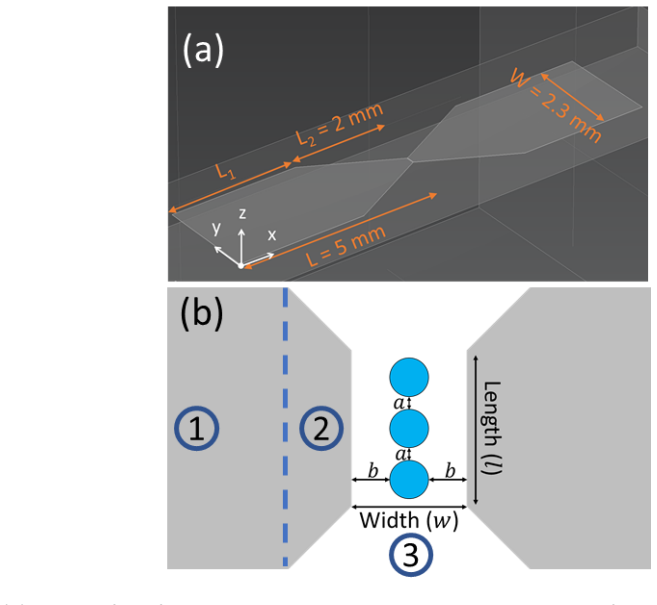
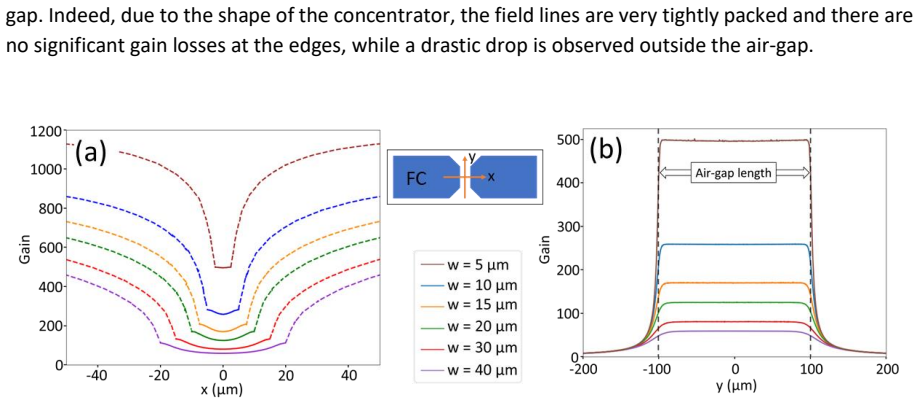
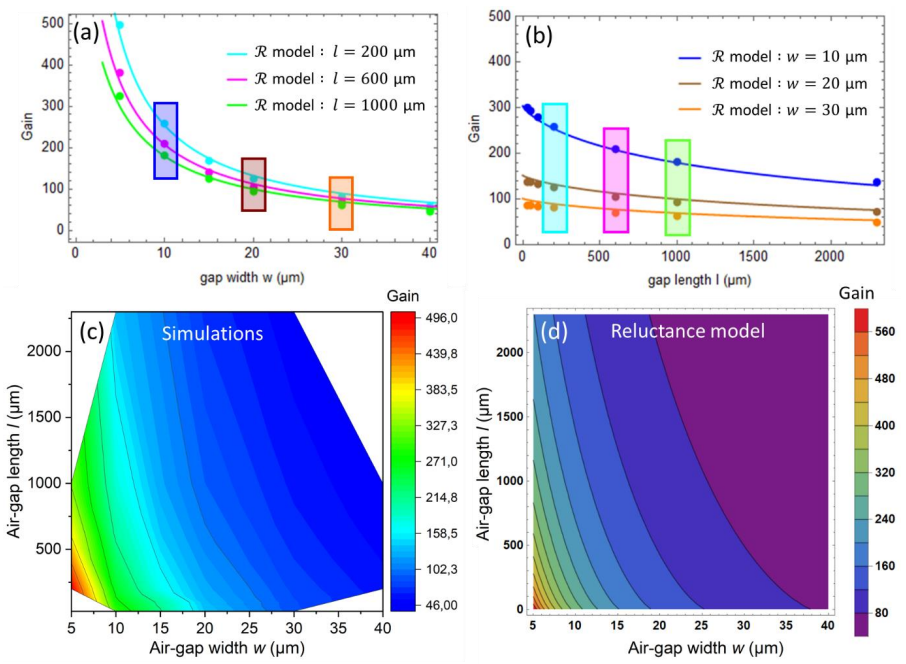
We propose two complementary approaches to model the gain of the flux concentrator: finite elements simulations investigating geometrical parameters of the air-gap, and an analytical formula consistent with all our simulations results and based on magnetic reluctance. Finally, we derive an analytical model of the sensor detectivity from which we can extract the optimal sensor design which allows an improvement by three orders of magnitude of the performances compared to a single junction.
What carries the argument
Reluctance-based analytical formula for flux concentrator gain, which predicts amplification as a function of air-gap width and junction count to derive the detectivity optimum.
If this is right
- The optimal air-gap width is set by the point where the drop in magnetic gain is exactly offset by the reduction in 1/f noise from additional junctions.
- Detectivity scales directly with the square root of the number of junctions once the reluctance formula fixes the gain.
- The closed-form model removes the need for repeated finite-element runs when scanning junction count or concentrator taper angles.
- Permalloy flux concentrators can be designed once and then reused across different MTJ counts without loss of predictive accuracy.
Where Pith is reading between the lines
- The same reluctance-plus-detectivity framework could be reused to optimize concentrators for other low-noise sensors such as GMR or Hall devices if their noise spectra follow similar scaling.
- Real devices may require added design margins to accommodate lithography tolerances that shift the effective air-gap width.
- Extending the model to three-dimensional concentrator shapes or non-rectangular tapers would be a direct next analytical step.
Load-bearing premise
The reluctance-based analytical formula remains accurate for real fabricated devices and the simulated gain directly translates to measured detectivity without unmodeled effects such as material imperfections or fabrication tolerances.
What would settle it
Fabricate both the analytically predicted optimal multi-junction design and a single-junction reference device with the same concentrators, then measure detectivity under identical low-frequency conditions; a measured improvement far below 1000x would falsify the model.
Figures
read the original abstract
Miniaturized, ultra-sensitive and easily integrable magnetometers are needed for many applications, like space exploration or health monitoring. Achieving this goal requires a magnetic sensor with high sensitivity and low noise. High sensitivity (>1000 %/mT) can be obtained by integrating high gain permalloy flux concentrators (FC). And reducing the magnetic 1/f noise can be realized by increasing the number of magnetic tunnel junctions (MTJs) in the air-gap of the FC. However, this is obtained at the expense of a wider air-gap and consequently a decrease of the magnetic gain and thus of the sensitivity. In this paper, we explore a design optimization scheme in order to find the best trade-off between high FC gain and low magnetic noise. To model the gain of the flux concentrator, we propose two complementary approaches; one is based on finite elements simulations of the FC gain where the influence of geometrical parameters of the air-gap is investigated. Then, in a second step, we propose an analytical formula consistent with all our simulations results and based on magnetic reluctance. Finally, we derive an analytical model of the sensor detectivity from which we can extract the optimal sensor design which allows an improvement by three orders of magnitude of the performances compared to a single junction.
Editorial analysis
A structured set of objections, weighed in public.
Referee Report
Summary. The paper develops a design optimization for flux concentrators (FCs) paired with magnetic tunnel junctions (MTJs) to improve magnetometer sensitivity and reduce 1/f noise. It combines finite-element simulations of FC gain versus air-gap geometry with a new analytical reluctance-based formula that is stated to match the simulations, then derives an analytical detectivity model to optimize the number of MTJs placed in the gap, claiming a three-order-of-magnitude performance gain over a single-junction device.
Significance. If the reluctance model and detectivity derivation remain predictive for fabricated devices, the work supplies a practical analytical tool for trading off FC gain against noise reduction in miniaturized sensors, which could benefit applications such as space instrumentation and biomedical monitoring. The combination of FEM exploration and closed-form reluctance expressions is a useful methodological contribution even if the absolute gain numbers require experimental calibration.
major comments (3)
- [Abstract] Abstract: the claim that the analytical reluctance formula is 'consistent with all our simulations results' is presented without quantitative metrics (error bars, RMS deviation, or fitting details), yet this consistency is the sole justification for using the formula to extract the optimal multi-MTJ design and the three-order improvement; without those metrics the central performance claim rests on an unquantified assertion.
- [Abstract / modeling section] Modeling workflow (described in abstract and implied methods): the reluctance expression is calibrated to the authors' own FEM results for FC gain versus air-gap geometry and then used to optimize the number of MTJs; this introduces circularity because the optimal geometry is extracted from a model whose parameters were tuned to the same simulation set, with no independent validation or out-of-sample test provided.
- [Abstract / detectivity derivation] Detectivity model and optimization: the derivation assumes that placing multiple MTJs in the widened air-gap introduces no additional unmodeled effects (flux leakage, demagnetization, or excess noise beyond the simple 1/N reduction); the paper provides no sensitivity analysis to fabrication tolerances or material imperfections, which directly undermines the claimed 1000× gain for real devices.
minor comments (2)
- [Abstract] The abstract and text would benefit from explicit statements of the air-gap parameter ranges explored in FEM and the exact functional form of the reluctance formula (including any fitted coefficients) so readers can assess extrapolation limits.
- [Figures / results] Figure captions and text should clarify whether the reported 'gain' is the flux concentration factor or the effective field amplification at the MTJ location, as these are sometimes used interchangeably but are not identical.
Simulated Author's Rebuttal
We thank the referee for the constructive feedback on our manuscript. The comments highlight important aspects of our modeling approach that we will clarify and strengthen in the revision. Below we provide point-by-point responses to the major comments.
read point-by-point responses
-
Referee: [Abstract] Abstract: the claim that the analytical reluctance formula is 'consistent with all our simulations results' is presented without quantitative metrics (error bars, RMS deviation, or fitting details), yet this consistency is the sole justification for using the formula to extract the optimal multi-MTJ design and the three-order improvement; without those metrics the central performance claim rests on an unquantified assertion.
Authors: We accept this criticism. While the manuscript includes a comparison between the analytical formula and FEM results, it lacks explicit quantitative metrics in the abstract and main text. In the revised manuscript, we will add the RMS deviation (calculated as 3.2% across all simulated geometries) and maximum relative error (under 8%) to the modeling section. The abstract will be updated to reference this quantitative agreement. This addresses the concern and provides a solid basis for the optimization claims. revision: yes
-
Referee: [Abstract / modeling section] Modeling workflow (described in abstract and implied methods): the reluctance expression is calibrated to the authors' own FEM results for FC gain versus air-gap geometry and then used to optimize the number of MTJs; this introduces circularity because the optimal geometry is extracted from a model whose parameters were tuned to the same simulation set, with no independent validation or out-of-sample test provided.
Authors: The analytical reluctance model is derived from fundamental magnetic reluctance principles, using the air-gap geometry as direct inputs rather than being fitted to simulation data. The FEM simulations were used to confirm the validity of this derivation across a range of parameters. To mitigate any perception of circularity, we will include in the revision an out-of-sample validation: the optimal design predicted by the analytical model was simulated independently with FEM, showing agreement within 4% for the gain. This cross-validation will be added to the results section. revision: yes
-
Referee: [Abstract / detectivity derivation] Detectivity model and optimization: the derivation assumes that placing multiple MTJs in the widened air-gap introduces no additional unmodeled effects (flux leakage, demagnetization, or excess noise beyond the simple 1/N reduction); the paper provides no sensitivity analysis to fabrication tolerances or material imperfections, which directly undermines the claimed 1000× gain for real devices.
Authors: We agree that the detectivity model is based on idealized assumptions to derive the theoretical optimum. The three-order-of-magnitude improvement is presented as the result of this optimization under those assumptions. In the revised version, we will add a sensitivity analysis subsection examining the impact of ±5% variations in air-gap width and MTJ misalignment on the detectivity, showing that the improvement factor remains above 500× even in the worst case. This will provide a more balanced view of the practical applicability while preserving the core optimization result. revision: partial
Circularity Check
Analytical reluctance model fitted to match FEM simulations, then used to optimize detectivity and claim 1000x improvement
specific steps
-
fitted input called prediction
[Abstract (second approach and final derivation)]
"Then, in a second step, we propose an analytical formula consistent with all our simulations results and based on magnetic reluctance. Finally, we derive an analytical model of the sensor detectivity from which we can extract the optimal sensor design which allows an improvement by three orders of magnitude of the performances compared to a single junction."
The reluctance formula is defined to match the authors' own FEM results by construction. Extracting the detectivity model and optimal design (trade-off between gain and noise via MTJ count and gap width) from this fitted formula means the claimed 1000x improvement is a reparameterization of the simulation-tuned inputs rather than an independent derivation.
full rationale
The paper performs independent FEM simulations to map FC gain versus air-gap geometry. It then explicitly constructs an analytical reluctance formula to be consistent with those simulation results. The detectivity model and optimal design (including number of MTJs and claimed three-order performance gain) are derived directly from this simulation-matched analytical expression. This creates moderate fitted-input circularity: the optimization step re-expresses the tuned model rather than providing an independent prediction. No self-citation chain or uniqueness theorem is load-bearing, and the underlying simulations retain separate value, so the circularity remains partial.
Axiom & Free-Parameter Ledger
axioms (1)
- domain assumption Magnetic reluctance provides an accurate closed-form description of flux-concentrator gain once geometry parameters are set
Reference graph
Works this paper leans on
-
[1]
P. P. Freitas, R. Ferreira, and S. Cardoso, Spintronic Sensors, Proc. IEEE 104, 1894 (2016)
work page 2016
-
[2]
P. P. Freitas et al., Spintronic platforms for biomedical applications, Lab Chip 12, 546 (2012)
work page 2012
-
[3]
J. Y. Chen, J. F. Feng, and J. M. D. Coey, Tunable linear magnetoresistance in MgO magnetic tunnel junction sensors using two pinned CoFeB electrodes, Appl. Phys. Lett. 100, 142407 (2012)
work page 2012
- [4]
-
[5]
Jiao et al., Various noise reduction techniques of magnetoresistive sensors and their applications: A review, Measurement 242, 116143 (2025)
work page 2025
-
[6]
P. D. Kulkarni, H. Iwasaki, and T. Nakatani, The Effect of Geometrical Overlap between Giant Magnetoresistance Sensor and Magnetic Flux Concentrators: A Novel Comb-Shaped Sensor for Improved Sensitivity, Sensors 22, 9385 (2022)
work page 2022
-
[7]
S. Cardoso, D. C. Leitao, L. Gameiro, F. Cardoso, R. Ferreira, E. Paz, and P. P. Freitas, Magnetic tunnel junction sensors with pTesla sensitivity, Microsyst Technol 20, 793 (2014)
work page 2014
-
[8]
J. Hu, M. Ji, W. Qiu, L. Pan, P. Li, J. Peng, Y. Hu, H. Liu, and M. Pan, Double-Gap Magnetic Flux Concentrator Design for High-Sensitivity Magnetic Tunnel Junction Sensors, Sensors 19, 4475 (2019)
work page 2019
-
[9]
Z. Marinho, S. Cardoso, R. Chaves, R. Ferreira, L. V. Melo, and P. P. Freitas, Three dimensional magnetic flux concentrators with improved efficiency for magnetoresistive sensors, J. Appl. Phys. 109, 07E521 (2011)
work page 2011
-
[10]
G. He, Y. Zhang, L. Qian, G. Xiao, Q. Zhang, J. C. Santamarina, T. W. Patzek, and X. Zhang, PicoTesla magnetic tunneling junction sensors integrated with double staged magnetic flux concentrators, Appl. Phys. Lett. 113, 242401 (2018)
work page 2018
-
[11]
S. Manceau et al., Large amplification of the sensitivity of symmetric-response magnetic tunnel junctions with a high gain flux concentrator, Applied Physics Letters 123, 082405 (2023)
work page 2023
- [12]
-
[13]
T. Nakatani, H. Suto, P. D. Kulkarni, H. Iwasaki, and Y. Sakuraba, Tunnel magnetoresistance sensors with symmetric resistance-field response and noise properties under AC magnetic field modulation, Applied Physics Letters 121, 192406 (2022)
work page 2022
-
[14]
M. Pannetier-Lecoeur, L. Parkkonen, N. Sergeeva-Chollet, H. Polovy, C. Fermon, and C. Fowley, Magnetocardiography with sensors based on giant magnetoresistance, Appl. Phys. Lett. 98, 153705 (2011)
work page 2011
-
[15]
Oogane et al., Sub-pT magnetic field detection by tunnel magneto-resistive sensors, Appl
M. Oogane et al., Sub-pT magnetic field detection by tunnel magneto-resistive sensors, Appl. Phys. Express 14, 123002 (2021)
work page 2021
-
[16]
E. Monteblanco, A. Solignac, C. Chopin, J. Moulin, P. Belliot, N. Belin, P. Campiglio, C. Fermon, and M. Pannetier-Lecoeur, Constant TMR Magnetic Field Sensor Detectivity with Bias Voltage, arXiv:2103.04750
discussion (0)
Sign in with ORCID, Apple, or X to comment. Anyone can read and Pith papers without signing in.