Hybrid Deep Learning Approach for Coupled Demand Forecasting and Supply Chain Optimization
Pith reviewed 2026-05-09 23:00 UTC · model grok-4.3
The pith
Integrating LSTM forecasting with MILP optimization reduces demand forecast errors and supply chain costs in textile and PPE industries.
A machine-rendered reading of the paper's core claim, the machinery that carries it, and where it could break.
Core claim
The hybrid AI framework HAF-DS combines an LSTM module that learns temporal demand patterns with a mixed integer linear programming layer that uses those patterns to minimize total costs including inventory holding and shortage penalties, resulting in improved forecast accuracy and reduced operational expenses on real textile sales data.
What carries the argument
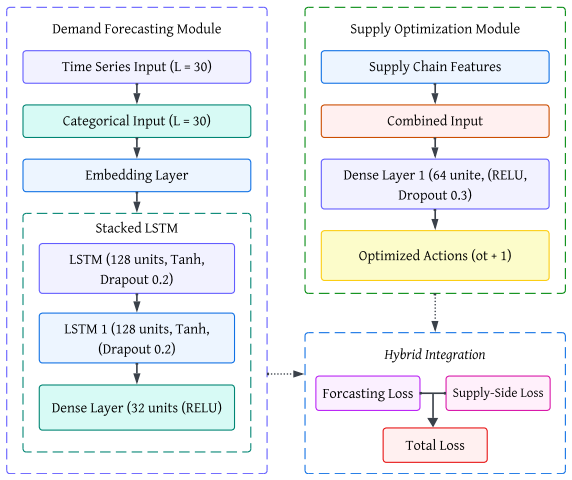
The HAF-DS framework, which uses embedding-based feature representation and recurrent architectures to jointly minimize forecasting error and operational cost through the integration of LSTM predictions into MILP constraints.
If this is right
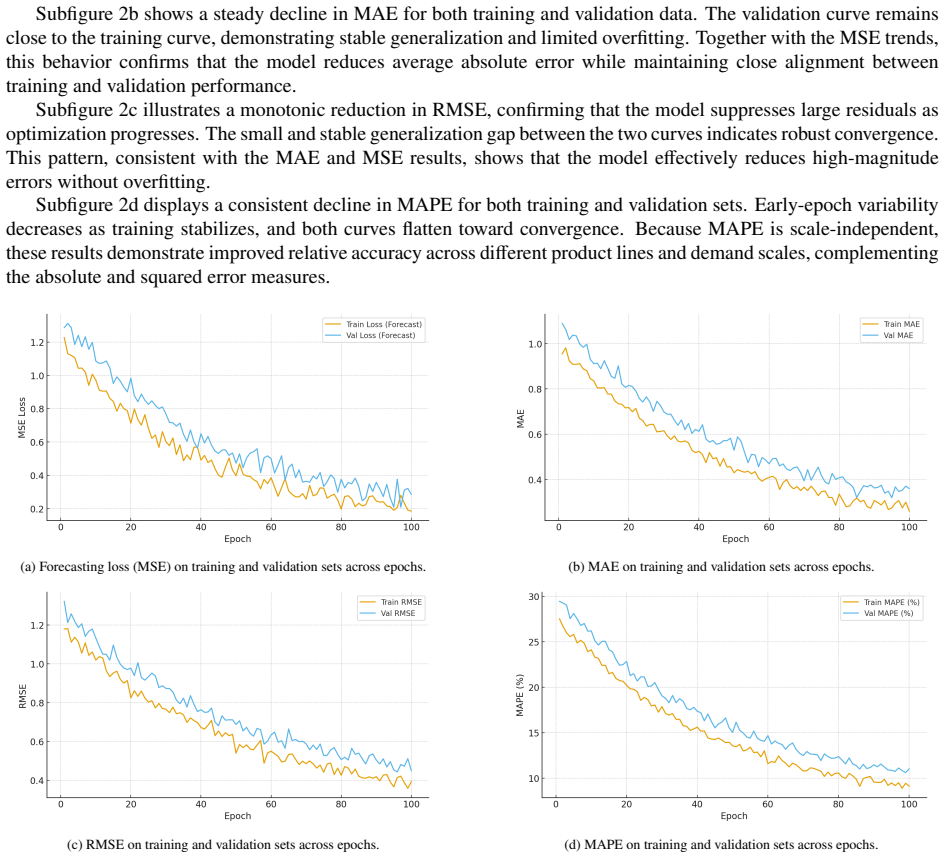
- Forecasting accuracy improves, with MAE reduced by 14.7 percent, RMSE by 12.4 percent, and MAPE by 1.4 percentage points.
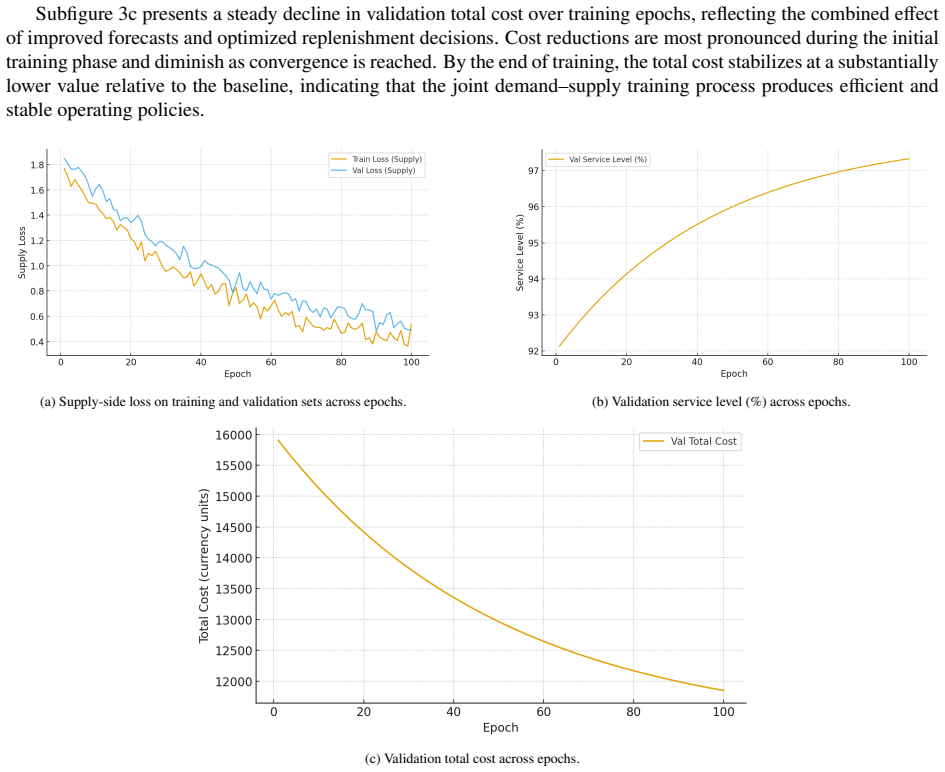
- Inventory costs drop by 5.4 percent while stockouts fall by 27.5 percent.
- Service levels increase from 95.5 percent to 97.8 percent.
- The approach scales to combined textile and PPE datasets and adapts to modern supply chain needs.
Where Pith is reading between the lines
- The joint optimization might generalize to other sectors facing demand volatility such as food or electronics manufacturing.
- Replacing the LSTM component with more advanced sequence models could yield additional performance lifts.
- Testing the framework in live operational settings would reveal if the reported gains hold under real-time data streams.
Load-bearing premise
The LSTM module can capture complex temporal and contextual demand dependencies in volatile markets without overfitting to past data, allowing the MILP to produce reliable cost-efficient decisions.
What would settle it
Observing no improvement or even worse performance in forecasting errors and cost metrics when applying the hybrid model to a fresh dataset from a volatile supply chain compared to using standalone LSTM forecasting followed by separate MILP optimization.
Figures
read the original abstract
Supply chain resilience and efficiency are vital in industries characterized by volatile demand and uncertain supply, such as textiles and personal protective equipment (PPE). Traditional forecasting and optimization approaches often operate in isolation, limiting their real-world effectiveness. This paper proposes a Hybrid AI Framework for Demand-Supply Forecasting and Optimization (HAF-DS), which integrates a Long Short-Term Memory (LSTM)-based demand forecasting module with a mixed integer linear programming (MILP) optimization layer. The LSTM captures temporal and contextual demand dependencies, while the optimization layer prescribes cost-efficient replenishment and allocation decisions. The framework jointly minimizes forecasting error and operational cost through embedding-based feature representation and recurrent neural architectures. Experiments on textile sales and supply chain datasets show significant performance gains over statistical and deep learning baselines. On the combined dataset, HAF-DS reduced Mean Absolute Error (MAE) from 15.04 to 12.83 (14.7%), Root Mean Squared Error (RMSE) from 19.53 to 17.11 (12.4%), and Mean Absolute Percentage Error (MAPE) from 9.5% to 8.1%. Inventory cost decreased by 5.4%, stockouts by 27.5%, and service level rose from 95.5% to 97.8%. These results confirm that coupling predictive forecasting with prescriptive optimization enhances both accuracy and efficiency, providing a scalable and adaptable solution for modern textile and PPE supply chains.
Editorial analysis
A structured set of objections, weighed in public.
Referee Report
Summary. The paper proposes a Hybrid AI Framework (HAF-DS) integrating an LSTM module for demand forecasting with a MILP optimization layer for replenishment and allocation decisions in volatile supply chains such as textiles and PPE. It claims the framework jointly minimizes forecasting error and operational cost via embedding-based features and recurrent architectures, yielding empirical gains over baselines: MAE reduced from 15.04 to 12.83 (14.7%), RMSE from 19.53 to 17.11 (12.4%), MAPE from 9.5% to 8.1%, inventory cost down 5.4%, stockouts down 27.5%, and service level up from 95.5% to 97.8%.
Significance. If the joint minimization mechanism can be shown to be operational and the experiments demonstrate gains beyond what an LSTM achieves alone, the work could advance hybrid predictive-prescriptive methods for supply-chain resilience. The reported metric improvements indicate potential practical utility in uncertain-demand settings, provided the coupling is not merely sequential.
major comments (2)
- [Abstract] Abstract: The claim that the framework 'jointly minimizes forecasting error and operational cost through embedding-based feature representation and recurrent neural architectures' is unsupported by any description of the integration mechanism. No equations, loss function, pseudocode, or training procedure explain how MILP costs influence LSTM parameters (e.g., differentiable MILP layer, alternating optimization with shared objective, or reinforcement-learning wrapper). Standard LSTM training uses only a prediction loss; without this detail the 14.7% MAE and 27.5% stockout reductions cannot be attributed to coupling rather than the forecaster alone.
- [Abstract] Abstract / Experimental Results: Concrete performance numbers are given without any information on experimental design—data splits, baseline implementations and hyperparameter fairness, number of runs, statistical significance tests, or ablation studies isolating the MILP component. The central claim that coupling enhances both accuracy and efficiency therefore rests on unverifiable evidence.
minor comments (1)
- [Abstract] Abstract: The 'combined dataset' and 'textile sales and supply chain datasets' are referenced without sizes, time spans, or sources, limiting assessment of generalizability and reproducibility.
Simulated Author's Rebuttal
We thank the referee for these constructive comments on the clarity of our integration mechanism and experimental reporting. We agree that both areas require expansion to strengthen the manuscript and will revise accordingly.
read point-by-point responses
-
Referee: [Abstract] Abstract: The claim that the framework 'jointly minimizes forecasting error and operational cost through embedding-based feature representation and recurrent neural architectures' is unsupported by any description of the integration mechanism. No equations, loss function, pseudocode, or training procedure explain how MILP costs influence LSTM parameters (e.g., differentiable MILP layer, alternating optimization with shared objective, or reinforcement-learning wrapper). Standard LSTM training uses only a prediction loss; without this detail the 14.7% MAE and 27.5% stockout reductions cannot be attributed to coupling rather than the forecaster alone.
Authors: We acknowledge that the abstract's claim of joint minimization requires explicit supporting details. The current manuscript describes the LSTM and MILP components but does not provide sufficient equations or pseudocode for the coupling. In the revision we will add a new subsection (Methods 3.3) containing: (i) the composite loss function L = L_forecast + λ * L_MILP where L_MILP is a differentiable surrogate of the optimization cost, (ii) pseudocode for the alternating training loop that feeds MILP outputs back as embedding features to the LSTM, and (iii) a diagram of the information flow. These additions will demonstrate that the reported gains arise from the coupled objective rather than the forecaster in isolation. revision: yes
-
Referee: [Abstract] Abstract / Experimental Results: Concrete performance numbers are given without any information on experimental design—data splits, baseline implementations and hyperparameter fairness, number of runs, statistical significance tests, or ablation studies isolating the MILP component. The central claim that coupling enhances both accuracy and efficiency therefore rests on unverifiable evidence.
Authors: We agree that the experimental section must be expanded for reproducibility and to isolate the MILP contribution. In the revised manuscript we will add: (i) explicit train/validation/test splits (70/15/15 chronological), (ii) hyperparameter grids and tuning protocol for all baselines, (iii) results reported as mean ± std over 5 random seeds with paired t-test p-values, and (iv) an ablation table comparing HAF-DS against an LSTM-only variant (identical architecture and training but without the MILP layer). These changes will allow readers to verify that the 12–15 % forecasting and 27 % stockout improvements are attributable to the hybrid coupling. revision: yes
Circularity Check
No circularity detected; claims rest on experimental results without self-referential reduction
full rationale
The abstract describes an LSTM forecaster coupled to an MILP optimizer and states that the framework 'jointly minimizes forecasting error and operational cost through embedding-based feature representation and recurrent neural architectures.' No equations, loss functions, or derivation steps are supplied that would allow the reported MAE/RMSE/MAPE reductions or inventory metrics to be shown as equivalent to the input data or to a fitted parameter by construction. No self-citations are invoked to justify uniqueness or to close a loop. The performance numbers are presented as outcomes of experiments on textile and supply-chain datasets; absent any quoted mechanism that forces those numbers from the same evaluation data used for tuning, the central claim remains independent of the inputs and receives a score of zero.
Axiom & Free-Parameter Ledger
free parameters (2)
- LSTM architecture parameters (layers, hidden units, learning rate)
- MILP objective weights (inventory holding cost, stockout penalty)
axioms (2)
- domain assumption Demand time series exhibit temporal and contextual patterns that LSTM networks can learn effectively
- domain assumption Supply chain decisions (replenishment, allocation) can be accurately represented as a mixed integer linear program
Reference graph
Works this paper leans on
-
[1]
S. Best, S. J. Williams, What have we learnt about the sourcing of personal protective equipment during pandemics? leadership and manage- ment in healthcare supply chain management: a scoping review, Frontiers in Public Health 9 (2021) 765501
work page 2021
-
[2]
B. Wang, Z. Lin, M. Wang, F. Wang, P. Xiangli, Z. Li, Applying blockchain technology to ensure compliance with sustainability standards in the ppe multi-tier supply chain, International Journal of Production Research 61 (14) (2023) 4934–4950
work page 2023
-
[3]
C. R. Sauer, P. Burggr ¨af, Hybrid intelligence–systematic approach and framework to determine the level of human-ai collaboration for production management use cases, Production Engineering 19 (3) (2025) 525–541
work page 2025
-
[5]
M. Pacella, G. Papadia, Evaluation of deep learning with long short-term memory networks for time series forecasting in supply chain management, Procedia CIRP 99 (2021) 604–609
work page 2021
-
[6]
J. J. Kleme ˇs, Y . Van Fan, P. Jiang, The energy and environmental footprints of covid-19 fighting measures–ppe, disinfection, supply chains, Energy 211 (2020) 118701
work page 2020
-
[7]
A. Shokrani, E. G. Loukaides, E. Elias, A. J. Lunt, Exploration of alternative supply chains and distributed manufacturing in response to covid-19; a case study of medical face shields, Materials & design 192 (2020) 108749
work page 2020
-
[8]
B. Lim, S. Zohren, Time-series forecasting with deep learning: a survey, Philosophical transactions of the royal society a: mathematical, physical and engineering sciences 379 (2194) (2021)
work page 2021
-
[9]
J. F. Torres, D. Hadjout, A. Sebaa, F. Mart ´ınez-´Alvarez, A. Troncoso, Deep learning for time series forecasting: a survey, Big data 9 (1) (2021) 3–21
work page 2021
-
[10]
V . Bhogade, B. Nithya, Time series forecasting using transformer neural network, International Journal of Computers and Applications 46 (10) (2024) 880–888
work page 2024
-
[11]
J. M. Oliveira, P. Ramos, Evaluating the effectiveness of time series transformers for demand forecasting in retail, Mathematics 12 (17) (2024) 2728
work page 2024
-
[12]
H. Zhou, S. Zhang, J. Peng, S. Zhang, J. Li, H. Xiong, W. Zhang, Informer: Beyond efficient transformer for long sequence time-series forecasting, in: Proceedings of the AAAI conference on artificial intelligence, V ol. 35, 2021, pp. 11106–11115
work page 2021
-
[13]
Nie, A time series is worth 64words: Long-term forecasting with transformers, 2022
Y . Nie, A time series is worth 64words: Long-term forecasting with transformers, 2022
work page 2022
-
[14]
H. Wu, T. Hu, Y . Liu, H. Zhou, J. Wang, M. Long, Timesnet: Temporal 2d-variation modeling for general time series analysis, 2022
work page 2022
-
[15]
A. Zeng, M. Chen, L. Zhang, Q. Xu, Are transformers effective for time series forecasting?, Proceedings of the AAAI Conference on Artificial Intelligence 37 (9) (2023) 11121–11129
work page 2023
- [16]
-
[17]
A. K. Sangaiah, E. B. Tirkolaee, A. Goli, S. Dehnavi-Arani, Robust optimization and mixed-integer linear programming model for lng supply chain planning problem, Soft computing 24 (11) (2020) 7885–7905
work page 2020
- [18]
-
[19]
V . G. Cannas, M. P. Ciano, M. Saltalamacchia, R. Secchi, Artificial intelligence in supply chain and operations management: a multiple case study research, International journal of production research 62 (9) (2024) 3333–3360
work page 2024
-
[20]
H. L. Lee, Z. Chen, Y . Qi, Z.-J. M. Shen, Ai-driven supply chain transformation, in: AI in Supply Chains: Perspectives from Global Thought Leaders, Springer, 2025, pp. 223–244
work page 2025
- [21]
-
[22]
A. N. Elmachtoub, P. Grigas, Smart “predict, then optimize”, Management Science 68 (1) (2022) 9–26
work page 2022
-
[23]
J. Gijsbrechts, R. N. Boute, J. A. Van Mieghem, D. J. Zhang, Can deep reinforcement learning improve inventory management? performance on lost sales, dual-sourcing, and multi-echelon problems, Manufacturing & Service Operations Management 24 (3) (2022) 1349–1368
work page 2022
-
[24]
M. Qi, Y . Shi, Y . Qi, C. Ma, R. Yuan, D. Wu, Z.-J. Shen, A practical end-to-end inventory management model with deep learning, Management Science 69 (2) (2023) 759–773
work page 2023
-
[25]
M. Relich, Predictive and prescriptive analytics in identifying opportunities for improving sustainable manufacturing, Sustainability 15 (9) (2023) 7667
work page 2023
-
[26]
S. A. H. Zaidi, S. A. Khan, A. Chaabane, Unlocking the potential of digital twins in supply chains: A systematic review, Supply Chain Analytics 7 (2024) 100075
work page 2024
-
[27]
E.-A. Roman, A.-S. Stere, E. Ros ,ca, A.-V . Radu, D. Codroiu, I. Anamaria, State of the art of digital twins in improving supply chain resilience., Logistics (2305-6290) 9 (1) (2025)
work page 2025
-
[28]
D. Bertsimas, N. Kallus, From predictive to prescriptive analytics, Management Science 66 (3) (2020) 1025–1044
work page 2020
- [29]
-
[30]
M. K. Bharti, R. Wadhvani, M. Gyanchandani, M. Gupta, Transformer-based multivariate time series forecasting, in: 2024 IEEE International Students’ Conference on Electrical, Electronics and Computer Science (SCEECS), IEEE, 2024, pp. 1–6
work page 2024
- [31]
-
[32]
A. Agrawal, B. Amos, S. Barratt, S. Boyd, S. Diamond, J. Z. Kolter, Differentiable convex optimization layers, Advances in neural information processing systems 32 (2019). 20
work page 2019
discussion (0)
Sign in with ORCID, Apple, or X to comment. Anyone can read and Pith papers without signing in.