Recognition: unknown
Two-gap to Single-gap Transition and Two-dome-like Superconductivity in Alkali-Metal Intercalated Bilayer PdTe2
Pith reviewed 2026-05-08 13:34 UTC · model grok-4.3
The pith
Alkali-metal intercalation in bilayer PdTe2 raises the superconducting transition temperature from 1.4 K to 13.5 K while switching the system from two-gap to single-gap superconductivity.
A machine-rendered reading of the paper's core claim, the machinery that carries it, and where it could break.
Core claim
First-principles calculations within the fully anisotropic Migdal-Eliashberg framework demonstrate that alkali-metal intercalation enhances the weak superconductivity of bilayer PdTe2, raising Tc from 1.4 K to values between 5.0 K and 13.5 K with a two-dome dependence on the intercalant species. Rubidium produces the highest Tc of 13.5 K, which increases further to 14.5 K under biaxial tensile strain. Lithium intercalation preserves a two-gap state, while larger alkali atoms induce a single-gap state through expansion of the interlayer distance that modulates the interlayer interaction and the electron-phonon coupling strength.
What carries the argument
Intercalation-induced interlayer expansion that weakens coupling between the PdTe2 layers and thereby controls both the electron-phonon interaction strength and whether the superconducting gap remains two-gap or collapses to single-gap.
If this is right
- Rubidium intercalation combined with moderate tensile strain produces the highest transition temperature of 14.5 K.
- The two-dome evolution of Tc with intercalant size and with applied strain follows from the competition between enhanced electron-phonon coupling and changes in the density of states at the Fermi level.
- Only lithium and sodium intercalation retain the two-gap character; sodium, potassium, rubidium, and cesium drive the system to single-gap superconductivity.
- Pristine and lithium- or sodium-intercalated bilayers host both superconductivity and nontrivial band topology.
Where Pith is reading between the lines
- Similar layer-expansion tuning could be applied to other weakly coupled van der Waals superconductors to raise Tc without introducing new chemical disorder.
- The observed two-dome pattern suggests that optimal Tc occurs at an intermediate interlayer spacing where electron-phonon coupling is maximized before band-structure effects dominate.
- Because the topology survives in the lightly intercalated cases, these materials offer a route to study the interplay between superconductivity and band topology by continuous control of the gap structure.
Load-bearing premise
The superconducting state is fully described by phonon-mediated pairing captured in the anisotropic Migdal-Eliashberg equations without important contributions from electron correlations or non-phonon mechanisms.
What would settle it
Direct measurement of the superconducting gap on rubidium-intercalated bilayer PdTe2 samples that either confirms a single isotropic gap or detects two distinct gaps at the predicted temperatures.
Figures


read the original abstract
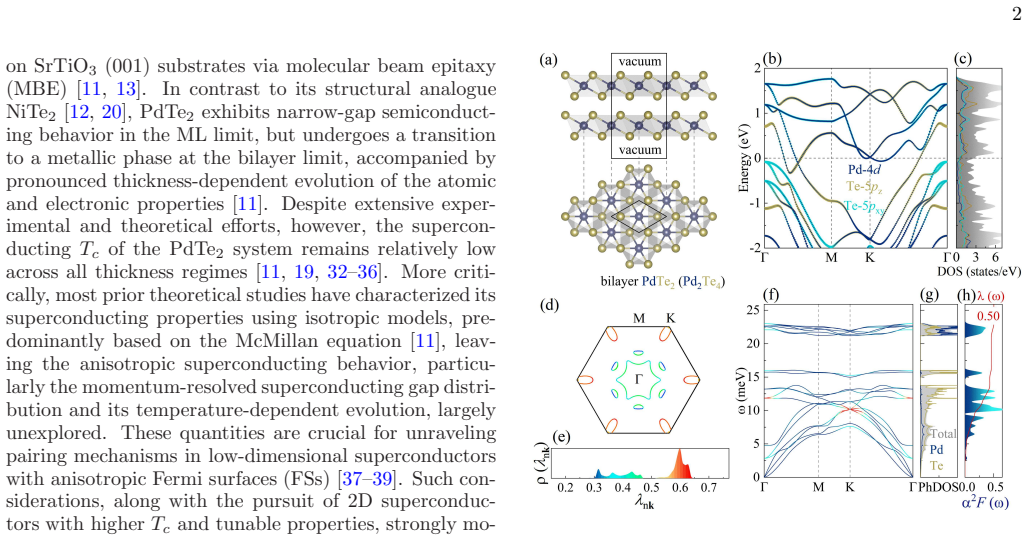
PdTe2 has been synthesized with controllable thickness down to the monolayer limit. Based on first-principles calculations within the fully anisotropic Migdal-Eliashberg framework, this work reveals that alkali-metal intercalation markedly enhances the weak superconductivity of bilayer PdTe2, boosting the transition temperature from 1.4 K to 5.0 -13.5 K and yielding a two-dome-like evolution of Tc. Rubidium intercalation induces the highest Tc of 13.5 K, which can be further increased to 14.5 K under biaxial tensile strain. The strain-dependent evolution of Tc also exhibits a two-dome-like behavior, reflecting the interplay between strain-induced band structure modifications and electron-phonon coupling (EPC). Moreover, a systematic correlation is identified between interlayer interaction and superconducting gap. Lithium intercalation induces a distinct two-gap state, whereas intercalants with larger atomic radii (Na, K, Rb, and Cs) drive the system into a single-gap character. The two-gap to single-gap transition originates from the modulation of interlayer coupling through intercalation-induced interlayer expansion. In addition, pristine and Li/Na-intercalated bilayers exhibit nontrivial band topology, suggesting that layered PdTe2 provides a promising platform for realizing the coexistence of superconductivity and nontrivial topology. These results provide detailed anisotropic insights into EPC and offer viable pathways for enhancing Tc and achieving diverse properties in layered PdTe2 systems.
Editorial analysis
A structured set of objections, weighed in public.
Referee Report
Summary. The manuscript employs first-principles DFT calculations of electronic structure, phonons, and electron-phonon coupling matrix elements, followed by fully anisotropic Migdal-Eliashberg solutions, to examine alkali-metal (Li, Na, K, Rb, Cs) intercalation in bilayer PdTe2. It reports that intercalation raises Tc from 1.4 K (pristine) to 5.0–13.5 K, with a two-dome-like Tc dependence on intercalant species and on biaxial strain; Rb intercalation yields the maximum Tc of 13.5 K (rising to 14.5 K under 2% tensile strain). Li intercalation produces a two-gap state while larger intercalants produce single-gap superconductivity, attributed to modulation of interlayer coupling by expansion. Pristine and Li/Na-intercalated bilayers are reported to host nontrivial band topology.
Significance. If the quantitative predictions hold, the work supplies concrete, tunable pathways to enhance Tc in a van-der-Waals superconductor and clarifies how interlayer spacing controls the number of gaps, which is of broad interest for multi-band superconductivity and for realizing topological superconductivity in layered chalcogenides.
major comments (2)
- [Computational Methods] Computational Methods / Results sections: No convergence tests, error bars, or sensitivity analysis are reported for the anisotropic Migdal-Eliashberg solver (Matsubara cutoff, k-mesh density, or Coulomb pseudopotential μ*). Because the headline Tc values (5–13.5 K) and the two-gap versus single-gap classification are obtained directly from these solutions, the lack of documented numerical convergence is load-bearing for the central quantitative claims.
- [Results] Results on gap structure: The claimed two-gap to single-gap transition is ascribed to intercalation-induced interlayer expansion, yet no quantitative metric (e.g., interlayer hopping or Fermi-surface nesting parameter) is provided to demonstrate that this mechanism dominates over changes in the density of states or phonon spectrum. This weakens the causal link asserted in the abstract and discussion.
minor comments (2)
- [Abstract] The abstract states a 'two-dome-like evolution' without defining the two domes; a brief clarification in the main text (e.g., which intercalants or strain values constitute each dome) would improve readability.
- Figure captions and axis labels for the strain-dependent Tc plots should explicitly state the strain range and the fixed intercalant species to avoid ambiguity.
Simulated Author's Rebuttal
We thank the referee for the thorough review and valuable comments on our manuscript. We have carefully considered the points raised regarding numerical convergence and the quantitative support for the gap-transition mechanism. Below we provide point-by-point responses and indicate the revisions we will implement in the resubmitted version.
read point-by-point responses
-
Referee: [Computational Methods] Computational Methods / Results sections: No convergence tests, error bars, or sensitivity analysis are reported for the anisotropic Migdal-Eliashberg solver (Matsubara cutoff, k-mesh density, or Coulomb pseudopotential μ*). Because the headline Tc values (5–13.5 K) and the two-gap versus single-gap classification are obtained directly from these solutions, the lack of documented numerical convergence is load-bearing for the central quantitative claims.
Authors: We agree that explicit documentation of convergence is essential for the reliability of the reported Tc values and gap structures. In the revised manuscript we will add a dedicated subsection in the Computational Methods section that reports: (i) convergence of Tc with respect to the Matsubara frequency cutoff (tested up to 20 times the maximum phonon frequency, with Tc stable within 0.2 K beyond 10 times); (ii) k-mesh density tests (24×24×1 versus 36×36×1, showing <0.3 K variation in Tc and no change in gap topology); and (iii) sensitivity to μ* (varied between 0.08 and 0.12, confirming the two-dome Tc trend and the two-gap/single-gap classification remain robust). Error bars derived from these tests will be included in the Tc tables and figures. These additions directly address the concern without altering the central conclusions. revision: yes
-
Referee: [Results] Results on gap structure: The claimed two-gap to single-gap transition is ascribed to intercalation-induced interlayer expansion, yet no quantitative metric (e.g., interlayer hopping or Fermi-surface nesting parameter) is provided to demonstrate that this mechanism dominates over changes in the density of states or phonon spectrum. This weakens the causal link asserted in the abstract and discussion.
Authors: We acknowledge that the original text relies on a systematic correlation between interlayer spacing and gap character without an explicit quantitative metric isolating the interlayer-coupling contribution. In the revised manuscript we will add a new paragraph and supplementary figure that extracts interlayer hopping amplitudes from maximally localized Wannier functions for each intercalated system. These values decrease monotonically with increasing interlayer distance, and we will plot them against the gap anisotropy parameter (defined as the ratio of the two largest gap magnitudes on the Fermi surface). We will also tabulate the changes in N(EF) and the Eliashberg spectral function α²F(ω) across the series, showing that the variation in N(EF) is non-monotonic and smaller in relative magnitude than the change in interlayer hopping, while the phonon spectrum softening is comparable for Na–Cs but does not correlate with the observed gap merging. This quantitative decomposition strengthens the causal attribution to interlayer expansion. revision: yes
Circularity Check
No circularity in the first-principles derivation chain
full rationale
The paper computes electronic bands, phonons, and EPC matrix elements via DFT, then solves the fully anisotropic Migdal-Eliashberg equations to obtain Tc and gap structures. These steps constitute a standard predictive workflow with no fitted parameters tuned to the reported Tc values (1.4 K to 13.5 K), no self-definitional loops, and no load-bearing self-citations that reduce the claims to tautologies. The two-dome behavior and gap-transition results emerge directly from the computed quantities rather than being presupposed by the inputs or by prior author work invoked as uniqueness theorems. The derivation is therefore self-contained against external benchmarks.
Axiom & Free-Parameter Ledger
axioms (2)
- domain assumption The Migdal-Eliashberg theory is applicable to describe the superconducting state in these materials
- domain assumption First-principles methods accurately predict the band structure, phonons, and EPC in intercalated PdTe2
Reference graph
Works this paper leans on
-
[1]
Sipos, A
B. Sipos, A. F. Kusmartseva, A. Akrap, H. Berger, L. Forr´ o, and E. Tutiˇ s, From Mott state to supercon- ductivity in 1T-TaS 2, Nat. Mater. 7, 960 (2008)
2008
-
[2]
Navarro-Moratalla, J
E. Navarro-Moratalla, J. O. Island, S. Manas- Valero, E. Pinilla-Cienfuegos, A. Castellanos-Gomez, J. Quereda, G. Rubio-Bollinger, L. Chirolli, J. An- gel Silva-Guillen, N. Agrait, G. A. Steele, F. Guinea, H. S. J. van der Zant, and E. Coronado, En- hanced superconductivity in atomically thin TaS 2, Nat. Commun. 7, 11043 (2016)
2016
-
[3]
M. M. Ugeda, A. J. Bradley, Y. Zhang, S. Onishi, Y. Chen, W. Ruan, C. Ojeda-Aristizabal, H. Ryu, M. T. Edmonds, H.-Z. Tsai, A. Riss, S.-K. Mo, D. Lee, A. Zettl, Z. Hussain, Z.-X. Shen, and M. F. Crommie, Character- ization of collective ground states in single-layer NbSe 2, Nat. Phys. 12, 92 (2016)
2016
-
[4]
M. Yan, H. Huang, K. Zhang, E. Wang, W. Yao, K. Deng, G. Wan, H. Zhang, M. Arita, H. Yang, Z. Sun, H. Yao, Y. Wu, S. Fan, W. Duan, and S. Zhou, Lorentz-violating type-II Dirac fermions in transition metal dichalcogenide PtTe2, Nat. Commun. 8, 257 (2017)
2017
-
[5]
B. Li, Z. Wan, C. Wang, P. Chen, B. Huang, X. Cheng, Q. Qian, J. Li, Z. Zhang, G. Sun, B. Zhao, H. Ma, R. Wu, Z. Wei, Y. Liu, L. Liao, Y. Ye, Y. Huang, X. Xu, X. Duan, W. Ji, and X. Duan, Van der Waals epitaxial growth of air-stable CrSe 2 nanosheets with thickness-tunable mag- netic order, Nat. Mater. 20, 818 (2021)
2021
-
[6]
M. S. Bahramy, O. J. Clark, B. J. Yang, J. Feng, L. Bawden, J. M. Riley, I. Markovic, F. Mazzola, V. Sunko, D. Biswas, S. P. Cooil, M. Jorge, J. W. Wells, M. Leandersson, T. Balasubramanian, J. Fu- jii, I. Vobornik, J. E. Rault, T. K. Kim, M. Hoesch, K. Okawa, M. Asakawa, T. Sasagawa, T. Eknapakul, W. Meevasana, and P. D. C. King, Ubiquitous formation of ...
2018
-
[7]
S.-Y. Xu, Q. Ma, H. Shen, V. Fatemi, S. Wu, T.- R. Chang, G. Chang, A. M. M. Valdivia, C.-K. Chan, Q. D. Gibson, J. Zhou, Z. Liu, K. Watanabe, T. Taniguchi, H. Lin, R. J. Cava, L. Fu, N. Gedik, and P. Jarillo-Herrero, Electrically switchable Berry curva- ture dipole in the monolayer topological insulator WTe 2, Nat. Phys. 14, 900 (2018)
2018
-
[8]
Q. H. Wang, K. Kalantar-Zadeh, A. Kis, J. N. Cole- man, and M. S. Strano, Electronics and optoelectron- ics of two-dimensional transition metal dichalcogenides, Nat. Nanotechnol. 7, 699 (2012)
2012
-
[9]
Sarkar, X
D. Sarkar, X. Xie, W. Liu, W. Cao, J. Kang, Y. Gong, S. Kraemer, P. M. Ajayan, and K. Banerjee, A sub- thermionic tunnel field-effect transistor with an atomi- cally thin channel, Nature(London) 526, 91 (2015)
2015
-
[10]
X. Xi, Z. Wang, W. Zhao, J.-H. Park, K. T. Law, H. Berger, L. Forro, J. Shan, and K. F. Mak, Ising pairing in superconducting NbSe 2 atomic layers, Nat. Phys. 12, 139 (2016)
2016
-
[11]
Liu, C.-S
C. Liu, C.-S. Lian, M.-H. Liao, Y. Wang, Y. Zhong, C. Ding, W. Li, C.-L. Song, K. He, X.-C. Ma, W. Duan, D. Zhang, Y. Xu, L. Wang, and Q.-K. Xue, Two- dimensional superconductivity and topological states in PdTe2 thin films, Phys. Rev. Mater. 2, 094001 (2018)
2018
-
[12]
B. Zhao, W. Dang, Y. Liu, B. Li, J. Li, J. Luo, Z. Zhang, R. Wu, H. Ma, G. Sun, Y. Huang, X. Duan, and X. Duan, Synthetic Control of Two-Dimensional NiTe 2 Single Crystals with Highly Uniform Thickness Distribu- tions, J. Am. Chem. Soc. 140, 14217 (2018)
2018
-
[13]
Y. Liu, Y. Xu, J. Sun, C. Liu, Y. Liu, C. Wang, Z. Zhang, K. Gu, Y. Tang, C. Ding, H. Liu, H. Yao, X. Lin, L. Wang, Q.-K. Xue, and J. Wang, Type-II Ising Superconductivity and Anomalous Metallic State in Macro-Size Ambient-Stable Ultrathin Crystalline Films, Nano Lett. 20, 5728 (2020)
2020
-
[14]
X. Xi, L. Zhao, Z. Wang, H. Berger, L. Forro, J. Shan, and K. F. Mak, Strongly enhanced charge-density-wave order in monolayer NbSe 2, Nat. Nanotechnol. 10, 765 (2015)
2015
-
[15]
Y. Noat, J. A. Silva-Guill´ en, T. Cren, V. Cherkez, C. Brun, S. Pons, F. Debontridder, D. Roditchev, W. Sacks, L. Cario, P. Ordej´ on, A. Garc ´ ıa, and E. Canadell, Quasiparticle spectra of 2 H-NbSe2: Two- band superconductivity and the role of tunneling selec- tivity, Phys. Rev. B 92, 134510 (2015)
2015
-
[16]
Khestanova, J
E. Khestanova, J. Birkbeck, M. Zhu, Y. Cao, G. L. Yu, D. Ghazaryan, J. Yin, H. Berger, L. Forro, T. Taniguchi, K. Watanabe, R. V. Gorbachev, A. Mishchenko, A. K. Geim, and I. V. Grigorieva, Unusual Suppression of the Superconducting Energy Gap and Critical Temperature in Atomically Thin NbSe 2, Nano Lett. 18, 2623 (2018)
2018
-
[17]
Zheng and J
F. Zheng and J. Feng, Electron-phonon coupling and the coexistence of superconductivity and charge-density wave in monolayer NbSe 2, Phys. Rev. B 99, 161119 (2019)
2019
-
[18]
C.-S. Lian, C. Si, and W. Duan, Unveiling Charge- Density Wave, Superconductivity, and Their Competitive Nature in Two-Dimensional NbSe 2, Nano Lett. 18, 2924 (2018) . 11
2018
-
[19]
F. Wang, Y. Zhang, Z. Wang, H. Zhang, X. Wu, C. Bao, J. Li, P. Yu, and S. Zhou, Ionic liquid gating in- duced self-intercalation of transition metal chalcogenid es, Nat. Commun. 14, 1 (2023)
2023
-
[20]
Zheng, X.-B
F. Zheng, X.-B. Li, P. Tan, Y. Lin, L. Xiong, X. Chen, and J. Feng, Emergent supercon- ductivity in two-dimensional NiTe 2 crystals, Phys. Rev. B 101, 100505(R) (2020)
2020
-
[21]
R. D. Septianto, A. P. Romagosa, Y. Dong, H. Matsuoka, T. Ideue, Y. Majima, and Y. Iwasa, Gate-Controlled Potassium Intercalation and Superconductivity in Molybdenum Disulfide, Nano Lett. 24, 13790 (2024)
2024
-
[22]
D. Wu, Y. Lin, L. Xiong, J. Li, T. Luo, D. Chen, and F. Zheng, Enhanced superconductivity in bilayer PtTe 2 by alkali-metal intercalations, Phys. Rev. B 103, 224502 (2021)
2021
-
[23]
Y. Song, X. Liang, J. Guo, J. Deng, G. Gao, and X. Chen, Superconductivity in Li-intercalated 1T − SnSe2 driven by electric field gating, Phys. Rev. Mater. 3, 054804 (2019)
2019
-
[24]
Rousuli, H
A. Rousuli, H. Zhang, K. Zhang, H. Zhong, R. Feng, Y. Wu, P. Yu, and S. Zhou, Induced anisotropic superconductivity in ionic liquid cation intercalated 1T − SnSe2, 2D Materials 8, 015024 (2020)
2020
-
[25]
H. Wu, S. Li, W. Liu, and B. Lv, Multiple-Intercalation Stages and Universal Tc Enhancement through Po- lar Organic Species in Electron-Doped 1 T − SnSe2, Inorg. Chem. 62, 3525 (2023)
2023
-
[26]
A. B. Karki, D. A. Browne, S. Stadler, J. Li, and R. Jin, PdTe: a strongly coupled superconductor, J. Phys.: Condens. Matter 24, 055701 (2012)
2012
-
[27]
Tiwari, R
B. Tiwari, R. Goyal, R. Jha, A. Dixit, and V. P. S. Awana, PdTe: a 4.5K type-II BCS superconductor, Supercond. Sci. Technol. 28, 055008 (2015)
2015
-
[28]
H.-J. Noh, J. Jeong, E.-J. Cho, K. Kim, B. I. Min, and B.-G. Park, Experimental Realization of Type-II Dirac Fermions in a PdTe 2 Superconductor, Phys. Rev. Lett. 119, 016401 (2017)
2017
-
[29]
H. Leng, C. Paulsen, Y. K. Huang, and A. de Visser, Type-I superconductivity in the Dirac semimetal PdTe 2, Phys. Rev. B 96, 220506 (2017)
2017
-
[30]
F. Fei, X. Bo, R. Wang, B. Wu, J. Jiang, D. Fu, M. Gao, H. Zheng, Y. Chen, X. Wang, H. Bu, F. Song, X. Wan, B. Wang, and G. Wang, Nontrivial Berry phase and type-II Dirac transport in the layered material PdTe 2, Phys. Rev. B 96, 041201 (2017)
2017
-
[31]
O. J. Clark, M. J. Neat, K. Okawa, L. Bawden, I. Markovi´ c, F. Mazzola, J. Feng, V. Sunko, J. M. Riley, W. Meevasana, J. Fujii, I. Vobornik, T. K. Kim, M. Hoesch, T. Sasagawa, P. Wahl, M. S. Bahramy, and P. D. C. King, Fermiology and Super- conductivity of Topological Surface States in PdTe 2, Phys. Rev. Lett. 120, 156401 (2018)
2018
-
[32]
Anemone, P
G. Anemone, P. Casado Aguilar, M. Garnica, F. Calleja, A. Al Taleb, C.-N. Kuo, C. S. Lue, A. Politano, A. L. Vazquez de Parga, G. Benedek, D. Farias, and R. Mi- randa, Electron-phonon coupling in superconducting 1 T - PdTe2, npj 2D Mater. Appl. 5, 25 (2021)
2021
-
[33]
C. Raub, V. Compton, T. Geballe, B. Matthias, J. Maita, and G. Hull, The occurrence of superconduc- tivity in sulfides, selenides, tellurides of Pt-group metal s, J. Phys. Chem. Solids 26, 2051 (1965)
2051
-
[34]
Kjekshus and W
A. Kjekshus and W. B. Pearson, Constitution and mag- netic and electrical properties of palladium tellurides (PdTe-PdTe2), Can. J. Phys. 43, 438 (1965)
1965
-
[35]
Ryu, Superconductivity in Cu- Intercalated CdI2-Type PdTe 2, J
G. Ryu, Superconductivity in Cu- Intercalated CdI2-Type PdTe 2, J. Supercond. Novel Magn. 28, 3275 (2015)
2015
-
[36]
Z. Liu, T. Han, M. Liu, S. Huang, Z. Zhang, M. Long, X. Hou, and L. Shan, Protona- tion enhanced superconductivity in PdTe 2, J. Phys.: Condens. Matter 34, 335603 (2022)
2022
-
[37]
H. Choi, D. Roundy, H. Sun, M. Cohen, and S. Louie, The origin of the anomalous superconducting properties of MgB 2, Nature (London) 418, 758 (2002)
2002
-
[38]
Sanna, S
A. Sanna, S. Pittalis, J. K. Dewhurst, M. Monni, S. Sharma, G. Ummarino, S. Massidda, and E. K. U. Gross, Phononic self-energy effects and superconductiv- ity in CaC 6, Phys. Rev. B 85, 184514 (2012)
2012
-
[39]
E. R. Margine and F. Giustino, Anisotropic migdal-eliashberg theory using wannier functions, Phys. Rev. B 87, 024505 (2013)
2013
-
[40]
A. K. S. G. R. A. H. S. Furuseth, K. Selte and A. Westerdahl, Redetermined crystal struc- tures of NiTe 2, PdTe 2, PtS 2, PtSe 2, and PtTe 2, Acta Chem. Scand. 19, 257 (1965)
1965
-
[41]
See Supplemental Materials for details of computa- tional details, summary of the calculated lattice con- stant and superconducting parameters of this work, semi- conducting monolayer PdTe 2, electronic structure and superconductivity of bulk PdTe 2, charge density differ- ence of Pd 2Te4, isotropic superconductivity of doped Pd2Te4, energetic comparison a...
-
[42]
Zheng, C
F. Zheng, C. Cai, S. Ge, X. Zhang, X. Liu, H. Lu, Y. Zhang, J. Qiu, T. Taniguchi, K. Watanabe, S. Jia, J. Qi, J.-H. Chen, D. Sun, and J. Feng, On the Quantum Spin Hall Gap of Monolayer 1T ′-WTe2, Adv. Mater. 28, 4845 (2016)
2016
-
[43]
Selte and A
K. Selte and A. Kjekshus, On the Struc- tural Properties of the Nb (1+x)Se2 Phase, Acta Chem. Scand. 18, 697 (1964)
1964
-
[44]
P. Chen, W. W. Pai, Y. H. Chan, A. Takayama, C. Z. Xu, A. Karn, S. Hasegawa, M. Y. Chou, S. K. Mo, A. V. Fedorov, and T. C. Chiang, Emergence of charge 12 density waves and a pseudogap in single-layer TiTe 2, Nat. Commun. 8, 516 (2017)
2017
-
[45]
W. L. McMillan, Transition temperature of strong- coupled superconductors, Phys. Rev. 167, 331 (1968)
1968
-
[46]
P. B. Allen and R. C. Dynes, Transition temper- ature of strong-coupled superconductors reanalyzed, Phys. Rev. B 12, 905 (1975)
1975
-
[47]
Kresse and J
G. Kresse and J. Furthm¨ uller, Efficient iterative schemes for ab initio total-energy calculations using a plane-wave basis set, Phys. Rev. B 54, 11169 (1996)
1996
-
[48]
Zhang, A
H. Zhang, A. Rousuli, K. Zhang, L. Luo, C. Guo, X. Cong, Z. Lin, C. Bao, H. Zhang, S. Xu, R. Feng, S. Shen, K. Zhao, W. Yao, Y. Wu, S. Ji, X. Chen, P. Tan, Q.-K. Xue, Y. Xu, W. Duan, P. Yu, and S. Zhou, Tai- lored Ising superconductivity in intercalated bulk NbSe2, Nat. Phys. 18, 1425 (2022)
2022
-
[49]
Li, R.-Z
E. Li, R.-Z. Zhang, H. Li, C. Liu, G. Li, J.-O. Wang, T. Qian, H. Ding, Y.-Y. Zhang, S.-X. Du, X. Lin, and H.- J. Gao, High quality PdTe2 thin films grown by molecular beam epitaxy, Chinese Physics B 27, 086804 (2018)
2018
-
[50]
Zheng, T
J. Zheng, T. Miao, R. Xu, X. Ping, Y. Wu, Z. Lu, Z. Zhang, D. Hu, L. Liu, Q. Zhang, D. Li, Z. Cheng, W. Ma, L. Xie, and L. Jiao, Chemical Synthesis and Integration of Highly Conductive PdTe2 with Low- Dimensional Semiconductors for p-Type Transistors with Low Contact Barriers, Adv. Mater. 33, 2101150 (2021)
2021
-
[51]
Pellegrini and A
C. Pellegrini and A. Sanna, Ab initio methods for super- conductivity, Nature Rev. Phys. 6, 509 (2024)
2024
-
[52]
Y. Yu, F. Yang, X. F. Lu, Y. J. Yan, Y.-H. Cho, L. Ma, X. Niu, S. Kim, Y.-W. Son, D. Feng, S. Li, S.-W. Cheong, X. H. Chen, and Y. Zhang, Gate- tunable phase transitions in thin flakes of 1T-TaS 2, Nat. Nanotechnol. 10, 270 (2015)
2015
-
[53]
Sajadi, T
E. Sajadi, T. Palomaki, Z. Fei, W. Zhao, P. Bement, C. Olsen, S. Luescher, X. Xu, J. A. Folk, and D. H. Cobden, Gate-induced superconductivity in a monolayer topological insulator, Science 362, 922 (2018)
2018
-
[54]
C. Si, Z. Liu, W. Duan, and F. Liu, First-principles calculations on the effect of doping and biaxial ten- sile strain on electron-phonon coupling in graphene, Phys. Rev. Lett. 111, 196802 (2013)
2013
-
[55]
L. Yan, R. Ku, J.-G. Si, P.-F. Liu, H. Gao, L. Zhou, and B.-T. Wang, Electron-phonon driven charge density wave and superconductivity in a 1 t− tasi2n4 monolayer, Phys. Rev. B 109, 134502 (2024)
2024
-
[56]
Seeyangnok, U
J. Seeyangnok, U. Pinsook, and G. J. Ackland, Su- perconductivity and strain-enhanced phase stability of janus tungsten chalcogenide hydride monolayers, Phys. Rev. B 110, 195408 (2024)
2024
-
[57]
C. Lee, X. Wei, J. W. Kysar, and J. Hone, Measurement of the elastic properties and intrinsic strength of mono- layer graphene, Science 321, 385 (2008)
2008
-
[58]
Y. Yang, X. Li, M. Wen, E. Hacopian, W. Chen, Y. Gong, J. Zhang, B. Li, W. Zhou, P. M. Ajayan, Q. Chen, T. Zhu, and J. Lou, Brittle Fracture of 2D MoSe2, Adv. Mater. 29, 1604201 (2017)
2017
-
[59]
J.-K. Qin, C. Sui, Z. Qin, J. Wu, H. Guo, L. Zhen, C.-Y. Xu, Y. Chai, C. Wang, X. He, P. D. Ye, and J. Lou, Mechanical Anisotropy in Two-Dimensional Se- lenium Atomic Layers, Nano Lett. 21, 8043 (2021)
2021
-
[60]
Falin, M
A. Falin, M. Holwill, H. Lv, W. Gan, J. Cheng, R. Zhang, D. Qian, M. R. Barnett, E. J. G. Santos, K. S. Novoselov, T. Tao, X. Wu, and L. H. Li, Mechanical Properties of Atomically Thin Tungsten Dichalcogenides: WS2, WSe2, and WTe2, ACS Nano 15, 2600 (2021)
2021
-
[61]
R. Ai, X. Cui, Y. Li, and X. Zhuo, Local Strain Engineering of Two-Dimensional Transition Metal Dichalcogenides Towards Quantum Emitters, Nano-Micro Lett. 17, 104 (2025)
2025
-
[62]
Liu, J.-Z
Y. Liu, J.-Z. Zhao, L. Yu, C.-T. Lin, A.-J. Liang, C. Hu, Y. Ding, Y. Xu, S.-L. He, L. Zhao, G.-D. Liu, X.-L. Dong, J. Zhang, C.-T. Chen, Z.-Y. Xu, H.-M. Weng, X. Dai, Z. Fang, and X.-J. Zhou, Identifica- tion of Topological Surface State in PdTe 2 Supercon- ductor by Angle-Resolved Photoemission Spectroscopy, Chin. Phys. Lett. 32, 067303 (2015)
2015
-
[63]
J. Cook, S. Mardanya, Q. Lu, C. Conner, M. Snyder, X. Zhang, J. McMillen, G. Watson, T.-R. Chang, and G. Bian, Observation of Gapped Topological Surface States and Isolated Surface Resonances in PdTe 2 Ultra- thin Films, Nano Lett. 23, 1752 (2023)
2023
discussion (0)
Sign in with ORCID, Apple, or X to comment. Anyone can read and Pith papers without signing in.