Recognition: unknown
Detecting Concept Drift in Evolving Malware Families Using Rule-Based Classifier Representations
Pith reviewed 2026-05-08 11:17 UTC · model grok-4.3
The pith
Rule comparisons from fixed two-month windows detect concept drift reliably across all malware family pairs when using feature-level Pearson correlation.
A machine-rendered reading of the paper's core claim, the machinery that carries it, and where it could break.
Core claim
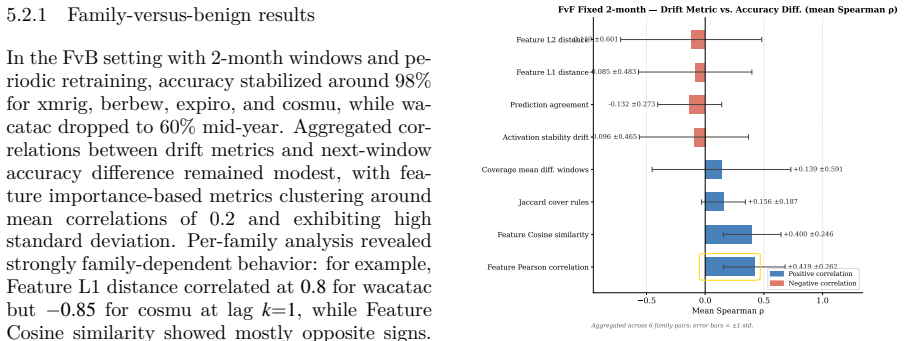
Classifiers trained on fixed two-month temporal windows, represented as decision tree rulesets, allow drift to be quantified via feature importance, prediction agreement, activation stability, and coverage; these rule metrics show positive correlation with accuracy degradation and distribution shift for every malware family pair exclusively under feature-level Pearson correlation.
What carries the argument
Decision tree rule representations extracted from temporally windowed classifiers, compared through feature importance, prediction agreement, activation stability, and coverage metrics.
If this is right
- Rule metric monitoring can signal the need for retraining before accuracy visibly declines in production malware detectors.
- Fixed-interval windowing produces more consistent drift signals than clustering-based windowing across the tested families.
- The rule approach works for both family-versus-benign and family-versus-family classification tasks.
- No single drift method dominates, so rule comparisons should be used alongside baselines such as RIPPER and Transcendent.
Where Pith is reading between the lines
- The same rule-comparison technique could track drift in other security tasks such as spam filtering or network anomaly detection where behaviors evolve over time.
- If rule changes reliably mark drift, future systems might retrain only the drifted features rather than rebuilding entire models.
- Testing the method on streaming malware data collected after 2024 would check whether the two-month fixed window remains optimal as family evolution patterns shift.
Load-bearing premise
The selected rule metrics and their correlations with accuracy loss and data shift genuinely measure concept drift instead of classifier artifacts or sampling effects in the malware families.
What would settle it
Finding even one malware family pair under fixed two-month windows where the Pearson correlation between a rule metric and accuracy degradation is zero or negative would disprove the claim that this configuration is the only reliable one.
Figures

read the original abstract
This work proposes a structural approach to concept drift detection in malware classification using decision tree rulesets. Classifiers are trained across temporal windows on the EMBER2024 dataset, and drift is quantified by comparing extracted rule representations using feature importance, prediction agreement, activation stability, and coverage metrics. These metrics are correlated with both accuracy degradation and data distribution shift as complementary drift indicators. The approach is evaluated across six malware families using fixed-interval and clustering-based windowing in family-vs-benign and family-vs-family settings, and compared against RIPPER and Transcendent baselines. Results show that fixed two-month windowing with feature-level Pearson correlation is the most reliable configuration, being the only one where all family pairs produce positive drift-accuracy correlations. The methods are complementary - no single approach dominates across all pairs.
Editorial analysis
A structured set of objections, weighed in public.
Referee Report
Summary. The paper proposes a structural approach to concept drift detection in malware classification by training decision tree classifiers on temporal windows of the EMBER2024 dataset and extracting rule representations. Drift is quantified via four metrics (feature importance, prediction agreement, activation stability, coverage) that are correlated against accuracy degradation and distribution shift in family-vs-benign and family-vs-family settings across six families. Fixed-interval and clustering-based windowing strategies are evaluated, with comparisons to RIPPER and Transcendent baselines. The central result is that fixed two-month windowing with feature-level Pearson correlation is the most reliable configuration, being the only one producing positive drift-accuracy correlations for every family pair.
Significance. If the correlations can be shown to specifically track malware concept drift, the work would supply an interpretable, rule-based alternative to black-box drift detectors that is directly applicable to security classifiers. The dual use of accuracy and distribution-shift indicators plus the systematic comparison of windowing schemes are positive design choices. However, the absence of statistical testing, ground-truth validation, or ablation studies currently limits the strength of the reliability claim.
major comments (3)
- [Results] The headline claim that fixed two-month windowing with feature-level Pearson correlation is uniquely reliable rests on the observation of positive correlations for all family pairs, yet the evaluation provides no error bars, p-values, or confidence intervals for the reported correlations and gives no justification or pre-specification for selecting the two-month window size after inspecting results (see abstract and results on windowing configurations).
- [Methodology] The four rule-extraction metrics are defined from the decision-tree rulesets and then correlated with accuracy degradation, but the manuscript contains no synthetic-drift ablation, external ground-truth labels for drift events, or comparison against established drift detectors to establish that the observed correlations are driven by malware family evolution rather than label noise, benign shifts, or sampling artifacts (see methodology on metric definitions and experiments on EMBER2024).
- [Experiments] While RIPPER and Transcendent are listed as baselines, the paper does not report quantitative drift-detection performance numbers or statistical comparisons showing how the proposed rule-based metrics improve upon or complement these methods, which is required to substantiate the claim of complementarity (see experiments section).
minor comments (2)
- [Abstract] The abstract states that 'the methods are complementary—no single approach dominates across all pairs' without defining which methods are being compared or citing the supporting table or figure.
- [Methodology] Notation for the four metrics (feature importance, prediction agreement, activation stability, coverage) should be introduced with explicit equations or pseudocode in the methodology section to improve reproducibility.
Simulated Author's Rebuttal
We thank the referee for the constructive feedback on our manuscript. The comments highlight important opportunities to strengthen the statistical rigor, validation, and comparative analysis of our rule-based concept drift detection approach. We address each major comment below and commit to revisions that directly respond to the concerns raised.
read point-by-point responses
-
Referee: [Results] The headline claim that fixed two-month windowing with feature-level Pearson correlation is uniquely reliable rests on the observation of positive correlations for all family pairs, yet the evaluation provides no error bars, p-values, or confidence intervals for the reported correlations and gives no justification or pre-specification for selecting the two-month window size after inspecting results (see abstract and results on windowing configurations).
Authors: We agree that the reliability claim requires statistical support to be fully convincing. In the revised manuscript we will add 95% bootstrap confidence intervals and permutation-test p-values for every reported correlation coefficient. On window-size selection, we will explicitly state that the two-month interval was chosen a priori on the basis of documented malware family update cycles in the security literature (typically monthly-to-quarterly), before the full experimental sweep. To demonstrate that the choice is not post-hoc, we will include a sensitivity analysis across window lengths of one to six months, showing that two months produces the most consistent positive drift-accuracy correlations across all family pairs. revision: yes
-
Referee: [Methodology] The four rule-extraction metrics are defined from the decision-tree rulesets and then correlated with accuracy degradation, but the manuscript contains no synthetic-drift ablation, external ground-truth labels for drift events, or comparison against established drift detectors to establish that the observed correlations are driven by malware family evolution rather than label noise, benign shifts, or sampling artifacts (see methodology on metric definitions and experiments on EMBER2024).
Authors: We accept that additional controls are needed to attribute the observed correlations specifically to malware evolution. We will add a synthetic-drift ablation in which controlled feature-distribution shifts that mimic known family evolution patterns are injected into EMBER2024 subsets; we will then verify that the four rule-based metrics respond to these injected drifts. For ground-truth validation we will align detected drift points with publicly documented malware family evolution timelines from vendor reports. We will also benchmark our metrics against two established drift detectors (ADWIN and the Kolmogorov-Smirnov test on feature distributions) and report detection performance on the same accuracy-drop proxy used in the original experiments. revision: yes
-
Referee: [Experiments] While RIPPER and Transcendent are listed as baselines, the paper does not report quantitative drift-detection performance numbers or statistical comparisons showing how the proposed rule-based metrics improve upon or complement these methods, which is required to substantiate the claim of complementarity (see experiments section).
Authors: We will expand the experimental evaluation to provide quantitative drift-detection results. Treating accuracy drops as the reference drift events, we will compute precision, recall, and F1 scores for our rule-based metrics, for RIPPER, and for Transcendent across all family pairs. We will further include paired statistical tests (Wilcoxon signed-rank and McNemar) to quantify whether any method significantly outperforms the others and to support the complementarity claim that no single approach dominates every family pair. revision: yes
Circularity Check
No significant circularity; metrics defined independently and correlated with separate accuracy measures.
full rationale
The paper defines four rule-extraction metrics (feature importance, prediction agreement, activation stability, coverage) directly from the extracted decision tree rulesets. These are then correlated against independently computed accuracy degradation and distribution-shift statistics on the EMBER2024 data. No equation reduces any drift metric to a fitted parameter of the same accuracy values, no self-citation chain supplies a load-bearing uniqueness theorem, and the central empirical claim (fixed two-month windowing yields the only all-positive correlations) is an observed statistical pattern rather than a definitional identity. The derivation therefore remains self-contained against external benchmarks.
Axiom & Free-Parameter Ledger
free parameters (1)
- temporal window size =
two months
axioms (1)
- domain assumption Decision-tree rules faithfully represent the classifier's decision logic for drift measurement purposes.
Reference graph
Works this paper leans on
-
[1]
Barbero, F., Pendlebury, F., Pierazzi, F., and Cav- allaro, L. (2022). Transcending transcend: Re- visiting malware classification in the presence of concept drift. In 2022 IEEE Symposium on Se- curity and Privacy (SP), pages 805–823. IEEE
2022
-
[2]
J., Tauritz, D
Blount, J. J., Tauritz, D. R., and Mulder, S. A. (2011). Adaptive Rule-Based Malware Detec- tion Employing Learning Classifier Systems: A Proof of Concept. In 2011 IEEE 35th Annual Computer Software and Applications Confer- ence Workshops, pages 110–115, Munich, Ger- many. IEEE
2011
- [3]
-
[4]
Oliveira, L. S., and Grégio, A. (2023). Fast & Fu- rious: Modelling Malware Detection as Evolving Data Streams. Expert Systems with Applica- tions, 212:118590. arXiv:2205.12311 [cs]
-
[5]
Chen, Y., Ding, Z., and Wagner, D. (2023). Con- tinuous learning for android malware detection. In 32nd USENIX Security Symposium (USENIX Security 23), pages 1127–1144
2023
-
[6]
Chow, T., Kan, Z., Linhardt, L., Cavallaro, L., Arp, D., and Pierazzi, F. (2023). Drift Forensics of Malware Classifiers. In Proceedings of the 16th ACM Workshop on Artificial Intelligence and Security, pages 197–207, Copenhagen Denmark. ACM
2023
-
[7]
H., Alanazi, S
Abawajy, J. H., Alanazi, S. M., and Al-Rezami, A. Y. (2021). An Adaptive Behavioral-Based Incremental Batch Learning Malware Variants Detection Model Using Concept Drift Detection and Sequential Deep Learning. IEEE Access, 9:97180–97196. Publisher: Institute of Electri- cal and Electronics Engineers (IEEE). Dolejš, J. and Jureček, M. (2022). Interpretabil...
2021
-
[8]
Fernando, D. W. and Komninos, N. (2022). FeSA: Feature selection architecture for ransomware detection under concept drift. Computers & Se- curity, 116:102659
2022
- [9]
-
[10]
Jiang, Y., Li, G., Li, S., and Guo, Y. (2024). BenchMFC: A benchmark dataset for trustwor- thy malware family classification under concept drift. Computers & Security, 139:103706
2024
-
[11]
K., Wang, Z., Papini, D., Nouretdinov, I., and Caval- laro, L
Jordaney, R., Sharad, K., Dash, S. K., Wang, Z., Papini, D., Nouretdinov, I., and Caval- laro, L. (2017). Transcend: Detecting concept drift in malware classification models. In 26th USENIX security symposium (USENIX security 17), pages 625–642
2017
-
[12]
Williams, E., Anderson, H., Raff, E., and Holt, J. (2025). Ember2024 - a benchmark dataset for holistic evaluation of malware classifiers. In Pro- ceedings of the 31st ACM SIGKDD Conference on Knowledge Discovery and Data Mining. Jurečková, O. and Jureček, M. (2026). Detecting and explaining malware family evolution using rule- based drift analysis. In Pr...
2025
-
[13]
Zhang, G. (2018). Learning under concept drift: A review. IEEE transactions on knowledge and data engineering, 31(12):2346–2363
2018
-
[14]
Manthena, H., Shajarian, S., Kimmell, J., Abdel- salam, M., Khorsandroo, S., and Gupta, M. (2025). Explainable artificial intelligence (xai) for malware analysis: A survey of techniques, applications, and open challenges. IEEE Access
2025
-
[15]
and Stamp, M
Mishra, A. and Stamp, M. (2025). Cluster analy- sis and concept drift detection in malware: A. mishra, m. stamp. Journal of Computer Virol- ogy and Hacking Techniques, 21(1):27
2025
-
[16]
Perrot, M., and Duchesnay, E. (2011). Scikit- learn: Machine learning in Python. Journal of Machine Learning Research, 12:2825–2830
2011
-
[17]
Singh, A., Walenstein, A., and Lakhotia, A. (2012). Tracking concept drift in malware families. In Proceedings of the 5th ACM workshop on Se- curity and artificial intelligence, pages 81–92, Raleigh North Carolina USA. ACM
2012
-
[18]
Virtanen, P. et al. (2020). SciPy 1.0: Fundamental algorithms for scientific computing in Python. Nature Methods, 17:261–272
2020
-
[19]
Yu, Q. (2023). A Survey of Adversarial Attack and Defense Methods for Malware Classification in Cyber Security. IEEE Communications Sur- veys & Tutorials, 25(1):467–496
2023
discussion (0)
Sign in with ORCID, Apple, or X to comment. Anyone can read and Pith papers without signing in.